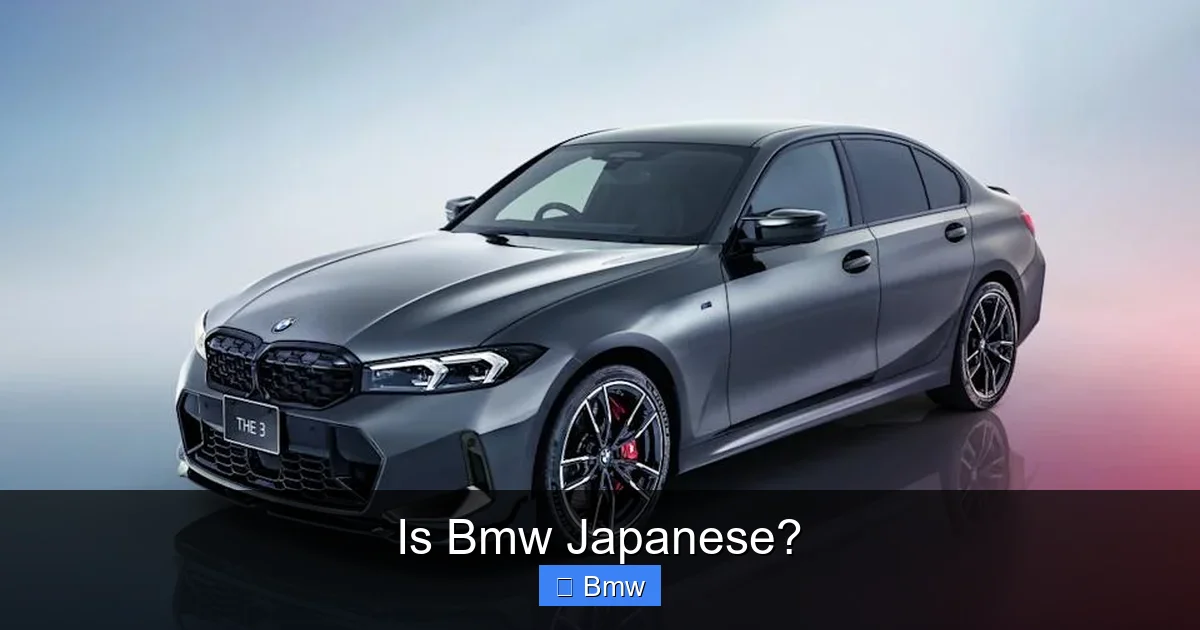
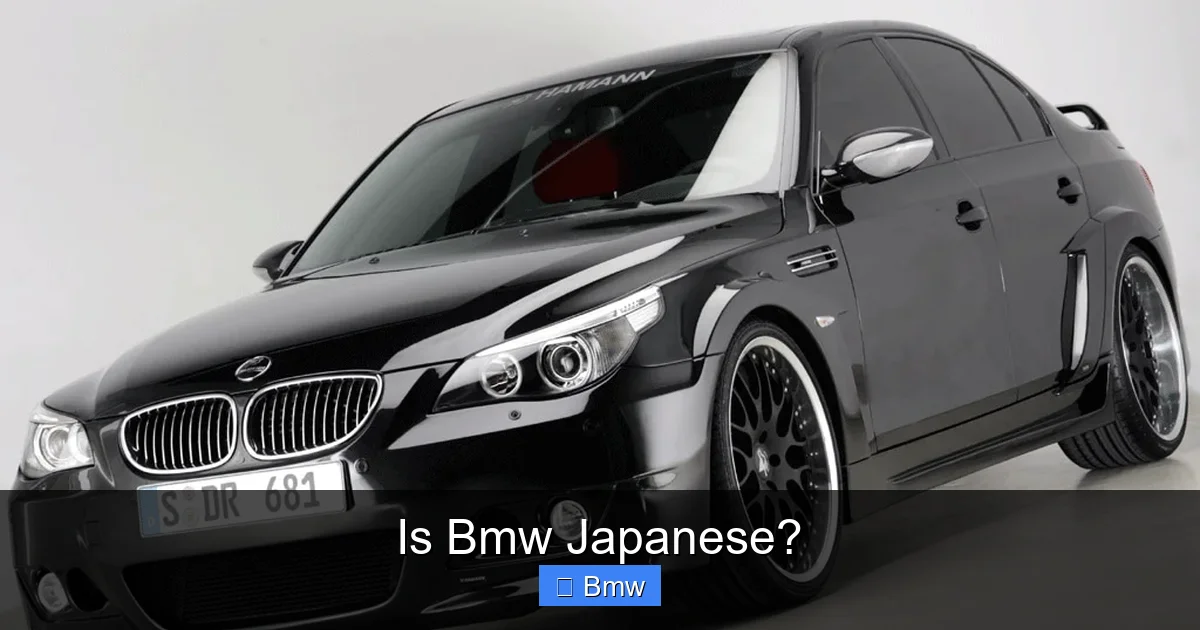
Is Bmw Japanese?

Contents
- 1 Key Takeaways
- 2 📑 Table of Contents
- 3 The Birth of BMW: German Engineering Roots
- 4 Where BMWs Are Made: A Global Manufacturing Footprint
- 5 Japanese Automotive Giants: A Brief Overview
- 6 Why the Confusion? Comparing BMW and Japanese Brands
- 7 Debunking Myths: Common Misconceptions About BMW
- 8 The Legacy of German Engineering: What Sets BMW Apart
- 9 Conclusion: The Clear Answer and What It Means for You
- 10 Frequently Asked Questions

Car GPS Navigator

Engine Flush Cleaner

Dashboard Polish

Car Sunshade for Windshield
Many people wonder, is BMW Japanese? The answer is a clear no—BMW is a German luxury automaker with a rich history in engineering. While Japanese brands like Toyota and Honda are known for reliability, BMW focuses on performance and driving dynamics. This guide clears up the confusion and explores what truly sets BMW apart.
Hey there! Have you ever found yourself in a conversation about cars, someone asks is BMW Japanese?, and you pause for a second? You’re not alone. It’s a surprisingly common question. Maybe it’s because BMWs are everywhere—on roads from Tokyo to Toronto. Or maybe it’s because Japanese brands like Toyota and Honda have built such a strong reputation for quality that people assume all premium cars must share that heritage. Let’s clear the air right now: BMW is not Japanese. It is, and has always been, a German company. But the confusion is understandable, and digging into why people mix this up tells us a lot about the global car industry. So, buckle up as we explore the history, manufacturing, and brand identity of BMW to settle this once and for all.
Key Takeaways
- BMW is German: Bayerische Motoren Werke was founded in Munich, Germany, in 1916 and remains a German company headquartered there.
- Global manufacturing: BMW produces vehicles in Germany and several international plants, but all are designed and engineered under German leadership.
- Different philosophies: Japanese automakers prioritize reliability and efficiency, while BMW emphasizes sporty performance, driving pleasure, and advanced technology.
- Common myths: BMW is not owned by a Japanese company, nor are its cars assembled in Japan—these are persistent misconceptions.
- Brand identity: BMW’s “Ultimate Driving Machine” slogan reflects its German engineering roots, focusing on dynamics over pure practicality.
- Ownership experience: BMWs often have higher maintenance costs than Japanese brands, requiring specialized service and parts.
- Market perception: BMW competes with German rivals like Mercedes-Benz and Audi, not Japanese luxury brands like Lexus or Acura, in core branding.
📑 Table of Contents
- The Birth of BMW: German Engineering Roots
- Where BMWs Are Made: A Global Manufacturing Footprint
- Japanese Automotive Giants: A Brief Overview
- Why the Confusion? Comparing BMW and Japanese Brands
- Debunking Myths: Common Misconceptions About BMW
- The Legacy of German Engineering: What Sets BMW Apart
- Conclusion: The Clear Answer and What It Means for You
The Birth of BMW: German Engineering Roots
To understand BMW’s origin, we need to travel back to the early 20th century. BMW stands for Bayerische Motoren Werke, which translates to “Bavarian Motor Works.” It was officially founded on March 7, 1916, in Munich, Bavaria, Germany. But here’s a fun twist: BMW didn’t start by making cars. Its first products were aircraft engines. During World War I, BMW supplied engines to the German military. After the war, the Treaty of Versailles banned Germany from producing aircraft, so BMW pivoted to motorcycle engines and eventually complete motorcycles.
From Aircraft to Automobiles
BMW’s transition to cars came indirectly. In 1928, BMW acquired Fahrzeugfabrik Eisenach, a German car manufacturer that was producing licensed copies of the Austin 7. This acquisition gave BMW its first foothold in the automobile market. The first car sold under the BMW brand was the BMW 3/15 PS in 1929, essentially a rebadged Eisenach model. Soon after, BMW began designing its own cars, like the iconic BMW 328 sports car launched in 1936. This beautiful roadster set the tone for BMW’s future: performance-oriented, driver-focused machines. Every step of this early evolution happened in Germany, with German engineers and German factories.
What the Name Tells Us
The name itself is a dead giveaway. “Bayerische” means Bavarian, referring to the southern German state. “Motoren Werke” means “Engine Works.” There’s no Japanese syllable in sight. Compare this to Toyota (from founder Sakichi Toyoda), Honda (from Soichiro Honda), or Nissan (an abbreviation of Nippon Sangyo, meaning “Japan Industries”). BMW’s name is intrinsically tied to its geographical and cultural roots in Germany. Even today, BMW’s corporate headquarters remain in Munich, and its R&D centers are predominantly in Germany. This deep German heritage is non-negotiable.
Where BMWs Are Made: A Global Manufacturing Footprint
Okay, so BMW is German. But here’s where the confusion often creeps in: BMW cars are built all over the world. A quick glance at a BMW’s VIN (Vehicle Identification Number) might show a plant code from the United States, China, or South Africa. Does that make it less German? Not really. It makes it a global company with German ownership and engineering. Let’s break it down.
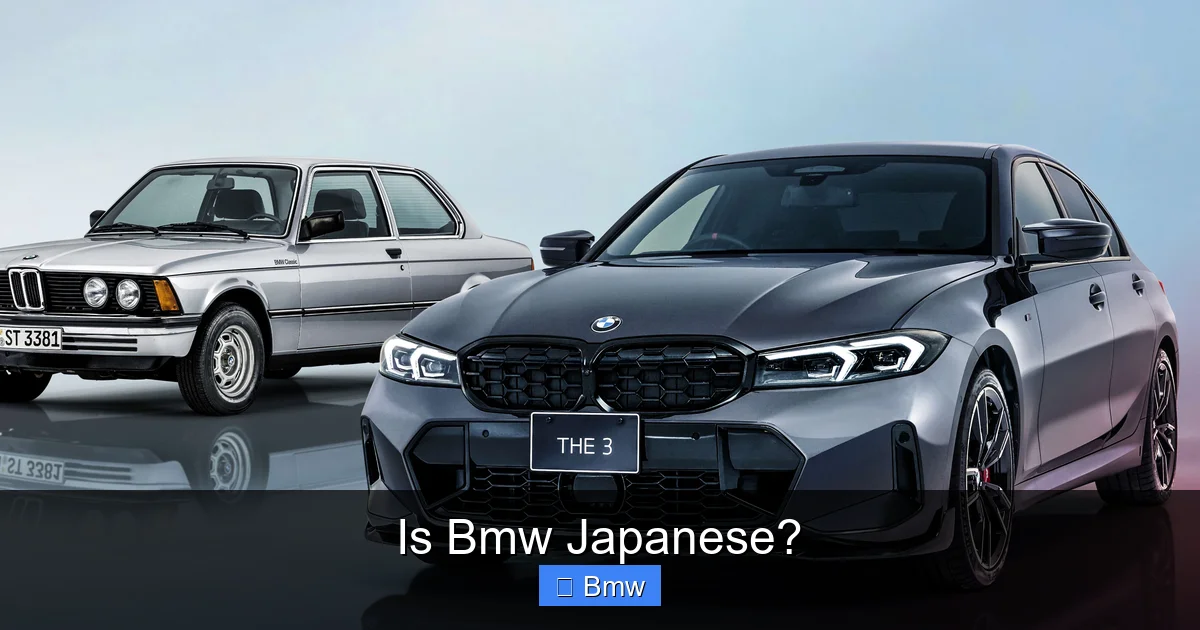
Visual guide about Is Bmw Japanese?
Image source: autoblog.com
Primary Plants in Germany
Germany remains the heart of BMW production. Key factories include:
- Munich Plant: The original home, producing 3 Series, 4 Series, and M models.
- Dingolfing Plant: BMW’s largest plant, building 5 Series, 7 Series, 6 Series Gran Turismo, and many electric models.
- Regensburg Plant: Focuses on 1 Series, 3 Series Touring, and roadsters like the Z4.
- Leipzig Plant: Home of the i3 electric car and the 2 Series Gran Coupe.
These plants are engineering hubs where German craftsmanship meets advanced robotics. The cars produced here are unequivocally German-made, from design to final assembly.
International Production Facilities
To serve local markets and reduce costs, BMW operates plants elsewhere:
- Spartanburg, USA: BMW’s only U.S. plant, dedicated to X3, X4, X5, X6, X7, and XM SUVs. It’s the company’s global production center for SUVs.
- Beijing, China: A joint venture with Brilliance Auto produces 1 Series, 3 Series, 5 Series, and X1, X3, X5 locally for the Chinese market.
- Rosslyn, South Africa: Assembles 3 Series sedans primarily for the African market.
- Chennai, India: Locally assembles 3 Series, 5 Series, X1, X3, X5, and X7.
- Rayong, Thailand: Produces 5 Series and various MINI models.
Cars from these plants are tailored to regional tastes and regulations, but the engineering, quality control, and brand standards come from Munich. So, while a BMW X5 built in South Carolina has a “Made in USA” label, it’s still a German-engineered luxury SUV. This global footprint sometimes fuels the is BMW Japanese question because people see “assembled in [non-German country]” and assume foreign ownership or design. It’s a supply chain reality, not a national identity shift.
Japanese Automotive Giants: A Brief Overview
To understand the confusion, we need to look at the brands people often compare to BMW. Japanese automakers have a distinct history and philosophy that differs greatly from BMW’s.
Visual guide about Is Bmw Japanese?
Image source: 2.bp.blogspot.com
Toyota, Honda, Nissan – The Big Three
Japan’s automotive industry boomed after World War II. Companies like Toyota, Honda, and Nissan (which owns Infiniti) became global powerhouses. Their rise was built on:
- Toyota Production System: Lean manufacturing, just-in-time inventory, and continuous improvement (kaizen). This made Toyota synonymous with reliability and efficiency.
- Honda’s Engineering Excellence: From motorcycles to the Civic and Accord, Honda focused on lightweight, high-revving engines and practical innovation.
- Nissan’s Technological Boldness: Nissan embraced technology early, with models like the 300ZX and later the GT-R. Its luxury division, Infiniti, targets performance and luxury.
Japanese brands are often praised for low cost of ownership, durability, and user-friendly designs. Their luxury divisions (Lexus, Acura, Infiniti) offer comfort and tech but generally lack the sporty, driver-centric ethos of BMW.
Key Differences in Philosophy
The core divergence is in brand purpose. Japanese automakers, broadly, aim to build cars that are practical, economical, and trouble-free for the masses. BMW, from its earliest days, targeted the ” enthusiast” driver. The company’s pre-war racing successes and post-war sports cars established a legacy of performance. This isn’t to say Japanese brands don’t make fast cars—they do (think Nissan GT-R, Honda NSX). But their mass-market identity is built on reliability and value. BMW’s identity is built on “sheer driving pleasure.” That philosophical split is fundamental and explains why BMW will never be Japanese, even if it builds cars in Japan (which it doesn’t).
Why the Confusion? Comparing BMW and Japanese Brands
So why do so many people ask is BMW Japanese? It’s not random. Several factors blur the lines in consumers’ minds.

Visual guide about Is Bmw Japanese?
Image source: img.gta5-mods.com
Shared Values of Reliability and Innovation
Both German and Japanese automakers are world leaders in engineering and quality. A well-maintained modern BMW can be very reliable, and a Toyota can be surprisingly engaging to drive. Over the decades, the quality gap has narrowed. Japanese brands adopted sophisticated manufacturing techniques that German brands later emulated. Conversely, BMW has improved its reliability significantly. When you see a smooth-running 10-year-old BMW 3 Series next to a Honda Civic, both feeling solid, it’s easy to lump them together as “foreign quality cars.” But the underlying priorities remain different: BMW will sacrifice some long-term cost for driving dynamics; Toyota will sacrifice sportiness for longevity.
Marketing and Global Perception
BMW’s marketing is globally consistent and incredibly strong. The “Ultimate Driving Machine” slogan, launched in 1975, is one of the most enduring in automotive history. It emphasizes performance, precision, and emotional connection. Japanese brands, meanwhile, often market practicality and dependability (“Oh, what a feeling!” for Toyota). However, in some markets, especially in Asia, Japanese luxury brands (like Lexus) are positioned as near-luxury alternatives to German brands. A consumer comparing a Lexus ES to a BMW 5 Series might see both as “premium foreign cars” and not distinguish their national origins deeply. Additionally, BMW’s global production network—building SUVs in the USA, sedans in China—can make the brand feel less “German” to a local buyer. If you buy a BMW assembled in your country, it might feel more domestic than imported, even if the brain trust is in Munich.
Another angle: BMW’s partnership with Japanese companies on specific technologies can sow seeds of confusion. For instance, BMW and Toyota collaborated on developing hydrogen fuel cell systems and shared platforms for the Supra and Z4. While this is a technical alliance, it doesn’t mean BMW becomes Japanese. It’s like two experts sharing notes—they remain distinct individuals. But casual observers might think, “They work together, so they must be similar.” Nope. Collaboration doesn’t erase heritage.
Debunking Myths: Common Misconceptions About BMW
Let’s tackle the most persistent myths head-on. These are the exact questions that fuel the is BMW Japanese debate.
“BMW is Reliable Like a Toyota”
This is a half-truth. Modern BMWs are far more reliable than their counterparts from the 1990s and early 2000s. However, independent studies (like those from Consumer Reports and J.D. Power) consistently rank Japanese brands, particularly Toyota and its luxury division Lexus, at the top for long-term reliability. BMW typically lands in the middle of the pack among luxury brands. Why? German engineering often pushes boundaries with complex turbocharged engines, advanced electronics, and lightweight materials that may require more meticulous maintenance. For example, BMW’s N54 engine (2006-2013) was groundbreaking but had issues with high-pressure fuel pumps and injectors. A Toyota 2GR-FE V6, by contrast, is famously bulletproof. So, while you can get a reliable BMW, you shouldn’t expect Toyota-level durability without higher maintenance costs and potential for expensive repairs. This difference in reliability philosophy is a key reason why BMW isn’t Japanese—Japanese brands design for bulletproof simplicity; BMW designs for performance first, then manages reliability.
“BMW Cars Are Assembled in Japan”
No, BMW does not have any production facilities in Japan. All BMW-branded vehicles are assembled in Germany or one of its international plants listed earlier (USA, China, South Africa, India, Thailand). Some components—like electronics, sensors, or even entire engines—might be sourced from Japanese suppliers (Bosch is German, but Denso is Japanese; many cars use parts from multiple countries). This global supply chain is standard. A “German” car can have Japanese-made alternators or Brazilian-made tires. But final assembly for BMW never happens in Japan. If you see a BMW with a Japanese VIN or assembly plate, it’s either a very rare gray-market import or a misidentification. The confusion might arise because Japanese brands like Toyota build cars in the USA (e.g., Kentucky-made Camry), and people generalize that all foreign brands do the same. BMW does, but not in Japan.
“BMW is Owned by a Japanese Company”
BMW is an independent, publicly traded German company. Its major shareholders are institutional investors and private individuals, primarily German and European. There is no Japanese parent company. Contrast this with some brands: Nissan is part of the Renault–Nissan–Mitsubishi Alliance, and Mazda has a significant investment from Toyota. But BMW has no such ties. It has partnerships (like with Toyota on sports cars and with Great Wall Motor on electric Mini models in China), but these are joint ventures, not takeovers. BMW’s corporate governance, executive leadership, and strategic decisions are made in Munich. So, no Japanese ownership here.
The Legacy of German Engineering: What Sets BMW Apart
If BMW isn’t Japanese, what makes it distinctly German? It’s a combination of history, engineering principles, and cultural attitudes.
The Ultimate Driving Machine Philosophy
Launched in 1975, this slogan wasn’t just marketing—it was a promise. BMW cars are designed with a front-engine, rear-wheel-drive layout (for most models) to achieve near 50/50 weight distribution. The steering is tuned for feedback, the suspension for agility, and the engines for linear power delivery. Even BMW’s all-wheel-drive system (xDrive) is rear-biased to maintain that sporty feel. Japanese luxury brands like Lexus often prioritize silence, comfort, and isolation from road imperfections. There’s a different emotional goal: BMW wants you to feel connected to the road; Lexus wants you to feel insulated from it. This philosophy permeates everything from chassis tuning to the iDrive infotainment system’s driver-focused layout. It’s a German approach: precision, performance, and technical excellence, often at the expense of ultimate comfort or low cost.
Innovations That Shaped the Industry
BMW has a history of pioneering technologies that later became industry standards:
- Turbocharging: BMW’s M1 supercar (1978) used a turbocharged inline-6. Today, turbocharging is ubiquitous, but BMW was an early adopter in production cars.
- Carbon Fiber: The i3 and i8 used extensive carbon-fiber-reinforced plastic (CFRP) to reduce weight—a costly but effective technique now spreading to other brands.
- Driver Aids: BMW introduced one of the first production adaptive cruise control systems (Active Cruise Control) in the late 1990s.
- Modular Platforms: The UKL platform for front-wheel-drive cars (like the 1 Series) and CLAR for rear-wheel-drive cars allow efficient production across models.
These innovations are hallmarks of German engineering: complex, expensive, and aimed at pushing boundaries. Japanese brands are also innovative (Toyota’s hybrid system, Honda’s ASIMO robot), but their innovations often target mass-market affordability and efficiency. BMW’s innovations frequently target performance and premium experiences. This difference in innovation focus is another reason BMW remains firmly German.
Conclusion: The Clear Answer and What It Means for You
So, after this deep dive, the answer to is BMW Japanese is definitively no. BMW is a German automaker through and through—its history, headquarters, engineering leadership, and core brand identity are all rooted in Germany. The confusion stems from BMW’s global manufacturing presence, its partnerships with Japanese firms, and the narrowing quality gap between German and Japanese cars. But beneath the surface, the philosophies diverge: Japanese brands build for reliability and efficiency; BMW builds for driving excitement and technical prestige.
What does this mean for you as a car buyer or enthusiast? If you’re drawn to BMW, you’re likely attracted to its driving dynamics, its “Ultimate Driving Machine” ethos, and its status as a German engineering icon. You should also be prepared for potentially higher maintenance costs compared to a Toyota or Honda. Understanding BMW’s German heritage helps you appreciate its design choices, its engineering priorities, and even its quirks. It also helps you make informed comparisons. Want a car that’s supremely comfortable and worry-free for 200,000 miles? A Japanese brand might be better. Want a car that’s thrilling to drive on a twisty road and packed with tech? BMW’s German character delivers that.
At the end of the day, national origin isn’t just about flags on factories; it’s about cultural mindset. BMW’s mindset is Bavarian, not Japanese. And that’s exactly why so many people love it. So next time someone asks you is BMW Japanese, you can confidently say, “No way—it’s proudly German, and here’s why that matters.”
Frequently Asked Questions
Is BMW owned by a Japanese company?
No, BMW is an independent German company headquartered in Munich. It has no Japanese parent corporation, though it partners with Toyota on specific projects like hydrogen fuel cells and sports car platforms.
Are any BMW cars manufactured in Japan?
No, BMW does not have any assembly plants in Japan. All BMW vehicles are built in Germany or at its international facilities in the USA, China, South Africa, India, or Thailand. Some individual parts may be sourced from Japanese suppliers, but final assembly never occurs in Japan.
Why do some people think BMW is Japanese?
The confusion usually comes from BMW’s global production network (e.g., SUVs made in the USA), its collaborations with Japanese brands like Toyota, and the fact that Japanese automakers also produce high-quality, reliable vehicles. People may also mistake BMW for Japanese because of its presence in Asian markets or because they associate all premium foreign cars with Japanese reliability.
Is BMW more reliable than Japanese luxury brands like Lexus?
Generally, no. Lexus (Toyota’s luxury division) consistently ranks higher in long-term reliability studies than BMW. BMW’s focus on performance and advanced technology can lead to more complex systems that may require costly repairs as the vehicle ages. However, modern BMWs have improved significantly, and with proper maintenance, they can be quite dependable.
What’s the main difference between BMW and Japanese luxury brands?
The core difference is philosophy. BMW emphasizes driving dynamics, sporty handling, and technical innovation (“Ultimate Driving Machine”). Japanese luxury brands like Lexus and Acura prioritize comfort, quietness, and bulletproof reliability. BMWs often have firmer rides and higher maintenance costs; Lexus models are typically smoother and cheaper to own long-term.
Should I buy a BMW if I want Japanese-level reliability?
If low cost of ownership and worry-free longevity are your top priorities, a Japanese brand like Toyota, Honda, or their luxury divisions (Lexus, Acura) is likely a better fit. BMW offers a different ownership experience—one focused on performance and prestige, with potentially higher maintenance expenses. That said, choosing a BMW with a proven engine (like the B48 turbo-4) and following a strict service schedule can mitigate many reliability concerns.