
Can a Ford F-150 Tow 10

The short answer is yes—many Ford F-150s can tow 10,000 pounds, but it’s not universal. Whether your specific truck can handle this weight depends on a combination of engine choice, axle ratio, and the presence of the Heavy-Duty Payload Package. Always verify your exact towing capacity using the door jamb sticker before hitting the road with a heavy load.
Key Takeaways
- Not all F-150s are equal: Only specific configurations, typically with the 3.5L EcoBoost V6 and the Heavy-Duty Payload Package, achieve the maximum published towing capacities that exceed 10,000 lbs.
- The Heavy-Duty Payload Package (HDPP) is often mandatory: This package upgrades the suspension, brakes, and sometimes the frame, increasing the Gross Vehicle Weight Rating (GVWR) to handle the stress of heavy trailers.
- Engine matters immensely: The 3.5L EcoBoost V6 has been the towing workhorse for over a decade, while the 5.0L V8 and newer hybrid powertrains have varying capacities that may or may not hit the 10,000 lb mark depending on other factors.
- “Real-world” capacity is lower than the sticker: The published max tow rating is for a bare-bones truck. Adding passengers, cargo, and accessories eats into your available capacity, often reducing your effective 10,000 lb capability.
- Proper setup is non-negotiable: You need the correct hitch, a functioning trailer brake controller, properly rated tires (often Load Range E), and a weight distribution system for trailers over 5,000 lbs to tow safely and legally.
- Model year is critical: Towing capacities have increased significantly in recent generations (2015+). An older F-150 might struggle to reach 10,000 lbs even with the “right” engine due to older technology and lower GCWRs.
- Always verify your truck’s exact ratings: The only authoritative source is the yellow tire information sticker on your driver’s door jamb, which lists your specific GVWR and GCWR.
📑 Table of Contents
- So, Can a Ford F-150 Really Tow 10,000 Pounds?
- Decoding the Jargon: What “Towing Capacity” Actually Means
- Engine and Configuration: The Heart of the Matter
- The Heavy-Duty Payload Package (HDPP): Your Secret Weapon (Often Required)
- Real-World Towing: Why the Sticker Number is a Best-Case Scenario
- Setting Up Your F-150 for Safe 10,000 lb Towing
- Model Year Matters: Which F-150s Can Tow 10,000 lbs?
- The Bottom Line: Your Checklist Before Towing 10,000 lbs
So, Can a Ford F-150 Really Tow 10,000 Pounds?
It’s the million-dollar question for anyone who needs to haul a large boat, a spacious camper, or a heavy equipment trailer. You look at the Ford F-150, the perennial best-selling truck in America, and you see those impressive max towing numbers advertised—sometimes well over 14,000 pounds. It’s natural to think, “My F-150 should easily tow 10,000 lbs.” But here’s the crucial truth: your Ford F-150 can only tow what its specific configuration is rated for, and that number can vary wildly from one truck to the next. The short answer is yes, a properly equipped Ford F-150 can absolutely tow 10,000 pounds. The longer, more important answer is understanding exactly what “properly equipped” means, because assuming your truck can do it without checking is a fast track to dangerous, illegal, and potentially devastating overloading.
This guide will strip away the marketing gloss and give you the plain-English, no-nonsense breakdown of how to determine if your F-150 can handle a 10,000-pound trailer. We’ll dive into the nitty-gritty of engine codes, axle ratios, payload packages, and the critical calculations you must do before you ever connect a hitch. Whether you’re shopping for a new truck or getting ready to tow with your current one, this is the information you need.
Decoding the Jargon: What “Towing Capacity” Actually Means
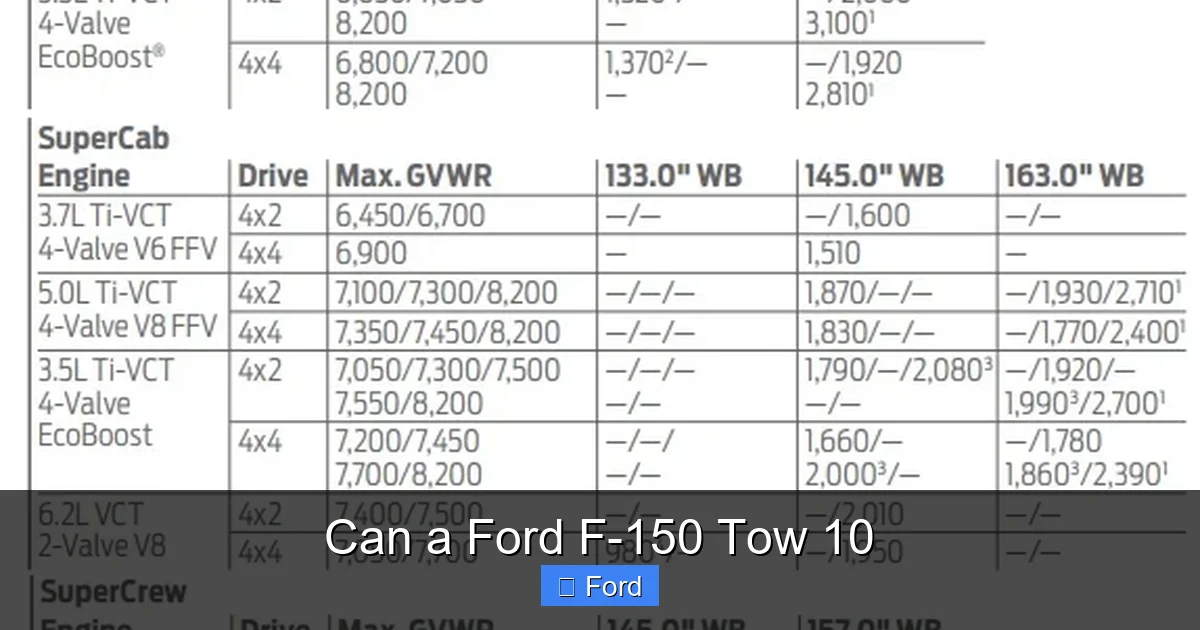
Before we talk about F-150s, we need to speak the language of towing. The number you see on the window sticker—”Max Towing Capacity: 14,000 lbs”—is a theoretical maximum calculated under ideal, laboratory-like conditions. It’s not a guarantee for your truck. To understand why, you need to grasp three key ratings.
Visual guide about Can a Ford F-150 Tow 10
Image source: towstats.com
Gross Combined Weight Rating (GCWR)
This is the single most important number for towing. The GCWR is the total allowable weight of everything: your truck (with all its fluids, a full tank of gas, and all passengers and cargo) plus the fully loaded trailer plus the tongue weight of the trailer pressing down on the hitch. Think of it as the truck and trailer’s shared weight limit. Your goal is to keep the combined actual weight of your loaded truck and loaded trailer under this GCWR number. If your GCWR is 20,000 lbs and your loaded truck (with you, your family, and your tools) weighs 6,000 lbs, you have 14,000 lbs available for the trailer. But if that same truck weighs 7,500 lbs because you’re carrying a crew and a bed full of gear, your trailer capacity drops to 12,500 lbs.
Gross Vehicle Weight Rating (GVWR)
This is the maximum safe weight of the truck itself. It’s the truck’s curb weight plus its maximum payload (passengers, cargo, and the tongue weight of the trailer). The tongue weight—typically 10-15% of the trailer’s total weight—counts against the truck’s payload capacity. A 10,000 lb trailer has a tongue weight of 1,000 to 1,500 lbs. That weight sits directly on the truck’s rear axle and counts toward the GVWR. If your truck’s GVWR is 6,000 lbs and it already weighs 5,000 lbs (curb weight + you), you only have 1,000 lbs of payload left for tongue weight and cargo. This is where many people get caught—they have a high GCWR but a low GVWR, creating a “payload-limited” situation. You might be able to *pull* a 10,000 lb trailer but not *carry* the weight of its tongue on your truck.
Tongue Weight and Payload
Tongue weight is the downward force exerted on the hitch by the trailer’s coupler. It’s not an optional extra; it’s a fundamental part of the load. Too little tongue weight causes trailer sway. Too much overloads the truck’s rear axle and reduces steering control. Your truck’s payload capacity (GVWR minus curb weight) must accommodate this tongue weight plus any other cargo or passengers. For a 10,000 lb trailer, you’re looking at needing at least 1,000-1,200 lbs of available payload just for the hitch load.
Practical Example: Let’s say your door jamb sticker says GVWR: 6,500 lbs and GCWR: 18,000 lbs. Your F-150’s curb weight is 4,800 lbs. You, your co-pilot, and some gear add 600 lbs. Your loaded truck weight is now 5,400 lbs. Your remaining payload is 1,100 lbs (6,500 – 5,400). That 1,100 lbs must cover your trailer’s tongue weight. For a 10,000 lb trailer, you’d ideally need 1,200 lbs of tongue weight (12%). You’re already 100 lbs short on payload, meaning you cannot legally or safely tow that trailer with this truck in this loaded condition, even though 18,000 – 5,400 = 12,600 lbs *seems* like enough trailer capacity on paper. The GVWR/payload is the limiting factor.
Engine and Configuration: The Heart of the Matter
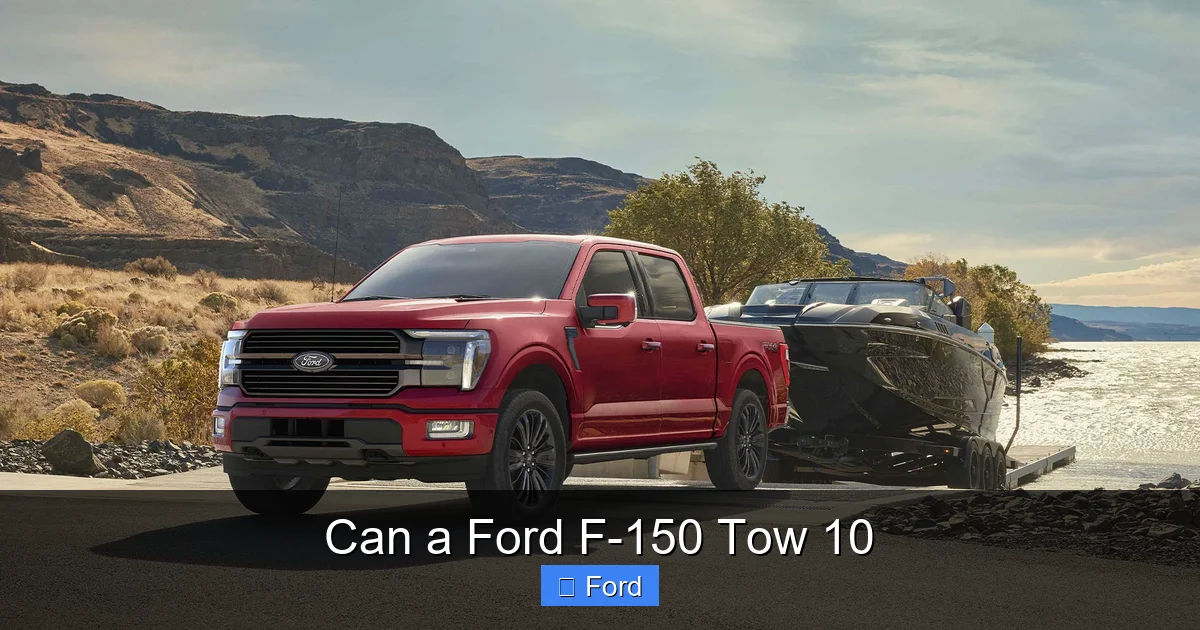
Now we get to the fun part: what makes one F-150 capable of 10,000+ lbs and another struggle at 7,000? It’s a specific recipe of engine, transmission, axle ratio, and tire size. Ford publishes max tow ratings for each cab/bed configuration with each engine. Let’s break down the modern (2015+) engines.
Visual guide about Can a Ford F-150 Tow 10
Image source: prestonford.com
The 3.5L EcoBoost V6: The undisputed Towing King
For the better part of a decade, the twin-turbocharged 3.5L EcoBoost V6 has been the go-to for maximum towing in the F-150. Its broad, flat torque curve (peaking at a low 3,000 RPM) is perfect for pulling heavy loads without constant downshifting. In recent model years (2021-2023), when paired with the 3.73 rear axle ratio (a common or optional ratio), the 3.5L EcoBoost in a crew cab, long bed configuration can tow up to 14,000 lbs. This means a 10,000 lb trailer is well within its comfortable capability. Even in more common 5.5-foot or 6.5-foot bed setups with the 3.55 axle, it often still exceeds 10,000 lbs. If your goal is 10k, the 3.5L EcoBoost is the safest, most consistent bet across a wide range of trims and configurations.
The 5.0L V8: Powerful, But Payload Can Be a Limiter
The Coyote 5.0L V8 is a fantastic engine, but its max tow ratings are typically a few thousand pounds less than the EcoBoost’s peak numbers. For example, in the same truck configuration, the 5.0L might be rated for 11,000-12,000 lbs max. That sounds fine for 10,000 lbs, but you must pay closer attention to the payload rating. V8-equipped trucks, especially older models or specific trims, sometimes have a lower GVWR than their EcoBoost counterparts because they don’t have the Heavy-Duty Payload Package (more on that next). You could find yourself in a situation where the GCWR allows the trailer weight, but the GVWR/payload does not. The V8 can do the job, but you need to be more meticulous in your configuration check.
The 2.7L EcoBoost V6 and 5.2L V8 (Raptor)
The efficient 2.7L EcoBoost is a great engine, but its max tow ratings usually cap out in the 8,000-9,000 lb range for standard configurations. It’s unlikely to be rated for 10,000 lbs unless in a very specific, long-bed, high-GVWR setup (which is rare). The high-performance 5.2L V8 in the Raptor is focused on off-road speed, not heavy towing, and has a relatively low tow rating around 8,000 lbs. Neither is a primary candidate for consistent 10k towing.
The Role of Axle Ratios and the 10-Speed Transmission
Numerical axle ratios (like 3.73, 3.55, 3.31) determine how many times the driveshaft turns for every wheel revolution. A higher number (3.73) gives more mechanical advantage, better for starting heavy loads and climbing hills, but reduces fuel economy and top speed. For max towing, you almost always want the numerically highest ratio available for your engine. The standard now is Ford’s 10-speed automatic transmission, which is excellent—it has very low first gear for getting a heavy trailer moving and enough gears to keep the engine in its power band. An older 6-speed might struggle more, but the axle ratio is still the primary gearing factor for tow capacity.
Pro Tip: When looking at a truck’s window sticker or spec sheet, the max tow rating is always listed for a specific configuration: cab size, bed size, drivetrain (2WD/4WD), axle ratio, and tire size. Don’t just look at the engine. A 4×4 model with the same engine will almost always have a 100-200 lb lower max tow rating than the 2WD version due to the added weight of the transfer case and front axle.
The Heavy-Duty Payload Package (HDPP): Your Secret Weapon (Often Required)
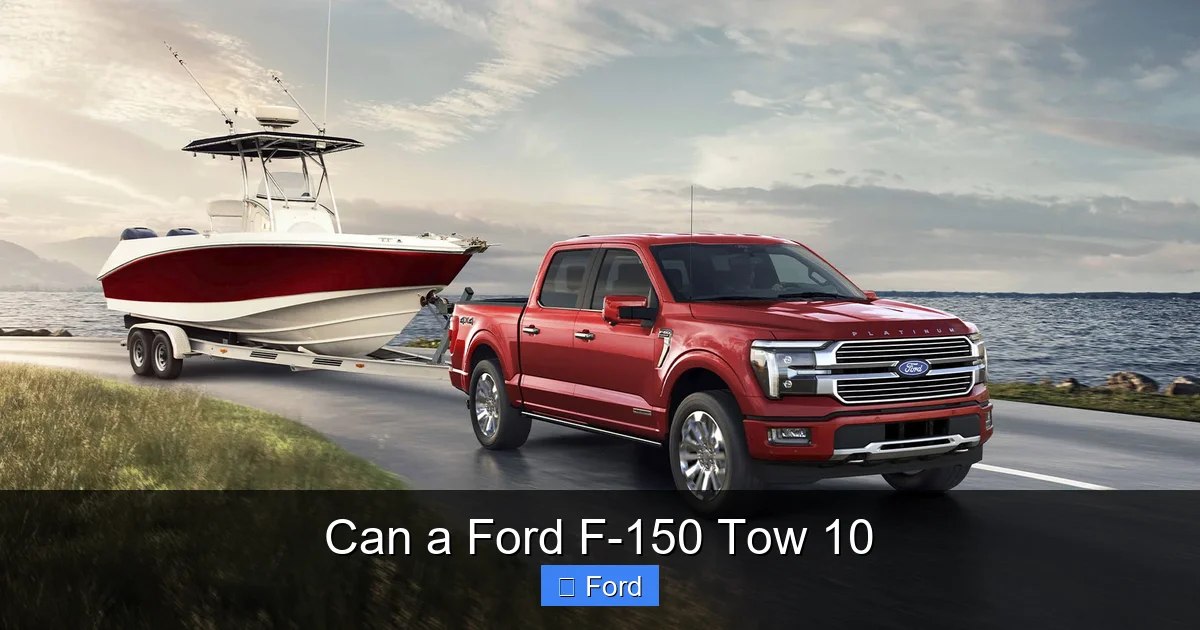
This is the most overlooked and misunderstood piece of the puzzle. You can have the most powerful engine, but if your truck’s chassis, suspension, and brakes aren’t beefed up, it simply cannot handle the stress of a heavy trailer. Enter the Heavy-Duty Payload Package, or HDPP.
Visual guide about Can a Ford F-150 Tow 10
Image source: prestonford.com
What’s Actually in the HDPP?
The HDPP is not just a marketing badge. It’s a collection of hard upgrades:
- Uprated Rear Axle: Often a 10.5-inch ring gear (vs. 9.75-inch standard) for the 3.5L EcoBoost, and sometimes a different gear ratio.
- Heavy-Duty Rear Springs: Stiffer, multi-leaf springs (or stronger multi-stage coils on some models) that significantly increase the truck’s GVWR.
- Larger Brakes: Bigger brake rotors and calipers, sometimes with upgraded pads, to handle the increased stopping power needed when towing.
- Enhanced Radiator: A larger, more efficient cooling system to manage the extra heat from the engine and transmission under load.
- Frame Reinforcement: In some generations, additional bracing or a heavier frame section.
The net effect is a higher GVWR. A standard XL or XLT trim might have a GVWR of 6,000 lbs. The same truck with the HDPP might have a GVWR of 6,700 or even 7,000 lbs. That extra 700-1,000 lbs of payload capacity is often the difference between being able to legally carry the tongue weight of a 10,000 lb trailer and being massively overloaded.
How to Identify an HDPP-Equipped F-150
This is critical. You cannot assume a truck has it. The only surefire way is to check the door jamb sticker. Look for the GVWR. If it’s 6,700 lbs or higher on a standard cab/short bed, or 7,000+ on a crew cab/long bed, it likely has the HDPP or a similar payload upgrade. You can also sometimes spot it by looking for a “HD Payload” decal on the glovebox door or in the window sticker’s option list. The option code is usually “67R” or similar, but it varies by year. For model years 2021-2023, Ford sometimes bundles payload upgrades into the “Max Trailer Tow” package, but you must still verify the GVWR on the sticker. Don’t trust a dealer’s word; trust the sticker.
Real-World Scenario: You find a 2018 F-150 XLT, 4×4, crew cab, 5.0L V8, with a 3.73 axle. Its published max tow rating might be 11,000 lbs. But its door jamb sticker says GVWR: 6,400 lbs. You load the truck with 5 people and gear (1,200 lbs). Curb weight is ~5,000 lbs. Your loaded truck is 6,200 lbs. You have 200 lbs of payload left. The tongue weight of an 11,000 lb trailer is 1,100-1,300 lbs. You are 900-1,100 lbs OVER your GVWR before you even hook up. That truck, despite its engine and axle, cannot safely tow 11,000 lbs. It might be limited to a 5,000 lb trailer in this loaded state. The HDPP, which would have given this truck a GVWR of 7,000 lbs, would have solved this problem.
Real-World Towing: Why the Sticker Number is a Best-Case Scenario
Manufacturer tow ratings are calculated using a “base vehicle” weight. That means a truck with a single driver, no options, a full fuel tank, and nothing in the bed. It’s a mythical creature. Your real-life truck is not that. Every single thing you add reduces your available towing capacity.
The Culprits That Eat Your Tow Rating
- Passengers: A family of four can easily add 500-800 lbs.
- Cargo: Tools, coolers, camping gear, firewood. 100 lbs here, 200 lbs there.
- Options & Accessories: A factory sunroof, upgraded stereo, running boards, spray-in bedliner, a heavy tonneau cover—all add weight. Even a high-quality tonneau cover can add 50-80 lbs.
- Fuel: A full 26-gallon tank of diesel (if you have a diesel F-150, which is rare) or gasoline weighs over 150 lbs.
- 4×4 System: Adds 150-200 lbs over a 2WD model.
- Altitude and Temperature: High altitude reduces engine power and turbo efficiency. Extreme heat also degrades performance. Your “sea level” tow rating drops in the mountains.
It’s not uncommon for a family-loaded F-150 with a crew cab, full tank, and a few hundred pounds of gear to be 1,000-1,500 lbs heavier than the “base vehicle.” That directly translates to 1,000-1,500 lbs less trailer capacity. If your sticker says 12,000 lbs max, your real-world safe number with a family on board might be 10,500 lbs or even lower.
The Tongue Weight Trap
As emphasized earlier, tongue weight is part of your payload. A common mistake is to max out the trailer’s cargo but not distribute it properly, leading to insufficient or excessive tongue weight. A poorly loaded 10,000 lb trailer might only put 600 lbs on the hitch, which is too light and causes sway. Or it might put 1,800 lbs on the hitch, which is way too heavy and will crush your rear suspension, cause brake imbalance, and make the front end light. You must weigh the loaded trailer on a public scale to get its actual weight, then use a hitch scale to measure the actual tongue weight. Only then can you accurately calculate your loaded truck weight + tongue weight and compare it to your GVWR.
Setting Up Your F-150 for Safe 10,000 lb Towing
Let’s assume you’ve done the math and your specific F-150, in its real-world loaded state, has the GCWR and GVWR headroom to tow a 10,000 lb trailer. Now you need the right hardware. Towing is a system, and every part matters.
Hitch Selection: It’s Not One-Size-Fits-All
For a 10,000 lb trailer, you need a Class IV or Class V receiver hitch. The F-150’s factory tow package typically includes a Class IV hitch rated for 10,000+ lbs. If your truck didn’t come with one, you must install an aftermarket hitch with an equal or higher rating. Never use a bumper-pull hitch for this weight. You’ll also need a weight distribution hitch (WDH) with sway control. For trailers over 5,000 lbs, a WDH is not a luxury; it’s a safety essential. It uses spring bars to redistribute the tongue weight from the rear axle of the truck to the front axle and the trailer’s axles. This keeps the truck level, improves steering and braking, and prevents sway. Ensure the WDH is properly rated for your trailer’s tongue weight and total weight.
Tires: The Link to the Road
Your truck’s stock tires might be all-season radials rated for light loads. For heavy towing, you need tires with a high load index. Look for “Load Range E” tires (10-ply rating) on the sidewall. These can carry much more weight at higher inflation pressures. Proper inflation is critical—check the tire placard on your door jamb for the towing pressure, which is often higher than the standard driving pressure. Under-inflated tires under heavy load overheat and can fail. Investing in a good set of towing tires is one of the best safety upgrades you can make. For specific recommendations based on your F-150’s model year and trim, consult a guide like the best tires for Ford F-150 to find models with proven load capacity and durability.
Brakes, Suspension, and Cooling
If your truck has the HDPP, its brakes and suspension are already upgraded. If not, towing 10,000 lbs regularly will accelerate brake wear and may overwhelm the stock suspension, causing sag and poor handling. Consider upgrading to heavy-duty brake pads and rotors. Some owners add auxiliary air springs or helper springs to the rear to maintain level ride height and prevent bottoming. The factory transmission cooler is usually adequate, but in extreme heat or mountain towing, an aftermarket auxiliary transmission cooler can provide valuable extra protection. Also, ensure your engine is in top shape. A well-tuned engine with fresh spark plugs (especially critical for the 3.5L EcoBoost) and clean fuel injectors will perform much better under load than a neglected one.
Trailer Brake Controller and Wiring
This is legally required in most states for trailers over 1,500-3,000 lbs. Your F-150’s factory tow package will have an integrated trailer brake controller (a knob on the dash). If not, you must install an aftermarket unit. You must also ensure the trailer’s electric brakes are properly wired and functional. Test them before every trip. The brake controller should be adjusted so that the trailer brakes do most of the work, with the truck’s brakes providing support.
Model Year Matters: Which F-150s Can Tow 10,000 lbs?
Towing technology has evolved. A 2010 F-150 is a different animal from a 2023 F-150. Here’s a general timeline.
The Game-Changer: 2015 Redesign (13th Generation)
The 2015 redesign brought aluminum body construction (saving weight) and, most importantly, the debut of the high-output 3.5L EcoBoost V6. This engine, paired with the 3.73 axle and HDPP, pushed max tow ratings into the 12,000+ lb range for the first time in the F-150’s history. 2015-2020 models are the first where a 10,000 lb tow rating becomes relatively common, but you still must hunt for the right configuration (HDPP, correct axle). The 5.0L V8 in this generation was also strong, often rated for 10,000-11,000 lbs with the right package.
2021-Present: Peak Performance and Refinement
The 2021 refresh (14th generation) saw further increases. The 3.5L EcoBoost, now with a 10-speed standard, saw max ratings climb to 14,000 lbs in certain long-bed, crew-cab configurations. The introduction of the 3.5L PowerBoost hybrid powertrain also offered strong, efficient towing (often 11,000-12,000 lbs). This is the sweet spot for finding a new or nearly new F-150 that can easily handle 10,000 lbs with a wide margin of safety. The payload ratings also increased on many trims, making the HDPP slightly less critical for hitting 10k, but still highly recommended for comfort and safety.
Pre-2015 Models: Proceed with Extreme Caution
2014 and earlier F-150s (with the old 5.0L, 6.2L V8, or 3.7L V6) have much lower GCWRs. The legendary 6.2L V8 in a 2014 Platinum might have a max tow of ~9,800 lbs—right on the edge. Most other configurations were well under 9,000 lbs. Towing 10,000 lbs with a pre-2015 F-150 is generally not feasible or safe without extensive (and expensive) modifications to the suspension and brakes. If you’re looking at an older truck for heavy towing, your best bets are the 2011-2014 models with the 6.2L V8 and the Heavy-Duty Payload Package, but even then, you’ll be at the absolute limit. For reliability and capability, focusing on the most reliable Ford F-150 model years from 2015 onward is a smarter strategy for a dedicated tow vehicle.
The Bottom Line: Your Checklist Before Towing 10,000 lbs
So, can your Ford F-150 tow 10,000 pounds? Follow this definitive process to find out:
- Find Your Door Jamb Sticker. Locate the yellow tire information sticker on the driver’s door jamb. Write down your GVWR and GCWR. These are the only numbers that matter for your truck.
- Weigh Your Loaded Truck. Go to a public truck scale (at a quarry, recycling center, or some RV parks) with your truck fully loaded as you would for a trip: full fuel tank, all passengers, all cargo, the hitch installed. Get the actual weight.
- Calculate Your Available Capacity. Subtract your loaded truck weight from your GCWR. That is your maximum allowable trailer weight. Example: GCWR 18,000 lbs – Loaded Truck 6,200 lbs = 11,800 lbs max trailer. This is your first checkpoint.
- Check Payload (GVWR). Subtract your loaded truck weight from your GVWR. That is your remaining payload capacity. This must be greater than the expected tongue weight of your trailer (10-15% of trailer weight). Example: GVWR 6,500 lbs – Loaded Truck 6,200 lbs = 300 lbs payload left. A 10,000 lb trailer needs ~1,200 lbs tongue weight. You fail this check. You must reduce truck load or get a truck with a higher GVWR (i.e., one with HDPP).
- Verify Your Configuration. Does your truck have the 3.5L EcoBoost (or high-output version)? Does it have the HDPP (check GVWR)? What is the rear axle ratio (3.73 is best for towing)?
- Equip Properly. Ensure you have a Class IV/V hitch, a properly rated weight distribution hitch with sway control, Load Range E tires at correct pressure, and a working brake controller.
If you pass steps 3 and 4 with room to spare, and your truck has the necessary equipment, then yes—your Ford F-150 can tow 10,000 pounds safely and legally. If you fail either check, you must either reduce your trailer weight, reduce your truck’s load, or find a truck with a higher GVWR/GCWR. Never guess. Never rely on marketing numbers. The scale and the door jamb sticker don’t lie.
Frequently Asked Questions
Can any Ford F-150 tow 10,000 pounds?
No. Only specific configurations with the right engine (usually the 3.5L EcoBoost V6), a sufficiently high axle ratio (like 3.73), and often the Heavy-Duty Payload Package can achieve a 10,000+ lb max tow rating. Many base-model F-150s are rated for significantly less.
Is the Heavy-Duty Payload Package absolutely necessary for towing 10,000 lbs?
It is almost always necessary to achieve a high enough GVWR (payload capacity) to safely carry the tongue weight of a 10,000 lb trailer along with passengers and cargo. Without the HDPP, your truck’s GVWR may be too low, making it “payload-limited” even if its GCWR seems high enough.
What about older F-150s, like from 2010? Can they tow 10,000 lbs?
Generally, no. Pre-2015 F-150s have much lower Gross Combined Weight Ratings. Even the most powerful engines of that era (like the 6.2L V8) were typically maxed out around 9,500-9,800 lbs. Towing 10,000 lbs safely with an older model is usually not feasible without dangerous overloading.
Does 4×4 or 4×2 affect my towing capacity?
Yes. A 4×4 model is heavier than a 2WD model due to the transfer case and front axle. This added weight reduces your available payload and, consequently, your max trailer capacity by about 100-200 lbs. For absolute maximum towing, a 2WD model will have a slightly higher rating.
What’s the real difference between a 10,000 lb and a 14,000 lb towing capacity F-150?
The difference is almost always in the Heavy-Duty Payload Package and the rear axle ratio. A truck rated for 14,000 lbs will have the HDPP (higher GVWR) and a 3.73 axle. A truck rated for 10,000 lbs might lack the HDPP, have a 3.55 axle, or both. The engine is often the same (3.5L EcoBoost).
Do I need a brake controller to tow 10,000 lbs?
Yes, absolutely. A trailer over 3,000 lbs must have its own braking system. You must have a functioning, properly adjusted trailer brake controller installed in your F-150’s cab to activate those brakes. This is a legal requirement in all 50 states and a critical safety component for stopping a heavy load.
