
Is 700 a Good Credit Score to Buy a Car

A 700 credit score is considered good and can help you qualify for a car loan with competitive interest rates. While not excellent, it puts you in a favorable position to secure financing, though improving your score slightly could save you hundreds in interest over the life of the loan.
Key Takeaways
- A 700 credit score is “good” on the FICO scale: It falls within the 670–739 range, making you eligible for most auto loans.
- You’ll likely get approved for financing: Lenders view a 700 score as low-risk, increasing your chances of loan approval.
- Interest rates will be moderate: Expect rates between 5% and 8% for new cars, slightly higher for used vehicles.
- You may qualify for better deals with a co-signer: Adding someone with a higher score can lower your rate or increase loan amount.
- Improving your score to 740+ can save money: Moving into the “very good” range could reduce your APR by 1–2 percentage points.
- Down payment matters: A larger down payment can offset a modest credit score and improve loan terms.
- Shop around for the best lender: Credit unions and online lenders often offer better rates than traditional banks for mid-tier scores.
📑 Table of Contents
- Is 700 a Good Credit Score to Buy a Car?
- Understanding Credit Scores and the 700 Threshold
- Auto Loan Interest Rates for a 700 Credit Score
- Can You Get a Car Loan with a 700 Credit Score?
- Tips to Improve Your Car Loan Terms with a 700 Score
- New vs. Used Cars: Which Is Better with a 700 Score?
- Alternatives to Traditional Auto Loans
- Final Thoughts: Is 700 a Good Credit Score to Buy a Car?
- FAQs
Is 700 a Good Credit Score to Buy a Car?
So, you’re thinking about buying a car — maybe it’s your first, or perhaps you’re upgrading from your current ride. You’ve checked your credit score, and it’s sitting at 700. Now you’re wondering: Is that good enough to get a car loan? Can you get a fair interest rate? Will dealers treat you seriously?
The short answer? Yes — a 700 credit score is generally considered good, and it puts you in a solid position to buy a car. But like most things in finance, the full picture is a bit more nuanced. While 700 won’t get you the absolute best rates reserved for people with 740+ scores, it’s definitely not a barrier to financing. In fact, with a 700, you’re likely to qualify for a loan from most lenders, and you’ll probably get reasonable terms — especially if you do your homework.
In this guide, we’ll break down what a 700 credit score really means when it comes to buying a car. We’ll look at how lenders view this score, what kind of interest rates you can expect, and how you can maximize your chances of getting the best deal possible. Whether you’re buying new or used, financing through a dealership or a bank, or considering a lease, understanding your credit score’s role is key to making a smart, affordable decision.
Understanding Credit Scores and the 700 Threshold
Before we dive into car loans, let’s make sure we’re on the same page about credit scores. Most lenders in the U.S. use the FICO scoring model, which ranges from 300 to 850. This score is calculated based on your payment history, amounts owed, length of credit history, credit mix, and new credit inquiries.
Here’s how FICO breaks it down:
– 300–579: Poor
– 580–669: Fair
– 670–739: Good
– 740–799: Very Good
– 800–850: Excellent
So, a 700 credit score falls squarely in the “good” category. That means you’ve demonstrated responsible credit behavior — you pay your bills on time, you don’t max out your credit cards, and you’ve built a decent credit history. Lenders see you as a relatively low-risk borrower.
But why does this matter for car buying? Because your credit score directly affects your auto loan terms. The higher your score, the lower your interest rate — and the less you’ll pay over the life of the loan. A 700 score won’t get you the rock-bottom rates that people with 750+ scores enjoy, but it’s still strong enough to open many doors.
How Lenders View a 700 Credit Score
When you apply for an auto loan, lenders don’t just look at your credit score — they also consider your income, employment history, debt-to-income ratio, and down payment. But your credit score is often the first filter. It tells them how likely you are to repay the loan on time.
With a 700 score, most traditional lenders — including banks, credit unions, and online lenders — will approve your application. You’re not in the “subprime” category (typically under 620), where loans come with high interest rates and strict terms. Instead, you’re in the sweet spot where lenders feel confident lending to you — and they’re willing to offer competitive rates.
That said, not all lenders are created equal. Some specialize in working with borrowers who have good (but not excellent) credit. Others may offer slightly better terms if you have a stable job or a large down payment. So while a 700 score gives you access to financing, shopping around can help you find the best deal.
Real-World Example: What a 700 Score Gets You
Let’s say you’re buying a $25,000 new car and financing $20,000 after a $5,000 down payment. With a 700 credit score, you might qualify for an interest rate around 6.5% on a 60-month loan.
Here’s what that looks like:
– Loan amount: $20,000
– Interest rate: 6.5%
– Loan term: 60 months
– Monthly payment: ~$391
– Total interest paid: ~$3,460
Now, compare that to someone with a 750 score, who might get a 4.5% rate:
– Monthly payment: ~$373
– Total interest paid: ~$2,380
That’s a difference of $18 per month and over $1,000 in total interest. Not life-changing, but still meaningful — especially if you’re on a tight budget.
The point? A 700 score gets you in the game, but there’s room to improve. And even small improvements can add up.
Auto Loan Interest Rates for a 700 Credit Score
One of the biggest factors in your car-buying experience is the interest rate on your loan. This determines how much extra you’ll pay beyond the car’s price. And your credit score is a major player in setting that rate.
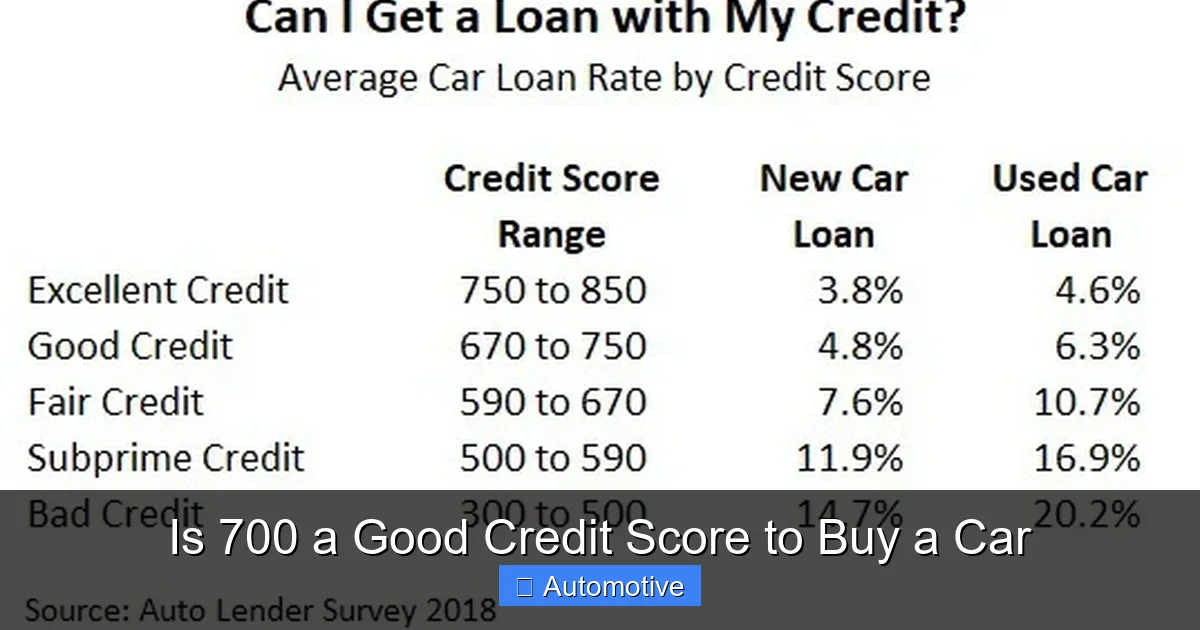
As of 2024, here’s a general idea of what interest rates look like by credit tier for new and used cars:
| Credit Score Range | New Car APR (Approx.) | Used Car APR (Approx.) |
|——————–|————————|————————-|
| 720–850 | 4.0% – 5.5% | 5.0% – 7.0% |
| 690–719 | 5.5% – 7.0% | 7.0% – 9.5% |
| 630–689 | 8.0% – 12.0% | 10.0% – 15.0% |
| Below 630 | 13.0%+ | 16.0%+ |
So, with a 700 credit score, you’re likely looking at an APR between 5.5% and 7.0% for a new car, and 7.0% to 9.5% for a used one. These rates can vary based on the lender, loan term, and current market conditions (like the Federal Reserve’s interest rate decisions).
Why Used Cars Have Higher Rates
You might notice that used car loans typically have higher interest rates than new ones — even for the same credit score. Why? Because used cars are considered riskier for lenders. They depreciate faster, may have hidden mechanical issues, and are harder to resell if the borrower defaults.
So even with a 700 score, you might pay 1–2 percentage points more for a used car loan. That’s why it’s especially important to shop around if you’re buying used — and to consider certified pre-owned (CPO) vehicles, which often come with better financing options.
How Loan Term Affects Your Rate and Payment
Another factor that influences your interest rate is the loan term — how long you take to repay the loan. Shorter terms (like 36 or 48 months) usually come with lower interest rates because the lender’s risk is lower. Longer terms (60, 72, or even 84 months) often have higher rates.
But here’s the catch: even if the rate is slightly higher, a longer term means lower monthly payments — which can be tempting if you’re on a tight budget. However, you’ll pay more in total interest over time.
For example, financing $20,000 at 6.5%:
– 48 months: ~$474/month, ~$2,750 total interest
– 60 months: ~$391/month, ~$3,460 total interest
– 72 months: ~$335/month, ~$4,120 total interest
So while a 72-month loan gives you a lower monthly payment, you’ll pay over $1,300 more in interest than with a 48-month term. With a 700 credit score, you might be tempted to stretch the loan to keep payments low — but it’s worth considering whether the extra cost is worth it.
Can You Get a Car Loan with a 700 Credit Score?
Absolutely. A 700 credit score is more than enough to qualify for an auto loan from most lenders. In fact, many dealerships and financial institutions specifically market to borrowers in the 670–739 range because they’re seen as reliable and creditworthy.
But approval isn’t guaranteed — and it’s not just about your credit score. Lenders also look at:
– Your income and employment stability
– Your debt-to-income ratio (DTI)
– The size of your down payment
– The car’s age and value
So even with a 700 score, you could face challenges if you’re unemployed, have a lot of existing debt, or want to finance a very expensive or old vehicle.
Dealership Financing vs. Direct Lender Loans
When buying a car, you usually have two main financing options: going through the dealership or getting a loan directly from a bank, credit union, or online lender.
Dealership financing is convenient — you can arrange everything at the lot — but it’s not always the best deal. Dealers often mark up interest rates to earn a commission from the lender. They may also push add-ons like extended warranties or gap insurance, which can increase your loan amount.
On the other hand, getting pre-approved from a direct lender (like a credit union) gives you more negotiating power. You’ll know exactly how much you can afford and what rate you qualify for — so you can walk into the dealership with confidence.
Many experts recommend getting pre-approved before visiting a dealership. It puts you in control and helps you avoid high-pressure sales tactics.
What If You’re Denied?
Even with a 700 score, there’s a small chance you could be denied financing — especially if your income is low or your DTI is high. If that happens, don’t panic. Ask the lender for a reason. It could be something you can fix quickly, like paying down a credit card balance or providing proof of stable income.
You can also consider:
– Adding a co-signer with a higher credit score
– Increasing your down payment
– Choosing a less expensive car
– Applying with a different lender
And remember: a rejection doesn’t hurt your credit score if it’s just one hard inquiry. Just avoid applying to too many lenders at once, as multiple inquiries can lower your score temporarily.
Tips to Improve Your Car Loan Terms with a 700 Score
While a 700 credit score is solid, there are smart moves you can make to get even better loan terms — and save money in the process.
1. Boost Your Credit Score Before Applying
Even a small increase can make a difference. If you have a few weeks before you plan to buy, take steps to improve your score:
– Pay down credit card balances (aim to use less than 30% of your limit)
– Make all payments on time
– Avoid opening new credit accounts
– Check your credit report for errors and dispute any inaccuracies
Raising your score from 700 to 720 could shave 0.5% off your interest rate — which adds up over time.
2. Save for a Larger Down Payment
A bigger down payment reduces the amount you need to finance, which lowers your monthly payment and total interest. It also shows lenders you’re financially responsible.
Aim for at least 10–20% down. For a $25,000 car, that’s $2,500 to $5,000. If you can’t afford that much, even $1,000 extra can help.
3. Choose a Shorter Loan Term
As we saw earlier, shorter terms usually come with lower interest rates and less total interest. If you can afford higher monthly payments, a 48- or 60-month loan is smarter than a 72- or 84-month one.
Just make sure the payment fits comfortably in your budget — you don’t want to stretch too thin.
4. Shop Around for the Best Rate
Don’t settle for the first offer you get. Compare rates from at least three lenders:
– Banks
– Credit unions (often offer lower rates for members)
– Online lenders (like LightStream, Capital One, or myAutoloan)
– Dealership financing (but compare it to your pre-approval)
Use a loan comparison tool or pre-qualification form (which doesn’t hurt your credit) to see estimated rates.
5. Consider a Co-Signer
If you’re struggling to get approved or want a lower rate, a co-signer with a strong credit history can help. Just remember: they’re equally responsible for the loan. If you miss payments, it affects their credit too.
Only use a co-signer if you’re confident you can make all payments on time.
6. Avoid Add-Ons That Increase Your Loan
Dealerships often try to sell you extras like:
– Extended warranties
– Paint protection
– VIN etching
– Gap insurance
Some, like gap insurance, can be useful — but others are overpriced. Be cautious about rolling these into your loan, as they increase the amount you’re financing and the interest you’ll pay.
New vs. Used Cars: Which Is Better with a 700 Score?
One of the biggest decisions when buying a car is whether to go new or used. And your credit score can influence which option makes more financial sense.
Pros and Cons of New Cars
Pros:
– Lower interest rates (especially with manufacturer incentives)
– Full warranty coverage
– Latest safety and tech features
– No hidden mechanical issues
Cons:
– Higher purchase price
– Rapid depreciation (loses 20–30% of value in first year)
– Higher insurance costs
With a 700 score, you can likely afford a new car — but make sure the monthly payment fits your budget.
Pros and Cons of Used Cars
Pros:
– Lower purchase price
– Slower depreciation
– Lower insurance premiums
– More car for your money
Cons:
– Higher interest rates
– Limited or no warranty
– Potential for hidden problems
– Fewer financing incentives
If you’re buying used, consider a certified pre-owned (CPO) vehicle from a reputable dealer. CPO cars are inspected, refurbished, and come with extended warranties — and often qualify for better loan terms.
Which Should You Choose?
If you want the latest features and can afford higher payments, a new car might be worth it — especially if you qualify for 0% APR promotions (which usually require excellent credit, but some lenders offer low rates to good-credit buyers).
But if you’re focused on value and minimizing long-term costs, a used or CPO car is often the smarter choice — even with a slightly higher interest rate.
Alternatives to Traditional Auto Loans
If you’re not ready for a traditional loan — or want more flexibility — there are other ways to finance a car with a 700 credit score.
Leasing a Car
Leasing is like renting a car for 2–4 years. You pay for the vehicle’s depreciation during the lease term, plus fees and interest.
With a 700 score, you can qualify for a lease — and may even get decent terms. Leases often have lower monthly payments than loans, and you can drive a newer car with the latest features.
But there are downsides: mileage limits, wear-and-tear fees, and no ownership at the end. And if you drive a lot or want to keep the car long-term, leasing doesn’t make sense.
Buy Here, Pay Here Dealerships
These dealerships finance cars directly — no bank involved. They often work with buyers who have lower credit scores, including those in the 600s.
But be cautious: interest rates are typically much higher (15–20%+), and the cars may be older or in poor condition. These should be a last resort.
Personal Loans
You can also use a personal loan to buy a car — especially from a private seller. Personal loans are unsecured, so rates depend heavily on your credit score.
With a 700 score, you might get a rate around 8–12% — higher than an auto loan, but still manageable. The advantage? You own the car outright, and there’s no collateral.
Final Thoughts: Is 700 a Good Credit Score to Buy a Car?
So, is 700 a good credit score to buy a car? The answer is a resounding yes — with some caveats.
A 700 score puts you in the “good” credit range, making you eligible for most auto loans at reasonable interest rates. You’ll likely get approved, and you can finance either a new or used car without major hurdles. But you won’t get the absolute best rates — those are reserved for borrowers with scores of 740 and above.
The key to getting the best deal is preparation. Check your credit report, shop around for lenders, save for a down payment, and consider improving your score before applying. Even small steps can lead to significant savings.
And remember: your credit score is just one piece of the puzzle. Your income, debt, down payment, and the car you choose all play a role in your financing success.
With a 700 score, you’re in a strong position to buy a car — and drive away with confidence.
FAQs
Can I get a car loan with a 700 credit score?
Yes, a 700 credit score is considered good and will qualify you for most auto loans from banks, credit unions, and dealerships. You’ll likely receive moderate interest rates and reasonable terms.

Visual guide about Is 700 a Good Credit Score to Buy a Car
Image source: creditcards.com
Visual guide about Is 700 a Good Credit Score to Buy a Car
Image source: i0.wp.com
Visual guide about Is 700 a Good Credit Score to Buy a Car
Image source: peerloansonline.com
What interest rate can I expect with a 700 credit score?
With a 700 score, expect APRs between 5.5% and 7.0% for new cars, and 7.0% to 9.5% for used cars, depending on the lender and loan term.
Will a 700 credit score get me the best car deals?
Not the absolute best, but close. Borrowers with 740+ scores get the lowest rates. However, a 700 score still qualifies you for competitive financing, especially with a strong down payment.
Should I wait to improve my credit before buying a car?
If you can wait a few months, improving your score to 720 or higher could save you money on interest. But if you need a car now, a 700 score is sufficient to get approved.
Can I buy a used car with a 700 credit score?
Yes, you can finance a used car with a 700 score. Just be aware that interest rates are typically higher than for new cars, so shop around for the best deal.
Is it better to lease or buy with a 700 credit score?
It depends on your goals. Leasing offers lower monthly payments and newer cars, but you don’t own the vehicle. Buying builds equity and is better long-term, especially if you keep the car after the loan is paid off.
Frequently Asked Questions
What is Is 700 a Good Credit Score to Buy a Car?
Is 700 a Good Credit Score to Buy a Car is an important topic with many practical applications.
