
How to Turn on Srh in Subaru

Turning on SRH (Steering Responsive Headlights) in your Subaru enhances nighttime visibility and safety by adjusting headlight direction based on steering input. This feature is available on many modern Subaru models and can be activated through simple dashboard controls or menu settings.
Driving at night can be challenging, especially when navigating sharp curves, winding mountain roads, or poorly lit rural streets. That’s where Subaru’s innovative Steering Responsive Headlights (SRH) come into play. This advanced safety feature dynamically adjusts the direction of your vehicle’s headlights based on steering wheel input, helping you see further and clearer around corners. Whether you’re driving a Subaru Outback on a foggy coastal highway or a Forester through a dark forest trail, SRH can make a noticeable difference in your confidence and safety behind the wheel.
But here’s the catch: not all Subaru owners know how to turn on SRH—or even that their vehicle has it. Some models activate the feature automatically, while others require a few simple steps through the dashboard or infotainment system. In this comprehensive guide, we’ll walk you through everything you need to know about SRH, including how to activate it, which models support it, troubleshooting tips, and best practices for getting the most out of this smart lighting system.
Key Takeaways
- Understanding How to Turn On SRH in Subaru: Provides essential knowledge
📑 Table of Contents
What Are Steering Responsive Headlights (SRH)?
Steering Responsive Headlights, commonly abbreviated as SRH, are an advanced driver-assistance feature designed to improve nighttime visibility during turns. Unlike traditional fixed headlights that only shine straight ahead, SRH systems use electric motors to pivot the headlights left or right in sync with your steering wheel movements. This allows the light beam to follow the direction of travel, illuminating the road ahead before you fully enter a curve.
Imagine driving down a dark, curvy road at night. With standard headlights, the light stays fixed forward, leaving the upcoming turn in shadow until you’re almost in it. But with SRH, the headlights begin to swivel as soon as you start turning the wheel, revealing the path ahead much earlier. This gives you more time to react to obstacles, pedestrians, or animals that might be lurking just out of sight.
Subaru introduced SRH as part of its commitment to safety and innovation, aligning with its EyeSight driver-assist suite. The system typically works in conjunction with adaptive LED or HID headlights and is most effective at lower speeds—usually under 25 mph (40 km/h)—where sharp turns are more common. At higher speeds, the system may reduce or disable movement to avoid over-correction or driver distraction.
How SRH Works: The Technology Behind the Feature
At the heart of SRH is a combination of sensors, control modules, and electric actuators. When you turn the steering wheel, sensors detect the angle and speed of rotation. This data is sent to the vehicle’s body control module (BCM), which then signals the headlight motors to pivot accordingly. The amount of movement is carefully calibrated to match real-world driving dynamics, ensuring smooth and natural illumination.
Most Subaru SRH systems also integrate with the vehicle’s speed sensor. This means the headlights pivot more aggressively at lower speeds—ideal for city driving or parking lot maneuvers—and less so at highway speeds, where sudden light movement could be disorienting. Some models even factor in yaw rate (how quickly the vehicle is rotating) to fine-tune the response.
It’s important to note that SRH is not the same as adaptive headlights that adjust beam pattern based on oncoming traffic (a feature called Dynamic Beam Control). While both enhance visibility, SRH specifically focuses on directional movement during turns. Together, they form a powerful lighting strategy that keeps you and others safer on the road.
Which Subaru Models Have SRH?
Not every Subaru comes equipped with Steering Responsive Headlights, but many of the brand’s most popular models do—especially higher trims and newer model years. The availability of SRH depends on the vehicle’s headlight type, trim level, and production year.
As of 2024, the following Subaru models commonly include SRH:
– **Subaru Outback**: Available on Limited, Touring, and Wilderness trims with LED or HID headlights.
– **Subaru Forester**: Found on Premium, Limited, Touring, and Sport trims with LED reflector or projector headlights.
– **Subaru Legacy**: Offered on Limited and Touring trims with adaptive LED headlights.
– **Subaru Ascent**: Standard on Limited and Touring trims with LED headlights.
– **Subaru Crosstrek**: Available on Limited and Sport trims with LED headlights (model years 2020 and newer).
It’s worth noting that SRH is typically paired with LED or HID (High-Intensity Discharge) lighting systems. Halogen headlights, which are more common on base trims, usually do not support SRH due to mechanical and design limitations.
To confirm whether your Subaru has SRH, check your owner’s manual under the “Lighting” or “Headlights” section. You can also look for a menu option in your instrument cluster or infotainment system labeled “SRH,” “Steering Responsive Headlights,” or “Adaptive Headlights.” If you see it, you likely have the feature—even if it’s not turned on yet.
How to Identify SRH on Your Subaru
If you’re unsure whether your Subaru has SRH, there are a few visual and functional clues to look for:
1. **Headlight Movement at Startup**: On some models, the headlights perform a quick “sweep” or calibration when you start the car. This is a sign of motorized components, often used in SRH systems.
2. **Menu Options**: Navigate to your vehicle settings via the steering wheel controls or touchscreen. Look for lighting or headlight settings that mention “SRH” or “Adaptive Headlights.”
3. **Owner’s Manual**: Search for “Steering Responsive Headlights” in the index. If it’s listed, your vehicle likely supports it.
4. **Dealer Confirmation**: If all else fails, contact your local Subaru dealership with your VIN. They can confirm whether your vehicle was built with SRH capability.
Keep in mind that even if your Subaru has the hardware for SRH, the feature might be disabled by default or require activation through the vehicle settings.
How to Turn On SRH in Subaru: Step-by-Step Guide
Activating Steering Responsive Headlights varies slightly depending on your Subaru model and infotainment system. However, the general process is straightforward. Below is a detailed guide to help you turn on SRH in most modern Subaru vehicles.
Method 1: Using the Infotainment System (Starlink)
If your Subaru has the Starlink infotainment system (common in 2017 and newer models), follow these steps:
1. **Turn on the ignition** (you don’t need to start the engine, but the dashboard should be active).
2. **Press the “Home” button** on the touchscreen to access the main menu.
3. **Tap “Settings”** (usually represented by a gear icon).
4. **Select “Vehicle”** or “Car Settings.”
5. **Choose “Lighting”** or “Headlights.”
6. **Look for “Steering Responsive Headlights” or “SRH.”**
7. **Toggle the switch to “On.”**
Once enabled, the system will activate automatically when you drive at night and turn the headlights on. You should notice the headlights begin to pivot slightly when you make turns at low speeds.
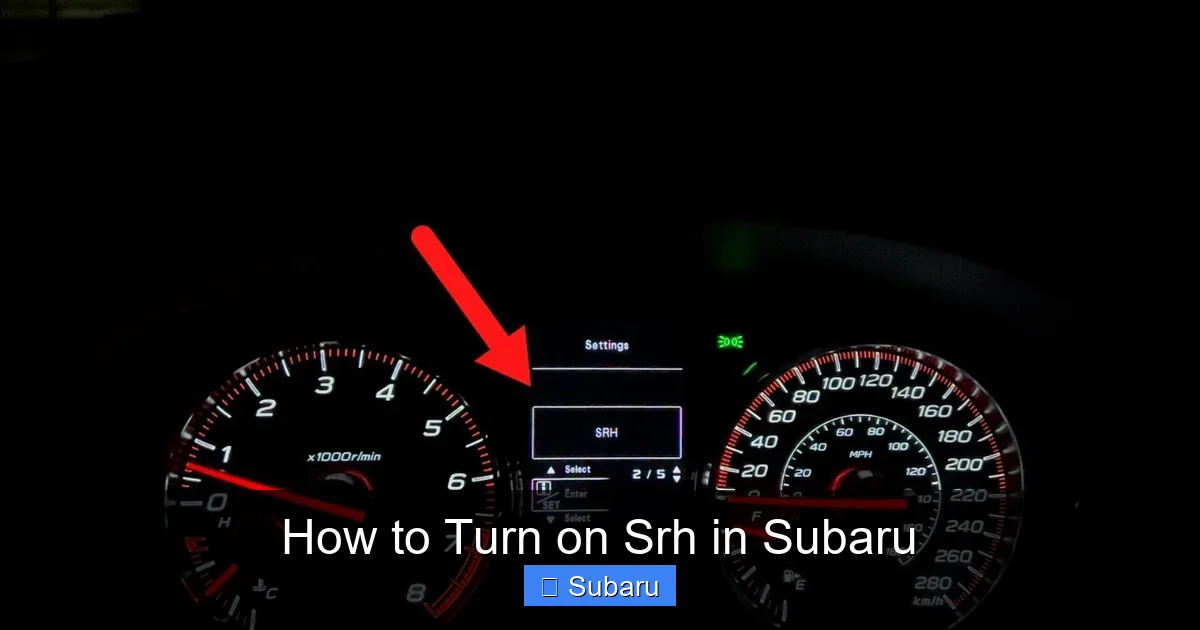
Method 2: Using the Instrument Cluster Menu
On some Subaru models, especially those without a large touchscreen, SRH settings are accessed through the instrument cluster:
1. **Press the “Info” or “Menu” button** on your steering wheel (usually located on the left side).
2. **Navigate to “Settings”** using the arrow buttons.
3. **Select “Vehicle Settings”** or “Car Settings.”
4. **Scroll to “Lighting”** or “Headlights.”
5. **Find “SRH” or “Steering Responsive Headlights.”**
6. **Press “OK” or “Enter”** and toggle it to “On.”
After enabling, exit the menu. The SRH icon may briefly appear on the dashboard to confirm activation.
Method 3: Automatic Activation (No Manual Setup)
On certain Subaru trims—particularly higher-end models like the Outback Touring or Ascent Limited—SRH may be enabled by default and require no manual activation. In these cases, the system turns on automatically when:
– The headlights are switched on.
– The vehicle is moving below 25 mph.
– The ambient light sensor detects low-light conditions.
If you don’t see a menu option for SRH, your vehicle might already have it active. Test it by driving slowly at night and making a sharp turn. Watch to see if the headlights pivot in the direction of the turn.
Tips for Successful Activation
– **Ensure headlights are on**: SRH only works when the headlights are active (auto or manual mode).
– **Drive at low speeds**: The system is most responsive under 25 mph. At higher speeds, movement is reduced.
– **Check for error messages**: If SRH fails to activate, look for warning lights or messages in the dashboard. This could indicate a calibration issue or sensor fault.
– **Restart the vehicle**: Sometimes, a simple ignition cycle can reset the system and allow activation.
Troubleshooting SRH Issues
Visual guide about How to Turn on Srh in Subaru
Image source: i.ytimg.com
Even with proper setup, you might encounter issues with SRH not working as expected. Here are common problems and how to fix them.
SRH Won’t Turn On
If you’ve followed the activation steps but SRH remains inactive, consider these possibilities:
– **Incorrect headlight mode**: Make sure your headlights are set to “Auto” or “On.” SRH doesn’t work in “Off” or “Parking Light” mode.
– **Daytime driving**: The system may not activate in bright daylight. Test it at dusk or in a tunnel.
– **Faulty ambient light sensor**: If the sensor thinks it’s daytime, SRH won’t engage. Clean the sensor (usually near the rearview mirror) or have it checked.
– **Software glitch**: Restart the vehicle or disconnect the battery for 10 minutes to reset the electrical system.
Headlights Move Erratically or Not at All
This could indicate a mechanical or calibration issue:
– **Recent windshield replacement**: Many Subaru models require SRH recalibration after windshield installation, as the camera and sensors are mounted behind the glass.
– **Suspension or alignment work**: Changes to the vehicle’s geometry can affect sensor accuracy. Visit a Subaru service center for recalibration.
– **Obstructed sensors**: Dirt, snow, or ice on the front grille or camera can interfere with operation. Clean the area thoroughly.
SRH Causes Glare for Oncoming Drivers
In rare cases, SRH might direct light toward oncoming traffic, especially on steep hills or uneven roads. If this happens:
– **Temporarily disable SRH**: Use the menu to turn it off during that drive.
– **Adjust headlight leveling**: Some models allow manual adjustment of headlight angle via a dial near the headlight switch.
– **Consult a technician**: Improper calibration could cause misalignment. A Subaru service center can correct it.
Best Practices for Using SRH
To get the most out of your Subaru’s Steering Responsive Headlights, follow these best practices:
Use SRH in Appropriate Conditions
SRH is designed for low-speed, low-light environments. It’s most useful when:
– Driving on winding roads at night.
– Navigating parking lots or driveways.
– Traveling through tunnels or underpasses.
– Driving in rain, fog, or snow where visibility is reduced.
Avoid relying on SRH at high speeds or on straight highways, where its benefits are minimal.
Keep the System Maintained
Regular maintenance ensures SRH works reliably:
– **Clean headlights**: Dirty or foggy lenses reduce light output and effectiveness.
– **Check alignment**: Misaligned headlights can reduce SRH performance. Have them inspected annually.
– **Update software**: Subaru occasionally releases software updates that improve SRH functionality. Ask your dealer about available updates.
Know When to Disable SRH
While SRH is generally safe, there are situations where turning it off is wise:
– On narrow mountain roads with frequent oncoming traffic.
– When driving in heavy fog (pivoting lights can increase glare).
– If you notice the system is malfunctioning or causing distraction.
You can usually disable SRH temporarily through the same menu used to turn it on.
SRH and Subaru Safety: A Bigger Picture
Steering Responsive Headlights are more than just a convenience—they’re part of Subaru’s broader safety philosophy. Alongside features like EyeSight, Blind Spot Detection, and Reverse Automatic Braking, SRH helps reduce the risk of nighttime accidents, especially in rural or poorly lit areas.
According to the National Highway Traffic Safety Administration (NHTSA), nearly 50% of fatal crashes occur at night, despite lower traffic volumes. Improved visibility is a key factor in reducing these incidents. By illuminating the road ahead of a turn, SRH gives drivers more time to react, potentially preventing collisions with animals, pedestrians, or debris.
Subaru’s commitment to safety is reflected in its consistent top ratings from organizations like IIHS (Insurance Institute for Highway Safety) and NHTSA. Features like SRH contribute to these accolades by enhancing driver awareness and control.
Real-World Example: Driving the Pacific Coast Highway
Imagine driving a Subaru Outback along California’s Pacific Coast Highway at night. The road is narrow, winding, and lined with steep cliffs. Without SRH, your headlights shine straight ahead, leaving the next curve in darkness until you’re almost in it. But with SRH activated, the headlights begin to pivot as you turn the wheel, revealing the road ahead and any potential hazards—like a fallen rock or a deer crossing—well in advance.
This extra visibility can mean the difference between a safe maneuver and a dangerous situation. It’s not just about comfort; it’s about confidence and control.
Conclusion
Turning on SRH in your Subaru is a simple yet powerful way to enhance your nighttime driving experience. Whether you’re navigating tight city streets or exploring remote backroads, Steering Responsive Headlights help you see more, react faster, and drive safer. By following the steps outlined in this guide, you can easily activate SRH on compatible models and troubleshoot common issues.
Remember, SRH is not available on all Subaru trims, so always check your owner’s manual or consult your dealer if you’re unsure. And while the feature is highly beneficial, it’s not a substitute for safe driving practices—always stay alert, obey speed limits, and adjust your driving to conditions.
With SRH enabled, your Subaru becomes more than just a vehicle; it becomes a smarter, safer partner on every journey. So the next time you head out after dark, take a moment to turn on SRH and experience the difference for yourself.
Frequently Asked Questions
What does SRH stand for in Subaru?
SRH stands for Steering Responsive Headlights. It’s a feature that adjusts the direction of your headlights based on steering input, improving visibility around corners.
Is SRH available on all Subaru models?
No, SRH is typically available on higher trims of models like the Outback, Forester, Legacy, Ascent, and Crosstrek with LED or HID headlights. Check your owner’s manual for confirmation.
Can I turn off SRH if I don’t want to use it?
Yes, you can disable SRH through the vehicle settings menu. This is useful in situations where the pivoting lights might cause glare for oncoming drivers.
Why isn’t my SRH working even though it’s turned on?
Common reasons include driving during the day, headlights being off, or a need for recalibration after windshield or suspension work. Check your settings and consult a Subaru technician if needed.
Do I need to recalibrate SRH after a windshield replacement?
Yes, most Subaru models require SRH recalibration after windshield replacement because the camera and sensors are mounted behind the glass. Visit a Subaru service center for this.
Does SRH work in the rain or snow?
Yes, SRH functions in rain and snow, but heavy precipitation or snow buildup on the headlights or sensors can reduce effectiveness. Keep the front of your vehicle clean for optimal performance.
