How to Turn Off the Check Engine Light on a 2013 Toyota Corolla

Contents
- 1 Key Takeaways
- 2 📑 Table of Contents
- 3 Understanding the Check Engine Light on Your 2013 Toyota Corolla
- 4 Common Causes for a Check Engine Light in a 2013 Toyota Corolla
- 5 Diagnostic Steps: What to Do BEFORE You Reset the Light
- 6 Methods to Turn Off the Check Engine Light After a Repair
- 7 When to Seek Professional Help Immediately
- 8 Preventive Maintenance to Keep the Light Off
- 9 Conclusion: Knowledge is Power Under the Hood
- 10 Frequently Asked Questions



The check engine light on your 2013 Toyota Corolla is a critical warning from your car’s computer that something needs attention. You should never simply turn off the light without first diagnosing and fixing the underlying problem, as this can lead to serious engine damage. After repairing the issue, you can reset the light using an OBD-II scanner, by disconnecting the battery, or through a specific drive cycle. If the light returns immediately or flashes, stop driving and seek professional help right away to avoid costly repairs.
Key Takeaways
- The check engine light is a serious warning: It indicates a problem with the emissions, engine, or transmission system that could harm your vehicle if ignored.
- Always diagnose before you reset: Use an OBD-II scanner to read the trouble code, perform a visual inspection, and fix the actual issue. Resetting without repair is pointless and dangerous.
- Common causes in a 2013 Corolla include: A loose or faulty gas cap, failing oxygen sensor, worn spark plugs, or an EVAP system leak.
- There are three main reset methods: Using an OBD-II scanner (most reliable), disconnecting the battery (resets all systems), or completing a specific drive cycle after a repair.
- A blinking light means stop driving: A flashing check engine light signals a severe misfire that can destroy the catalytic converter. Pull over safely and call for assistance.
- Professional help is essential for complex codes: If multiple codes appear, the light persists after a reset, or you lack tools, a mechanic can prevent further damage.
- Preventive maintenance avoids future lights: Regular oil changes, spark plug replacement, and gas cap checks keep your Corolla’s engine healthy and the light off.
📑 Table of Contents
- Understanding the Check Engine Light on Your 2013 Toyota Corolla
- Common Causes for a Check Engine Light in a 2013 Toyota Corolla
- Diagnostic Steps: What to Do BEFORE You Reset the Light
- Methods to Turn Off the Check Engine Light After a Repair
- When to Seek Professional Help Immediately
- Preventive Maintenance to Keep the Light Off
- Conclusion: Knowledge is Power Under the Hood
Understanding the Check Engine Light on Your 2013 Toyota Corolla
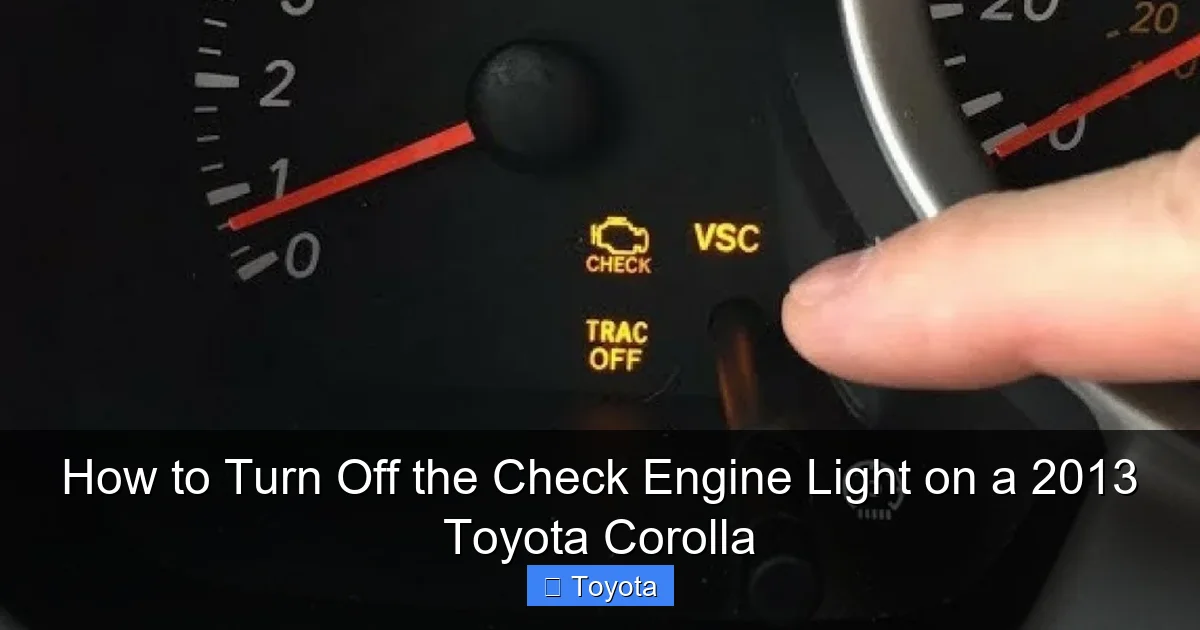
That little amber glow on your dashboard—the one shaped like an engine with an exclamation point—can send a shiver down any driver’s spine. It’s the check engine light, and on your 2013 Toyota Corolla, it’s far more than a simple annoyance. It’s your car’s primary way of communicating that something within its complex computer-controlled systems isn’t operating correctly. Unlike a low fuel light or a reminder to change your oil, the check engine light (sometimes called the “service engine soon” light) points to issues that can directly impact performance, fuel economy, and, most importantly, the long-term health of your engine and emissions components.
Your 2013 Corolla is equipped with an On-Board Diagnostics II (OBD-II) system, a standardized computer network that constantly monitors dozens of sensors and actuators. When a sensor reading falls outside the predetermined range, the system stores a diagnostic trouble code (DTC) and illuminates the check engine light to alert you. This system is incredibly sophisticated, tracking everything from oxygen levels in the exhaust to the position of the throttle. The light itself doesn’t tell you the specific problem; it simply says, “Hey, something’s wrong—go find out what.” That’s why the first and most crucial rule is this: the goal is never just to turn off the light. The goal is to fix the problem that turned it on.
It’s also vital to distinguish this light from others on your dash. The check engine light is typically amber or yellow and depicts an engine silhouette. It is different from the red, blinking “maintenance required” light, which is a simple mileage-based reminder for routine service like oil changes. If you’re dealing with that service reminder, the process is entirely different and simpler. For clarity on that separate indicator, you can refer to our guide on how to turn off the maintenance light on a Toyota. But for the check engine light, we need a systematic approach.
What the Light Actually Means
When the check engine light illuminates steadily, it generally indicates a non-emergency but potentially progressive issue. Your Corolla will usually continue to drive normally, but you might notice reduced fuel efficiency, a rough idle, or a loss of power. These are clues that the engine’s computer is trying to compensate for a faulty component. A flashing check engine light, however, is a dire emergency. It means the engine is misfiring severely enough to unburned fuel is entering the exhaust system, which can overheat and permanently damage the catalytic converter within minutes. If your light is flashing, pull over safely, turn off the engine, and call for a tow. Do not continue driving.
The OBD-II System: Your Car’s Doctor
Think of the OBD-II system as your car’s onboard doctor. It runs constant tests (called “monitors”) on the emissions-related components. For your 2013 Corolla to pass a state emissions inspection, all these monitors must be “ready” or “complete.” When you clear a trouble code by resetting the light, you also clear the monitor statuses. The car will then need to complete a specific “drive cycle”—a set of driving conditions like steady cruising, deceleration, and stops—to set the monitors back to “ready.” This is why sometimes, after a repair and reset, the light may not come back on immediately, but it might return later if the problem wasn’t fully fixed or if the drive cycle wasn’t completed.
Common Causes for a Check Engine Light in a 2013 Toyota Corolla
While hundreds of trouble codes can trigger the light, certain issues are particularly prevalent in the 2011-2013 Toyota Corolla models. Understanding these common culprits can help you perform a preliminary check before you break out the diagnostic tools. Remember, a code is a starting point, not a final diagnosis. For example, a code for an oxygen sensor might mean the sensor is bad, or it could mean there’s an exhaust leak before the sensor that’s fooling it.
Visual guide about How to Turn Off the Check Engine Light on a 2013 Toyota Corolla
Image source: dodgecheckenginelight.com
1. Loose or Faulty Gas Cap
This is the most common and easiest fix. The Evaporative Emission Control (EVAP) system captures fuel vapors from the gas tank and burns them in the engine. A gas cap that isn’t tightened properly, is missing, or has a damaged seal will cause the system to fail its leak test, storing codes like P0455 (large EVAP leak) or P0442 (small EVAP leak). Always start here: remove the cap, inspect the seal for cracks, and re-tighten it until you hear several clicks. This simple step resolves a surprising number of check engine lights.
2. Oxygen (O2) Sensor Failure
The Corolla’s 1.8L 2ZR-FE engine uses multiple oxygen sensors to monitor exhaust oxygen levels. The primary “upstream” sensor before the catalytic converter is critical for fuel mixture calculation. A failing O2 sensor will cause codes like P0130-P0134 (Bank 1 Sensor 1) or P0150-P0154 (Bank 1 Sensor 2). Symptoms include poor fuel economy, a sulfur or rotten egg smell from the exhaust, and a rough idle. Replacing an O2 sensor is a common repair for this model year.
3. Spark Plugs and Ignition Coils
Worn-out spark plugs or a failing ignition coil can cause engine misfires, leading to codes P0300-P0304 (random/multiple cylinder misfire or specific cylinder misfire). A single misfire (P0301, P0302, etc.) often points to that cylinder’s spark plug, wire (if equipped), or coil. The 2013 Corolla uses individual coil-on-plug ignition, so a bad coil will only affect one cylinder. Symptoms include a noticeable shake or vibration at idle or acceleration, and a loss of power. If the misfire is bad enough, the light will flash.
4. Catalytic Converter Efficiency
The catalytic converter reduces harmful emissions. Over time, it can become clogged or its efficiency can drop below the threshold, triggering codes like P0420 (Catalyst System Efficiency Below Threshold). This is often not a sudden failure of the converter itself but a result of a previously ignored problem, like a misfiring cylinder that dumped unburned fuel into the exhaust, overheating and poisoning the catalyst. Fixing the root cause (like bad spark plugs) is essential; replacing the converter is expensive.
5. Mass Air Flow (MAF) Sensor Issues
The MAF sensor measures the amount of air entering the engine. If it becomes dirty with oil or dust (common on high-mileage vehicles) or fails, it can cause codes like P0101-P0103. This leads to incorrect air/fuel ratios, causing rough running, stalling, and poor acceleration. Sometimes, cleaning the MAF sensor with a dedicated MAF cleaner can resolve the issue.
6. EVAP System Leaks
Beyond a loose gas cap, the EVAP system includes hoses, valves, and the charcoal canister. Cracks in hoses or a faulty purge valve/solenoid can cause leaks. Codes in the P0440-P0457 range are common. These issues are often intermittent and can be tricky to diagnose without a smoke machine.
7. Electrical and Sensor Issues
Other frequent triggers include a faulty crankshaft position sensor (codes P0335-P0338), which can cause starting or stalling problems; a bad throttle position sensor (codes P0120-P0124); or even a weak battery or failing alternator. Electrical gremlins can cause voltage drops that confuse sensors. If you suspect electrical issues, understanding how to reset the battery light on a Toyota Corolla can be a related skill, as a charging system problem often triggers multiple warning lights.
Diagnostic Steps: What to Do BEFORE You Reset the Light
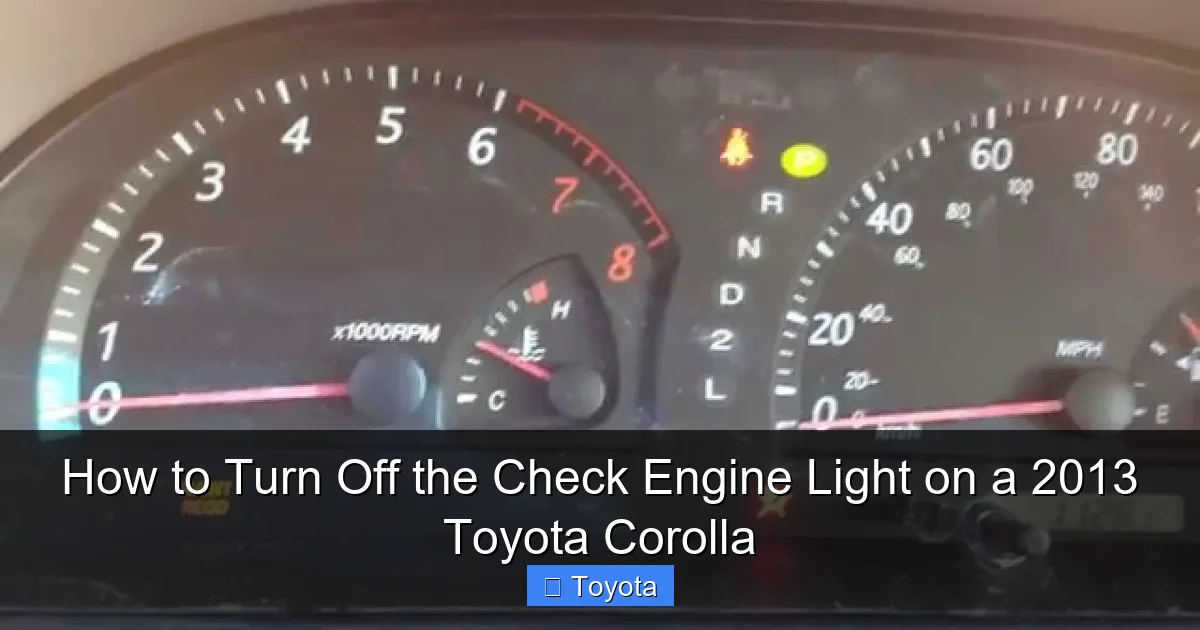
This is the most important phase. Resetting the check engine light without addressing the root cause is like taking a painkiller for a broken bone—it masks the pain but the injury gets worse. The light will return, often with a more serious problem. Follow these steps to diagnose properly.
Visual guide about How to Turn Off the Check Engine Light on a 2013 Toyota Corolla
Image source: i.ytimg.com
Step 1: Connect an OBD-II Scanner
This is non-negotiable for an accurate diagnosis. Your 2013 Corolla’s OBD-II port is located under the dashboard, just to the left of the steering column. You’ll need a compatible scanner. Basic code readers are inexpensive (<$30) and will pull the stored diagnostic trouble codes (DTCs). More advanced scanners provide live data stream readings, which are invaluable. Plug the scanner in, turn the ignition to "ON" (don't start the engine), and follow the device's prompts to read the codes. Write down all codes—they are usually in a format like "P0420." Don't just clear them yet!
Step 2: Research the Code(s)
A code tells you which system or component the computer has flagged, not necessarily that the part is bad. For example, a P0302 code means “Cylinder 2 Misfire Detected.” The cause could be a spark plug, ignition coil, fuel injector, or even a compression problem. Use reputable online resources or forums specific to the Toyota Corolla to understand the possible causes for your specific code(s). Look for patterns—multiple codes often share a common cause (e.g., a massive vacuum leak can trigger both a lean condition code and an O2 sensor code).
Step 3: Perform a Basic Visual and Physical Inspection
Often, the solution is right in front of you. With the hood open, check for:
- Loose or damaged gas cap: Tighten it firmly. Replace if the seal is cracked.
- Disconnected or cracked hoses: Especially in the engine bay’s air intake system and the EVAP canister near the gas tank.
- Wiring issues: Look for frayed, burnt, or disconnected wires, particularly near the engine compartment’s sensors.
- Oil and coolant levels: Low levels can sometimes trigger sensors. Also, check for active leaks.
- Spark plug wires/coils: On your Corolla, remove the engine cover and check that all ignition coils are securely seated on the spark plugs.
If you need to access the engine compartment safely, ensure you know the proper procedure. You can find a detailed walkthrough on how to open the hood on a Toyota Corolla to avoid any mishaps.
Step 4: Check for Service Bulletins
Sometimes, a known issue with a specific model year has an official manufacturer’s service bulletin (TSB) that outlines the fix. A quick search online for “2013 Toyota Corolla check engine light [your code] TSB” might reveal that your problem is a known issue with a prescribed repair procedure beyond simple part replacement.
Methods to Turn Off the Check Engine Light After a Repair
Once you have identified the problem, repaired it, and verified the repair (e.g., replaced the spark plug, tightened the gas cap), you can then reset the light. Here are the three primary methods, in order of preference.
Method 1: Using an OBD-II Scanner (The Best Way)
This is the cleanest, most reliable method. Your code reader/scanner will have a function to “Clear Codes” or “Erase DTCs.” After repairing the issue:
- Reconnect the scanner to the OBD-II port.
- Turn the ignition to “ON.”
- Navigate to the “Erase Codes” or “Clear DTCs” menu.
- Select it and confirm. The check engine light should go out immediately.
Important: Clearing codes also resets all the OBD-II monitors. Your car will now need to complete a full drive cycle for all monitors to set to “Ready” again. This is normal. You can check monitor status with your scanner. Until all monitors are “Ready,” your car may not pass an emissions test.
Method 2: The Battery Disconnect Method (A Last Resort)
This method works because disconnecting the battery removes power from the engine control module (ECM), forcing a reset. However, it has significant downsides:
- It will also reset other systems like your radio presets, clock, and climate control settings.
- It may require you to perform a “relearn” procedure for the engine’s idle and throttle position, causing rough running for the first few drive cycles.
- It does not address the underlying problem and will not work if the fault is still present. The light will simply come back on.
If you must use this method:
- Ensure the ignition is OFF.
- Open the hood and locate the battery. (If you’re unsure, review the hood-opening guide linked earlier).
- Using a wrench (usually 10mm), loosen and remove the NEGATIVE (black, marked -) battery cable first. Secure it so it cannot touch the terminal.
- Wait at least 10-15 minutes. This allows residual power to drain from the ECM’s capacitors.
- Reconnect the negative cable and tighten it securely.
- Close the hood. The check engine light may come on initially when you turn the key to “ON,” but it should go out after a few seconds if the fault is truly fixed. If it stays on, the problem persists.
Method 3: The Natural Drive Cycle
Sometimes, after you fix a minor issue like a loose gas cap, the car’s computer will automatically turn off the light on its own after it successfully completes a series of self-tests (monitors) during normal driving. This can take 50-100 miles of varied driving (including highway speeds, idle time, and deceleration). If you’ve repaired the issue and don’t have a scanner, you can try this. Just drive normally for a few days. If the light goes out, great. If it remains on after a week of driving, you need to scan it to see if the fault is still present or if a different code has appeared.
When to Seek Professional Help Immediately
Your diagnostic journey doesn’t always end with a simple fix. Here are clear signs that you need to call a qualified mechanic, preferably one familiar with Toyotas:
The Light is Flashing
As stated repeatedly, a flashing check engine light means a severe misfire. Continuing to drive can cause catastrophic damage to the catalytic converter, leading to a repair bill of $1,500 or more. Stop driving immediately.
The Light Comes Back Immediately After Reset
If you fix a suspected issue, reset the light, and it returns within a day or even a single drive cycle, the repair was either incorrect or incomplete. There may be a secondary issue, or the part you replaced was defective.
You Have Multiple or Complex Codes
If your scan reveals numerous codes from different systems (e.g., an O2 sensor code, an EVAP code, and a random misfire), it can be overwhelming. A professional has the experience and advanced tools (like a live data stream and oscilloscope) to trace these inter-related problems to their root cause, which might be something like a major vacuum leak or a failing ECM.
You Lack the Tools or Expertise
Diagnosing an intermittent problem or one that requires advanced testing (like a fuel pressure test or compression test) is beyond most DIYers. If you’ve tried the basics and the light persists, a professional diagnosis (which typically costs $80-$130 for the initial scan and analysis) is a wise investment that can save you from throwing parts at the problem blindly.
Performance is Significantly Affected
If you notice serious symptoms along with the light—such as the car stalling, extreme loss of power, black smoke from the exhaust, or unusual noises—do not delay. These indicate a problem that is actively damaging the engine.
Preventive Maintenance to Keep the Light Off
The best way to deal with a check engine light is to prevent it from coming on in the first place. Sticking to a rigorous maintenance schedule for your 2013 Corolla is the ultimate defense.
Stick to the Factory Service Schedule
Toyota designed specific intervals for a reason. For the 2013 Corolla, this typically means:
- Oil and filter change: Every 5,000-10,000 miles (or as indicated by the maintenance required light, which is separate). Clean oil prevents sludge that can clog sensors.
- Spark plugs: Replace every 120,000 miles (or sooner if worn). Worn plugs cause misfires.
- Air filter: Replace every 15,000-30,000 miles. A clogged air filter strains the engine and can affect MAF sensor readings.
- Fuel filter: Part of the in-tank pump assembly, but fuel system cleaning additives can help maintain injector cleanliness.
- EVAP system: Inspect gas cap and hoses for integrity during regular service.
Use Quality Fuel and Don’t Ignore the Gas Cap
Always use the recommended octane fuel (regular 87 AKI for the Corolla). Avoid cheap, low-quality fuels with inconsistent detergent levels. And make it a habit to firmly tighten the gas cap until it clicks every single time you refuel. A $20 gas cap replacement is cheaper than an EVAP system diagnosis any day.
Address Minor Issues Immediately
That slight rough idle you’ve noticed for a week? The minor hesitation when accelerating? Don’t let it become “normal.” These are often early symptoms of a sensor or component that is failing. Catching it early usually means a cheaper, simpler fix before it triggers a check engine light or causes secondary damage.
Invest in a Basic Code Reader
For $30-$50, you can own a simple OBD-II Bluetooth or wired code reader that pairs with your smartphone. This allows you to instantly see if a light is caused by a loose gas cap (which you can fix yourself) or a serious problem (which requires a shop). It empowers you with information and can save you a diagnostic fee at a shop for simple issues.
Conclusion: Knowledge is Power Under the Hood
Seeing the check engine light glow on your 2013 Toyota Corolla doesn’t have to be a moment of panic. With a calm, methodical approach, you can take control of the situation. Remember the golden rule: diagnose, don’t just delete. Start with the simplest, most common causes—a loose gas cap is a frequent offender. Use an OBD-II scanner to read the specific trouble code; this is your roadmap to the problem. Perform a thorough visual inspection, and only after you’ve made a confident repair should you proceed to reset the light using a scanner, the battery disconnect method, or by allowing the car’s computer to complete its drive cycle.
Never ignore a steady light, and never drive with a flashing light. Your Corolla is known for its reliability, and part of maintaining that reliability is listening to its warnings. By understanding what the check engine light means, the common causes for your model, and the proper reset procedures, you’re not just fixing a problem—you’re protecting your investment and ensuring many more miles of safe, efficient, and worry-free driving. When in doubt, the modest cost of a professional diagnosis is a small price to pay for the peace of mind and the prevention of a minor issue becoming a major engine repair.
Frequently Asked Questions
Can I just disconnect the battery to turn off the check engine light?
Yes, disconnecting the negative battery terminal for 10-15 minutes will reset the engine computer and turn off the light. However, this is a blunt tool that also resets all other vehicle settings (radio, clock, etc.) and may cause idle/throttle relearn issues. More importantly, it does not fix the underlying problem, so the light will likely return if the fault remains.
How long does it take for the check engine light to reset after fixing the problem?
If you use an OBD-II scanner to clear the code, the light goes out immediately. If you rely on the car’s natural drive cycle, it can take anywhere from 50 to 100 miles of varied driving (including highway speeds, stops, and idle time) for all system monitors to complete and for the computer to turn the light off on its own.
Will the check engine light turn off by itself if the problem is fixed?
Yes, but only after the car’s computer successfully completes its self-tests (monitors) for the affected system. This “drive cycle” can take several days of normal driving. Using a scanner to clear the code is faster and more certain, but the monitor readiness will still need to be re-established.
What does a blinking check engine light mean on my 2013 Corolla?
A flashing or blinking check engine light indicates a severe engine misfire. Unburned fuel is entering the exhaust system, which can quickly overheat and destroy the expensive catalytic converter. You should stop driving as safely and immediately as possible, turn off the engine, and have the vehicle towed to a repair shop.
How much does it typically cost to diagnose a check engine light?
The cost for a professional diagnostic scan can range from free (at some auto parts stores) to $80-$130 at a repair shop. The scan itself is quick, but the mechanic’s time to interpret the code, perform additional tests, and pinpoint the exact failed component is what you’re paying for. This fee is usually waived if you proceed with the recommended repair at that shop.
Can low oil cause the check engine light to come on?
Low oil level alone typically does not trigger the check engine light; it usually triggers a separate low oil pressure warning light. However, extremely low oil can cause engine mechanical problems (like low compression) that might eventually set a misfire or other engine-related code. Always check and maintain proper oil level as part of regular maintenance.