How to Turn Off Paddle Shifters on a Jeep Grand Cherokee

Contents
- 1 Key Takeaways
- 2 📑 Table of Contents
- 3 Introduction: The Paddle Shifter Predicament
- 4 Understanding Your Grand Cherokee’s Paddle Shifters
- 5 Why Would You Want to Turn Them Off? (The Common Complaints)
- 6 The Reality Check: Methods to Disable Paddle Shifters
- 7 Model Year Deep Dive: Does It Vary?
- 8 The Big Picture: Implications and Considerations
- 9 Alternatives and Smarter Approaches
- 10 Conclusion: The Path Forward
- 11 Frequently Asked Questions

Side Mirror Rain Guard

Car Sunshade for Windshield

Multipurpose Lubricant Spray

LED Emergency Road Flares
Paddle shifters on the Jeep Grand Cherokee provide manual gear control but can be accidentally triggered. There is no standard user-activated “off” button or menu setting to disable them permanently. Deactivation requires factory-level software reprogramming by a dealership or a qualified tuner. Physically disconnecting the paddles is dangerous and will void your warranty, making professional software adjustment the only safe and recommended method.
Key Takeaways
- No Simple Switch: Jeep does not provide a driver-accessible menu or button to permanently turn off the paddle shifters.
- Software Reprogramming Required: The only safe and effective method is having a dealer or tuner alter the vehicle’s transmission control module (TCM) software.
- Physical Tampering is Hazardous: Attempting to unplug the paddle shifter switches or cut wiring risks airbag deployment, steering wheel damage, and voids the vehicle warranty.
- Model Year Matters: Integration and accessibility of TCM settings vary significantly between Grand Cherokee generations (WK, WL, etc.).
- Understand the Implications: Disabling paddle shifters may affect resale value, and some driving modes like Sport may still prompt their use.
- Consider Alternatives First: Adjusting driving habits or simply ignoring the paddles is often a more practical solution than seeking deactivation.
- Professional Consultation is Key: Always discuss goals and risks with a Jeep specialist before pursuing any modification.
📑 Table of Contents
- Introduction: The Paddle Shifter Predicament
- Understanding Your Grand Cherokee’s Paddle Shifters
- Why Would You Want to Turn Them Off? (The Common Complaints)
- The Reality Check: Methods to Disable Paddle Shifters
- Model Year Deep Dive: Does It Vary?
- The Big Picture: Implications and Considerations
- Alternatives and Smarter Approaches
- Conclusion: The Path Forward
Introduction: The Paddle Shifter Predicament
You’re cruising down the highway in your Jeep Grand Cherokee, everything automatic and relaxed. Suddenly, your hand brushes against a steering wheel paddle, and the transmission downshifts aggressively. The engine roars, the Jeep lurches, and your peaceful drive is shattered. If this sounds familiar, you’re not alone. Many Grand Cherokee owners, particularly those who use their vehicle for daily commuting or family duty, find the paddle shifters more of a nuisance than a feature. They ask: “How do I turn off paddle shifters on a Jeep Grand Cherokee?”
The desire is understandable. You bought a Grand Cherokee for its comfort, capability, and effortless driving experience—not to play gear-shifting games. The paddles, while fun on a twisty road, can be accidentally activated during normal steering wheel adjustments, leading to jarring shifts and reduced fuel efficiency. The solution seems simple: just turn them off. Unfortunately, the reality is far more complex. Unlike turning off a lane departure warning or an auto stop-start system, which often have clear menu options, the paddle shifters are a deeply integrated part of the Grand Cherokee’s transmission brain. There is no magic button, no hidden dashboard setting, and no fuse to pull that will silence them for good.
This guide will walk you through the *actual* process, or lack thereof, for disabling paddle shifters. We’ll explore why Jeep designed them this way, what your limited options are, the significant risks of DIY attempts, and the professional path that exists. By the end, you’ll have a clear understanding of what’s possible, what’s not, and what your best course of action might be. Let’s dive into the mechanical and electronic world of your Grand Cherokee’s transmission.
Understanding Your Grand Cherokee’s Paddle Shifters
How They Work: More Than Just Switches
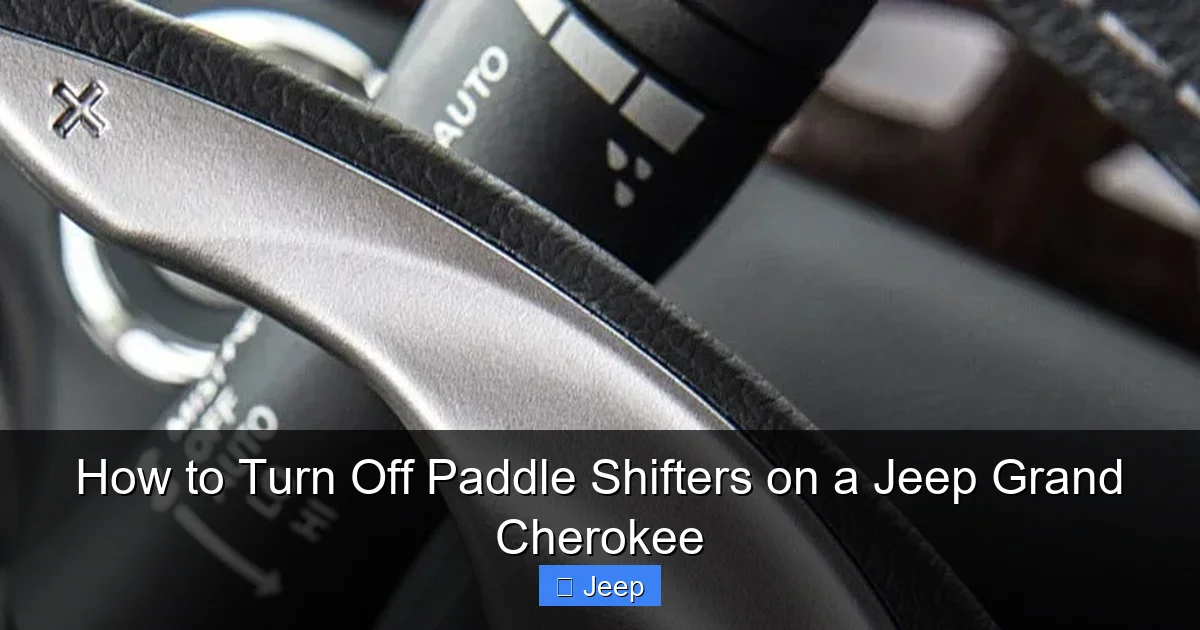
To understand why turning them off is difficult, you first need to know what paddle shifters actually are. They are not physical gears. They are electronic switches—essentially two momentary contact buttons (one for upshift, one for downshift) mounted on the steering wheel column or wheel itself. When you press a paddle, it sends a signal to the vehicle’s Transmission Control Module (TCM).

Visual guide about How to Turn Off Paddle Shifters on a Jeep Grand Cherokee
Image source: jeepfixes.com
The TCM is the computer that commands your transmission. In automatic mode, it decides when to shift on its own based on throttle input, speed, and engine load. When you tap a paddle, you are sending a direct command to the TCM: “Upshift now” or “Downshift now.” The TCM obeys, overriding its own programming for that moment. The system is designed to be temporary. Once you let off the throttle or the vehicle reaches a certain speed/RPM, the TCM will often resume automatic control. This integration is seamless and fast, which is why they feel so responsive. But it also means they are hard-wired into the core logic of the transmission’s operation.
Manual Mode vs. Paddle Shifter Only
It’s crucial to distinguish between two concepts: the full manual mode (often selected by moving the gear lever to a “M” or “+/-” gate) and the paddle shifters in automatic mode. In many Grand Cherokees, especially newer models, you can use the paddles to command shifts *without* fully engaging a manual mode. The transmission remains in “Automatic” but yields to your paddle inputs. This is a convenience feature for passing or engine braking. Disabling the paddles would mean you lose this ability to manually control the transmission while still in Drive. You would only be able to manually shift by first selecting the dedicated manual gate on the gear selector, if your model has one. This functional nuance is part of why there’s no simple “off” switch—the system sees the paddles as an extension of driver intent within the automatic program.
Why Would You Want to Turn Them Off? (The Common Complaints)
Before we tackle solutions, let’s validate the problem. Here are the top reasons Grand Cherokee owners seek to disable their paddle shifters:

Visual guide about How to Turn Off Paddle Shifters on a Jeep Grand Cherokee
Image source: jeepfixes.com
- Accidental Activation: This is the number one complaint. The paddles are positioned for easy thumb access. During normal driving, especially on long trips with hands at 9-and-3, thumbs can easily bump the downshift paddle. This causes a sudden, unnecessary downshift, a loud engine rev, and a jolt to the vehicle. It’s annoying and can be confusing to passengers.
- Preference for Pure Automation: Some drivers simply want a true “set-and-forget” automatic experience. They bought a Jeep for its capability and comfort, not for sporty driving. The paddles feel like an unnecessary complication that breaks the serene, automatic driving experience.
- Confusion for Inexperienced Drivers: If you share your Grand Cherokee with other drivers—a spouse, teen, or valet—they may inadvertently use the paddles, not understanding their function or when to use them. This can lead to rough shifts or confusion about why the transmission is behaving differently.
- Reduced Fuel Efficiency: Unintended downshifts raise engine RPM, which burns more fuel. While one accidental downshift doesn’t matter, frequent accidental activations can have a small but measurable negative impact on MPG, especially in highway driving.
- Faulty or Sticky Paddles: In rare cases, a paddle shifter switch can fail or become sticky, sending constant or intermittent signals to the TCM. This can cause the transmission to hunt erratically between gears or refuse to upshift. In this scenario, “turning off” the function is a diagnostic step to confirm the faulty paddle is the culprit.
These are all valid concerns. However, as we’ll see, the path to a solution is not a simple DIY project. The very integration that makes the paddles responsive also makes them resilient to casual disablement.
The Reality Check: Methods to Disable Paddle Shifters
Let’s be brutally honest up front: there is no officially sanctioned, user-friendly way to turn off paddle shifters on a Jeep Grand Cherokee. You cannot go into the Uconnect settings or the vehicle menus in the instrument cluster and find a “Paddle Shifters: ON/OFF” toggle. Fiat Chrysler Automobiles (FCA), now Stellantis, did not design the system with a disable function because they view the paddles as a core performance and control feature. Therefore, any method involves intervening at a deeper, more technical level.
Visual guide about How to Turn Off Paddle Shifters on a Jeep Grand Cherokee
Image source: carid.com
Method 1: Dealer/Professional Software Reprogramming (The Only Viable Path)
This is the correct, safe, and warranty-safe method. It involves using factory-level diagnostic tools (like the wiTECH system) or advanced aftermarket tuning software (from companies like Jeep/Stellantis specialists) to access the Transmission Control Module’s configuration.
A trained technician can navigate the TCM’s proprietary software. Within these deep settings, there may or may not be an option to disable the paddle shifter input function. This varies wildly by model year and specific TCM software version. For some Grand Cherokees, especially earlier WK models (2011-2020), such an option might exist but is not meant for customer activation. For newer WL models (2022+), the integration is even tighter, and a simple disable option is less likely.
The Process: You would take your vehicle to a reputable Jeep dealership or a high-end performance shop that specializes in Stellantis products. You would explain your desire to have the paddle shifter function deactivated. They would connect their diagnostic computer, access the TCM, and look for a setting. If found, they would change it and likely perform a TCM reset/relearn procedure. The cost is typically a diagnostic fee plus an hour or two of labor, ranging from $150 to $400+ depending on the shop.
Important Note: When discussing vehicle software changes with a dealer, you might find them reluctant. This is not a standard, bulletin-backed procedure. They may see it as an unapproved modification. A third-party tuner is often more flexible. Also, be aware that modifying the TCM software, even to disable a feature, *could* in very rare cases be viewed as a modification that affects warranty coverage for transmission-related issues, though the Magnuson-Moss Warranty Act protects you from warranty denial for unrelated problems.
Method 2: Physical Disconnection (The Dangerous, Warranty-Voiding Idea)
This is what you might be tempted to try after watching a YouTube video on “how to remove steering wheel airbags.” DO NOT ATTEMPT THIS. The paddle shifters are not on a simple, independent plug. They are part of the steering wheel’s electrical system, which is intricately connected to the airbag system (the clockspring).
- Airbag Risk: The steering wheel contains an airbag module with explosive charges. Improperly disconnecting components can inadvertently set off the airbag, causing serious injury or death.
- Clockspring Damage: The clockspring is a delicate, ribbon-like cable that allows the steering wheel to turn while maintaining electrical connections to the airbag, horn, and controls (including paddle shifters). Tampering almost always damages this component, leading to a dead airbag light, non-functional horn, and loss of all steering wheel controls. Replacing a clockspring is expensive and labor-intensive.
- Warranty Void: Any physical modification to the steering wheel or its wiring will immediately void the warranty on those components and potentially the entire vehicle’s warranty if it leads to a failure in a related system (like the airbag or TCM).
- It Won’t Fully Work: Even if you somehow unplugged the paddle switch, the TCM might interpret the open circuit as a fault and log a diagnostic trouble code (DTC), potentially triggering a warning light or default limp mode.
In short, the physical route is a non-starter. It is unsafe, costly if you break something, and will create more problems than it solves. The potential for an accidental airbag deployment alone makes this method reckless.
Method 3: “Workarounds” That Aren’t Real Solutions
You might find suggestions online that are not true disablement methods. These include:
- Fuse Removal: There is no single fuse for “paddle shifters.” They are on the same circuit as the steering wheel controls and potentially the audio system. Pulling a fuse will disable much more than just the paddles, like your horn, cruise control buttons, and infotainment controls.
- Aftermarket Steering Wheel Covers/Grips: These can sometimes add bulk that makes it harder to accidentally hit the paddles, but they do not disable the function. They also may interfere with airbag deployment.
- Simply Ignoring Them: This is the easiest and safest “method.” Train yourself to rest your thumbs on the back of the wheel, not the front where the paddles are. Over time, muscle memory avoids them. It requires no cost, no risk, and no modification.
These are not solutions to *turn off* the feature, but rather coping strategies to *avoid* using it.
Model Year Deep Dive: Does It Vary?
The feasibility of software disablement is not uniform across the Grand Cherokee lineup. Here’s a breakdown by major generation:
WK Generation (2011-2020)
This is the most common generation on the road. It includes the popular V6 and V8 models with the 8-speed automatic transmission. The paddle shifters are integrated with the 8HP70 or 8HP90 transmission. TCM software for this era is somewhat accessible to aftermarket tuners. Some tuners report that within their software, there is an option to disable the paddle shifter function. However, this is not a standard offering and would require a custom tune or a specific request to a shop that has explored these settings. The older the model, the more likely a knowledgeable tuner has encountered this setting.
WL Generation (2022-Present)
The current Grand Cherokee WL platform, especially the plug-in hybrid 4xe models, features a more complex, integrated powertrain management system. The paddle shifters in these models are often tied to multiple drive modes (Auto, Sport, Snow, etc.). In Sport mode, they are prominently featured. The TCM software is more encrypted and proprietary. Disabling the paddles may be significantly more difficult, if not impossible, without a complete replacement of the TCM’s firmware with a custom tune that explicitly removes the paddle input logic. Even then, the integration with the vehicle’s drive mode selectors might cause conflicts. For WL owners, the “ignoring them” strategy is realistically the only practical path.
The SRT Models (Grand Cherokee SRT, Trackhawk)
High-performance SRT and Trackhawk models treat the paddle shifters as a critical component of their driver-focused identity. The software is the most locked-down, and the paddles are integral to the “Race” and “Sport” driving modes. It is exceptionally unlikely that any dealer or tuner would offer, or even be able to perform, a paddle disable on these models without causing significant drivetrain fault codes. Owners of these vehicles should assume the paddles are a permanent, non-negotiable feature.
The Big Picture: Implications and Considerations
Before you commit to seeking a software change, you must weigh the broader implications.
Warranty and Dealer Relations
As mentioned, a software change to the TCM is a modification. While the Magnuson-Moss Warranty Act protects you, the dealer could argue that an unauthorized TCM flash *could* have contributed to a future transmission failure, placing the burden of proof on you to show no relation. This is a gray area. A cooperative, knowledgeable independent shop might be a better bet than a dealership service department for this specific request, as they are less bound by factory policies and more accustomed to custom tuning.
Resale Value and Future Owners
A Grand Cherokee with modified software can be a red flag for a future buyer. It introduces uncertainty. A savvy buyer might ask for a significant discount or walk away, fearing undisclosed issues. If you ever want to return the vehicle to stock (perhaps to sell it), you would need to have the original software re-flashed, which may not be possible if the tuner didn’t save a backup. This process would incur additional cost.
Safety and Driving Experience
Consider why the paddles are there. They provide a way to manually control the transmission for engine braking on long descents or for a quick pass where automatic shifting is too slow. If you disable them, you lose that ability. You would have to rely solely on the automatic mode’s logic or use the clunky, slower-to-engage manual gate on the shifter (if equipped). Are you certain you never, ever want that manual override? For many, the answer is yes, but it’s worth confirming.
Legal and Diagnostic Concerns
In some jurisdictions, tampering with factory emissions or control systems can violate regulations, though paddle shifters are not an emissions device. More practically, a modified TCM could cause the vehicle to fail a state inspection if the inspection system checks for software integrity or if the modification triggers a readiness monitor that won’t set. Also, if a fault code related to the TCM or steering wheel controls appears, a technician’s first step is to check for modifications, which could complicate diagnostic work.
Alternatives and Smarter Approaches
Given the hurdles, risks, and costs of true disablement, here are more practical strategies to live with—or mitigate—the paddle shifters:
1. Master the Art of Ignorance (The Thumb Anchor Technique)
This is the #1 recommended solution. Consciously place the pad of your thumb on the *back* of the steering wheel, not the front where the paddles are. Use the “10-and-2” or “9-and-3” hand position, but with thumbs resting along the seam at the rear of the wheel. This simple habit change eliminates 95% of accidental activations. It takes about a week of conscious effort to become automatic.
2. Explore Uconnect/Vehicle Settings Thoroughly
While there is no “disable paddles” option, some Grand Cherokees have settings related to the steering wheel or transmission. Go through every menu in the instrument cluster and Uconnect system. Look for terms like “Steering Wheel Controls,” “Transmission,” “Sport Mode,” or “Driver Preferences.” You might find options to change shift points or disable certain *prompts*, but not the paddle function itself. Familiarity with your vehicle’s full capability is never a waste of time. For other vehicles, like a Honda Civic, you can often turn off lane departure warnings through similar menu diving—a process explained in guides like how to turn off lane departure on a Honda Civic. Jeep simply doesn’t offer that level of granular control for the paddles.
3. Consult a Specialist for a Custom Tune (With Eyes Wide Open)
If you are determined, find a reputable Stellantis/Jeep tuning shop. Be explicit: “I want the paddle shifter input function completely removed from the TCM’s logic. I understand this is a custom request.” Get a clear quote, ask if they have done it before, and request a written guarantee that they will save and can restore the original software. Understand that this is a modification, not a factory feature. Ask if the tune will affect shift quality, shift points, or trigger any fault codes. A good tuner will be honest about the feasibility for your specific VIN and model year.
4. Aftermarket Steering Wheel (Extreme and Costly)
Replacing the entire steering wheel with an aftermarket unit that lacks paddle shifters is technically possible but wildly impractical. It would require dealing with airbag compatibility, clockspring adaptation, and potentially losing other integrated controls (cruise, audio, etc.). The cost would be thousands of dollars for a solution that a $150 software tweak could potentially achieve. This is only for the most extreme, modification-focused enthusiasts and is not recommended for the average owner.
Conclusion: The Path Forward
So, how do you turn off paddle shifters on a Jeep Grand Cherokee? The honest, frustrating answer is: you very likely cannot do it yourself, and even professionally, it’s not a guaranteed or simple service. The system was never designed to be turned off. The paddle shifters are a permanent feature woven into the transmission’s electronic fabric.
Your realistic options are ranked thusly:
- Adapt: Change your thumb position and learn to ignore them. This is free, safe, and reversible. For the vast majority of drivers who are bothered by accidental activation, this is the best solution.
- Research & Inquire: Contact a few highly-regarded Jeep tuning shops. Explain your specific model year and your goal. Get their honest assessment. It may be a quick, inexpensive software flag for a WK2, or they may tell you it’s impossible for your WL. Knowledge is power.
- Accept: Recognize that you own a vehicle with a feature you don’t use. It’s a minor annoyance, not a critical flaw. Focus on the many things your Grand Cherokee does right—its comfort, capability, and towing power—and let the paddles become background noise.
Attempting to physically disable them is a recipe for disaster. Seeking a software solution is a niche request with no guarantees. In the world of modern, software-defined vehicles, some factory features are immutable. The paddle shifters on your Grand Cherokee are very likely one of them. Your safest, most cost-effective, and stress-free path is to master the art of not touching them.
Frequently Asked Questions
Can I turn off paddle shifters on a Jeep Grand Cherokee by myself?
No. There is no built-in menu, button, or fuse that allows a driver to disable the paddle shifter function. Any effective disablement requires accessing and reprogramming the Transmission Control Module (TCM) with professional diagnostic tools.
Will disabling paddle shifters void my Jeep’s warranty?
Physically tampering with the steering wheel components will absolutely void related warranties (steering, airbag). A software reprogram of the TCM is a gray area. While the Magnuson-Moss Act protects against warranty denial for unrelated failures, a dealer could challenge transmission warranty work if they believe an unauthorized TCM modification contributed to a problem.
Do all Jeep Grand Cherokee models have paddle shifters?
No. Paddle shifters became common on higher-trim Grand Cherokees (Limited, Overland, Summit, SRT) with the V6 or V8 engines and the 8-speed automatic transmission, primarily from the WK2 generation (2014-2020) onward. Base Laredo models often did not include them. Always check your specific vehicle’s equipment.
How much does it cost to have a dealer turn off my paddle shifters?
It is not a standard dealer service. If a dealer agrees to attempt it as a custom request, you would pay for diagnostic time (to check if the option exists) and labor (to reprogram the TCM), likely totaling $200-$600. An independent Jeep tuner might offer a better rate or more flexibility if the setting is available in their software.
Is there a fuse I can pull to disable just the paddle shifters?
No. The paddle shifters are on the same electrical circuit as other critical steering wheel controls like the horn, cruise control buttons, and sometimes audio controls. Pulling a fuse would disable all those functions and likely trigger multiple dashboard warning lights, creating more problems than it solves.
What’s the safest and easiest alternative to turning off paddle shifters?
The safest and easiest method is to change your driving habit. Consciously rest your thumbs on the back of the steering wheel (at the 9-and-3 or 10-and-2 positions) instead of wrapping your hands around the front where the paddles are located. This simple adjustment prevents 95% of accidental activations with no cost, no risk, and no modification to your vehicle.