How to Turn Off Check Engine Light on Toyota Camry 2005

Contents
- 1 Key Takeaways
- 2 📑 Table of Contents
- 3 Understanding Your 2005 Toyota Camry’s Check Engine Light
- 4 Common Reasons Your 2005 Camry’s Check Engine Light Comes On
- 5 Essential Tools for the Job
- 6 How to Turn Off the Check Engine Light: Step-by-Step Methods
- 7 What Happens After You Reset the Light?
- 8 When to Seek Professional Help
- 9 Conclusion: A Permanent Fix is the Only Real Fix
- 10 Frequently Asked Questions


Turning off the check engine light on your 2005 Toyota Camry is a simple process, but it’s crucial to understand that resetting the light is not the same as fixing the problem. The light illuminates to warn you of an issue, often related to emissions. You can reset it using an OBD2 scanner or by temporarily disconnecting the car’s battery. However, if the underlying problem isn’t repaired, the light will return. Always diagnose the trouble code first for a permanent solution.
Key Takeaways
- The light is a warning, not a fix: Resetting the light without addressing the cause is temporary and potentially dangerous.
- Always read the code first: Use an OBD2 scanner to identify the specific problem before considering a reset.
- Simple issues can trigger the light: A loose gas cap is a very common and easy-to-fix cause on a 2005 Camry.
- Two main reset methods: You can use an OBD2 scanner or disconnect the battery for a few minutes to clear the code.
- Disconnecting the battery has side effects: This may also reset radio presets, clock, and engine idle adaptations.
- Some problems require a professional: Issues with the catalytic converter or internal engine sensors need a qualified mechanic.
- The light may self-clear: If the issue was minor and transient, the car’s computer may turn the light off after several successful drive cycles.
📑 Table of Contents
- Understanding Your 2005 Toyota Camry’s Check Engine Light
- Common Reasons Your 2005 Camry’s Check Engine Light Comes On
- Essential Tools for the Job
- How to Turn Off the Check Engine Light: Step-by-Step Methods
- What Happens After You Reset the Light?
- When to Seek Professional Help
- Conclusion: A Permanent Fix is the Only Real Fix
Understanding Your 2005 Toyota Camry’s Check Engine Light
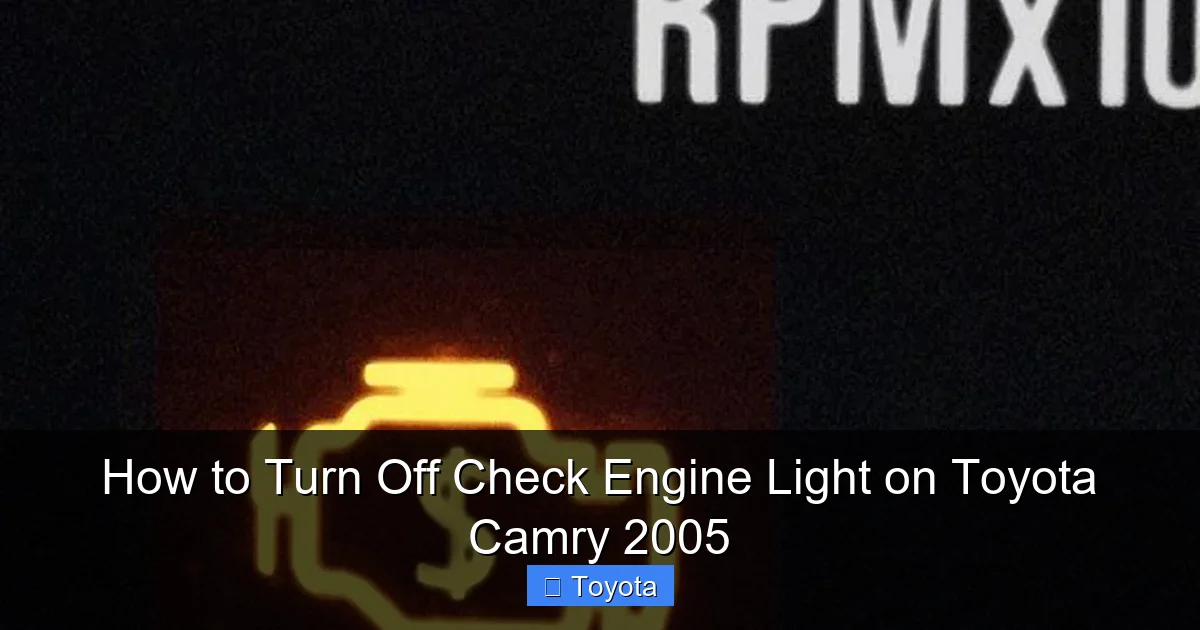
That little amber glow on your dashboard, shaped like an engine, can cause a knot in your stomach. It’s the check engine light (CEL), and on your 2005 Toyota Camry, it’s the car’s primary way of communicating that something under the hood needs attention. Before you learn how to turn it off, you must understand what it truly means. This light is part of your Camry’s On-Board Diagnostics II (OBD-II) system, a standardized computer network that monitors your engine, transmission, and emissions systems.
When the car’s main computer, the Engine Control Unit (ECU), detects a parameter outside its normal range—like a sensor reading that’s too high or too low—it stores a diagnostic trouble code (DTC) and illuminates the check engine light. This is your car asking for help. For the 2005 model year, the Camry fully complies with OBD-II regulations, meaning any generic OBD2 scanner can read the codes. The goal is never just to turn off check engine light on Toyota Camry 2005 without knowing why it came on. Doing so is like ignoring a fever; the underlying illness remains.
What the Check Engine Light Actually Signifies
The light can behave in two ways: a steady glow or a rapid blink. A steady check engine light indicates a non-emergency issue, such as a faulty oxygen sensor, a loose gas cap, or a minor misfire. A flashing or blinking check engine light is a severe warning. It means the ECU has detected a condition that is likely causing immediate damage to your catalytic converter, usually from a severe engine misfire. If your light is flashing, you should stop driving the car as soon as it is safe and have it towed to a mechanic. Continuing to drive can destroy the expensive catalytic converter.
It’s also important not to confuse the check engine light with other maintenance lights. Your Camry has a separate “MAINT REQD” light that illuminates after a set number of miles to remind you of scheduled maintenance like oil changes. That light is reset differently, often via a procedure with the odometer button. If you’re trying to turn off check engine light on Toyota Camry 2005, you are dealing with the engine-shaped icon, not the “MAINT REQD” text. You can learn more about resetting that specific maintenance light in our guide on how to turn off the maintenance light on Toyota.
Common Reasons Your 2005 Camry’s Check Engine Light Comes On
Before you grab a tool to reset the light, a basic understanding of common culprits can save you time and money. The 2005 Camry, with its reliable 2.4L 4-cylinder or optional 3.0L V6 engine, has its own set of frequent triggers. Here are the top offenders we see consistently.
Visual guide about How to Turn Off Check Engine Light on Toyota Camry 2005
Image source: i.ytimg.com
1. The Loose or Faulty Gas Cap
This is the number one most common and easiest fix. Your fuel system is a sealed environment. If the gas cap is not tightened properly, is missing, or has a damaged seal, it allows fuel vapors to escape. The EVAP (evaporative emission) system detects this leak and sets a code, most commonly P0455 (large leak) or P0442 (small leak). Simply remove the cap, listen for the clicks as you re-tighten it firmly until it clicks, and drive for a few days. The light may go off on its own. If not, you’ve at least ruled out the simplest issue.
2. Oxygen Sensor (O2 Sensor) Failure
The 2005 Camry has multiple oxygen sensors that monitor exhaust gases to help the ECU optimize fuel mixture. Over time, these sensors can become sluggish or fail. A common code is P0131 (O2 Sensor Circuit Low Voltage) or P0420 (Catalyst System Efficiency Below Threshold). A failing O2 sensor reduces fuel economy and can eventually damage the catalytic converter. Replacing an O2 sensor is a common repair for this model.
3. Mass Air Flow (MAF) Sensor Issues
The MAF sensor measures the amount of air entering the engine. It’s critical for proper fuel injection. A dirty or faulty MAF sensor will cause poor running, hesitation, and codes like P0101 (Mass Air Flow Circuit Range/Performance). Sometimes, cleaning it with a dedicated MAF cleaner can solve the problem.
4. Misfires (P0300-P0304)
A misfire means fuel isn’t burning in one or more cylinders. Causes range from spark plugs, spark plug wires (on some models), ignition coils, to fuel injector issues. A random misfire code (P0300) or a cylinder-specific misfire (P0301 for cylinder 1, etc.) will turn on the light. If the misfire is severe, the light will blink. You might feel the car shake or notice a loss of power.
5. Catalytic Converter Efficiency
Code P0420 indicates the catalytic converter isn’t cleaning exhaust gases as efficiently as it should. This can be caused by a failing converter itself or by an upstream problem (like a bad O2 sensor or persistent misfire) that has poisoned the catalyst. This is an expensive repair, so proper diagnosis is key.
Essential Tools for the Job
To properly address a check engine light, you need more than just a wish. Here’s your basic toolkit for diagnosis and reset.
Visual guide about How to Turn Off Check Engine Light on Toyota Camry 2005
Image source: toyotacheckenginelight.com
The OBD2 Scanner/Code Reader
This is non-negotiable. Since 1996, all cars sold in the US have an OBD2 port, usually located under the dashboard on the driver’s side, near the steering column. You need a tool to plug into this port. You have several options:
- Basic Code Reader ($20-$50): Reads and clears generic OBD2 codes. Perfect for most common issues on your Camry. It won’t access manufacturer-specific or ABS/airbag codes, but for the check engine light, it’s sufficient.
- Advanced Scanner/App ($50+): Tools like the Autel, Launch, or BlueDriver (which uses your phone) offer more data, live sensor readings, and better diagnostics. Highly recommended for DIYers.
- Free Scan at Auto Parts Stores: Chains like AutoZone, Advance Auto Parts, and O’Reilly offer free code reading. They’ll plug in their professional scanner and print the code for you. This is a great first step if you don’t own a tool.
Basic Hand Tools
Depending on the repair, you might need wrenches, sockets, and screwdrivers. For the reset procedure itself, you typically only need the OBD2 tool or a wrench to loosen the battery terminal.
A Notebook or Phone
Always write down the exact trouble code (e.g., P0455) and its description. This is your roadmap for repair. Searching for “P0455 Toyota Camry 2005” online will yield specific troubleshooting guides and community experiences.
How to Turn Off the Check Engine Light: Step-by-Step Methods
Once you’ve identified the code and, ideally, performed the repair, you’re ready to reset the light. Here are the two primary methods, from simplest to more involved.
Visual guide about How to Turn Off Check Engine Light on Toyota Camry 2005
Image source: images.saymedia-content.com
Method 1: The Proper Way – Using an OBD2 Scanner
This is the recommended, manufacturer-approved method. It’s quick, clean, and doesn’t have any negative side effects.
- Locate the OBD2 Port: In your 2005 Camry, it’s under the dash, to the left of the steering wheel, often behind a small plastic cover.
- Connect the Scanner: Plug the OBD2 connector firmly into the port. Turn your car’s ignition to the “ON” position (do not start the engine). The scanner should power on.
- Read Codes: On the scanner, select “Read Codes” or “Diagnostics.” It will display any stored codes. Confirm you see the code that triggered the light. Write it down if you haven’t already.
- Clear Codes: Navigate to the “Erase Codes,” “Clear DTCs,” or “Reset” function. Confirm the action. The scanner will communicate with the ECU and clear the stored fault.
- Verify: The check engine light should immediately go out. Start the engine. The light should remain off. If it comes back on immediately or after a short drive, the problem has not been fixed and the code has returned.
Method 2: The Alternative – Disconnecting the Battery
This old-school method works on the 2005 Camry but comes with caveats. It’s a hard reset of the car’s computer memory.
- Safety First: Ensure the car is off, the keys are out, and you’re wearing safety gloves and eye protection. You’ll need a 10mm wrench or socket for the negative battery terminal.
- Locate the Battery: In the 2005 Camry, the battery is in the engine bay, typically on the driver’s side.
- Disconnect the Negative Terminal: Loosen the nut on the black (negative) cable clamp. Remove the clamp and set it aside, ensuring the cable doesn’t touch the battery post.
- Wait: Leave it disconnected for at least 10-15 minutes. This allows the ECU’s capacitors to fully discharge, clearing its memory.
- Reconnect: Reattach the negative clamp and tighten the nut securely.
- Start the Car: You may notice the engine idle is slightly rough for the first minute or two. This is normal as the ECU “relearns” the engine’s idle parameters. The check engine light should be off.
Important Side Effects of Battery Disconnect: This method will also reset your radio presets, clock, and any learned data in the transmission control module (TCM). Your Camry’s automatic transmission may shift harshly for the first 20-30 minutes of driving as it relearns your driving style. Power windows and sunroof may need to be initialized (consult your manual). For these reasons, the OBD2 scanner method is strongly preferred.
What Happens After You Reset the Light?
Success! The light is off. But your job isn’t necessarily done. Here’s what to expect and why your work might not be complete.
The Drive Cycle and Readiness Monitors
When you clear codes, the ECU also resets its “readiness monitors.” These are self-tests the computer runs on various emission systems (like the EVAP system, oxygen sensors, and catalytic converter). To pass a state emissions inspection (smog test), all readiness monitors must be set to “Ready.”
After a reset, they all go to “Not Ready.” You must drive the car under a variety of conditions (steady highway speeds, stop-and-go traffic, idle time) for the monitors to run and complete. This can take 50-100 miles of driving, sometimes more. If you go for a smog test too soon, you will fail because the monitors aren’t ready. So, after a reset, drive normally for a week or two before an inspection.
Will the Light Come Back On?
If you reset the light without fixing the underlying problem, the ECU will detect the same fault again and the light will return, often within a few drive cycles. For example, if you have a bad oxygen sensor and just clear the code, the sensor will still send bad data, the ECU will see it, and the light will pop back on. This is the ultimate test: if the light stays off after a week of driving, you likely solved the problem. If it returns, you need to perform the actual repair indicated by the code.
When to Seek Professional Help
While many check engine light issues are DIY-friendly, some are not. Here are clear signs it’s time to call a professional.
Complex or Intermittent Codes
Some codes are vague, like P0420 (Catalyst Efficiency). Diagnosing this requires a professional-level scan tool to monitor oxygen sensor waveforms and perform specific tests to determine if the catalyst is truly bad or if an upstream sensor is the real culprit. Intermittent problems that cause the light to flicker on and off are also notoriously difficult to catch without advanced data-logging tools.
Flashing Check Engine Light
As stated earlier, a flashing light means a severe misfire. This can quickly overheat and destroy your catalytic converter. Stop driving and get the car towed. Diagnosing the cause of the misfire (coil, plug, injector, etc.) is best left to a professional to ensure it’s fixed correctly the first time.
Multiple or Confusing Codes
Sometimes, you get a laundry list of codes. A single root cause (like a bad ground strap or a failing ECU) can trigger multiple, seemingly unrelated codes. A trained mechanic uses their experience and advanced diagnostics to trace the primary fault.
For other Toyota models, resetting procedures can differ. For instance, resetting the check engine light on a Toyota Highlander or a Toyota Corolla follows the same OBD2 principle, but it’s always good to verify model-specific nuances.
Conclusion: A Permanent Fix is the Only Real Fix
Learning how to turn off check engine light on Toyota Camry 2005 is a useful skill, but it should be the final step in a repair process, not the first. The true solution lies in listening to your car’s warning, retrieving the diagnostic trouble code, and performing the appropriate repair. Whether it’s tightening a gas cap, replacing an oxygen sensor, or addressing a misfire, fixing the root cause is what ensures your Camry remains reliable, fuel-efficient, and ready to pass emissions testing. Using an OBD2 scanner to clear the code after a repair is the clean, professional way to complete the job. Remember, that little light is your car’s way of asking for a little help—give it the right help, and it will reward you with many more miles of smooth, worry-free driving.
Frequently Asked Questions
Can I just disconnect the battery to turn off the check engine light on my 2005 Camry?
Yes, disconnecting the negative battery terminal for 10-15 minutes will clear the code and turn off the light. However, this is a blunt method that also resets your radio, clock, and transmission adaptations. It’s better to use an OBD2 scanner to clear the code specifically.
My check engine light is off, but the code is still stored. Is that normal?
No, that’s not how it works. If the problem is repaired and the code is cleared, the light goes off. If the light is off but a scanner shows a code, it means the code is historical (the problem fixed itself or was repaired) but was never cleared. You should clear it to set the readiness monitors.
How many miles do I need to drive after resetting the light for the monitors to be ready?
It varies, but generally you need to complete a full “drive cycle.” This usually means 50-100 miles of mixed driving, including both steady highway speeds (55+ mph for 10+ minutes) and stop-and-go city traffic. Consult your Camry’s service manual for the exact procedure.
Will the check engine light reset itself?
Yes, but only under specific conditions. If the ECU detects that the fault is no longer present over a series of consecutive drive cycles (usually 3), it will turn the light off and store the code as history. This can happen with minor, transient issues like a slightly loose gas cap that you eventually tighten.
Is it safe to drive with the check engine light on?
If the light is steady, you can generally drive the car but should have it diagnosed as soon as possible. If the light is flashing, you must stop driving immediately, as a severe misfire can cause catastrophic damage to the catalytic converter. Reduced performance or strange noises also warrant immediate attention.
Why did my check engine light come on after I replaced the battery?
Disconnecting the battery resets the ECU’s learned fuel trim and idle settings. The engine may run slightly rough for a short time as it recalibrates. The light should not stay on unless a new, unrelated problem exists. If it does, have the codes read to see what triggered it.