How to Turn Off Adaptive Cruise Mode on Toyota Tacoma 2025

Contents
- 1 Key Takeaways
- 2 📑 Table of Contents
- 3 Understanding Your 2025 Tacoma’s Adaptive Cruise Control
- 4 Method 1: The Quick Temporary Cancel (Most Common)
- 5 Method 2: Permanent Disable via Multi-Information Display (MID)
- 6 Method 3: Understanding the “OFF” Switch and Other Controls
- 7 When and Why You Should Turn Off Adaptive Cruise Control
- 8 Troubleshooting: Why Won’t My ACC Turn Off?
- 9 Safety First: Best Practices for Managing Your Tacoma’s ACC
- 10 Conclusion: You’re in Command
- 11 Frequently Asked Questions

LED Indicator Light

Tire Pressure Monitoring System (TPMS)

Car Seat Organizer

Car Battery Tester
Turning off Adaptive Cruise Control (ACC) on your 2025 Toyota Tacoma is a simple process with multiple methods. You can temporarily cancel it using the steering wheel controls, or permanently disable the system through the vehicle’s multi-information display settings. The method you choose depends on whether you need a quick, momentary disengagement or a longer-term solution for specific driving conditions like towing or off-roading. Understanding these controls ensures you have full command over your truck’s advanced driver-assist features.
Key Takeaways
- Multiple Methods Exist: You can disable ACC temporarily with a button press or permanently via the vehicle’s settings menu.
- The “CANCEL” Button is Key: The most common and fastest way to disengage ACC is pressing the dedicated CANCEL button on the steering wheel.
- Settings Menu Offers Control: For a longer-term disable, use the “Driver Assist” or “Safety” settings on your multi-information display to turn off the entire system.
- Understand the Difference: “Canceling” stops the current speed hold but keeps the system ready; “Turning Off” deactivates the standby mode until manually re-enabled.
- Safety Systems May Interact: Disabling ACC does not turn off other related systems like Pre-Collision Braking, which may still be active.
- Consult Your Manual: Your owner’s manual provides the definitive guide for your specific Tacoma trim and software version.
- Re-engagement is Simple: You can easily reactivate ACC using the SET/- or RES/+ buttons once conditions are safe and desired.
[FEATURED_IMAGE_PLACEHOLDER]
📑 Table of Contents
- Understanding Your 2025 Tacoma’s Adaptive Cruise Control
- Method 1: The Quick Temporary Cancel (Most Common)
- Method 2: Permanent Disable via Multi-Information Display (MID)
- Method 3: Understanding the “OFF” Switch and Other Controls
- When and Why You Should Turn Off Adaptive Cruise Control
- Troubleshooting: Why Won’t My ACC Turn Off?
- Safety First: Best Practices for Managing Your Tacoma’s ACC
- Conclusion: You’re in Command
Understanding Your 2025 Tacoma’s Adaptive Cruise Control
So, you’ve got a brand-new 2025 Toyota Tacoma. It’s a capable, modern truck packed with technology designed to make your drive easier and safer. One of the standout features is the Toyota Safety Sense™ (TSS) 3.0 suite, and within that, the Dynamic Radar Cruise Control (DRCC), commonly called Adaptive Cruise Control or ACC. This isn’t your grandpa’s cruise control. It uses a front-mounted camera and radar sensor to automatically adjust your speed to maintain a preset following distance from the vehicle ahead. It’s fantastic for long highway stretches, reducing driver fatigue.
But what happens when you need to turn it off? Maybe you’re about to tackle a winding mountain road, you’re towing a heavy trailer, you’re in stop-and-go traffic where the system feels hesitant, or you simply prefer to have full manual control. Knowing exactly how to disengage this system is a crucial part of being a confident Tacoma owner. This guide will walk you through every method, from the quick tap of a button to navigating the in-cab menus, ensuring you have the knowledge to command your truck’s technology, not the other way around.
What is Adaptive Cruise Control on the Tacoma?
Before we dive into turning it off, let’s quickly clarify what it is. On the 2025 Tacoma, ACC is part of the standard Toyota Safety Sense™ 3.0 on most trims. Once activated (usually by pressing the “CRUISE” button on the steering wheel, then setting a speed with SET/-), it will:
- Maintain a driver-set speed on clear roads.
- Slow down automatically if it detects a slower vehicle ahead, using gentle braking.
- Resume the preset speed when the road ahead clears.
- Bring the vehicle to a complete stop in some traffic conditions (Full-Speed Range DRCC).
It’s a sophisticated system. But sophistication means it has specific operating parameters. It may not function optimally in heavy rain, fog, on very curvy roads, or when the front camera/sensor is obstructed by mud, snow, or a damaged bumper. In these cases, knowing how to turn it off is essential. For a broader look at Toyota’s safety tech, you can explore how to manage other features like Lane Assist on a Toyota Camry, which shares some underlying sensor technology.
Method 1: The Quick Temporary Cancel (Most Common)
This is the method you’ll use 90% of the time. It’s for when you need immediate, momentary control—like to pass a slower vehicle, exit the highway, or react to a situation where the automated speed adjustment isn’t desired. Think of this as tapping the brakes on the system’s autonomy.

Visual guide about How to Turn Off Adaptive Cruise Mode on Toyota Tacoma 2025
Image source: tacomaexplorer.com
Using the CANCEL Button
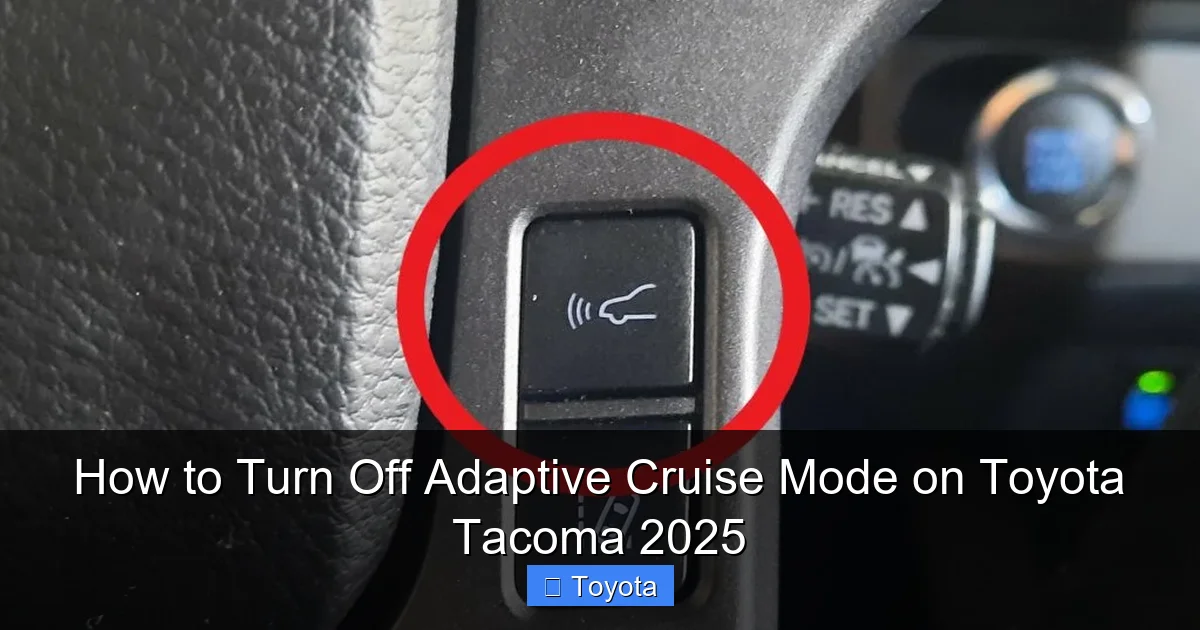
Locate your steering wheel. On the right-hand spoke (for left-hand drive models), you’ll find the cruise control cluster. The buttons are typically labeled with icons. The button you need is marked with a “CANCEL” label or a simple “X” icon. It’s often positioned above or below the main “+” (RES) and “-” (SET) buttons.
Here’s exactly what to do:
- Ensure your ACC is currently active (the green “CRUISE” icon and your set speed will be illuminated in the instrument cluster).
- Firmly press the CANCEL button. You do not need to hold it; a single, definite press is sufficient.
- Immediately, you will see the green “CRUISE” indicator in your digital gauge cluster go out. The set speed number will disappear. The system is now disengaged.
Your vehicle will now coast or slow down based on your foot on the brake or accelerator pedal, just like a conventional car with cruise control turned off. The system is in a “standby” mode. It remembers your last set speed and following distance setting. You can reactivate it instantly by pressing the RES/+ button, and it will return to your previous settings, provided the driving conditions are still appropriate (a vehicle ahead isn’t too close, etc.).
Alternative: Tapping the Brake Pedal
This is an even more instinctive method. A simple, light tap on your brake pedal will also cancel the Adaptive Cruise Control. The brake lights will illuminate, and the system will disengage just as if you pressed the CANCEL button. This is useful because your foot is already near the brake pedal in situations where you might want to cancel. However, be aware that a firm brake press will not only cancel ACC but also activate the brake hold or come to a full stop, depending on traffic. The light tap is the key for just canceling the cruise function.
Method 2: Permanent Disable via Multi-Information Display (MID)
What if you want to turn the system off more permanently? For instance, you’re going off-roading in your Tacoma’s 4×4 mode, towing a large trailer where radar detection can be erratic, or you simply don’t want to use ACC for an entire trip. You can disable the system’s standby mode so it doesn’t automatically activate when you press the “CRUISE” button. This is done through your truck’s settings menu.
Visual guide about How to Turn Off Adaptive Cruise Mode on Toyota Tacoma 2025
Image source: tacomaexplorer.com
Navigating the Menu
The 2025 Tacoma’s interface is handled through a central touchscreen (likely an 8-inch or 14-inch display depending on trim) and/or physical buttons on the steering wheel. The path is generally consistent:
- From the home screen, locate and select the “Settings” or “Vehicle Settings” icon (often looks like a gear or wrench).
- Within Settings, scroll to find “Driver Assist” or “Safety”**.
- Look for an option called “Adaptive Cruise Control”, “Dynamic Radar Cruise Control”, or sometimes just “Cruise Control”**.
- You will see a toggle switch. Toggle it to “OFF”.
Once this is done, the system is fully deactivated. Pressing the “CRUISE” button on your steering wheel will now only activate the basic, non-adaptive cruise control (if your Tacoma is equipped with it as a separate function), or it may do nothing at all, depending on the trim. The ACC will not enter standby mode. To re-enable it, you must return to this menu and toggle it back “ON”.
Important Note on Model Year Differences
While this is the standard procedure for the 2025 Tacoma, menu structures can vary slightly between the SR, SR5, TRD Sport, TRD Off-Road, Limited, and Trailhunter trims, especially if they have different audio system head units (Entune™ vs. larger displays). If you cannot find the exact setting, your owner’s manual is the ultimate authority. It has a dedicated section for “Disabling/Enabling the Pre-Collision System and Cruise Control.” Remember, disabling ACC this way does not disable the entire Toyota Safety Sense™ suite. Features like Pre-Collision System with Pedestrian Detection and Lane Departure Alert will likely remain active unless turned off separately in this same menu.
Method 3: Understanding the “OFF” Switch and Other Controls
You might be looking for a physical “OFF” switch for ACC, similar to an old-school toggle for traction control. The 2025 Tacoma does not have a dedicated, separate physical switch solely for Adaptive Cruise Control. Its integration into the steering wheel controls and software menus is the primary interface. However, there are related controls that affect its operation.

Visual guide about How to Turn Off Adaptive Cruise Mode on Toyota Tacoma 2025
Image source: tacomaexplorer.com
The Main “CRUISE” Button
The large button on the steering wheel spoke labeled “CRUISE” is the master on/off for the cruise control system as a whole. Pressing it once activates the standby mode for whichever cruise system is currently enabled (Basic or Adaptive). Pressing it again while the system is in standby will turn the standby indicator off in the cluster. If you have permanently disabled ACC in the settings menu, pressing this “CRUISE” button will not bring up the ACC green icon. It might bring up a different icon for conventional cruise control, or nothing at all. So, while not a direct “ACC OFF” switch, it is the closest physical control for powering down the cruise function’s readiness.
Interaction with Other Systems
It’s critical to understand that Adaptive Cruise Control is one component of a larger network. You can turn off ACC, but the radar sensor behind the front grille and the camera behind the windshield are still powering up for:
- Pre-Collision System (PCS): This can still provide warnings and automatic braking.
- Lane Tracing Assist (LTA): If equipped, this steering assist may still function when ACC is off, though it often works in tandem with ACC.
- Automatic High Beams: The camera still reads oncoming traffic.
If your goal is to turn off all automated driving interventions for a specific activity (like serious off-roading where sensor inputs are unreliable), you would need to disable multiple systems in that “Driver Assist” settings menu. This is a common point of confusion. You might turn off ACC, but the truck could still give you a sudden brake warning if it misreads a situation. For off-road enthusiasts, this is a key reason to explore the full suite of settings. Interestingly, managing vehicle settings for specific conditions is a common theme across brands; for example, learning how to turn off X-Mode on a Subaru Outback involves a similar dive into the vehicle’s all-terrain system menus.
When and Why You Should Turn Off Adaptive Cruise Control
Knowing the “how” is useless without understanding the “why.” Using ACC is a choice, and there are many valid, safety-conscious reasons to disable it.
Driving Condition Scenarios
- Towing: This is the #1 reason. The radar system can struggle with the close proximity of a trailer and its fluctuating position. The ACC may brake unexpectedly or fail to maintain a consistent distance, causing an unsafe “push-pull” feeling on the hitch. Always turn off ACC when towing a trailer.
- Severe Weather: Heavy rain, snow, fog, or dust storms can obscure the camera and radar. The system may disengage itself with warnings, or worse, give false readings. Manual control is safer.
- Winding, Mountain Roads: ACC is designed for relatively straight highways. On a tight, twisty road, it may constantly disengage as it loses sight of the car ahead around a curve, creating a jarring experience. Turn it off and enjoy the drive.
- Heavy, Stop-and-Go Traffic: While ACC is designed for this, some drivers find the system’s acceleration and braking too aggressive or hesitant compared to their own smooth inputs. In dense city traffic, your foot gives you more predictable control.
- Construction Zones: Unpredictable lane shifts, workers, and equipment can confuse the sensors. It’s best to be fully alert and in control.
- When Using 4-Low (4L) Range: ACC is not designed for the very low speeds and high-torque demands of rock crawling or deep mud/sand. It should be off.
A Note on Off-Roading: The Trailhunter and TRD Off-Road
If you have a 2025 Tacoma Trailhunter or TRD Off-Road, you’re likely an adventure seeker. These trims come with advanced off-road features like Multi-Terrain Select and a locking rear differential. ACC is a highway system. The moment you engage 4WD Low (4L) or even Multi-Terrain Select (MTS) modes like “MUD & SAND” or “ROCK,” you should be thinking about disabling all electronic nannies that could interfere with your throttle and brake control. While the Tacoma’s systems are generally well-tuned, a disengaged driver-aid system is one less variable when navigating a difficult obstacle. It’s about having the truck respond solely to your inputs.
Troubleshooting: Why Won’t My ACC Turn Off?
Sometimes, you press CANCEL, but the green icon stays lit, or the system re-engages itself. Here’s what’s likely happening.
It’s Not ACC, It’s Another System
First, confirm what’s active. Look at your instrument cluster. Is the symbol a car with a speedometer (regular cruise) or a car with a radar waves icon (Adaptive/Dynamic Radar Cruise)? If you accidentally activated basic cruise control, the CANCEL button will work, but the behavior is different. Make sure you’re pressing the correct button on the correct steering wheel control cluster.
System Fault or Sensor Obstruction
If the ACC icon is flashing or you see a warning message like “Cruise Control Unavailable” or “Front Radar Obstructed,” the system has automatically disabled itself due to a detected problem. This could be:
- Dirty Front Grille/Bumper: Mud, snow, bugs, or a thick layer of road salt can block the radar sensor (usually behind the Toyota emblem or a mesh section). Clean it carefully.
- Damaged or Misaligned Sensor: A front-end collision, even a minor one, can knock the sensor out of alignment. It needs a dealer recalibration.
- Extreme Temperature: Very hot or cold can temporarily affect sensor performance.
- Electrical Glitch: Sometimes, a simple system reset is needed. Turn the vehicle completely off, open and close the driver’s door (to fully power down the vehicle’s “Ignition ON” circuits), wait 30 seconds, and restart.
If a warning light persists after cleaning and a restart, you need a diagnostic scan at a Toyota dealer. They can check for fault codes in the radar or camera module.
The “Auto Cancel” Behavior
ACC is designed to cancel itself in certain scenarios. If you’re using it and you:
- Press the brake pedal.
- Press the CANCEL button.
- Move the steering wheel significantly (indicating you’re taking manual control).
- Shift the transmission out of “D” (e.g., to “N” or “R”).
It will disengage. This is normal. If it seems to be disengaging on its own while driving straight on a clear highway, that points to a sensor issue or system fault.
Safety First: Best Practices for Managing Your Tacoma’s ACC
Turning off a driver-assist feature is a responsibility. These systems are aids, not replacements for an attentive driver.
Know Your Defaults
When you start your Tacoma, ACC will be in a “standby” state if it was last used and not permanently disabled via the menu. The green “CRUISE” light will be off, but the system is powered and ready. Be mindful of this. If you’re in a situation where you don’t want it active (like right after leaving a dealership lot or entering a crowded city), make a conscious effort to either not press the SET button or to permanently disable it in settings until you need it.
Re-Engaging Mindfully
When you’re ready to use ACC again, don’t just hit RES/+ blindly. Take a second to:
- Check your following distance setting (the bars on the display). Is it appropriate for current traffic?
- Scan ahead. Is the road clear and straight enough for the system to function?
- Ensure the front grille area is clean.
Then, press RES/+ to set your speed. The system will immediately start looking for a vehicle ahead. Keep your hands ready on the wheel and be prepared to intervene.
It’s Part of a Larger Ecosystem
As mentioned, turning off ACC doesn’t turn off the entire TSS 3.0 suite. Your Tacoma will still beep at you if it thinks you’re drifting out of your lane (Lane Departure Alert) or if it detects a potential forward collision (Pre-Collision Warning). If you want a truly “analog” drive with no electronic interventions, you must go into the “Driver Assist” menu and disable each system individually: Pre-Collision System, Lane Departure Alert, Lane Tracing Assist, and Adaptive Cruise Control. This is the “nuclear option” for a pure driving experience, which some drivers prefer on certain roads. Managing these complex systems is similar to troubleshooting other dashboard alerts; for instance, understanding how to address a VSC TRAC light on a Toyota 4Runner requires knowledge of how multiple stability systems interact.
Conclusion: You’re in Command
Your 2025 Toyota Tacoma is a masterpiece of engineering, blending rugged truck capability with sophisticated, comfort-enhancing technology like Adaptive Cruise Control. But technology should serve you, not dictate your drive. Remember the core lessons: a quick CANCEL button press or brake tap is for momentary, immediate disengagement. For a lasting change, dive into the Settings > Driver Assist menu to toggle ACC off completely. Always consider your driving conditions—towing, off-roading, and poor weather are prime times to take manual control. Finally, understand that disabling ACC is just one piece of the puzzle; other safety systems may still be active.
Take a moment, right now, to locate the CANCEL button on your steering wheel. Familiarize yourself with the path to the settings menu on your touchscreen. This small investment of time pays huge dividends in confidence and safety. Whether you’re using ACC to ease a long commute on the interstate or turning it off to conquer a backcountry trail, you now have the knowledge to make that choice seamlessly. Enjoy your incredible new Tacoma, on your terms.
Frequently Asked Questions
Will turning off Adaptive Cruise Control also turn off the Pre-Collision Braking system?
No. Adaptive Cruise Control and Pre-Collision Braking are separate functions within Toyota Safety Sense. Turning off ACC via the CANCEL button or settings menu will not disable the Pre-Collision System, which can still provide warnings and automatic emergency braking if it detects an imminent collision.
What’s the difference between pressing CANCEL and turning the system OFF in the menu?
Pressing CANCEL provides a temporary disengagement; the system remains in standby and will reactivate instantly if you press RES/+. Turning it OFF in the settings menu deactivates the standby mode entirely. The system will not activate when you press the “CRUISE” button until you return to the menu and re-enable it.
My Adaptive Cruise Control icon is flashing. Does that mean I need to turn it off?
A flashing ACC icon usually indicates a system fault or that the radar/camera is obstructed (e.g., by dirt, snow, or a damaged bumper). The system has likely already disabled itself. You should first clean the front grille area carefully. If the light continues to flash after a restart, a dealer diagnostic is needed to identify the specific sensor issue.
Can I turn off just the automatic braking part of ACC but keep the speed-keeping?
No. The ACC system is an integrated package. You cannot separate the automatic distance-keeping (which uses braking) from the speed-holding function. You either have the full ACC system active or you do not. For simple speed holding without distance management, you would need to use the basic, non-adaptive cruise control if your Tacoma is equipped with it as a separate function.
Does turning off ACC affect my fuel economy?
Not directly. ACC is designed to optimize speed for traffic flow, which can sometimes be more efficient than a human driver’s constant speed adjustments. However, the difference is minimal. The primary impact on fuel economy comes from your own driving habits—smooth acceleration and braking—whether you use ACC or not.
I turned off ACC in the menu, but the green cruise light still comes on when I press the steering wheel button. Why?
This is likely because your Tacoma has a separate, basic “non-adaptive” cruise control system. When you disable the “Adaptive” or “Dynamic Radar” Cruise Control in the settings, you may have only turned off the radar-based feature. Pressing the “CRUISE” button may now activate the conventional cruise control, which maintains a set speed without adjusting for traffic. Check your owner’s manual to see if your specific trim includes both systems. You may also want to check settings related to other vehicle features like fog lights to understand your truck’s full capabilities.