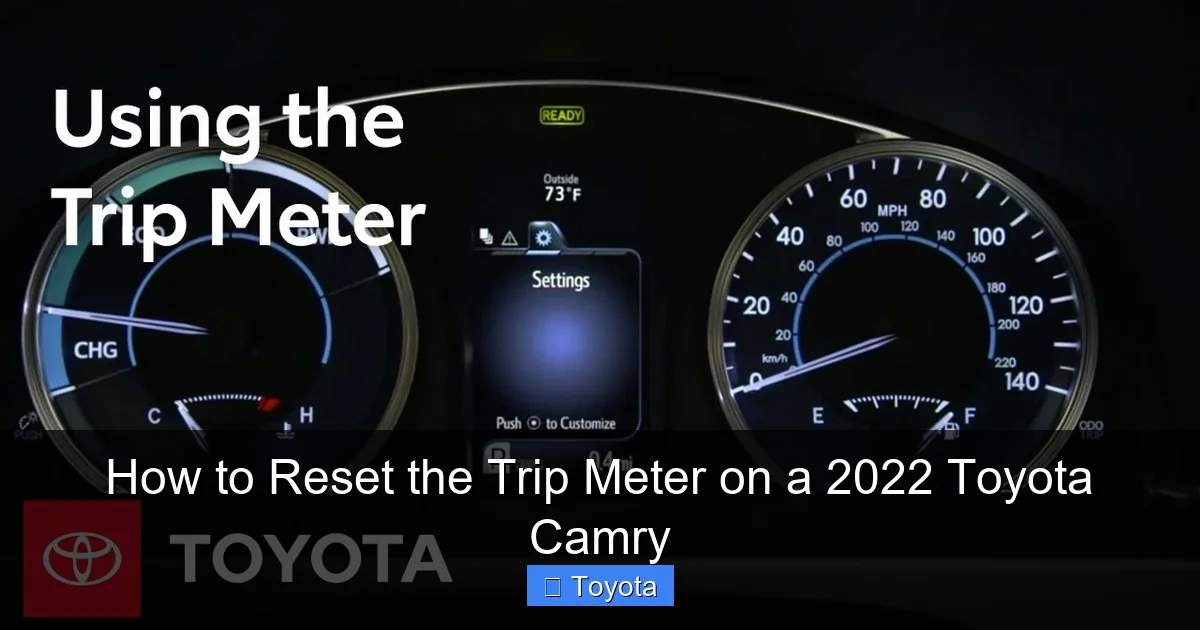
How to Reset the Trip Meter on a 2022 Toyota Camry

Contents
- 1 Key Takeaways
- 2 📑 Table of Contents
- 3 Understanding the 2022 Toyota Camry Trip Meter System
- 4 Step-by-Step Guide to Resetting the Trip Meter
- 5 Why Resetting the Trip Meter Matters
- 6 Troubleshooting Common Trip Meter Issues
- 7 Tips for Getting the Most Out of Your Trip Meters
- 8 Conclusion
- 9 Frequently Asked Questions
Car Inverter

Engine Flush Cleaner

Anti-Slip Dashboard Mat

Car Window Tint Film
Resetting the trip meter on a 2022 Toyota Camry is quick and easy once you know the right steps. Whether you’re tracking fuel efficiency, planning a road trip, or just keeping tabs on your mileage, this guide walks you through the process clearly and simply.
So, you’ve just filled up your gas tank, started a new road trip, or simply want to track how many miles you’ve driven since your last oil change. Whatever the reason, knowing how to reset the trip meter on your 2022 Toyota Camry is a small but super useful skill. It might seem like a tiny feature, but trip meters are actually powerful tools for monitoring your car’s performance, fuel efficiency, and maintenance schedule.
The 2022 Toyota Camry comes equipped with a sleek digital instrument cluster that displays everything from speed and fuel level to trip information. Among these features are two trip meters—Trip A and Trip B—that let you track mileage independently. Whether you’re trying to calculate miles per gallon (MPG) on a long drive or just keeping tabs on your daily commute, these meters give you real-time data at a glance. And the best part? Resetting them is incredibly simple once you know where to look and what to do.
In this guide, we’ll walk you through the entire process step by step, explain why trip meters matter, and share some pro tips to get the most out of this handy feature. We’ll also cover troubleshooting, common mistakes, and how to use Trip A and Trip B like a pro. By the end, you’ll feel confident resetting your trip meter anytime—no mechanic required.
Key Takeaways
- Locate the trip meter button: It’s usually on the steering column stalk or dashboard near the instrument cluster.
- Switch between Trip A and Trip B: Use the same button to toggle between the two trip meters for different tracking purposes.
- Hold the button to reset: Press and hold the trip meter button for 3–5 seconds until the display resets to zero.
- No tools required: The entire process is done using built-in controls—no need for special equipment or apps.
- Use trip meters wisely: Trip A can track daily commutes, while Trip B monitors long-distance travel or fuel economy between fill-ups.
- Check your owner’s manual: If you’re unsure, the manual provides model-specific instructions and helpful diagrams.
- Troubleshoot common issues: If the meter won’t reset, check for software glitches or consult a Toyota service center.
📑 Table of Contents
Understanding the 2022 Toyota Camry Trip Meter System
Before diving into the reset process, it’s helpful to understand how the trip meter system works in your 2022 Toyota Camry. Unlike older models that used analog dials, the 2022 Camry features a fully digital instrument cluster that displays trip data clearly and accurately. This system includes two separate trip meters: Trip A and Trip B. Each can be reset independently, allowing you to track different types of driving.
For example, you might use Trip A to monitor your daily commute—resetting it every morning to see how many miles you drive to and from work. Meanwhile, Trip B could be used to track mileage between oil changes or during a long vacation road trip. This dual-system design gives you flexibility and helps you stay on top of your vehicle’s maintenance and fuel economy.
The trip meters are controlled via a button located on the steering column stalk—the same lever you use to activate your turn signals and headlights. Depending on your Camry’s trim level (LE, SE, XLE, or XSE), the exact placement might vary slightly, but it’s almost always on the left side of the steering wheel. The button is typically labeled with a small “DISP” or “TRIP” icon, or it may simply be a multi-function button you press to cycle through different display modes.
When you press this button, the instrument cluster will toggle between various screens: total odometer, Trip A, Trip B, average fuel economy, instant fuel consumption, and more. Each press advances to the next display. To reset a trip meter, you’ll need to navigate to the correct trip screen and then hold the button down. We’ll cover the exact steps in the next section, but first, let’s talk about why this feature is so valuable.
Trip meters aren’t just for curiosity—they’re practical tools. For instance, if you’re trying to improve your fuel efficiency, you can reset Trip A after filling up your tank and then check the mileage when you refuel again. Divide the miles driven by the gallons pumped, and you’ll get your actual MPG. This is more accurate than relying on the car’s estimated average, which can be influenced by driving conditions and habits.
Similarly, mechanics often ask for trip meter readings during service appointments. If your Camry needs an oil change every 5,000 miles, you can use Trip B to track exactly how far you’ve driven since the last change. This helps ensure you don’t miss important maintenance windows, which can extend the life of your engine and improve performance.
Step-by-Step Guide to Resetting the Trip Meter

Visual guide about How to Reset the Trip Meter on a 2022 Toyota Camry
Image source: oilreset.com
Now that you understand the basics, let’s get into the actual process of resetting the trip meter on your 2022 Toyota Camry. The steps are straightforward, but it’s important to follow them carefully to avoid confusion. Here’s a detailed walkthrough:
Step 1: Turn on the Ignition
You don’t need to start the engine to reset the trip meter, but the ignition must be in the “ON” position. This means turning the key to the second position (or pressing the start button without pressing the brake pedal if your Camry has push-button ignition). The instrument cluster will light up, displaying all the gauges and trip information.
Step 2: Locate the Trip Meter Button
Look to the left side of your steering wheel, where the turn signal and headlight controls are located. You’ll see a small button—often labeled “DISP” or “TRIP”—on the end of the stalk. This is your trip meter control button. On some trims, it might be a multi-function button that also controls the display brightness or audio settings, but its primary role is to cycle through trip data.
Step 3: Cycle to the Desired Trip Meter
Press the trip meter button repeatedly until you see either “Trip A” or “Trip B” displayed on the instrument cluster. Each press will advance the display to the next option. For example:
– First press: Total odometer
– Second press: Trip A
– Third press: Trip B
– Fourth press: Average fuel economy
– And so on
Keep pressing until you land on the trip meter you want to reset. Let’s say you want to reset Trip A after a long road trip. Press the button until “Trip A” appears on the screen.
Step 4: Hold the Button to Reset
Once the correct trip meter is displayed, press and hold the trip meter button for about 3 to 5 seconds. You’ll notice the numbers on the trip meter begin to flash or reset to zero. Release the button once the display shows “0.0” or “0000.0.” That’s it—your trip meter has been successfully reset!
Step 5: Confirm the Reset
To make sure the reset worked, press the trip meter button once to cycle away and then press it again to return to the same trip screen. The display should now show “0.0” miles (or kilometers, depending on your settings). If it does, you’re all set. If not, repeat the process—sometimes a quick tap isn’t enough, and a longer hold is needed.
Pro Tip: Use Both Trip Meters Strategically
Here’s a smart way to use your trip meters: Set Trip A to reset every time you fill up your gas tank. This lets you track fuel economy accurately. Use Trip B to monitor mileage between oil changes or major services. For example, reset Trip B when you get an oil change, and when it hits 5,000 miles, you’ll know it’s time for the next one.
Let’s say you drive 15,000 miles a year. If you reset Trip B at every oil change (every 5,000 miles), you’ll get three resets per year. This helps you stay consistent with maintenance and avoid overdue services.
Why Resetting the Trip Meter Matters

Visual guide about How to Reset the Trip Meter on a 2022 Toyota Camry
Image source: oilreset.com
You might be thinking, “It’s just a number—why does it matter?” But resetting your trip meter regularly can actually have a big impact on your driving habits, vehicle maintenance, and even your wallet. Let’s break down the key reasons why this simple action is worth your time.
Track Fuel Efficiency Accurately
One of the most common uses for trip meters is calculating fuel economy. The 2022 Toyota Camry has an estimated 28–39 MPG depending on the engine and drivetrain, but real-world results can vary. Weather, traffic, driving style, and tire pressure all affect how much gas you use.
By resetting Trip A after filling up your tank, you can track exactly how many miles you drive before the next fill-up. When you stop for gas again, note the trip meter reading and the number of gallons pumped. Divide miles by gallons, and you’ll get your actual MPG.
For example:
– You reset Trip A at 12.3 gallons filled.
– You drive 340 miles.
– You refill with 11.8 gallons.
Your MPG = 340 ÷ 11.8 = 28.8 MPG.
This number is more reliable than the car’s onboard computer, which estimates based on short-term averages. Over time, tracking your MPG can help you identify trends—like a drop in efficiency that might signal a problem with your engine or tires.
Stay on Top of Maintenance
Regular maintenance is crucial for keeping your Camry running smoothly. Toyota recommends oil changes every 5,000 to 10,000 miles, depending on driving conditions. But how do you know when you’ve hit that milestone?
That’s where Trip B comes in. Reset it every time you get an oil change. When the trip meter reaches 5,000 miles, you’ll know it’s time to schedule your next service. This prevents you from guessing or forgetting, which can lead to engine wear or costly repairs.
The same logic applies to other maintenance tasks:
– Tire rotations: Every 5,000–7,500 miles
– Brake inspections: Every 10,000–15,000 miles
– Air filter replacement: Every 15,000–30,000 miles
Using trip meters helps you stay proactive instead of reactive.
Monitor Road Trips and Long Drives
Planning a cross-country trip? Use Trip B to track your progress. Reset it at the start of your journey, and you’ll see exactly how far you’ve driven each day. This can help with navigation, fuel planning, and even sharing updates with family.
Plus, if you’re renting a car or using a company vehicle, trip meters help you log business mileage for tax or reimbursement purposes. Just reset at the start of each trip and record the final reading.
Detect Potential Issues Early
A sudden drop in fuel economy or an unusually high trip meter reading between services could signal a problem. For example, if you normally get 35 MPG but suddenly drop to 28 MPG, it might mean your air filter is clogged, your tires are underinflated, or there’s an issue with the oxygen sensor.
By tracking trip data regularly, you’ll notice these changes faster and can address them before they become serious.
Troubleshooting Common Trip Meter Issues

Visual guide about How to Reset the Trip Meter on a 2022 Toyota Camry
Image source: wikihow.com
Even though resetting the trip meter is simple, you might run into a few hiccups. Here are some common issues and how to fix them.
The Trip Meter Won’t Reset
If you press and hold the button but the meter doesn’t reset, try these steps:
– Make sure the ignition is on. The car must be in “ON” mode, not just accessory mode.
– Hold the button for at least 5 seconds. Sometimes a quick press isn’t enough.
– Try resetting when the car is stationary. Some systems won’t allow resets while driving.
– Check if the button is stuck or dirty. Use a soft cloth to clean around the stalk.
If none of these work, there might be a software glitch. Try turning the car off completely, waiting 30 seconds, and turning it back on. This can reset the instrument cluster.
Trip Meter Resets on Its Own
If your trip meter resets unexpectedly, it could be due to:
– A weak battery or electrical issue
– A software bug in the instrument cluster
– Accidental button presses (e.g., while adjusting the steering wheel)
Check your battery voltage and consider visiting a Toyota service center if the problem persists.
Can’t Find the Trip Meter Button
On some Camry trims, the button might be less obvious. Look for a small, round button on the left stalk. If you still can’t find it, consult your owner’s manual—it will have a diagram showing the exact location.
Trip Meter Shows Incorrect Mileage
If the trip meter seems off, compare it to your odometer. The trip meter should never exceed the total mileage. If it does, there may be a sensor issue. Have it checked by a professional.
Tips for Getting the Most Out of Your Trip Meters
Now that you know how to reset and use your trip meters, here are some expert tips to maximize their usefulness:
Use Trip A for Daily Tracking
Reset Trip A every morning to monitor your daily driving. This helps you understand your habits—like how much you drive to work, run errands, or take weekend trips.
Use Trip B for Long-Term Goals
Set Trip B to track major milestones, like a road trip or the time between oil changes. This keeps you accountable and organized.
Record Your Data
Keep a simple log in your phone or notebook. Note the date, trip meter reading, and gallons filled. Over time, you’ll build a valuable record of your car’s performance.
Combine with Other Tools
Use your trip meter alongside apps like Fuelly or Google Sheets to track fuel economy, maintenance, and costs. This gives you a complete picture of your vehicle’s health.
Teach Family Members
If others drive your Camry, show them how to reset the trip meter. This ensures everyone can use the feature correctly and avoid confusion.
Conclusion
Resetting the trip meter on your 2022 Toyota Camry is a small action with big benefits. It takes just a few seconds, requires no tools, and gives you powerful insights into your driving habits, fuel efficiency, and maintenance needs. Whether you’re tracking a road trip, monitoring MPG, or staying on top of oil changes, the trip meter is one of the most underrated features in your car.
By following the simple steps outlined in this guide—locating the button, cycling to the right trip, and holding to reset—you can master this feature in no time. And with smart use of Trip A and Trip B, you’ll keep your Camry running smoothly for years to come.
So the next time you fill up your tank or start a new journey, take a moment to reset that trip meter. It’s a small habit that can make a big difference in how you care for your vehicle.
Frequently Asked Questions
Can I reset the trip meter while driving?
No, for safety reasons, most Toyota models require the vehicle to be stationary when resetting the trip meter. Always pull over safely before attempting to reset.
What if the trip meter button doesn’t work?
First, ensure the ignition is on. If the button is unresponsive, try cleaning it or restarting the car. If the issue persists, consult your owner’s manual or visit a Toyota service center.
Can I reset both Trip A and Trip B at the same time?
No, Trip A and Trip B must be reset individually. You’ll need to navigate to each one separately and hold the button to reset them.
Does resetting the trip meter affect the odometer?
No, resetting the trip meter only clears the trip data. The main odometer, which tracks total mileage, remains unchanged.
How often should I reset my trip meter?
It depends on your needs. Many drivers reset Trip A after every fill-up to track fuel economy, and Trip B after every oil change to monitor maintenance intervals.
Is there a way to reset the trip meter using the touchscreen?
No, the 2022 Toyota Camry does not allow trip meter resets via the infotainment screen. You must use the physical button on the steering column stalk.