
How to Reset the Red Lightning Bolt Light on a Dodge Avenger

Contents
- 1 Key Takeaways
- 2 📑 Table of Contents
- 3 What Does the Red Lightning Bolt Light Mean?
- 4 Why the Red Lightning Bolt Light Comes On
- 5 Step-by-Step Guide to Reset the Red Lightning Bolt Light
- 6 When to Seek Professional Help
- 7 Preventing Future Red Lightning Bolt Warnings
- 8 Conclusion
- 9 Frequently Asked Questions


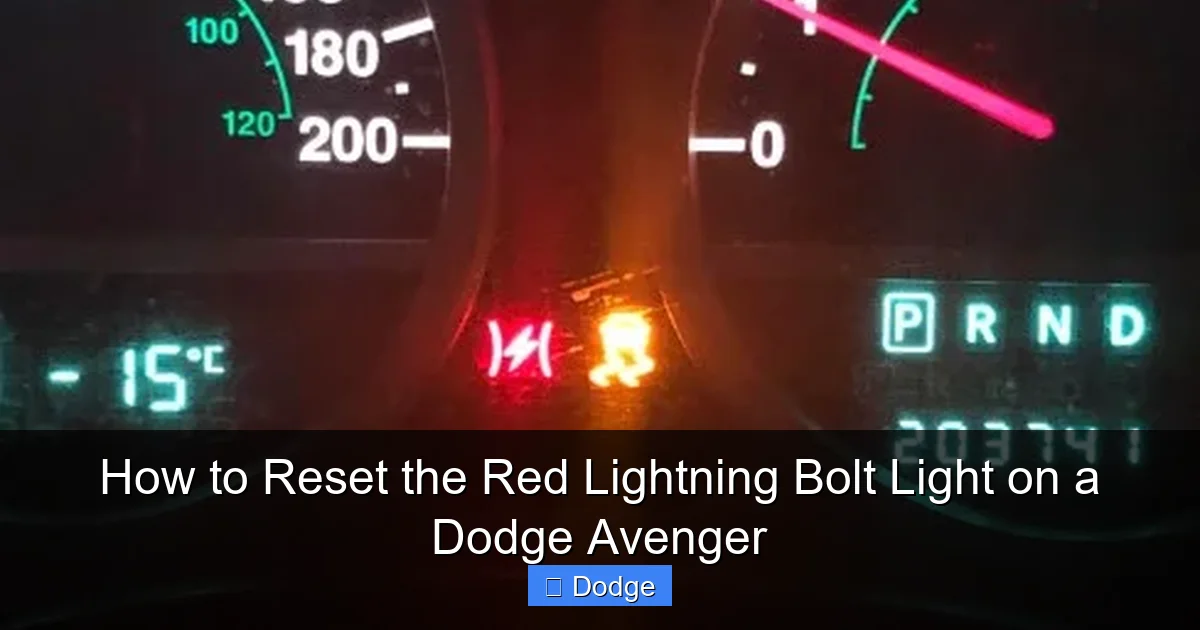
The red lightning bolt light on your Dodge Avenger is a warning signal related to the electronic throttle control system. Resetting it properly can resolve minor glitches and restore normal driving performance—without needing a mechanic.
If you’ve ever been driving your Dodge Avenger and suddenly seen a bright red lightning bolt flash on your dashboard, you’re not alone. This startling symbol can send any driver into a mild panic—especially if you’re unsure what it means or how to fix it. Don’t worry: while the red lightning bolt light looks alarming, it’s often fixable with a few simple steps. In this guide, we’ll walk you through exactly what that light means, why it comes on, and—most importantly—how to reset the red lightning bolt light on a Dodge Avenger safely and effectively.
The red lightning bolt is part of your vehicle’s electronic throttle control (ETC) system, also known as “drive-by-wire.” Unlike older cars that used physical cables to connect the gas pedal to the engine, modern vehicles like the Dodge Avenger use electronic signals to manage throttle response. When the car’s computer detects a problem in this system—such as a sensor malfunction, wiring issue, or communication error—it triggers the red lightning bolt warning light. Ignoring it isn’t wise: your car might go into “limp mode,” limiting speed and power to protect the engine. But the good news? Many causes are temporary or easily resolved at home.
In the following sections, we’ll break down everything you need to know—from understanding the root cause to performing DIY resets and knowing when to call a professional. Whether you’re a seasoned DIYer or just want peace of mind behind the wheel, this guide will help you get back on the road confidently.
Key Takeaways
- Understand the warning: The red lightning bolt indicates an issue with the electronic throttle control (ETC), not just a simple maintenance reminder.
- Don’t ignore it: Driving with this light on can lead to reduced power, limp mode, or unsafe driving conditions.
- Try a soft reset first: Turning the ignition off and on may clear temporary glitches in the throttle system.
- Use the pedal reset method: A specific sequence of accelerator pedal presses can recalibrate the throttle body in many Avenger models.
- Check for error codes: Use an OBD2 scanner to read diagnostic trouble codes (DTCs) like P2135 or P2122 for accurate diagnosis.
- Inspect wiring and sensors: Damaged throttle position sensors or loose connections often trigger the light.
- Seek professional help if needed: Persistent issues may require dealership-level diagnostics or throttle body replacement.
📑 Table of Contents
What Does the Red Lightning Bolt Light Mean?
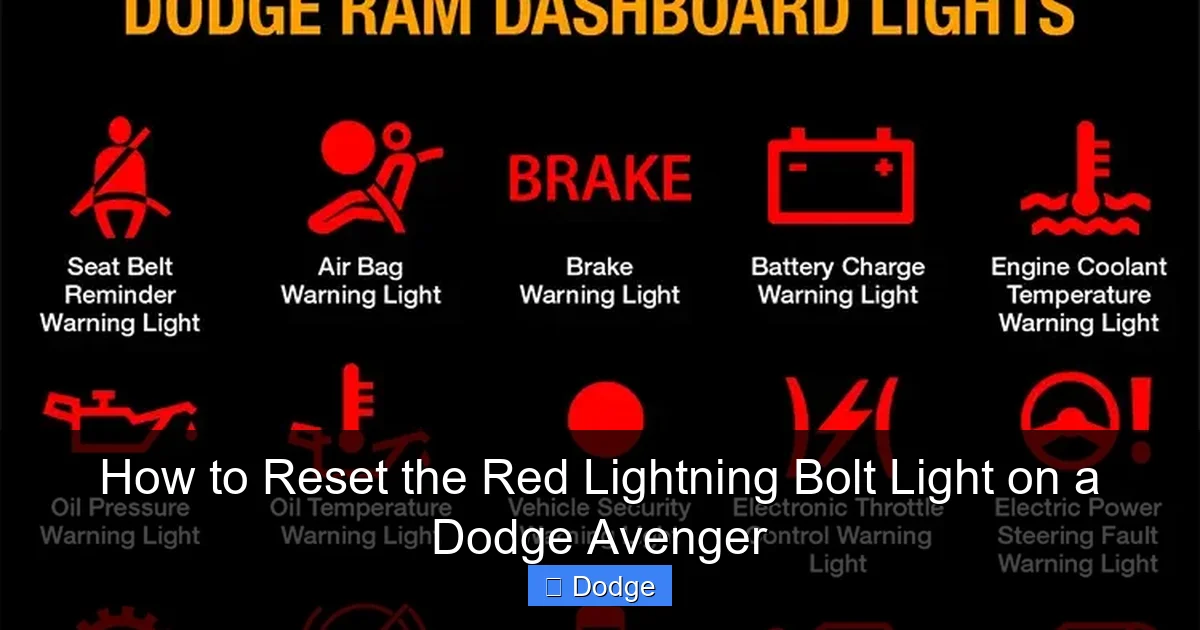
The red lightning bolt symbol on your Dodge Avenger’s dashboard is more than just a random warning—it’s a direct message from your car’s onboard computer about a problem with the electronic throttle control (ETC) system. This system replaces the traditional mechanical linkage between your gas pedal and the engine’s throttle body with electronic sensors and actuators. When everything works smoothly, you get precise, responsive acceleration. But when something goes wrong, the car alerts you immediately with this distinctive icon.
Common triggers include faulty throttle position sensors (TPS), poor electrical connections, software glitches, or even dirt buildup inside the throttle body. The light may appear suddenly while driving or stay on after starting the engine. In some cases, it flickers intermittently, suggesting an unstable signal rather than a complete failure. Regardless of how it appears, the message is clear: your car has detected a potential safety issue with how it controls engine power.
It’s important to note that this isn’t the same as the check engine light. While both relate to engine performance, the red lightning bolt specifically points to throttle system faults. That’s why it often comes with other symptoms—like hesitation when accelerating, stalling, or the car refusing to go above 25–30 mph (a condition known as “limp mode”). Understanding these signs helps you respond appropriately instead of panicking or dismissing the warning.
How the Electronic Throttle Control System Works
To truly grasp why the red lightning bolt appears, it helps to understand how your Avenger’s throttle system operates. Instead of a steel cable pulling open the throttle plate when you press the gas pedal, your car uses two main components: the accelerator pedal position sensor (APPS) and the throttle position sensor (TPS). These sensors send voltage signals to the powertrain control module (PCM), which then commands the electric motor on the throttle body to open or close the plate accordingly.
This setup allows for smoother operation, better fuel efficiency, and integration with features like cruise control and traction control. However, it also means that any disruption in the signal chain—whether from a worn sensor, corroded connector, or software hiccup—can confuse the PCM. When the computer receives conflicting or out-of-range data from the sensors, it assumes there’s a fault and illuminates the red lightning bolt to warn you.
For example, if the TPS reports that the throttle is 50% open while the APPS says the pedal is only 10% depressed, the PCM can’t trust either reading. To prevent unintended acceleration or stalling, it defaults to a safe mode—often turning on the warning light and limiting engine output. This protective measure keeps you safe but can be frustrating if the issue is minor and easily fixed.
Common Symptoms That Accompany the Light
When the red lightning bolt appears, it rarely shows up alone. Most Dodge Avenger owners notice one or more accompanying symptoms that confirm a throttle system issue. These include:
– **Reduced engine power**: Your car may feel sluggish or refuse to accelerate beyond a certain speed.
– **Hesitation or jerking**: The engine might hesitate when you press the gas, especially from a stop.
– **Stalling or rough idling**: The engine could stall at traffic lights or idle unevenly.
– **Limp mode activation**: The transmission may stay in second gear, and top speed drops significantly.
– **Cruise control failure**: Since cruise control relies on throttle input, it often won’t engage when the light is on.
These symptoms aren’t just annoying—they can be dangerous in heavy traffic or highway driving. If you experience sudden loss of power while merging onto a freeway, for instance, it creates a real safety risk. That’s why addressing the red lightning bolt promptly is crucial, even if the car seems to run “well enough” otherwise.
Why the Red Lightning Bolt Light Comes On
Visual guide about How to Reset the Red Lightning Bolt Light on a Dodge Avenger
Image source: obdadvisor.com
Now that you know what the light means and how the system works, let’s explore the most common reasons it triggers in your Dodge Avenger. While some causes are serious and require professional attention, many are surprisingly simple—and often stem from everyday wear and environmental factors.
One of the top culprits is a dirty or carbon-fouled throttle body. Over time, oil vapors from the crankcase ventilation system and fuel residues can build up inside the throttle bore and on the throttle plate. This gunk restricts airflow and interferes with the precise movement the ETC system expects. The PCM detects the mismatch between commanded and actual throttle position and lights up the warning.
Another frequent cause is electrical issues. Corroded connectors, frayed wires, or loose plugs at the throttle body or pedal assembly can disrupt signal transmission. Moisture intrusion—especially in humid climates or after car washes—can worsen these problems. Even a weak battery or failing alternator can cause voltage fluctuations that confuse the throttle sensors.
Software glitches also play a role. Like any computer, your Avenger’s PCM can occasionally freeze or misread data due to temporary bugs. These often resolve with a simple power cycle (turning the car off and on), but they may recur if underlying hardware issues aren’t addressed.
Sensor and Wiring Problems
The throttle position sensor (TPS) and accelerator pedal position sensor (APPS) are critical to the ETC system—and common failure points. The TPS, mounted on the throttle body, monitors how far the throttle plate is open. If its internal resistor wears out or gets dirty, it sends erratic signals. Similarly, the APPS—located under the dashboard—tracks your foot’s pressure on the gas pedal. A cracked circuit board or worn contact points can cause false readings.
Wiring harnesses that connect these sensors to the PCM are equally vulnerable. Rodent damage, abrasion against sharp edges, or corrosion at connector pins can break the circuit. In older Avengers (2008–2014), the wiring near the firewall or under the hood is especially prone to wear due to heat and vibration.
A practical tip: if you’re comfortable under the hood, visually inspect the throttle body and pedal area for obvious damage. Look for cracked housings, green corrosion on terminals, or wires that look pinched or melted. Even if everything looks fine, gently wiggling connectors while the engine is running (with caution!) can sometimes reveal intermittent faults.
Software and Calibration Issues
Modern vehicles rely heavily on software to manage engine functions, and the Dodge Avenger is no exception. Sometimes, the PCM loses its calibration for the throttle body—especially after a battery disconnect, jump-start, or software update. This doesn’t mean the hardware is broken; it just needs to “relearn” the correct range of motion for the throttle plate.
This is where reset procedures come in handy. By following a specific sequence of ignition and pedal actions, you can prompt the PCM to recalibrate itself. It’s like rebooting your computer when an app freezes—it doesn’t fix a hardware problem, but it clears temporary glitches.
Additionally, aftermarket modifications (like performance chips or throttle response controllers) can interfere with factory settings and trigger the light. If you’ve recently installed such devices, consider removing them temporarily to see if the issue resolves.
Step-by-Step Guide to Reset the Red Lightning Bolt Light

Visual guide about How to Reset the Red Lightning Bolt Light on a Dodge Avenger
Image source: i.ytimg.com
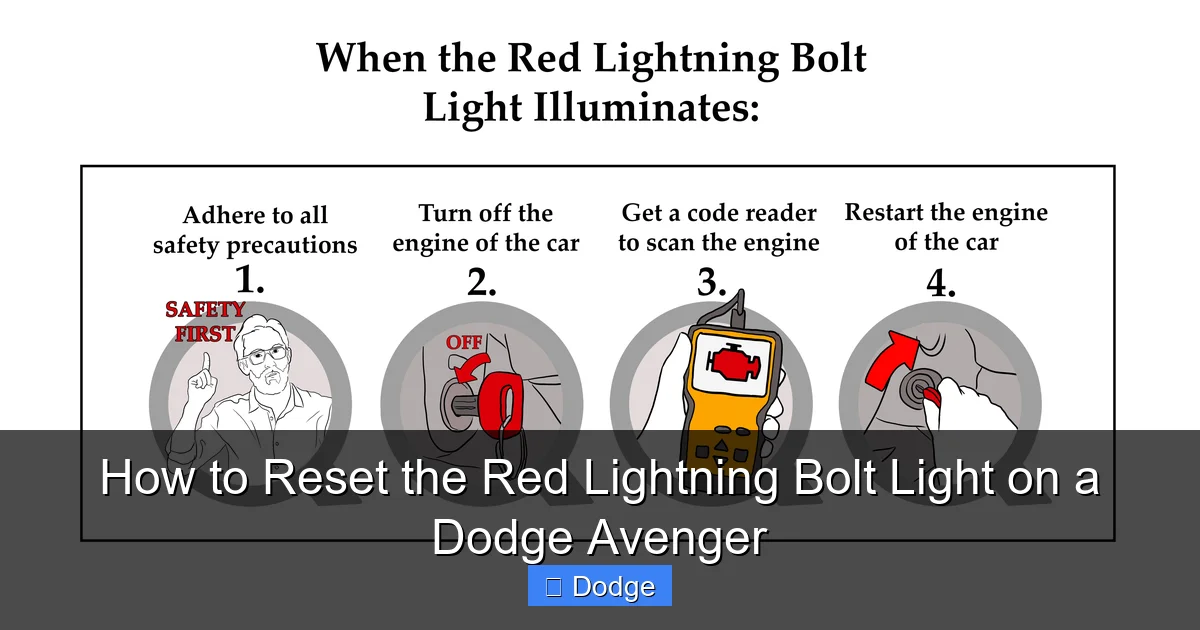
Resetting the red lightning bolt light on your Dodge Avenger is often simpler than you think—and doesn’t always require tools or a trip to the dealership. Below are three proven methods, starting with the easiest and moving to more advanced options. Try them in order, and stop once the light goes off and stays off.
Method 1: The Soft Reset (Ignition Cycle)
This is the first thing every Avenger owner should try. It’s quick, safe, and resolves many temporary glitches.
1. **Turn off the engine** completely. Remove the key from the ignition (or press the Start/Stop button if equipped).
2. **Wait 10–15 minutes**. This allows the PCM and throttle system capacitors to fully discharge.
3. **Reinsert the key** and turn the ignition to the “ON” position (but don’t start the engine). Watch the dashboard—the red lightning bolt may flash briefly.
4. **Wait 30 seconds**, then turn the ignition back to “OFF.”
5. **Start the engine** normally. If the light doesn’t return, the reset worked!
Why this works: Power cycling clears volatile memory in the PCM and resets communication between modules. It’s especially effective after minor electrical disturbances, like a low battery or jump-start.
Method 2: The Pedal Reset Procedure
If the soft reset doesn’t work, the pedal reset method often does. This recalibrates the throttle body by teaching the PCM the full range of pedal and throttle movement.
**For most Dodge Avenger models (2008–2014):**
1. Ensure the vehicle is in Park (automatic) or Neutral (manual) with the parking brake engaged.
2. Turn the ignition to “ON” (engine off).
3. Slowly press the accelerator pedal **all the way to the floor** and hold for 3 seconds.
4. Slowly release the pedal **completely** and wait 5 seconds.
5. Repeat steps 3 and 4 **two more times** (three total cycles).
6. Turn the ignition to “OFF” and wait 10 seconds.
7. Start the engine. The red lightning bolt should be gone.
**Important notes:**
– Do this on a flat surface with no obstructions around the pedal.
– Don’t rush—slow, deliberate movements are key.
– If the light returns after driving, the issue may be mechanical or require further diagnosis.
This procedure forces the PCM to relearn the minimum and maximum throttle positions, syncing the pedal and throttle body sensors.
Method 3: Using an OBD2 Scanner
When manual resets fail, an OBD2 scanner becomes essential. It reads diagnostic trouble codes (DTCs) stored in the PCM, giving you precise insight into what’s wrong.
Common codes associated with the red lightning bolt include:
– **P2135**: Throttle/Pedal Position Sensor/Switch D/E Voltage Correlation
– **P2122**: Throttle/Pedal Position Sensor/Switch D Circuit Low Input
– **P2127**: Throttle/Pedal Position Sensor/Switch E Circuit Low Input
To use an OBD2 scanner:
1. Plug the scanner into the OBD2 port (usually under the dashboard, near the driver’s knee).
2. Turn the ignition to “ON” (engine off).
3. Follow the scanner prompts to read codes.
4. Write down any codes displayed.
5. Clear the codes using the scanner’s “Erase” function.
6. Start the engine and test drive.
If the light stays off, great! If it returns, the codes will help pinpoint whether you need a new sensor, wiring repair, or throttle body cleaning.
When to Seek Professional Help
Visual guide about How to Reset the Red Lightning Bolt Light on a Dodge Avenger
Image source: autoquarterly.com
While many red lightning bolt issues can be resolved at home, some problems require expert diagnosis and repair. Knowing when to call a mechanic saves time, money, and frustration.
If you’ve tried all reset methods and the light keeps coming back—or if you notice persistent symptoms like stalling, hard starting, or loss of power—it’s time to visit a trusted Dodge service center or ASE-certified technician. They have advanced scan tools that can perform bidirectional tests, checking not just for codes but also whether sensors and actuators are responding correctly.
Additionally, if your OBD2 scanner shows codes like P0121, P0221, or P2106, these often indicate internal throttle body failures or motor issues that can’t be fixed with a reset. In such cases, the throttle body may need cleaning, recalibration with factory software, or replacement.
Don’t delay if you smell burning electronics, hear unusual noises from the throttle area, or notice smoke. These could signal a short circuit or motor burnout—serious issues that pose fire risks.
Cost Considerations
Repair costs vary widely based on the root cause:
– **Throttle body cleaning**: $80–$150 (DIY kits cost $20–$40)
– **Throttle position sensor replacement**: $120–$300 (part + labor)
– **Throttle body replacement**: $400–$800 (new OEM unit)
– **Wiring repair**: $100–$250 (depending on accessibility)
Always get a written estimate before authorizing repairs. Some independent shops offer lower rates than dealerships, but ensure they use quality parts and have experience with Chrysler/Dodge systems.
Preventing Future Red Lightning Bolt Warnings
Once you’ve resolved the issue, take steps to prevent it from happening again. Regular maintenance and mindful driving habits go a long way.
First, keep your throttle body clean. Every 30,000–50,000 miles, consider a professional throttle body cleaning or use a quality intake cleaner spray (like CRC Mass Air Flow Sensor Cleaner) to remove carbon buildup. Avoid harsh chemicals that can damage sensors.
Second, maintain your battery and charging system. A weak battery causes voltage drops that confuse electronic sensors. Test your battery annually and replace it every 4–5 years. Clean battery terminals to ensure solid connections.
Third, avoid aftermarket electronics that interfere with factory systems. If you must install performance mods, choose reputable brands and have them professionally calibrated.
Finally, pay attention to early warning signs—hesitation, rough idle, or occasional flickering of the light. Addressing small issues early prevents major failures down the road.
Conclusion
The red lightning bolt light on your Dodge Avenger might look intimidating, but it’s usually a manageable issue—not a death sentence for your car. By understanding what it means, trying simple reset procedures, and knowing when to seek help, you can keep your Avenger running smoothly and safely. Remember: this warning exists to protect you and your vehicle. Respect it, but don’t fear it.
Whether you reset it with a quick ignition cycle, recalibrate using the pedal method, or dig deeper with an OBD2 scanner, you now have the tools to take control. And if all else fails, a qualified mechanic can get you back on the road with confidence. Drive smart, stay informed, and never ignore that little red bolt—it’s your car’s way of saying, “Hey, let’s talk.”
Frequently Asked Questions
Can I drive my Dodge Avenger with the red lightning bolt light on?
You can drive short distances cautiously, but it’s not recommended. The light indicates a throttle system fault that could lead to loss of power or limp mode, creating safety risks in traffic or on highways.
Will disconnecting the battery reset the red lightning bolt light?
Sometimes, but not reliably. A full battery disconnect may clear temporary glitches, but it won’t recalibrate the throttle system like the pedal reset method. Also, it may reset radio presets and require window reinitialization.
How much does it cost to fix the red lightning bolt issue?
Costs range from $0 (if a simple reset works) to $800+ for throttle body replacement. Most common fixes—like sensor replacement or cleaning—fall between $100 and $300.
Does the red lightning bolt light affect fuel economy?
Yes, indirectly. If the car goes into limp mode or the throttle response is impaired, you may experience reduced fuel efficiency due to altered engine management and driving behavior.
Can a bad gas cap cause the red lightning bolt light?
No. The red lightning bolt is specific to the electronic throttle control system. A bad gas cap typically triggers the check engine light, not the lightning bolt symbol.
Is the red lightning bolt covered under warranty?
If your Avenger is still under the factory powertrain warranty (typically 5 years/60,000 miles), throttle system repairs may be covered. Check your warranty booklet or contact a Dodge dealer for confirmation.


