
How to Reset Service Shifter on a Dodge Durango

Resetting the service shifter on a Dodge Durango is a common maintenance task that ensures smooth gear shifting and prevents transmission issues. This guide walks you through the process clearly, safely, and efficiently—no mechanic required.
Key Takeaways
- Understand the service shifter light: It alerts you to transmission or shifter system issues, not just routine maintenance.
- Know your model year: Reset procedures vary slightly between older (2004–2010) and newer (2011–2024) Durango models.
- Use the ignition cycle method: Most Durangos allow a manual reset using the key and brake pedal—no scan tool needed.
- Check for underlying problems: A recurring service shifter message may signal electrical or mechanical faults needing professional diagnosis.
- Reset after repairs or battery replacement: Always perform a reset after disconnecting the battery or servicing the transmission.
- Keep a record: Note the mileage and date of each reset to track transmission health over time.
- When to see a mechanic: If the light returns quickly or shifting feels rough, seek professional help immediately.
📑 Table of Contents
What Is the Service Shifter Light on a Dodge Durango?
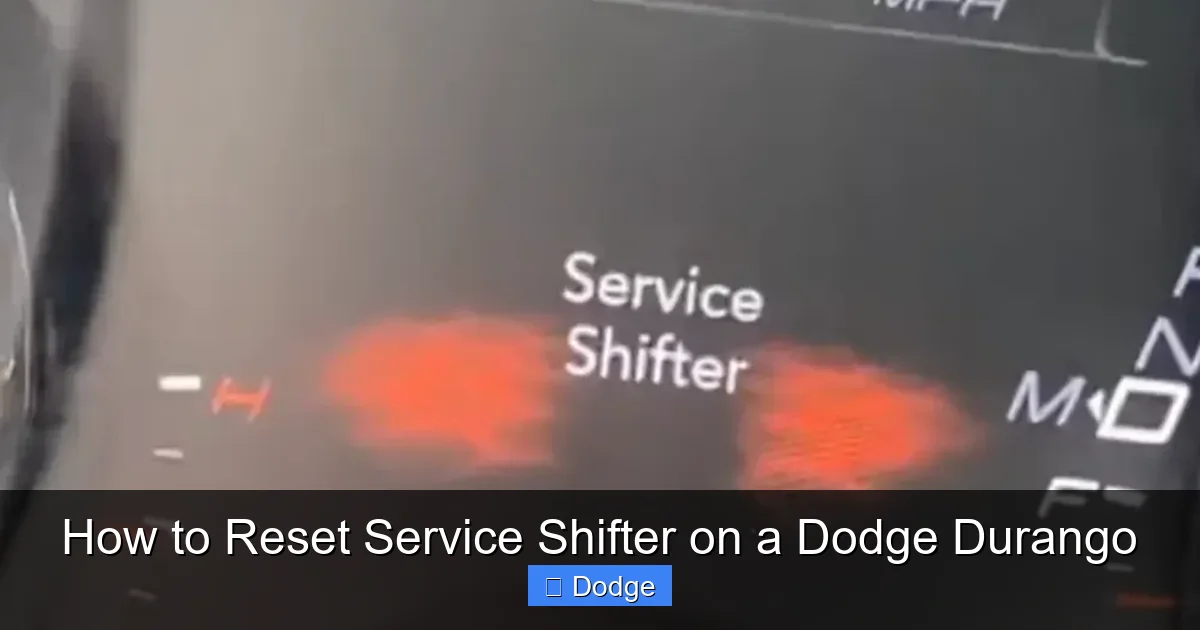
If you’ve ever been driving your Dodge Durango and suddenly noticed a warning light on the dashboard that says “Service Shifter” or “Shift Interlock,” you’re not alone. This alert can be confusing, especially if your vehicle is shifting gears just fine. But don’t ignore it—this light is your Durango’s way of saying something in the shifter or transmission system needs attention.
The service shifter message typically appears when the vehicle’s onboard computer detects an issue with the electronic shift system. Unlike older vehicles with mechanical linkages, modern Durangos use an electronic gear selector that communicates with the transmission control module (TCM). When something goes out of sync—like after a battery disconnect, a software glitch, or a minor sensor fault—the system triggers the warning to prevent potential damage.
It’s important to note that the “Service Shifter” light is not the same as a “Check Engine” light. While the Check Engine light relates to emissions and engine performance, the service shifter warning is specifically tied to the gear selection system. This includes the shifter assembly, brake shift interlock, transmission range sensor, and related wiring.
In many cases, the issue is minor and can be resolved with a simple reset. However, if the light persists or returns frequently, it could indicate a deeper problem such as a faulty sensor, damaged wiring, or even internal transmission wear. That’s why understanding how to reset the service shifter—and when to seek professional help—is essential for every Durango owner.
Why Does the Service Shifter Light Come On?
Visual guide about How to Reset Service Shifter on a Dodge Durango
Image source: cdn.cartipsdaily.com
There are several reasons why your Dodge Durango might display the service shifter warning. Some are temporary and easy to fix, while others may require diagnostic tools or repairs. Let’s break down the most common causes so you can better understand what’s happening under the hood.
Electrical Glitches and Software Errors
Modern vehicles like the Durango rely heavily on electronic control systems. Sometimes, these systems experience temporary glitches—similar to a computer freezing. A sudden power loss, such as when the battery is disconnected or dies, can cause the transmission control module to lose its calibration. When the system reboots, it may not recognize the shifter’s position correctly, triggering the service shifter light.
This is especially common after jump-starting the vehicle, replacing the battery, or performing electrical work. The good news? A simple reset often clears the error and restores normal operation.
Brake Shift Interlock Malfunction
The brake shift interlock is a safety feature that prevents you from shifting out of “Park” unless the brake pedal is pressed. If this system fails—due to a worn brake pedal switch, low brake fluid, or a faulty solenoid—the shifter may not respond properly. The vehicle interprets this as a shifter issue and turns on the warning light.
For example, if you press the brake but the shifter still won’t move, the interlock might be stuck. In some cases, tapping the shifter gently or pressing the brake multiple times can free it up. But if the problem continues, a reset or component replacement may be needed.
Transmission Range Sensor Issues
The transmission range sensor (also called the neutral safety switch) tells the vehicle what gear the shifter is in. If this sensor becomes misaligned, dirty, or damaged, it can send incorrect signals to the TCM. This leads to confusion in the system, resulting in the service shifter alert.
Symptoms include difficulty shifting, the vehicle not starting in “Park,” or the shifter feeling loose or unresponsive. While a reset might temporarily fix the issue, a faulty sensor usually requires replacement.
Low Transmission Fluid or Fluid Contamination
Transmission fluid plays a crucial role in lubricating and cooling the transmission. If the fluid level is low or the fluid is dirty, burnt, or contaminated, it can affect shifter performance. The Durango’s system may detect irregular pressure or temperature readings and trigger the service shifter warning as a precaution.
Checking your transmission fluid regularly is a smart maintenance habit. Look for a dipstick (on older models) or use the fill plug method (on newer sealed transmissions). Fresh fluid should be bright red and smell slightly sweet—dark, burnt-smelling fluid means it’s time for a change.
After Repairs or Maintenance
If you’ve recently had your Durango serviced—especially work involving the transmission, battery, or electrical system—the service shifter light may appear as a result. Mechanics often disconnect the battery during repairs, which can reset the vehicle’s electronics. Without a proper relearn procedure, the system may not recognize the shifter correctly.
This is why it’s always a good idea to perform a shifter reset after any major maintenance. It’s a quick step that can save you a trip back to the shop.
How to Reset the Service Shifter on a Dodge Durango (Step-by-Step Guide)
Visual guide about How to Reset Service Shifter on a Dodge Durango
Image source: cdn.cartipsdaily.com
Now that you understand why the service shifter light comes on, let’s get to the main event: how to reset it. The good news is that in most cases, you can reset the system yourself—no special tools or dealership visit required. The process involves a series of ignition and pedal cycles that allow the vehicle to recalibrate the shifter and transmission control module.
Below is a detailed, step-by-step guide that works for most Dodge Durango models from 2004 to 2024. Always ensure your vehicle is parked on a level surface, the parking brake is engaged, and the engine is off before beginning.
Step 1: Prepare Your Vehicle
Start by making sure your Durango is in a safe, stationary position. Turn off the engine and remove the key from the ignition. Press the brake pedal a few times to release any residual pressure in the system. This helps ensure a clean reset.
Next, check that all doors are closed and the key fob is nearby (if your Durango has keyless entry). Some models require the key fob to be inside the vehicle for the reset to work.
Step 2: Turn the Ignition to the “ON” Position
Insert the key into the ignition and turn it to the “ON” position—but do not start the engine. You should see the dashboard lights illuminate, including the service shifter warning. Wait about 10 seconds to allow the system to power up fully.
If your Durango has a push-button start, press the “Start” button twice without pressing the brake pedal. This will turn on the electronics without cranking the engine.
Step 3: Press and Hold the Brake Pedal
With the ignition on, press and hold the brake pedal firmly. Keep it pressed throughout the next steps. This activates the brake shift interlock system and signals the vehicle that you’re ready to shift.
Step 4: Cycle the Gear Selector
While holding the brake, move the gear selector through all positions in this order: Park (P) → Reverse (R) → Neutral (N) → Drive (D) → Low (L or 2). Pause for about 2–3 seconds in each position. This allows the transmission control module to relearn the correct gear positions.
Some newer Durango models (2011 and later) use a rotary shifter or electronic push-button system. In these cases, you’ll need to press the brake and use the shifter buttons or dial to cycle through the gears. Make sure each selection is confirmed before moving to the next.
Step 5: Return to Park and Turn Off the Ignition
After cycling through all gears, return the shifter to “Park.” Release the brake pedal. Now, turn the ignition back to the “OFF” position and remove the key (or press the start button once to turn off the engine).
Wait at least 30 seconds before restarting the vehicle. This gives the system time to fully reset and store the new calibration.
Step 6: Test the Shifter
Start the engine and test the shifter by moving it through the gears again. The service shifter light should be off. If it’s still on, repeat the process once more. In rare cases, a second reset is needed.
If the light returns immediately or the shifter feels stiff or unresponsive, there may be an underlying issue that requires professional diagnosis.
Alternative Method: Using the OBD-II Port (For Advanced Users)
Some Durango owners prefer using an OBD-II scanner to reset the service shifter light. This method is faster and more precise, especially if the manual reset doesn’t work.
To do this, plug a compatible scanner into the OBD-II port (usually under the dashboard near the steering column). Follow the device’s instructions to access the transmission module and clear any stored error codes. Some scanners also allow you to perform a “shifter relearn” procedure.
While this method is effective, it requires purchasing or borrowing a scanner. For most drivers, the manual reset is sufficient and cost-free.
Model-Specific Reset Tips for Dodge Durango
Visual guide about How to Reset Service Shifter on a Dodge Durango
Image source: cdn.cartipsdaily.com
Not all Dodge Durango models are exactly the same. While the basic reset procedure works for most, there are slight differences depending on the year and trim level. Here’s what you need to know to ensure a successful reset.
2004–2010 Dodge Durango (Third Generation)
These older models use a traditional column or floor-mounted shifter with a mechanical cable. The reset process is straightforward:
– Turn the ignition to “ON.”
– Press and hold the brake.
– Move the shifter from Park to Drive and back to Park.
– Turn off the ignition and wait 30 seconds.
Some owners report that cycling the shifter multiple times helps. If the light persists, check the transmission range sensor, which is a common failure point on these models.
2011–2015 Dodge Durango (Fourth Generation)
The fourth-generation Durango introduced a rotary dial shifter and more advanced electronics. The reset process is similar but requires extra care:
– With the ignition on, press the brake and rotate the dial through all gears.
– Pause in each position for 2–3 seconds.
– Return to Park and turn off the ignition.
Note: If the rotary dial feels stiff or unresponsive, avoid forcing it. This could damage the internal mechanism.
2016–2024 Dodge Durango (Fifth Generation)
These newer models feature a push-button or electronic shifter with enhanced diagnostics. The reset process is the same, but the system is more sensitive to timing:
– Ensure the key fob is inside the vehicle.
– Turn the ignition on (or press the start button twice).
– Press the brake and cycle through all gears using the buttons or dial.
– Wait 30 seconds after turning off the ignition.
Some 2020+ models may require a “relearn” procedure through the Uconnect system. Check your owner’s manual for specific instructions.
Durango GT, R/T, and SRT Models
High-performance trims like the R/T and SRT have more aggressive transmission tuning. While the reset process is the same, these models may take longer to recalibrate. Be patient and allow extra time between steps.
Also, avoid aggressive driving immediately after a reset. Let the system stabilize for the first few miles.
When to Seek Professional Help
While resetting the service shifter is often a quick fix, there are times when you should stop and call a mechanic. Ignoring persistent issues can lead to costly repairs down the road.
The Light Keeps Coming Back
If you’ve reset the service shifter multiple times and the light returns within a few days or weeks, there’s likely an underlying problem. This could be a failing sensor, damaged wiring, or internal transmission wear. A professional diagnostic scan can pinpoint the exact cause.
Shifter Feels Stiff or Stuck
A shifter that won’t move or feels gritty may indicate a mechanical issue. For example, the shift cable could be frayed, or the interlock solenoid might be seized. Continuing to force the shifter can cause further damage.
Vehicle Won’t Start in Park
If your Durango won’t start even when the shifter is in Park, the neutral safety switch may be faulty. This is a safety-critical component—don’t ignore it. Have it inspected immediately.
Transmission Slipping or Jerking
The service shifter light is not always about the shifter itself. If you notice the transmission slipping, jerking, or shifting at the wrong times, the issue could be internal. Low fluid, worn clutches, or solenoid problems may be to blame.
After an Accident or Flood Damage
If your Durango has been in an accident or exposed to water, electrical components in the shifter system may be compromised. Even if the reset works temporarily, hidden damage could cause future failures.
Preventing Future Service Shifter Issues
An ounce of prevention is worth a pound of cure. Here are some tips to keep your Durango’s shifter system running smoothly and avoid future warnings.
Check Transmission Fluid Regularly
Low or dirty fluid is a leading cause of transmission problems. Check your fluid every 30,000 miles or as recommended in your owner’s manual. Top it off if needed, and consider a full flush every 60,000–100,000 miles.
Keep the Shifter Clean
Dirt, dust, and debris can accumulate around the shifter mechanism, especially in floor-mounted designs. Use a soft brush and compressed air to clean the area periodically. Avoid using harsh chemicals that could damage electronic components.
Avoid Forcing the Shifter
Never force the shifter into gear. If it doesn’t move easily, check that the brake pedal is fully pressed. Forcing it can damage the interlock system or shift cable.
Replace the Battery Properly
When replacing the battery, use a memory saver device if possible. This keeps the vehicle’s electronics powered during the swap, preventing resets and glitches. If you don’t have a memory saver, perform a shifter reset after installation.
Use Quality Parts for Repairs
If you’re replacing a sensor or solenoid, use OEM or high-quality aftermarket parts. Cheap components may fail prematurely and trigger the service shifter light again.
Keep Software Updated
Some Durango models receive over-the-air updates or require dealership software flashes. These updates can fix bugs in the transmission control module. Check with your dealer periodically for available updates.
Conclusion
Resetting the service shifter on your Dodge Durango is a simple yet important maintenance task that every owner should know. Whether you’ve just replaced the battery, noticed a warning light, or want to ensure your transmission is running smoothly, this guide gives you the tools to handle it confidently.
By following the step-by-step reset procedure, understanding the common causes, and knowing when to seek help, you can keep your Durango shifting smoothly for years to come. Remember, the service shifter light is your vehicle’s way of communicating—don’t ignore it, but don’t panic either. With a little knowledge and care, you’ve got this.
Frequently Asked Questions
How often should I reset the service shifter on my Durango?
You only need to reset the service shifter when the warning light appears or after maintenance like a battery replacement. There’s no scheduled reset interval—only do it when needed.
Can I drive my Durango with the service shifter light on?
Yes, you can usually drive short distances, but avoid long trips. The light may indicate a developing issue that could worsen if ignored.
Will disconnecting the battery reset the service shifter light?
Disconnecting the battery may clear the light temporarily, but it won’t recalibrate the shifter. A full reset procedure is still recommended.
Does the service shifter reset work on all Durango models?
The manual reset works on most 2004–2024 models, but procedures vary slightly by year. Always refer to your owner’s manual for model-specific instructions.
Can a bad battery cause the service shifter light to come on?
Yes, a weak or failing battery can cause electrical glitches that trigger the service shifter warning. Test your battery if the light appears frequently.
Do I need a scan tool to reset the service shifter?
No, a scan tool is not required. The manual ignition and pedal method works for most Durango models. A scanner is only needed for advanced diagnostics.
