
How to Reset Low Tire Pressure Light on a 2010 Toyota Corolla

Is your 2010 Toyota Corolla’s tire pressure light glowing? This usually means one or more tires are underinflated. First, always check and adjust the tire pressures to the manufacturer’s specs. If the light persists after proper inflation, you can reset it using a manual procedure via the TPMS button or by driving at a steady speed for a short period. Understanding your Corolla’s direct TPMS system is key to a successful reset and preventing future warnings.
Hey there, fellow Toyota owner! That little yellow exclamation point on your dashboard can be a real nuisance, right? It’s your car’s way of saying, “Hey, check my tires!” But what do you do when you’ve already filled them up and the light just won’t quit? Don’t worry, resetting the low tire pressure light on a 2010 Toyota Corolla is a straightforward process you can handle yourself. This guide will walk you through every step, from understanding why that light is on to performing a successful reset, saving you a trip to the dealer or mechanic.
We’ll break it down in simple, no-nonsense terms. Think of me as your friend who’s done this a hundred times. By the end, you’ll not only know how to turn off that annoying light but also understand how your Corolla’s Tire Pressure Monitoring System (TPMS) works, so you can prevent it from happening unexpectedly. Let’s get that dashboard cleared and get you back on the road with confidence.
Key Takeaways
- Safety First: The TPMS light is a critical warning. Never ignore it; always inspect tires for damage or severe underinflation before attempting a reset.
- Inflation is Mandatory: A reset will not work if tire pressures are not set to the exact PSI found on the driver’s door jamb sticker, not the tire sidewall.
- Two Reset Methods: Your 2010 Corolla uses a “direct” TPMS. You can reset via the dash-mounted TPMS button after inflation, or by driving at 50+ mph for 10-15 minutes.
- Sensor Issues Persist: If the light flashes then stays solid, or returns immediately after a reset, a faulty tire pressure sensor is likely the culprit.
- Seasonal Changes: Cold weather naturally lowers tire pressure, triggering the light. A simple refill in cooler months is often all that’s needed before resetting.
📑 Table of Contents
- Understanding Your 2010 Corolla’s TPMS: It’s Not Magic, It’s Science
- Step 1: The Non-Negotiable Foundation – Check & Inflate Tires Correctly
- Step 2: The Manual Reset Procedure – Using the TPMS Button
- Step 3: The Driving Relearn Method – Let the Car Do the Work
- Special Situations & Troubleshooting the Stubborn Light
- Preventive Maintenance: Keeping the Light Off for Good
- Conclusion: You’ve Got This!
Understanding Your 2010 Corolla’s TPMS: It’s Not Magic, It’s Science
Before we start pushing buttons, it’s super helpful to know what’s happening behind the scenes. Your 2010 Toyota Corolla is equipped with a direct TPMS. This means each wheel has its own tiny sensor, usually mounted inside the valve stem, that actively monitors the air pressure. These sensors are battery-powered and transmit a signal to your car’s computer.
When the pressure in any tire drops 25% or more below the recommended level, the system triggers the warning light on your dash. It’s a fantastic safety feature that helps prevent blowouts, poor fuel economy, and uneven tire wear. However, this system can also be a bit sensitive. Things like a sudden temperature drop (a 10-degree Fahrenheit change can lower pressure by about 1 PSI), a slow leak from a nail, or even just a loose gas cap (which can trigger the check engine light, a separate but sometimes confusing issue—learn about that here) can set it off.
The “Why” Matters More Than the “How”
Rushing to reset the light without fixing the cause is like turning off a smoke alarm while a fire is still smoldering. The light is a symptom, not the disease. The most common reason for the light is simple underinflation. Other causes include:
- Punctures or slow leaks: A nail or screw in the tread.
- Damaged or leaking valve stem.
- Faulty TPMS sensor: Sensors have batteries that last 7-10 years. On a 2010 model, original sensors could be nearing the end of their life.
- Recent tire service: If you had tires rotated or a flat repaired, the system may need to be reset to recognize the new sensor positions.
Always start with a thorough visual inspection and a proper pressure check. If you find a damaged tire or wheel, address that first. A reset is only appropriate when all tires are correctly inflated and there are no active faults.
Step 1: The Non-Negotiable Foundation – Check & Inflate Tires Correctly
This is the most critical step, and skipping it guarantees your reset will fail. You cannot reset a system that is still detecting low pressure. Here’s exactly how to do it right.
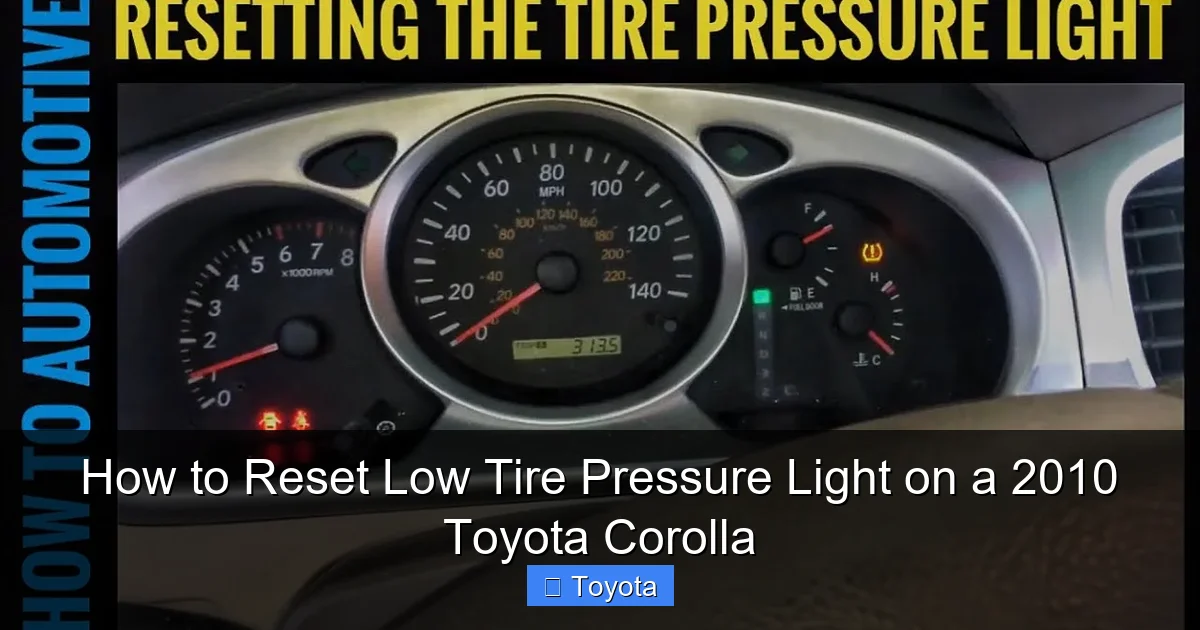
Visual guide about How to Reset Low Tire Pressure Light on a 2010 Toyota Corolla
Image source: i.ytimg.com
Finding the Correct Pressure
Do NOT use the pressure number printed on the tire’s sidewall. That’s the maximum pressure the tire can hold, not what your Corolla needs. The correct pressure is on a sticker located on the driver’s side door jamb (the B-pillar) when you open the door. It will say something like “Tire Placard” and list pressures for the front and rear tires, usually in PSI (pounds per square inch). For a base 2010 Corolla, it’s commonly 32 PSI for all four tires, but always verify with your door sticker.
The Proper Inflation Process
- Check when cold: “Cold” means the car hasn’t been driven for at least three hours or has been driven less than a mile. Driving heats the tires and gives a falsely high reading.
- Use a reliable gauge: Digital stick-style gauges are inexpensive and accurate. Don’t trust the gauge at a gas station air pump; they are often inaccurate.
- Remove the valve cap: Screw it off and set it somewhere safe.
- Press the gauge on firmly: You’ll hear a slight hiss. Read the PSI.
- Add air as needed: Use an air compressor. Add a few seconds at a time, then re-check. It’s easy to over-inflate.
- Replace the valve cap: Screw it back on tightly to keep dirt and moisture out.
Inflate all four tires to the exact spec on your door jamb sticker. If one tire is significantly lower than the others, you likely have a leak that needs repair before proceeding.
Step 2: The Manual Reset Procedure – Using the TPMS Button
Once all tires are correctly inflated, it’s time to tell your car’s computer, “Hey, we’re good now!” Your 2010 Corolla has a dedicated TPMS reset button for this purpose.
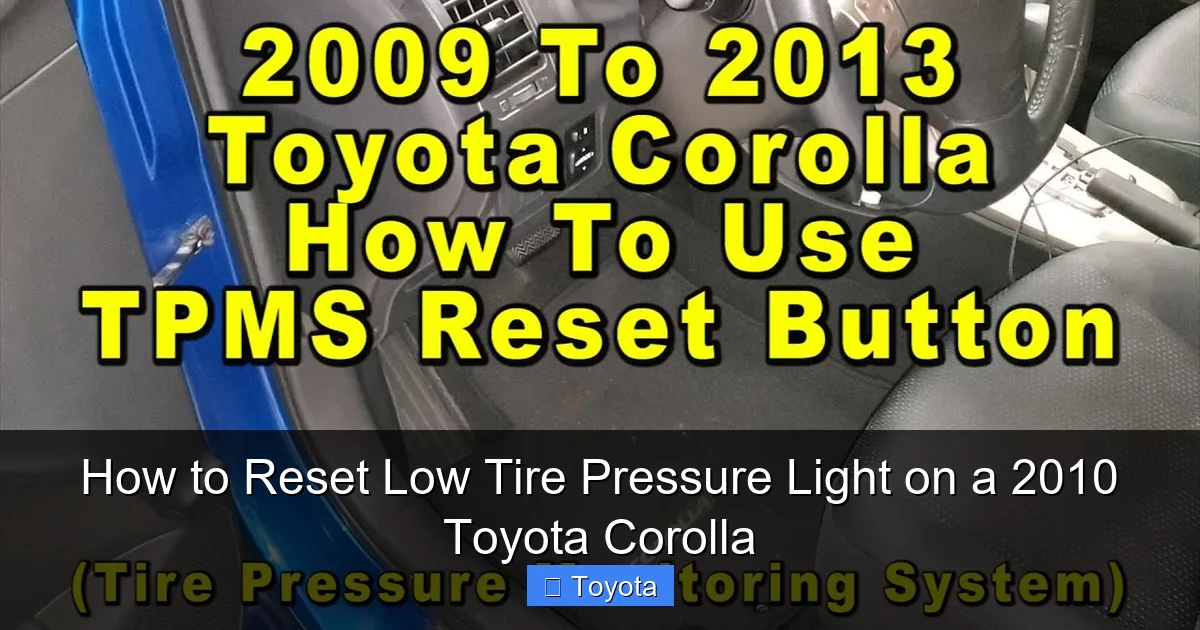
Visual guide about How to Reset Low Tire Pressure Light on a 2010 Toyota Corolla
Image source: i.ytimg.com
Locating the TPMS Button
The button is typically located on the lower dash, to the left of the steering column, near the hood release. It’s usually a small, round button labeled “TPMS” or with a symbol that looks like a cross-section of a tire with an exclamation point inside. Consult your owner’s manual if you can’t find it immediately.
The Exact Reset Sequence
Follow these steps precisely:
- Turn the ignition to “ON”: Do not start the engine. Just turn the key to the position where all dashboard lights come on.
- Press and hold the TPMS button: You’ll need to hold it for about 3 seconds. You should hear a short, audible beep.
- Watch the TPMS light: After the beep, the tire pressure warning light on your dash should start blinking three times. This indicates the reset process has been initiated and the system is now relearning the sensor values.
- Start the engine: After the light blinks three times, you can start the car. The light should go off within a few seconds. If it remains on, drive the car at a steady speed (see next section).
Important Note: If the light comes back on immediately or flashes repeatedly, it indicates a sensor fault. At this point, you need to have the system scanned with a TPMS diagnostic tool to identify which sensor is failing. This is often a job for a tire shop.
Step 3: The Driving Relearn Method – Let the Car Do the Work
Sometimes, the manual button press doesn’t complete the relearn process immediately. The system might need to verify the sensor signals while the car is moving. This is a common and effective secondary method.
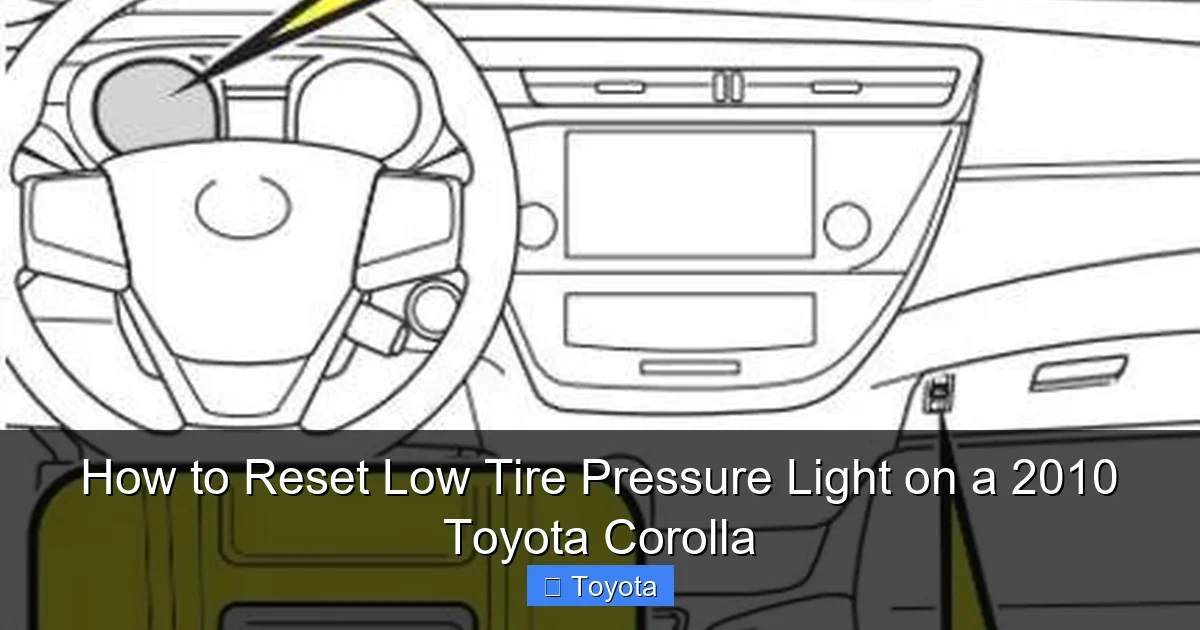
Visual guide about How to Reset Low Tire Pressure Light on a 2010 Toyota Corolla
Image source: seventrumpet.com
The Driving Protocol
After you’ve inflated the tires and attempted the manual reset (or even if you skipped the button), you can try this:
- Ensure the light is on: Drive at a steady speed of 50 mph (80 km/h) or higher for at least 10-15 minutes.
- Constant speed is key: Avoid heavy acceleration or braking. Highway driving is perfect for this.
- Varied temperatures: The system may also need to see the sensors under load and at operating temperature.
During this drive, the TPMS control module is “listening” to each sensor’s signal and comparing the pressure data. Once it confirms all sensors are reporting pressures within the acceptable range, it will automatically turn off the warning light. You might see it blink once or twice during the drive before going solid off.
When Driving Reset Fails
If you’ve driven for 20 minutes at highway speed and the light is still on, it strongly points to one of two issues: 1) A tire is still not at the correct pressure (re-check them all!), or 2) A sensor is damaged, has a dead battery, or is otherwise malfunctioning. At this stage, professional diagnosis is required.
Special Situations & Troubleshooting the Stubborn Light
What if you’ve done everything right and the light is still mocking you? Let’s troubleshoot some common tricky scenarios.
The Flashing Light
A TPMS light that flashes for about 30-60 seconds when you start the car and then stays solid is a classic indicator of a system fault, usually a communication error with a sensor. This is different from the solid light that simply means “low pressure.” A flashing light means “Hey, I have a problem with my monitoring system.” This almost always requires a scan tool to pinpoint the faulty sensor or, in rare cases, an issue with the vehicle’s receiver module.
After Tire Service
If you just had tires rotated, a flat repaired, or new tires installed, the TPMS may need a specific “relearn” procedure that is more involved than the standard button press. Some shops use a handheld tool to activate each sensor and teach the car its new location (e.g., the sensor that was on the front right is now on the rear left). If the light came on after such a service, call the shop—they may have forgotten to complete the relearn.
Seasonal Changes
This is the #1 culprit for repeat offenders. As temperatures dip in fall and winter, tire pressure naturally drops. You might fill your tires in October, only to see the light again in December. The solution is to check and top off pressures monthly during cold months. If the light comes on after a cold snap, simply add a little air to bring pressures back to the door jamb spec, then reset. For a related issue on a different Toyota model, you can see how the process is similar when resetting the tire pressure light on a Toyota Sienna.
Preventive Maintenance: Keeping the Light Off for Good
A little routine care goes a long way in avoiding TPMS headaches.
Monthly Pressure Checks
Make it a habit to check your tire pressures at least once a month and before long trips. Use your own gauge for accuracy. This simple act catches slow leaks early and compensates for natural pressure loss (tires lose about 1 PSI per month) and temperature fluctuations.
Visual Inspections
While checking pressure, look for:
- Objects embedded in the tread (nails, screws).
- Sidewall cuts, bulges, or cracks.
- Uneven tread wear, which can indicate an alignment issue.
- Damaged or corroded valve stems.
Understanding Sensor Lifespan
TPMS sensors are not lifetime parts. The internal battery typically lasts 7-10 years. For a 2010 vehicle, the original sensors are at or beyond their expected lifespan. If you are frequently getting low pressure warnings with no obvious cause, or if a sensor reading is “dead” during a diagnostic scan, plan for sensor replacement. It usually involves removing the tire and wheel, replacing the sensor (or the entire valve stem assembly), and performing a system relearn. While this is a professional job, knowing the potential cost helps you budget.
Conclusion: You’ve Got This!
Resetting the low tire pressure light on your 2010 Toyota Corolla is a simple two-part dance: 1) Inflate correctly, 2) Reset the system. The manual button press is your primary tool, backed up by a short highway drive. Always start with the root cause—proper tire inflation—and remember that a persistent or flashing light is your car’s signal for deeper, professional help. By incorporating monthly pressure checks into your routine, you’ll enjoy safer driving, better fuel economy, and a lot less annoyance from that little dashboard icon. Your Corolla is a reliable car; taking care of its tires is one of the easiest and most important things you can do to keep it that way for years to come.
Frequently Asked Questions
Why does my tire pressure light come on in cold weather?
Cold air is denser, which reduces tire pressure. A drop of 10°F can lower pressure by about 1 PSI. This often triggers the light. Simply add air to reach the recommended PSI on your door jamb sticker, then reset the light.
Can I reset the TPMS light without starting the car?
Yes. The manual reset procedure requires turning the ignition to the “ON” position (all dash lights on) but does not require the engine to be running. You start the engine only after holding the TPMS button and hearing the beep.
How long do I need to drive to reset the tire pressure light?
If the manual reset doesn’t work immediately, drive at a steady speed of 50 mph or higher for 10-15 minutes. The system needs this time to relearn and verify the sensor signals while the tires are up to temperature and under load.
What if the TPMS light keeps coming back after a reset?
This usually means a tire is still losing air (have it checked for a puncture or bead leak) or one of the TPMS sensors is faulty. A flashing light that goes solid is a definite sign of a sensor or system communication fault that needs professional diagnosis.
Is it safe to drive with the tire pressure light on?
It depends. If the light came on suddenly and the tire looks visibly flat or damaged, do not drive. Call for assistance. If the light is on but the tire appears normal and you’ve checked the pressure, it’s likely just a few PSI low. Driving a short distance to a safe location to add air is generally okay, but prolonged driving on underinflated tires is dangerous and causes damage.
Does replacing a tire affect the TPMS reset?
Yes. If a tire is removed from the wheel (for a patch, plug, or replacement), the sensor’s connection to the valve stem can be disturbed. After remounting and inflating the tire, you will almost always need to perform the manual TPMS reset procedure for the system to recognize the sensor is back in place and functioning. This is a standard step after any tire service.
