

How to Replace the Alternator on a 2013 Hyundai Elantra

Contents
- 1 Key Takeaways
- 2 📑 Table of Contents
- 3 Understanding Your Elantra’s Alternator
- 4 Tools and Preparation: Getting Ready for the Job
- 5 Removing the Old Alternator: A Step-by-Step Walkthrough
- 6 Installing the New Alternator: Positioning and Securing
- 7 Reconnecting the Serpentine Belt and Final Checks
- 8 Reconnecting the Battery and Testing Your Work
- 9 Conclusion and Final Tips for Success
- 10 Frequently Asked Questions

Car Cup Holder Expander

Car Armrest Cushion

Car Tool Kit Set

LED Indicator Light
Replacing the alternator on your 2013 Hyundai Elantra is a manageable DIY project that can save you significant labor costs. With basic tools and careful attention to safety, you can complete this repair in under two hours. Follow our detailed guide to ensure a successful installation and get your Elantra back on the road reliably.
Hey there, fellow car enthusiast! Is your 2013 Hyundai Elantra giving you warning signs like a flickering dashboard light, dimming headlights, or that dreaded battery warning icon? It’s a classic symptom of a failing alternator. Before you panic and head to the dealership, take a deep breath. Replacing the alternator on this model is a very doable DIY job for anyone with basic mechanical skills and a willingness to get their hands dirty. In this complete guide, we’ll walk through every single step, from understanding the part to the final test. By the end, you’ll have the confidence and knowledge to tackle this repair yourself, saving a small fortune in labor costs. Let’s pop the hood and get started.
Key Takeaways
- Cost Savings: DIY alternator replacement saves $300-$600 in labor fees compared to a dealership.
- Essential Tools: You’ll need common hand tools, a torque wrench, and safety gear like gloves and glasses.
- Safety First: Always disconnect the negative battery terminal before starting to avoid electrical shorts.
- Belt Tension is Critical: Proper serpentine belt tension prevents slippage and premature wear on the new alternator.
- Torque Specifications: Follow manufacturer torque specs for mounting bolts to prevent damage or vibration.
- Test Thoroughly: After installation, check voltage output and monitor the battery light to confirm success.
- Consider the Belt: Inspect the serpentine belt; replace it if worn to avoid future failures.
📑 Table of Contents
- Understanding Your Elantra’s Alternator
- Tools and Preparation: Getting Ready for the Job
- Removing the Old Alternator: A Step-by-Step Walkthrough
- Installing the New Alternator: Positioning and Securing
- Reconnecting the Serpentine Belt and Final Checks
- Reconnecting the Battery and Testing Your Work
- Conclusion and Final Tips for Success
Understanding Your Elantra’s Alternator
Before we grab any tools, let’s quickly understand what we’re dealing with. The alternator is the heart of your Elantra’s charging system. While the battery starts the car, the alternator takes over once the engine is running. It generates electricity to power all the car’s electronics—from the radio and lights to the engine control computer—and, crucially, it recharges the battery. If it fails, you’re running on battery power alone, which will eventually drain, leaving you stranded.
What Does an Alternator Do?
Think of it as a small, engine-driven generator. A serpentine belt spins the alternator’s pulley, which turns an internal rotor and creates a magnetic field. This process generates alternating current (AC), which is converted to direct current (DC) by a rectifier to power your car’s 12-volt electrical system. A healthy alternator typically outputs around 13.8 to 14.4 volts to the battery when the engine is running.
Common Signs of a Failing Alternator on a 2013 Elantra
Your Elantra will give you clues. Watch for:
- The Battery Light: This is the most obvious sign. It looks like a little battery and usually illuminates when you start the car. If it comes on while driving, the alternator isn’t charging properly.
- Dim or Flickering Lights: Headlights, interior lights, or dashboard lights that dim when the engine idles or brighten when you rev the engine point to voltage instability.
- Electrical Glitches: Slow or struggling power windows, a radio that cuts out, or erratic gauge behavior.
- Dead Battery: If your battery is relatively new but keeps dying, the alternator isn’t recharging it.
- Strange Noises: A squealing or grinding noise from the engine bay could indicate a worn serpentine belt or failing alternator bearings.
If you’ve diagnosed a bad alternator, don’t worry. The 2013 Elantra’s 1.8L or 2.0L engine makes this replacement straightforward. We’ll focus on the most common 1.8L GDI engine, but the process is nearly identical for the 2.0L.
Tools and Preparation: Getting Ready for the Job
Proper preparation is half the battle. Gathering your tools and creating a clean workspace will make this repair smooth and efficient. Rushing this step can lead to lost bolts or damaged components.
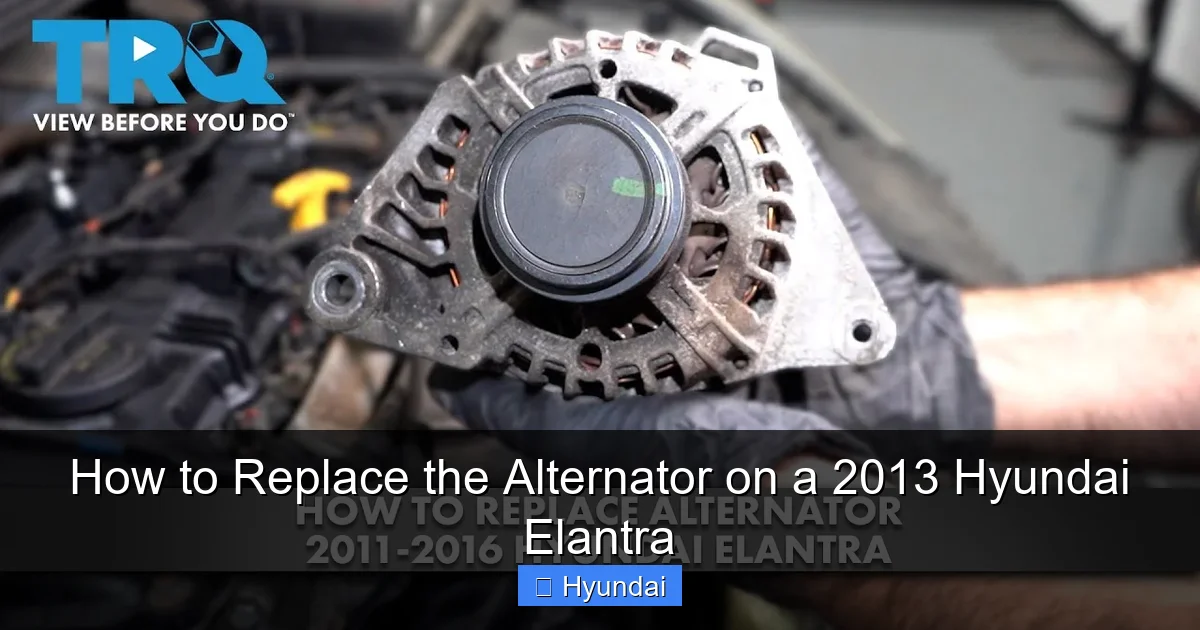
Visual guide about How to Replace the Alternator on a 2013 Hyundai Elantra
Image source: i.ytimg.com
Essential Tools You’ll Need
You likely have most of these in your garage:
- Socket Set and Ratchet: A 10mm, 12mm, and 14mm socket will cover nearly every bolt on this job. A 3/8″ drive ratchet is ideal for tight spaces.
- Wrenches: A 10mm and 12mm combination wrench for the battery terminal and some mounting bolts.
- Torque Wrench: Critical for properly tightening the alternator mounting bolts to spec (usually around 18-25 ft-lbs). If you don’t have one, be very careful not to overtighten.
- Screwdrivers: A flathead and Phillips for prying and removing plastic clips.
- Pliers: Needle-nose pliers are great for removing electrical connector locks and small clips.
- Serpentine Belt Tool (Optional but Helpful): A special tool that fits into the tensioner pulley to release belt tension. You can often use a ratchet and socket on the tensioner bolt instead.
- Flashlight or Work Light: The alternator location is dark. A good light is essential.
Safety First: Disconnecting the Battery
This is non-negotiable. Before touching a single bolt, you must disconnect the negative (-) battery terminal. This prevents any accidental short circuits that could damage the car’s electronics or cause sparks. Use your 10mm wrench to loosen the nut on the negative terminal, then lift the cable off and tuck it safely away from the battery post. For more on basic battery safety, you can review general maintenance steps similar to those in our guide on changing an air filter on a Honda Civic, where the same principle of disconnecting power applies for certain procedures.
Getting the Right Replacement Part
Don’t just buy any alternator. For your 2013 Hyundai Elantra, you need an alternator that matches the engine and electrical specs. The OEM part number is important. You have a few options:
- OEM (Hyundai): Most reliable, often with a warranty, but the most expensive.
- Rebuilt/Remanufactured: A cost-effective middle ground. These are used units that have been disassembled, worn parts replaced, and tested. Look for reputable brands with good warranties.
- Aftermarket New: Brands like Denso, ACDelco, or Bosch make new alternators. Ensure it’s an exact fit for your Elantra’s year, make, model, and engine size.
Pro Tip: While you’re under the hood, inspect your serpentine belt. If it’s cracked, glazed, or has more than 60,000 miles on it, replace it now. It’s cheap insurance and saves you from doing this job again in a few months. A belt and tensioner kit is a good investment.
Removing the Old Alternator: A Step-by-Step Walkthrough
Now for the hands-on part. The alternator on the Elantra is located on the front of the engine, near the top, on the passenger side. It’s held by two or three bolts and connected by electrical wires and the serpentine belt. Let’s get it out.

Visual guide about How to Replace the Alternator on a 2013 Hyundai Elantra
Image source: i.ytimg.com
Step 1: Access and Belt Removal
First, you need to relieve the tension on the serpentine belt so you can slip it off the alternator pulley. Locate the belt tensioner—a pulley with a built-in arm, usually on the driver’s side of the engine. It has a square or hex-shaped hole in the arm. Use your serpentine belt tool or a 1/2″ breaker bar (or a long-handled ratchet) inserted into that hole. Pivot the tensioner clockwise (usually) to slacken the belt. Be careful; the spring is strong. Hold it in that position. Now, reach over and slide the belt off the alternator pulley. Slowly release the tensioner. Do not let the tensioner snap back. If your belt has a diagram under the hood (it should!), take a photo for reinstallation.
Step 2: Disconnecting Electrical Connections
The alternator has two main electrical connectors: a large, multi-wire plug and a smaller, single-wire cable that goes to the battery (the charging wire). The large plug has a small plastic locking tab. Press the tab in and pull the connector straight off. The smaller cable is usually held on by a 10mm nut. Use your wrench to loosen it, then pull the cable off the alternator’s terminal. Label these connectors with tape or a marker if they look similar to others. This prevents confusion during reinstallation.
Step 3: Unbolting the Alternator
With the belt and wires free, it’s time to unbolt the alternator from the engine. You’ll typically find two mounting bolts. One is at the top, often a 12mm or 14mm bolt that goes through a fixed bracket. The other is at the bottom, usually a 10mm or 12mm bolt that goes through an adjustable bracket. Start with the top bolt. Use your socket and ratchet to break it loose, then unscrew it completely. Now, the bottom bolt. This one may be slightly trickier to reach. Loosen it, but you might not be able to remove it entirely until you wiggle the alternator out. Do not force it. Once both bolts are loose, carefully pivot and maneuver the alternator out of the engine bay. It’s heavy (about 15 lbs), so have a good grip. Watch for any snagged wires or hoses.
Practical Example: On many 2013 Elantras, the bottom bolt threads into the alternator itself. Loosening it allows the alternator to pivot on the top bolt, creating slack to remove the belt. Remembering this pivot point can save you frustration.
Installing the New Alternator: Positioning and Securing
With the old unit out, give the mounting brackets a quick wipe with a rag. Now, let’s install the new or remanufactured alternator. It’s basically the reverse of removal, but with a few important details.

Visual guide about How to Replace the Alternator on a 2013 Hyundai Elantra
Image source: i.ytimg.com
Step 1: Position the New Unit
Lift the new alternator into place. Align the holes in the mounting brackets with the holes on the engine block. Start by threading the bottom bolt (the one through the adjustable bracket) by hand. This bolt often has a long, threaded stud on the alternator. Get it started a few turns. Then, pivot the alternator to align the top bolt hole and thread the top bolt in. Hand-tighten both bolts to hold the unit in place. Ensure the pulley is roughly aligned with the other engine pulleys.
Step 2: Tightening the Mounting Bolts to Spec
This is where your torque wrench comes in. Consult your service manual for the exact torque spec, but it’s typically around 18-25 ft-lbs for the bolts. Tighten the bottom bolt first to its spec, then the top bolt. Do not overtighten. Overtightening can crack the alternator housing or strip the threads in the engine block. If you don’t have a torque wrench, tighten the bolts firmly and evenly—think “snug plus a quarter turn.” The goal is to eliminate any wobble or movement.
Step 3: Reconnecting the Electrical System
Now, reconnect the electrical connectors you labeled earlier. First, attach the smaller battery charging cable to its terminal on the alternator (usually a post with a nut). Tighten the 10mm nut securely. Then, plug the main multi-wire connector back in. You should hear it click as the locking tab engages. Give each connection a gentle tug to ensure it’s seated properly. A loose connection here will cause charging problems.
Reconnecting the Serpentine Belt and Final Checks
With the alternator bolted and wired, it’s time to get the belt back on. This step requires a bit of finesse.
Step 1: Routing the Serpentine Belt
Refer to the belt routing diagram under your hood or the photo you took earlier. The belt must pass around several pulleys in a specific path. Start by placing the belt on the alternator pulley. Then, using your serpentine belt tool or breaker bar, pivot the tensioner clockwise again to create slack. Carefully route the belt around the remaining pulleys (crank, water pump, AC compressor, etc.) according to the diagram. Ensure the belt is fully seated in the groove of every pulley. A misrouted belt will cause overheating and a total breakdown.
Step 2: Releasing the Tensioner
Once the belt is on all pulleys, slowly and carefully release the tensioner. The belt will tighten into place. Do not let go of the tool until the belt is fully on and the tensioner is resting against its stop. Visually inspect the belt. It should have about a half-inch of deflection when pressed firmly in the middle of its longest run. If it’s too tight or too loose, you’ll need to re-check the routing or the tensioner’s condition.
Step 3: The All-Important Final Inspection
Before you reconnect the battery, do a thorough once-over:
- Are all bolts tight? Double-check the alternator mounting bolts.
- Are all electrical connectors fully plugged in and locked?
- Is the serpentine belt properly seated on every pulley and tensioner?
- Are any tools, rags, or debris left in the engine bay?
- Did you accidentally leave any covers or shields off?
This “pre-flight check” can save you from a frustrating re-do.
Reconnecting the Battery and Testing Your Work
The moment of truth has arrived. It’s time to power everything up and see if your hard work paid off.
Step 1: Reconnect the Battery
Go back to the battery. Reconnect the negative (-) terminal. Tighten the nut securely with your wrench. A loose connection here can cause all sorts of intermittent electrical problems.
Step 2: Start the Engine and Listen
Turn the key and start the engine. It should crank normally and start without hesitation. Listen carefully. Is there any new squealing or grinding noise? A new alternator should be quiet. A high-pitched squeal could mean the belt is still misaligned or the new alternator’s bearings are defective (unlikely but possible).
Step 3: Check Voltage Output
This is the definitive test. You need a multimeter. Set it to DC volts (20V range). Connect the red probe to the positive battery terminal and the black probe to the negative terminal. With the engine off, you should see about 12.4-12.6 volts. Now, start the engine. The voltage should rise to between 13.8 and 14.4 volts. This confirms the alternator is charging the battery. Rev the engine to about 2000 RPM; the voltage should stay within that range and not spike above 15 volts. If it reads 12 volts or less with the engine running, the alternator isn’t working. If it’s above 15 volts, the voltage regulator is faulty (rare on a new unit). For those who enjoy troubleshooting electrical gremlins, procedures like resetting a computer on a Dodge Ram after an electrical repair follow a similar principle of verifying system functionality after a key component is serviced.
Step 4: Monitor the Dashboard
Look at your instrument cluster. The battery light should be off. If it’s still on, double-check all your electrical connections and belt tension. Drive the car for 15-20 minutes, varying the RPMs. Keep an eye on the voltage gauge (if equipped) or the battery light. It should remain off. After driving, turn the car off and try to restart it. A properly charging system will have no issues.
Conclusion and Final Tips for Success
Congratulations! You’ve successfully replaced the alternator on your 2013 Hyundai Elantra. You’ve just saved yourself hundreds of dollars and gained valuable insight into your car’s inner workings. This repair is a perfect example of how many routine maintenance items are within reach of the dedicated DIYer. Remember these key final points: always torque bolts to specification, never skip the battery disconnect, and always verify your work with a multimeter. If at any point you feel stuck, consult a factory service manual for your specific VIN or seek advice from Hyundai-specific forums. The sense of accomplishment you’ll feel when you drive that freshly repaired Elantra is worth every minute. Now, go enjoy that well-earned sense of pride and the money you kept in your pocket. For other common maintenance tasks, like resetting a maintenance light after your work is done, you can find model-specific guides similar to resetting the light on a Toyota Highlander, though procedures vary by manufacturer.
Frequently Asked Questions
How long does it take to replace an alternator on a 2013 Hyundai Elantra?
For a competent DIYer with the right tools, expect this job to take between 1.5 to 2.5 hours. Your first time will be slower as you learn the layout. A professional mechanic might do it in an hour.
What is the most common mistake during this replacement?
The most frequent errors are improper serpentine belt routing or tension, and forgetting to torque the mounting bolts. A misrouted belt will cause immediate failure. Overtightened bolts can crack the alternator housing.
Can I drive with a bad alternator?
You can drive a short distance on battery power alone, but it’s risky. Once the battery drains, the car will stall, and you’ll lose power steering and brakes. It’s not safe and can strand you. Replace it as soon as possible.
How much does a replacement alternator cost?
A remanufactured alternator for a 2013 Elantra typically costs $150-$250. A new OEM unit can be $400-$600. Adding a serpentine belt and tensioner kit adds another $50-$100. This compares to a total dealership cost of $500-$900 for parts and labor.
Do I need to reset anything after replacing the alternator?
Usually, no reset is required. The battery light should go off once the new alternator is working and the system voltage is normal. However, if the light persists, check connections and voltage output. Some models may require a battery disconnect reset, but it’s not standard for the Elantra.
What if my serpentine belt is worn? Should I replace it?
Absolutely yes. The belt is relatively inexpensive. Since you’re already removing it to access the alternator, this is the perfect time to install a new one. A worn belt can slip on the new alternator pulley, causing noise and poor charging, leading you to think the new alternator is bad.


