
How to Put an Infiniti Qx50 in Neutral with a Dead Battery

Facing a dead battery in your Infiniti QX50 can trap you in park, making towing or jump-starting impossible. The solution is a manual shift lock override, a hidden feature that lets you move the shifter to neutral without power. This process is simple but requires knowing the exact location of the release mechanism and following critical safety steps to avoid damaging your vehicle’s transmission.
Key Takeaways
- Your QX50’s electronic shifter locks in Park when the battery dies. The vehicle’s safety system requires battery power to release the shift lock solenoid, leaving you unable to move the shifter.
- A manual shift lock release is built into every QX50. This is a small, covered slot near the shifter that allows for mechanical override when electronic controls fail.
- You must access the shift lock cover first. The plastic cover is secured by a clip or small screw and must be removed carefully to avoid breaking it.
- A flat-head screwdriver or a dedicated shift lock release tool is required. You will insert the tool into the slot and push down while simultaneously moving the shifter.
- Engaging neutral is only for towing or pushing the vehicle a short distance. The QX50 must be in neutral for a tow truck’s dolly or flatbed, and for safe push-starting if applicable.
- Once the battery is charged or replaced, the system resets automatically. The electronic shift lock will function normally again once the vehicle has sufficient power.
- Always consult your owner’s manual first. While this guide is accurate for 2026 models, specific instructions and warnings are always in your vehicle’s manual.
[FEATURED_IMAGE_PLACEHOLDER]
📑 Table of Contents
- Introduction: When Your QX50 is Stuck in Park
- Understanding Your QX50’s Electronic Shift System
- Step-by-Step: How to Put Your QX50 in Neutral
- Important Safety Precautions and Warnings
- After the Move: What to Do Next
- Common Mistakes and Troubleshooting
- Conclusion: Knowledge is Power (Especially When Your Battery is Dead)
Introduction: When Your QX50 is Stuck in Park
You’re all set. The tow truck is on its way, or you’ve got a friend ready to give you a push to get the engine turning. You go to put your Infiniti QX50 in neutral, and the shifter won’t budge. It’s firmly locked in the “P” (Park) position. The culprit? A dead battery. In modern vehicles like the 2026 Infiniti QX50, the shift interlock system is electronically controlled. No battery power means no solenoid release, and your shifter becomes a solid, unmoving piece of plastic and metal. This isn’t just an inconvenience; it’s a roadblock to getting your car moving again.
But don’t panic. Infiniti engineers, anticipating this exact scenario, built in a manual bypass. This feature, often called a “shift lock release” or “manual shift override,” is your key to freedom. It’s a purely mechanical solution that disengages the electronic lock, allowing you to physically move the shifter into neutral. This guide will walk you through everything you need to know, from locating that tiny hidden slot to performing the maneuver safely and correctly. We’ll cover the specifics for your 2026 QX50, safety must-knows, and what to do after you’ve got it in neutral.
Understanding Your QX50’s Electronic Shift System
Before we get our hands dirty, it helps to understand *why* this happens. The Infiniti QX50 uses what’s called an “electronic shift-by-wire” system. There’s no direct mechanical linkage between the shifter lever and the transmission. Instead, when you move the lever, you’re sending an electronic signal to a control module, which then commands a solenoid (an electromagnetic switch) to physically move the transmission’s shift mechanism.
Visual guide about How to Put an Infiniti Qx50 in Neutral with a Dead Battery
Image source: i.ytimg.com
The “Park” position has a secondary, crucial safety lock. A small pin physically engages a slot in the transmission shaft to prevent it from rolling. This pin is held in place by a spring and released by the shift lock solenoid when you press the brake pedal and move the shifter. With no battery power, that solenoid is dead. The pin stays engaged, and the shifter’s internal mechanism is electronically blocked from moving. The manual shift lock release we’ll use provides a direct, mechanical way to push that solenoid pin out of the way, bypassing the need for electricity.
Where to Find the Shift Lock Release on a 2026 Infiniti QX50
The location is consistent across recent QX50 model years. You’ll find it on the center console, right on the trim panel surrounding the shifter assembly. It’s a small, rectangular or oval-shaped plastic cover, often with a tiny groove or slit in it. On the 2026 model, it’s typically located:
- On the front face of the shifter console, just below the shifter boot (the leather or fabric cover around the base of the lever).
- To the right of the shifter, near where the drive mode buttons (if equipped) are located.
- It might be labeled with a tiny symbol of a shifter in neutral or have a “SHIFT LOCK RELEASE” stamping, though it’s often just an unmarked cover.
Take a close look. You’re searching for a small panel, about 1-2 inches long, that looks like it could be pried off. It’s held in place by a plastic clip or a tiny Torx screw. A good flashlight will be your friend here.
Step-by-Step: How to Put Your QX50 in Neutral
Now, let’s get to it. Follow these steps precisely. If at any point you feel unsure, stop and call for professional roadside assistance. Forcing the wrong thing can cause damage.
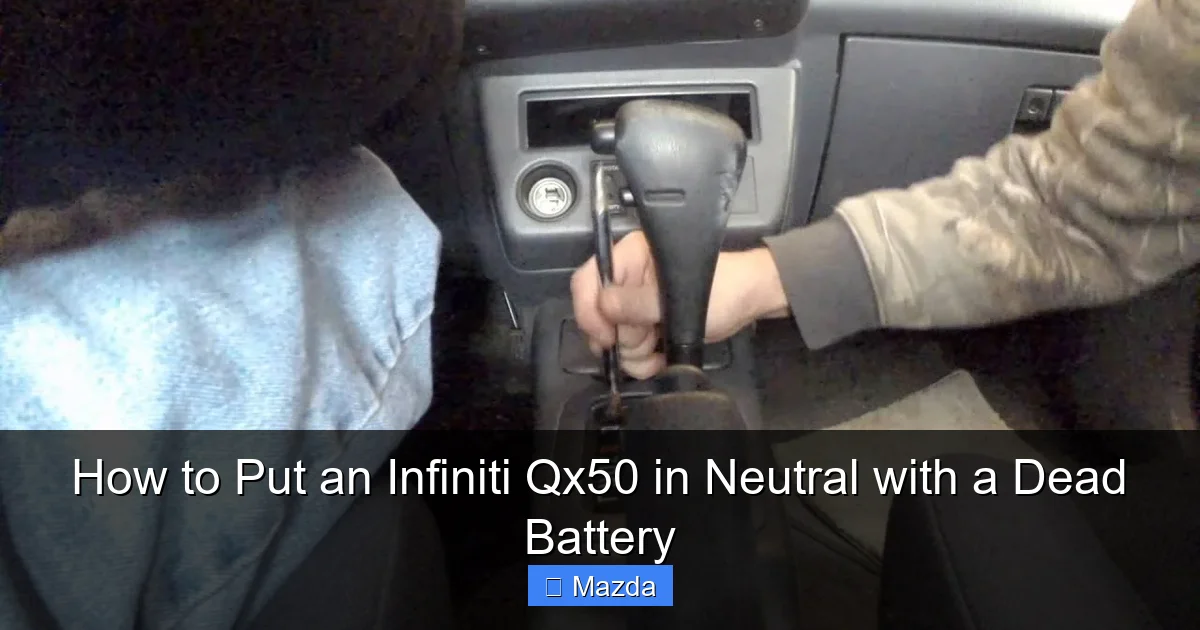
Visual guide about How to Put an Infiniti Qx50 in Neutral with a Dead Battery
Image source: i.ytimg.com
Step 1: Preparation and Safety First
Ensure the vehicle is on a level, solid surface. Engage the parking brake firmly—even though the car is in park, this is a critical backup. Turn off all accessories and the ignition if it’s still on (it likely isn’t with a dead battery). If you plan to push the car, make sure the path is clear and you have enough people to do it safely. Never attempt this on a hill or sloped surface. The parking brake should hold, but it’s not designed for long-term security on an incline. If you’re on a slight grade, chock the wheels opposite the direction you’ll be moving.
Step 2: Access the Shift Lock Release Slot
Locate the small plastic cover described above. Using your fingernails or a plastic pry tool (like an old credit card), gently pry the cover off. It’s a friction-fit clip. Start at one edge and work your way around. Be patient; aggressive prying can crack the plastic. If it has a tiny screw, use the appropriate Torx bit from your emergency kit. Set the cover aside in a safe place so it doesn’t get lost.
Once the cover is off, you’ll see a small hole or slot. This is the manual override port.
Step 3: The Override Procedure
This is the critical step that requires finesse. You need a tool that fits snugly into the slot. A flat-head screwdriver with a 3-4mm blade is usually perfect. Some vehicles come with a dedicated plastic tool in the glove box or trunk—check your owner’s manual.
Here is the exact sequence:
- Insert the flat-head screwdriver straight down into the slot. You should feel it engage with a mechanism inside.
- While holding the screwdriver firmly inserted and pressed down, use your other hand to grasp the shifter knob.
- Apply constant, steady pressure on the screwdriver (downwards). You are mechanically depressing the solenoid that is locked by the dead battery.
- Simultaneously, push the brake pedal down with your foot (if you can reach it). On some models, the brake pedal must be depressed for the shifter to move, even in manual override. On others, it’s not required. Depressing the brake is a safe, universal step to try.
- While holding the screwdriver down and the brake pedal down, move the shifter lever into the Neutral (N) position. You will feel it click into place. It may require a firm but controlled push.
- Once the shifter is securely in Neutral, you can slowly remove the screwdriver.
The shifter should now stay in Neutral. If it springs back to Park, you likely didn’t hold the screwdriver down firmly enough during the entire move. Try again.
Step 4: Verification and Moving the Vehicle
Gently rock the vehicle back and forth by hand. You should feel a distinct lack of resistance from the transmission. The wheels should be able to turn freely (though they’ll have the drag of the parking brake if engaged). If you feel the hard “clunk” of the parking pawl engaging, you are still in Park.
Once confirmed in neutral:
- If towing: The vehicle can now be loaded onto a flatbed tow truck. For dolly towing (front wheels lifted), your QX50’s all-wheel-drive system typically requires all four wheels to be off the ground or a specific procedure. Always confirm the correct towing method for your AWD QX50 with the tow truck operator. Incorrect dolly towing can destroy the transmission.
- If push-starting (manual transmission only): The QX50 is an automatic, so push-starting is not possible. You must jump-start it or tow it to a location for a battery service.
- If just moving it a short distance (e.g., out of a tight parking spot): Proceed with extreme caution. Have helpers guide you. Remember, without power, you have no power steering or brake boost. Steering will be very heavy, and braking will require significant force. Only move the vehicle at a crawl, a few feet at a time, if absolutely necessary and safe.
Important Safety Precautions and Warnings
Working with a dead battery and a heavy vehicle carries risk. Here are non-negotiable safety rules:
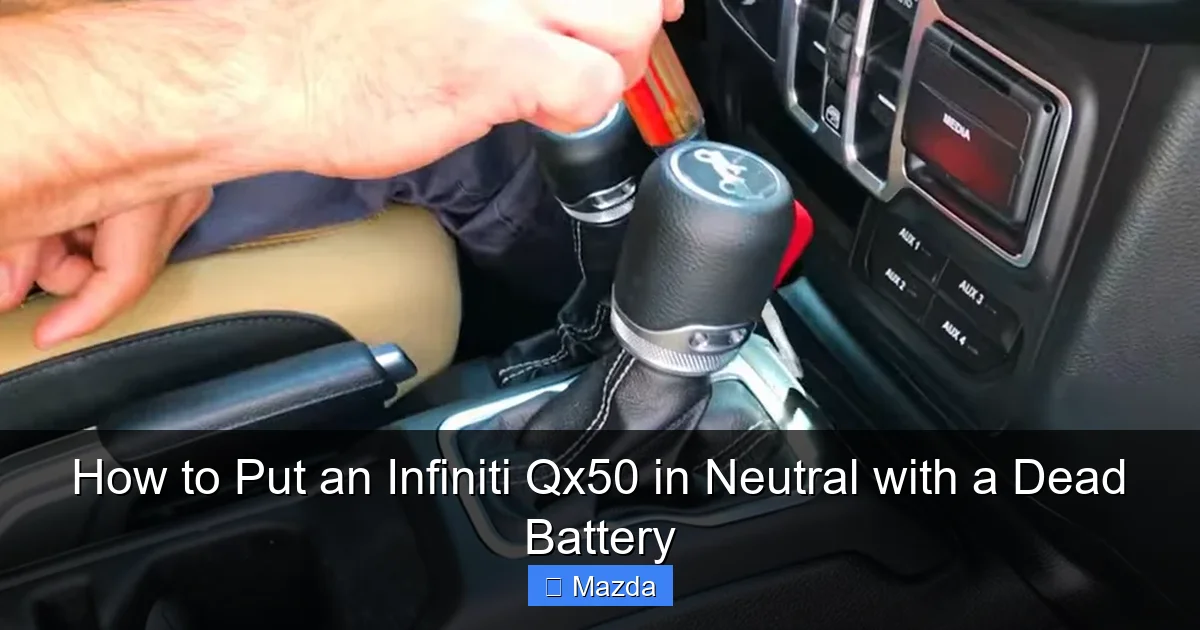
Visual guide about How to Put an Infiniti Qx50 in Neutral with a Dead Battery
Image source: adventurejeep.com
- Wheel Chocks Are Essential: Always chock the wheels that will not be moving. If you’re moving forward, chock the rear wheels. If moving backward, chock the front wheels. Use proper wheel chocks, not bricks or random objects.
- Parking Brake Reliability: The parking brake in your QX50 is electronic (if equipped with the Electronic Parking Brake). With a dead battery, it may not engage or disengage electronically. The manual override for the parking brake is usually a separate lever or cable under the hood or in the trunk. You must verify the parking brake is fully engaged before attempting to access the shift lock. If your electronic parking brake is dead and won’t engage, you may need to use wheel chocks on a steep incline or call for a professional tow truck that can winch the vehicle safely.
- Heavy Steering and Braking: Without the engine running, your power steering pump and brake booster are dead. The steering wheel will be very difficult to turn, and the brake pedal will be hard and require immense pressure to stop the car. Only attempt to move the vehicle if you are physically capable of handling this, and only at a very slow, controlled speed.
- Never Crawl Under the Vehicle: Do not attempt this procedure if you need to be under the car for any reason. A vehicle on a flat surface can still roll if the parking brake fails. Use jack stands only on solid ground and for the correct lifting points, but never perform the shift lock procedure while under the car.
- Transmission Damage Risk: The manual override is designed for this exact situation. However, if you force the shifter violently or try to move it while the transmission is still mechanically engaged in Park (pawl not released), you can cause serious damage to the shift linkage or transmission internals. The procedure requires a simultaneous, firm push on the tool and the shifter.
After the Move: What to Do Next
Getting your QX50 into neutral is just the first step. Now you need to address the root cause: the dead battery.
Option 1: Jump-Starting the QX50
Once the vehicle is in a safe location (like your driveway or a service center), you can attempt a jump-start. The 2026 QX50 has specific jump-starting terminals in the engine compartment (often a red positive terminal and a black negative grounding point). Do not connect directly to the dead battery terminals if they are corroded or inaccessible. Follow the sequence in your owner’s manual precisely: connect positive to positive, negative to the designated ground point. Start the assisting vehicle, let it run, then try starting your QX50. If it starts, let both engines run for several minutes before disconnecting. For more detailed jump-starting procedures that are universal, you can read our comprehensive guide on how to start a car with dead battery.
Option 2: Battery Replacement or Recharging
If the jump-start works, drive the vehicle for at least 30 minutes to recharge the battery. However, a battery that dies completely is usually at the end of its life (3-5 years). You should have it tested at an auto parts store or service center. They can tell you if it needs replacement. Replacing the battery in a QX50 requires specific steps to avoid damaging the sensitive electronics, often involving a memory saver. Our article on how to put a car battery in covers the general process, but always verify the procedure for your specific Infiniti model year.
Option 3: Professional Service
If the battery is completely dead and you cannot jump it, or if you are uncomfortable with any of these steps, the safest and smartest move is to have the vehicle towed directly to a trusted mechanic or Infiniti dealer. They can replace the battery with the correct AGM (Absorbent Glass Mat) type and ensure all electronic systems are properly reset.
Common Mistakes and Troubleshooting
What if it’s not working? Here are common pitfalls:
- The shifter won’t move even with the tool inserted. Ensure you are pressing the tool down HARD and CONTINUOUSLY while trying to move the shifter. The mechanism can be stiff. Also, confirm you are pressing the brake pedal. Finally, double-check you found the correct slot—it’s easy to mistake another cavity for the override.
- The plastic cover broke. This is a common issue. The clips are fragile. If it breaks, you can still access the slot. You may need to carefully pry out any remaining plastic fragments. The cover is inexpensive and can be replaced later.
- The parking brake won’t disengage after the battery is charged. This can happen with electronic parking brakes. There is often a manual release lever in the trunk or under the hood. Consult your owner’s manual for the “Electronic Parking Brake Manual Release” procedure. This is a separate system from the shifter lock.
- I think I’m in neutral, but the car still won’t roll. You are likely still in Park. Repeat the procedure, ensuring a definitive “clunk” or soft click as the shifter enters the Neutral gate. Sometimes you need to wiggle the shifter slightly left or right while holding the tool down to find the neutral position.
- My QX50 is AWD. Can I tow it with two wheels on the ground? Generally, no. Towing an Infiniti QX50 with two wheels on the ground (like on a dolly) can cause severe damage to the transmission and drivetrain unless the vehicle is specifically designed for it (most AWD vehicles are not). The only safe methods are a flatbed tow truck (all four wheels off the ground) or, in an emergency, towing with all four wheels on the ground for a very short distance at low speed (check manual for exact distance/speed limits). Always inform the tow operator your QX50 is AWD.
Conclusion: Knowledge is Power (Especially When Your Battery is Dead)
A dead battery in your 2026 Infiniti QX50 doesn’t have to mean a complete standstill. That little plastic cover on your center console holds the key to regaining mobility. By understanding the “why” behind the electronic shift lock and mastering the manual override procedure, you transform a frustrating problem into a manageable one. Remember the core principles: safety first with wheel chocks and a engaged parking brake, a firm and simultaneous action with the override tool and shifter, and a clear understanding of your vehicle’s AWD towing requirements. This skill is a powerful addition to your owner’s manual knowledge base. Bookmark this guide, keep a flat-head screwdriver in your glove compartment, and drive with confidence, knowing you’re prepared for one of the most common modern automotive predicaments.
Frequently Asked Questions
Will putting my QX50 in neutral with a dead battery damage the transmission?
No, if done correctly using the manufacturer-provided manual shift lock release, it will not damage the transmission. This feature is designed specifically for this scenario. Damage only occurs if you try to force the shifter without using the override port or if you try to tow the vehicle incorrectly (e.g., with two wheels on the ground in an AWD model).
Can I put an Infiniti QX50 in neutral without a key?
Yes, absolutely. The entire purpose of the manual shift lock release is to allow you to put the vehicle in neutral without any battery power or key in the ignition. The process is entirely mechanical and does not require the key fob to be present or the vehicle to be powered on. This is a critical safety feature for towing and recovery situations.
What if my QX50 has an electronic parking brake and it won’t disengage?
With a dead battery, the electronic parking brake motor will not work. Your QX50 should have a manual release mechanism, typically a lever or cable located in the trunk (often under the trunk liner) or sometimes under the hood. You must consult your owner’s manual for the exact location and procedure to manually release the parking brake before attempting to move the vehicle. Wheel chocks become even more critical in this scenario.
Is it safe to push my Infiniti QX50 once it’s in neutral?
It is safe only under very controlled conditions. With a dead battery, you have no power steering or brake assist. Steering will be extremely heavy, and braking will require immense pedal pressure. Only push the vehicle a very short distance (e.g., to clear a parking spot) on a flat surface, with enough strong people to guide and stop it, and with wheel chocks on the wheels that will not roll. For any significant distance, professional towing is mandatory.
My shift lock cover is missing or broken. What do I do?
If the plastic cover is broken off, you can often still see and access the slot underneath. Carefully remove any broken plastic fragments from the slot. You may need to use a smaller, more precise tool like a small Allen wrench or the tip of a sturdy pen. The vehicle will function normally once the battery is replaced, but you should replace the missing cover (available from Infiniti parts) to keep dust and debris out of the mechanism.
Once I jump-start or replace the battery, do I need to do anything special?
No. Once the vehicle has a stable power supply (from a good battery or a running engine), the electronic shift interlock system will automatically reset and function normally. The shifter will lock and unlock with the brake pedal as usual. Simply drive the vehicle for a while to ensure the battery is fully charged. If you had to manually release the electronic parking brake, you may need to re-engage it electronically once power is restored—usually by pressing the parking brake switch with the engine running.