How to Jump a Subaru Outback

Contents
- 1 Key Takeaways
- 2 📑 Table of Contents
- 3 How to Jump a Subaru Outback: A Complete Guide
- 4 Why Subaru Outback Batteries Die
- 5 What You’ll Need to Jump a Subaru Outback
- 6 Step-by-Step Guide to Jump a Subaru Outback
- 7 Safety Tips and Common Mistakes to Avoid
- 8 Alternative: Using a Portable Jump Starter
- 9 After the Jump: What to Do Next
- 10 Final Thoughts
- 11 Frequently Asked Questions

Car Windshield Wiper Blades

Car Window Tint Film

Dashboard Polish

Car Storage Net
Jumping a dead battery in your Subaru Outback doesn’t have to be stressful. With the right tools, safety precautions, and a clear process, you can get back on the road quickly and safely—even if you’re a beginner.
Key Takeaways
- Safety first: Always wear safety glasses and avoid open flames or sparks near the battery to prevent hydrogen gas ignition.
- Use quality jumper cables: Thick, insulated cables with strong clamps ensure efficient power transfer and reduce the risk of electrical issues.
- Correct jump-start sequence: Connect red to positive, black to negative (or a grounded metal part), and follow the exact order to avoid damage.
- Know your battery location: Most Outbacks have the battery under the hood, but some models (like older ones) may have it in the trunk—check your owner’s manual.
- Let the donor car run: Keep the working vehicle running during the jump to maintain voltage and help charge the dead battery.
- Don’t jump if the battery is damaged: If the battery is cracked, leaking, or frozen, do not attempt a jump—replace it instead.
- Drive after jumping: Once started, drive for at least 20–30 minutes to allow the alternator to recharge the battery fully.
📑 Table of Contents
How to Jump a Subaru Outback: A Complete Guide
Picture this: It’s a cold winter morning, you’re running late for work, and you turn the key in your Subaru Outback—nothing. Just a faint click or maybe silence. Your heart sinks. You’ve got a dead battery.
Don’t panic. A dead battery is one of the most common car problems, and it’s totally fixable—especially with a jump start. Whether you’re in a parking lot, at home, or on a quiet country road, knowing how to jump a Subaru Outback can save your day. This guide walks you through the entire process, from safety checks to post-jump care, so you can handle it like a pro—even if it’s your first time.
Why Subaru Outback Batteries Die
Before we dive into the how-to, let’s talk about why your Outback’s battery might have died in the first place. Understanding the cause can help prevent future issues and keep you from being stranded again.
Visual guide about How to Jump a Subaru Outback
Image source: lh6.googleusercontent.com
Common Causes of Battery Failure
Batteries don’t last forever—typically 3 to 5 years, depending on climate and usage. But several factors can drain your battery faster:
- Leaving lights on: Interior or exterior lights left on overnight are a classic culprit.
- Extreme temperatures: Cold weather reduces battery capacity, while heat accelerates internal corrosion.
- Short trips: Frequent short drives don’t give the alternator enough time to recharge the battery fully.
- Old age: As batteries age, they lose their ability to hold a charge.
- Parasitic drain: Faulty electronics or accessories drawing power when the car is off.
Signs Your Battery Is Dying
You don’t have to wait for a complete failure. Watch for these warning signs:
- Slow engine crank (the engine turns over slowly)
- Dim headlights or interior lights
- Dashboard warning lights (like the battery or check engine light)
- Electrical issues (power windows, radio, or locks acting up)
- Clicking sound when turning the key
If you notice any of these, it’s a good idea to test your battery or have it checked at an auto parts store. Many offer free battery testing.
What You’ll Need to Jump a Subaru Outback
Jumping a car isn’t complicated, but you do need the right tools. Here’s what you’ll need:

Visual guide about How to Jump a Subaru Outback
Image source: wonderfulengineering.com
Essential Tools
- Jumper cables: Look for heavy-duty cables (at least 4-gauge) with thick insulation and strong clamps. Longer cables (10–20 feet) give you more flexibility.
- A working vehicle: Another car with a healthy battery and a compatible voltage (12V for most Outbacks).
- Safety glasses: Protect your eyes from sparks or battery acid.
- Gloves (optional but recommended): Insulated gloves add an extra layer of safety.
Optional but Helpful Items
- Portable jump starter: A battery-powered device that doesn’t require another vehicle. Great for emergencies.
- Owner’s manual: Your Outback’s manual has model-specific info, like battery location and jump-starting tips.
- Flashlight: If you’re jumping at night or in low light.
Pro tip: Keep a set of jumper cables and a portable jump starter in your Outback’s trunk. You never know when you—or someone else—might need them.
Step-by-Step Guide to Jump a Subaru Outback
Now for the main event: how to safely and correctly jump your Subaru Outback. Follow these steps carefully to avoid damage to your vehicle or injury to yourself.

Visual guide about How to Jump a Subaru Outback
Image source: 2024subaru.com
Step 1: Park Safely and Prepare
Find a safe, flat area away from traffic. Turn off both vehicles and engage the parking brakes. If you’re on a slope, use wheel chocks if available.
Make sure both cars are in Park (for automatics) or Neutral (for manuals) with the ignition off. This prevents accidental movement during the process.
Step 2: Locate the Batteries
Most Subaru Outbacks (especially 2000 and newer) have the battery under the hood on the driver’s side. Open the hood and look for a black box with two terminals—positive (+) and negative (−).
However, some older models (like the 1995–1999 Outback) have the battery in the trunk, under the floor mat on the driver’s side. Check your owner’s manual if you’re unsure.
Important: Never assume. If you can’t find the battery under the hood, consult the manual or look in the trunk.
Step 3: Identify the Terminals
The positive terminal is usually marked with a + sign and may have a red cover. The negative terminal is marked with a − sign and is typically black or bare metal.
Some Outbacks have a remote positive terminal under the hood (a small red cap near the fuse box) and a grounding point (a bare metal bolt or bracket) instead of direct access to the negative terminal. This is for safety—connecting directly to the negative terminal can cause sparks near the battery, which is risky if hydrogen gas is present.
If your Outback has a remote positive terminal, use that instead of the battery’s positive post. The negative clamp should go to a solid, unpainted metal part of the engine block or chassis—never to the battery’s negative post.
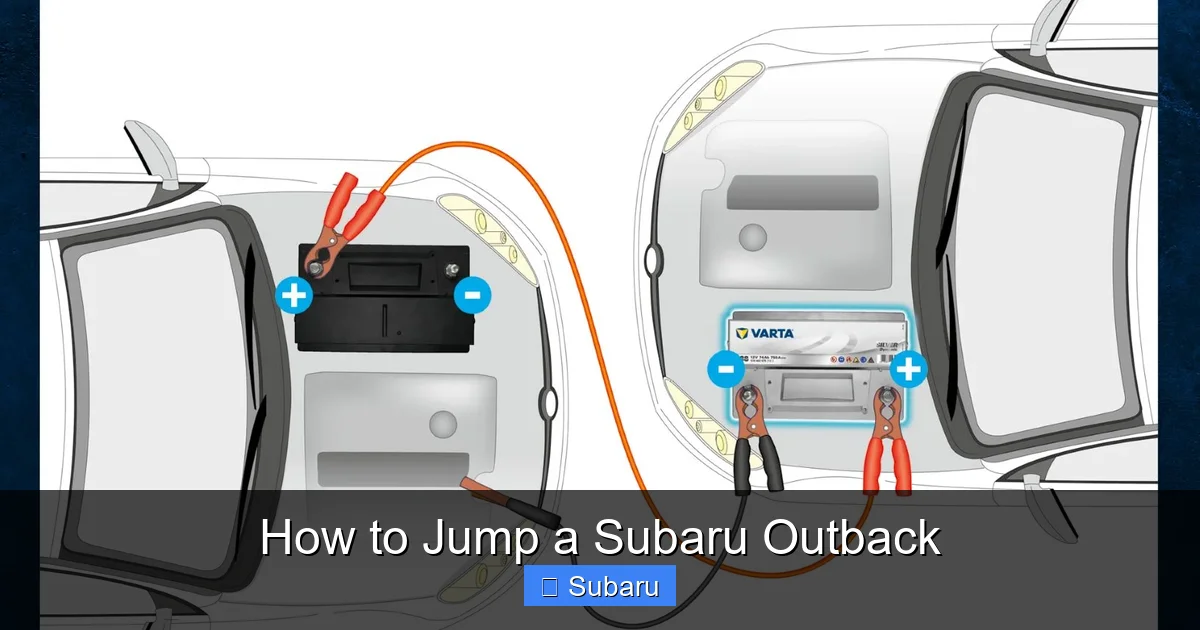
Step 4: Connect the Jumper Cables
Follow this exact sequence to avoid sparks or electrical damage:
- Red clamp to dead battery’s positive terminal (or remote positive post).
- Red clamp to donor car’s positive terminal.
- Black clamp to donor car’s negative terminal.
- Black clamp to a grounded metal part on the dead car (not the battery). Use a bolt, bracket, or engine block—something clean and unpainted.
Double-check all connections. Loose or reversed clamps can cause sparks, damage electronics, or even start a fire.
Step 5: Start the Donor Vehicle
Start the working car and let it run for 2–3 minutes. This allows the alternator to send power through the cables and begin charging the dead battery.
Keep the engine at a moderate idle—no need to rev it. Some people think revving helps, but it’s unnecessary and can strain the donor car’s electrical system.
Step 6: Attempt to Start the Outback
Now, try starting your Subaru Outback. Turn the key and listen for the engine to turn over.
If it starts right away—great! If not, wait another 2–3 minutes and try again. Sometimes it takes a few tries, especially if the battery is very low.
If it still doesn’t start after 3–4 attempts, stop and check your connections. Make sure the cables are secure and the donor car is still running.
Step 7: Disconnect the Cables (in Reverse Order)
Once your Outback is running, disconnect the cables in the reverse order:
- Black clamp from the grounded metal part on the Outback.
- Black clamp from the donor car’s negative terminal.
- Red clamp from the donor car’s positive terminal.
- Red clamp from the Outback’s positive terminal (or remote post).
Never let the clamps touch each other or any metal while they’re connected to a live battery.
Step 8: Let the Outback Run
Keep your Subaru running for at least 20–30 minutes. This gives the alternator time to recharge the battery. If you turn it off too soon, the battery may not have enough charge to start again.
If possible, drive the car instead of idling. Driving generates more alternator output, which charges the battery faster.
Safety Tips and Common Mistakes to Avoid
Jumping a car is generally safe if done correctly, but there are risks. Here’s how to stay safe and avoid common pitfalls.
Safety First: Protect Yourself and Your Vehicle
- Wear safety glasses: Batteries can emit hydrogen gas, which is flammable. A spark could ignite it.
- No smoking or open flames: Keep matches, lighters, and cigarettes far away.
- Check for damage: If the battery is cracked, swollen, or leaking, do not jump it. Replace it instead.
- Avoid touching metal parts: Don’t let the clamps touch each other or your skin while connected.
- Keep children and pets away: This is not a job for kids.
Common Mistakes to Avoid
- Reversing the cables: Connecting red to negative or black to positive can fry electronics or cause a fire.
- Connecting black to the dead battery’s negative post: This can cause sparks near the battery. Always use a grounded metal part.
- Letting the cars touch: Metal-to-metal contact can cause a short circuit.
- Jumping a frozen battery: If the battery is frozen (common in winter), do not jump it. It could explode. Let it thaw first.
- Using thin or damaged cables: Weak cables won’t transfer enough power and can overheat.
What If It Still Won’t Start?
If your Outback still won’t start after a proper jump, the problem might not be the battery. It could be:
- A faulty alternator (not charging the battery)
- A bad starter motor
- A blown fuse or relay
- A more serious electrical issue
In that case, call a tow truck or roadside assistance. Don’t keep trying to jump it—you could damage the electrical system.
Alternative: Using a Portable Jump Starter
What if you’re alone with no other car around? That’s where a portable jump starter comes in handy.
How It Works
A portable jump starter is a rechargeable battery pack with jumper cables built in. You connect it to your Outback’s battery (or remote terminals) just like you would with another car, then start your engine.
Benefits
- No need for another vehicle
- Compact and easy to store
- Often includes USB ports, flashlights, and air compressors
- Safer than traditional jumping (less risk of incorrect connections)
Tips for Using a Portable Jump Starter
- Keep it charged—many lose power if unused for months.
- Check the voltage compatibility (most are 12V, which works for Outbacks).
- Follow the manufacturer’s instructions carefully.
- Store it in a cool, dry place—not in extreme heat or cold.
Popular brands include NOCO, Jump-N-Carry, and Schumacher. A good portable jump starter costs $80–$150 and can last for years.
After the Jump: What to Do Next
Getting your Outback started is just the first step. Here’s what to do afterward to ensure everything’s working properly.
Drive to Recharge the Battery
As mentioned earlier, drive for at least 20–30 minutes. This allows the alternator to recharge the battery. Avoid turning off the engine too soon.
Check the Battery and Charging System
Visit an auto parts store or mechanic to have your battery and alternator tested. Many stores offer this service for free.
If the battery is old (3+ years), it might need replacing—even if it starts now. A weak battery can leave you stranded again.
Prevent Future Dead Batteries
- Turn off all lights and accessories when exiting the car.
- Use a battery maintainer if the car sits for long periods.
- Avoid short trips when possible.
- Have the electrical system checked annually.
When to Replace the Battery
Even with proper care, batteries wear out. Replace your Outback’s battery if:
- It’s more than 4–5 years old
- It struggles to start in cold weather
- It’s been jumped multiple times
- It fails a load test
Most Subaru Outbacks use a standard 12V, 60–70Ah battery. Check your owner’s manual for the exact specification.
Final Thoughts
Knowing how to jump a Subaru Outback is a valuable skill that every owner should have. It’s not just about getting your car started—it’s about safety, preparedness, and peace of mind.
With the right tools, a clear process, and a focus on safety, you can handle a dead battery like a pro. Whether you’re using jumper cables and a friend’s car or a portable jump starter, the key is to stay calm, follow the steps, and avoid common mistakes.
And remember: a jump start is a temporary fix. If your battery keeps dying, it’s time for a replacement. Don’t wait until you’re stranded again.
Keep this guide handy, share it with fellow Outback owners, and drive with confidence—knowing you’re ready for whatever the road throws your way.
Frequently Asked Questions
Can I jump a Subaru Outback with a hybrid or electric vehicle?
Yes, you can jump a Subaru Outback using a hybrid or electric vehicle, as long as it has a 12V auxiliary battery. Most hybrids and EVs have a small 12V battery that can power the jump, but check the donor vehicle’s manual first to confirm.
Is it safe to jump a Subaru Outback in the rain?
Yes, it’s generally safe to jump a car in light rain, but avoid doing it in heavy downpours or thunderstorms. Water increases the risk of electrical shock, so keep the battery area as dry as possible and wear insulated gloves.
How long should I let the donor car run before attempting to start the Outback?
Let the donor car run for 2–3 minutes before trying to start the Outback. This gives the dead battery a small charge. If it doesn’t start, wait another 2–3 minutes and try again—don’t keep cranking the engine.
Can I use a portable jump starter on a Subaru Outback with a manual transmission?
Yes, portable jump starters work the same way on manual and automatic transmissions. Just make sure the car is in neutral and the parking brake is engaged before jumping.
What if my Subaru Outback has a start-stop system?
Outbacks with start-stop systems (typically 2015 and newer) use enhanced batteries (like AGM). Jump them the same way, but avoid frequent jump starts—these systems are sensitive to battery health. Consider a professional inspection if issues persist.
How often should I replace my Subaru Outback’s battery?
Most Subaru Outback batteries last 3–5 years. Replace it sooner if you notice slow cranking, dim lights, or frequent jump starts. Have it tested annually after the 3-year mark.