
How to Fold a Car Cover: Easy Step-by-Step Guide

Quick Answer
To fold a car cover, first make sure the cover is completely dry. Release it from the bumpers, fold both sides inward over the roof until you have a narrow strip, then fold or roll that strip from one end toward the other. Keep the vehicle-facing surface away from dirt and the ground, then place the finished bundle in a clean storage bag. Proper handling also matters when choosing and caring for a cover, as shown in Car and Driver’s car-cover testing.
Quick Folding Steps
- Dry it first: Never fold or bag a car cover while moisture remains in the fabric or seams.
- Release both ends: Remove straps and elastic hems from the front and rear bumpers.
- Fold the sides: Bring each side inward over the roof until the cover forms a narrow strip.
- Fold or roll: Work from the front or rear until the cover becomes compact enough for storage.
- Protect the liner: Keep the clean vehicle-facing side away from the pavement, dirt, leaves, and grit.
- Store it dry: Put the bundle in its bag and keep it in a cool, dry location.
Best Habit
- Fold the cover while it is still on the vehicle whenever possible. It is easier to control and much less likely to touch the ground.
I’ve wrestled with enough oversized covers to know that stuffing one into a bag is tempting. It also makes the next installation harder and can trap dirt where you don’t want it.
This guide shows the method I use for everyday sedans, SUVs, trucks, and heavier outdoor covers. You’ll also see how to keep the clean inner surface away from grit.
Definition: A car cover is a fitted or semi-fitted protective fabric shell placed over a parked vehicle to reduce exposure to dust, sunlight, moisture, debris, and other contaminants.
In This Guide
- How Do You Fold a Car Cover Step by Step?
- Should You Fold a Car Cover on the Car or on the Ground?
- Which Side Should Face Inward When Folding a Car Cover?
- Is It Better to Fold or Roll a Car Cover?
- How Should You Store a Folded Car Cover?
- What Car Cover Folding Mistakes Should You Avoid?
- Frequently Asked Questions
How Do You Fold a Car Cover Step by Step?
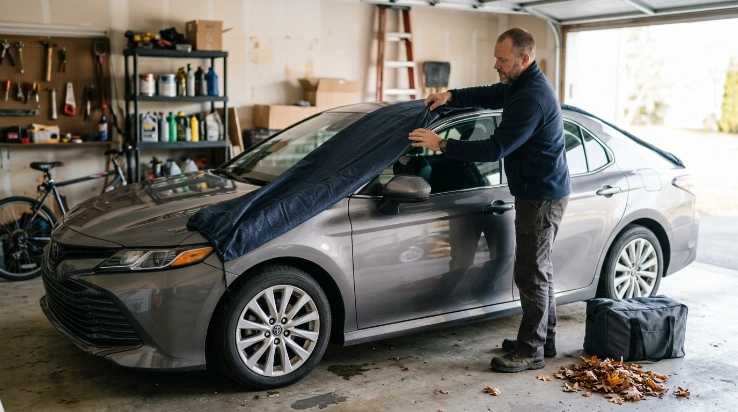
The easiest method is to fold the cover while it is still resting across the vehicle. This gives you a clean work surface and helps control all that loose fabric.
My goal is simple: make one narrow strip over the center of the vehicle, then reduce its length. The process usually takes only a few minutes once you’ve done it a few times.
1. Make sure the car cover is completely dry
Check the roof, seams, mirror pockets, elastic hems, and any layered sections. Moisture can remain hidden in thicker areas even when the surface feels dry.
If the cover is damp, spread it out or leave it loosely positioned until both sides dry. Don’t compress moisture into a storage bag.
2. Shake or brush away loose debris
Remove leaves, pollen, dust, or other loose material before you start folding. Pay extra attention to anything that might fall onto the paint.
- Leaves: Pick them off instead of folding them into the fabric.
- Loose dust: Shake it away gently without dragging the cover.
- Grit: Stop and clean the affected area before the material touches the vehicle again.
- Wet spots: Let them dry before continuing.
3. Release the cover from both bumpers
Undo any approved straps or fasteners first. Then lift the elastic hem clear of the front and rear bumpers.
Don’t yank the cover across license-plate frames, exhaust tips, spoilers, antennas, or sharp trim. Lift the material free instead.
4. Fold one side toward the center of the roof
Start along one side of the car and bring the hanging material upward. Fold it lengthwise so it rests over the roof, hood, and trunk area.
Repeat with the opposite side. A practical target is a long strip roughly two feet wide, although larger covers may remain wider.
5. Straighten the long strip
Pull in loose mirror pockets, straps, and corners. Nothing should hang low enough to touch a tire or the ground.
This is where I usually spend an extra few seconds. A neat strip now produces a much cleaner bundle later.
6. Fold or roll the strip into a compact bundle
Start at one end and work toward the opposite end. Use sections that fit your storage bag rather than forcing tight, sharp creases.
- Bring the first section inward.
- Press out trapped air gently.
- Make the next fold over the first.
- Continue until the bundle reaches the opposite end.
- Place it directly into its storage bag.
Some manufacturers recommend rolling instead of making repeated short folds. Follow your cover manufacturer’s care instructions if they specify a particular method.
Coverstore’s vehicle-cover care instructions use a similar approach: narrow the cover lengthwise while it remains on the vehicle, then roll it into a manageable bundle.
Section Takeaway: Keep the cover dry and off the ground. Fold both sides toward the center first, then reduce the long strip into a compact bundle.
Should You Fold a Car Cover on the Car or on the Ground?
For most everyday drivers, folding the cover on the vehicle is the better method. The car itself becomes a large, relatively clean folding surface.
A driveway or garage floor can work, but only when it is clean and completely dry. Even then, fine grit may transfer to the cover’s vehicle-facing surface.
| Method | Best Use | Main Advantage | Main Risk |
|---|---|---|---|
| Fold on vehicle | Routine removal | Keeps fabric controlled and off the ground | Grit can touch paint if the cover is already dirty |
| Fold on clean floor | Inspection or washing | Lets you see the entire cover | Floor debris can transfer to the liner |
| Two-person fold | Large SUV or truck covers | Less dragging and easier alignment | Requires a second person |
| Roll after narrowing | Frequent use or softer fabrics | Fewer hard fold lines | Can become bulky with thick covers |
If I’m dealing with a pickup or full-size SUV cover alone, I usually divide the side material into smaller folds. Trying to lift the whole side at once makes it more likely to slide onto the ground.
Another person makes heavy covers much easier. Each person can control one side while keeping the clean liner away from pavement.
Which Side Should Face Inward When Folding a Car Cover?
The important rule is to keep the clean vehicle-facing surface separated from dirt. You don’t want the dirty exterior rubbing against the liner that will later touch your paint.
When folding the cover on the vehicle, bring the sides inward in a controlled way so dirty exterior surfaces contact each other where practical. Never drag the inner lining across the ground.
Why the inner surface matters
Fine sand and hard debris can become trapped in fabric. Movement between contaminated material and paint can then create scratches or blemishes.
Car and Driver also warns that debris stored inside a car cover can later contact glass or paint. Keeping the cover clean between uses is therefore part of safe folding.
- Before folding: Check the inner liner for grit.
- While folding: Keep the liner away from tires and pavement.
- Before reinstalling: Inspect both the vehicle and cover.
- If contaminated: Clean the cover according to its manufacturer instructions.
A soft, breathable vehicle-facing material is also worth considering when buying a cover. Consumer Reports’ vehicle-protection guidance recommends a soft-lined, breathable cover to reduce scratching and moisture buildup.
Is It Better to Fold or Roll a Car Cover?
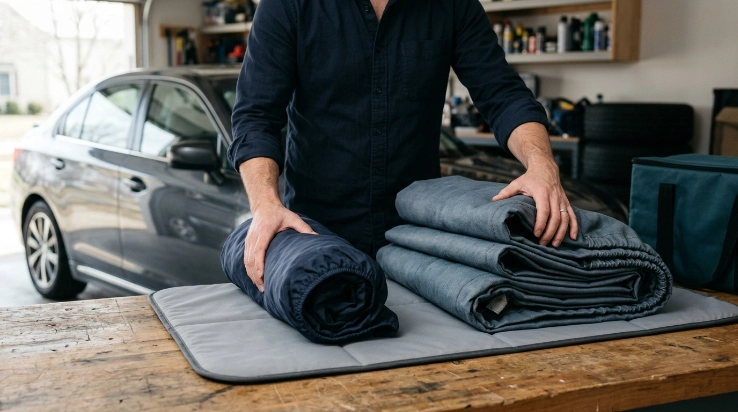
Both methods can work. The best option depends on the cover’s thickness, how often you use it, and the size of its storage bag.
I prefer a combination: fold the sides inward first, then roll or make broad folds along the final strip. That keeps the cover under control without creating dozens of small creases.
| Cover Type | Practical Method | Why |
|---|---|---|
| Light indoor cover | Fold sides, then loosely roll | Soft fabric compresses easily |
| Multi-layer outdoor cover | Broad accordion-style folds | Thicker material can make tight rolls bulky |
| Sedan or coupe cover | Standard roof-strip method | Smaller dimensions are easy to manage alone |
| SUV or truck cover | Extra side folds, then broad folds or roll | Reduces the amount of loose hanging material |
For long-term storage, avoid crushing the cover under heavy objects. A slightly loose bundle is better than forcing thick fabric into an undersized space.
CarCover.com’s folding and storage guide also emphasizes cleaning, drying, compact folding or rolling, and dry storage.
How Should You Store a Folded Car Cover?
Store the cover only after it is completely dry. Place it in a clean bag or suitable container that protects it from dust, pests, sharp objects, and accidental spills.
A garage shelf or indoor closet usually works well. Keep the bundle away from direct sunlight and standing moisture.
Good storage locations
- Garage shelf: Keeps the bag off potentially damp flooring.
- Storage cabinet: Protects the cover from dirt and sharp tools.
- Indoor closet: Offers stable conditions for seasonal covers.
- Vehicle trunk: Convenient for short-term storage if conditions are dry and not excessively hot.
What should you check before storing it?
- Fabric is completely dry.
- Inner surface is free of grit.
- Straps and buckles aren’t trapped under sharp folds.
- Elastic hems aren’t stretched around another object.
- No torn seam or damaged grommet needs attention.
If you use the cover outdoors, inspect it more often. Wind, sunlight, dirt, and moisture create tougher conditions than indoor garage storage.
As of 2026, modern car covers still vary widely in material, fit, weight, and weather protection. Your manufacturer’s care label should override generic washing or storage advice.
What Car Cover Folding Mistakes Should You Avoid?
The biggest problems aren’t complicated. Most come from folding a wet, dirty, or uncontrolled cover.
Folding the cover while it is wet
Don’t compress a damp cover and forget about it. Let the entire cover dry, including hems and seams.
Dragging the cover across the ground
A clean-looking driveway can still contain sand and hard grit. Lift the cover instead of pulling it across concrete or asphalt.
Stuffing it into the storage bag
Stuffing creates a tangled bundle and makes the next installation harder. It can also hide leaves, dirt, straps, or damp sections.
Folding dirt against the vehicle-facing liner
Keep contaminated exterior material away from the clean liner whenever possible. Inspect the liner before putting the cover back on your car.
Forcing thick material into tiny folds
Heavy multi-layer covers need broader folds. Compressing them aggressively adds unnecessary stress and usually makes storage more frustrating.
Ignoring the manufacturer’s instructions
Not every car-cover fabric should be washed, dried, or stored the same way. Always check the label before using heat, detergent, or a washing machine.
Section Takeaway: Dry it, keep it clean, keep it off the ground, and don’t force the material. Those four habits make folding easier and help keep debris away from your paint.
Frequently Asked Questions
Can you fold a car cover while it is wet?
You should let a wet car cover dry completely before folding and storing it. Pay attention to seams, elastic hems, straps, and layered areas because they can remain damp longer than the main fabric.
What is the easiest way to fold a car cover by yourself?
Leave the cover on the vehicle, release the front and rear hems, and fold both sides inward over the roof. Once you have a narrow center strip, fold or roll it from one end toward the other.
How small should a folded car cover be?
It only needs to be compact enough to fit its storage bag without excessive force. Thick outdoor covers will naturally create larger bundles than lightweight indoor covers.
Should I roll my car cover instead of folding it?
Rolling works well for lightweight or flexible covers and can reduce hard fold lines. Thick multi-layer covers may be easier to manage with broad folds after the sides have been narrowed.
Can I fold my car cover on the driveway?
You can if the surface is clean and completely dry, but folding it on the car is usually safer. Pavement can contain fine grit that you don’t want transferred to the vehicle-facing liner.
How do I keep a car cover clean when removing it?
Avoid dropping or dragging it on the ground. Fold it inward in controlled sections, inspect the liner for grit, and store the dry bundle in a clean bag immediately after removal.
Where should I keep my car cover when I’m not using it?
A dry garage shelf, cabinet, or indoor storage space is a good choice. Keep the cover away from moisture, direct sun, chemicals, pests, and sharp objects that could damage the fabric.
The simplest routine is the one you’ll repeat: dry the cover, narrow it over the roof, fold or roll it neatly, then put it straight into its storage bag.
Do that every time and your next installation will be faster. More importantly, you’ll reduce the chance of carrying driveway grit back onto your vehicle’s finish.
“`