How to Check Tire Pressure on a 2022 Mazda Cx-5

Contents
- 1 Key Takeaways
- 2 📑 Table of Contents
- 3 Understanding Your CX-5’s Tire Pressure Monitoring System (TPMS)
- 4 Method 1: The Manual Check – Your Most Reliable Tool
- 5 Method 2: Using the Mazda Connect Infotainment System
- 6 Resetting the TPMS After Service or Rotation
- 7 Seasonal and Situational Considerations for Your CX-5
- 8 Professional Service vs. Your DIY Routine
- 9 Conclusion: A Simple Habit for a Superior Drive
- 10 Frequently Asked Questions


Maintaining proper tire pressure in your 2022 Mazda CX-5 is a non-negotiable safety and performance task. You can check pressure manually with a standard gauge or use the vehicle’s integrated Tire Pressure Monitoring System (TPMS) via the Mazda Connect infotainment screen. Always check tires when “cold” and refer to the placard on your driver’s door jamb for the exact PSI requirement for your specific model and load.
Let’s be real: checking tire pressure isn’t the most glamorous part of owning a 2022 Mazda CX-5. It’s easy to forget, tucked between worrying about oil changes and scheduling that next brake service. But here’s the thing—it’s arguably one of the most critical simple maintenance tasks you can do. Proper tire pressure is the foundation of your SUV’s safety, its fuel efficiency, its handling precision, and even the lifespan of those expensive all-season or all-terrain tires. Neglecting it leads to uneven wear, poor gas mileage, longer stopping distances, and a higher risk of a blowout. The good news? Your CX-5 is equipped with smart technology to help, and the manual check is a skill anyone can master in under a minute. This guide will walk you through every single method, step-by-step, so you can confidently keep your CX-5 riding on properly inflated tires, year-round.
Key Takeaways
- Know Your Number: The correct PSI for your 2022 CX-5 is on a yellow and white sticker on the driver’s door jamb, not the tire sidewall. It varies by trim and load.
- TPMS is a Warning System: The dashboard low-pressure light only illuminates when pressure is significantly low (usually 25% below spec). It is not a substitute for regular manual checks.
- Check Cold: For an accurate reading, check tire pressure when tires are cold—driven less than one mile or after sitting for three hours.
- Manual Check is Gold Standard: A good-quality digital or dial tire pressure gauge provides the most reliable, instant reading and should be part of your monthly maintenance routine.
- Resetting TPMS: After rotating tires, replacing sensors, or adjusting pressure, you must recalibrate the system through the Mazda Connect menu for it to function correctly.
- Seasonal Changes Matter: Tire pressure drops about 1 PSI for every 10°F decrease in temperature. Check more frequently during major seasonal shifts.
- Don’t Forget the Spare: Your compact spare tire has its own, often higher, recommended pressure (usually 60 PSI). Check it periodically.
📑 Table of Contents
- Understanding Your CX-5’s Tire Pressure Monitoring System (TPMS)
- Method 1: The Manual Check – Your Most Reliable Tool
- Method 2: Using the Mazda Connect Infotainment System
- Resetting the TPMS After Service or Rotation
- Seasonal and Situational Considerations for Your CX-5
- Professional Service vs. Your DIY Routine
- Conclusion: A Simple Habit for a Superior Drive
Understanding Your CX-5’s Tire Pressure Monitoring System (TPMS)
Before we grab a gauge, we need to understand the high-tech helper already watching your tires. Every 2022 Mazda CX-5 comes standard with a direct Tire Pressure Monitoring System. This isn’t just a vague warning; it’s a network of four small radio transmitters, one inside each wheel (except the spare), that continuously measure the actual air pressure and temperature inside each tire. They send this data to your vehicle’s computer.
How the TPMS Warning Light Works
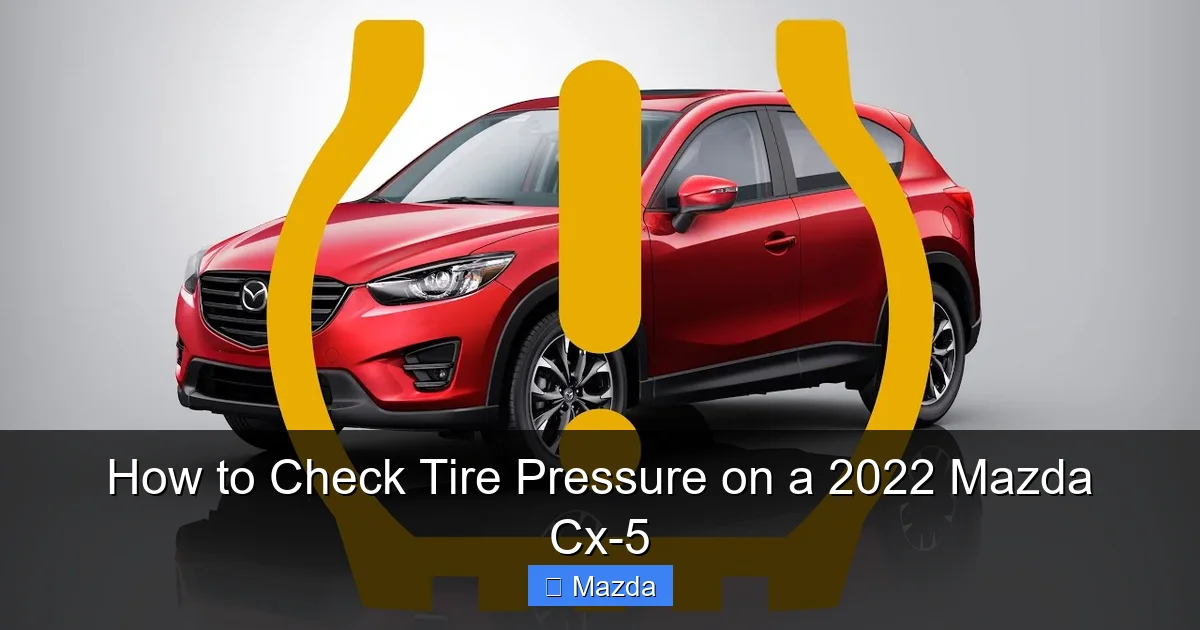
You’ll recognize the TPMS warning light—it’s an exclamation point inside a cross-section of a tire, usually yellow or amber. It illuminates in two scenarios: first, when you start the CX-5, all dashboard lights, including the TPMS light, should briefly come on as a system check. If it goes off after a few seconds, that’s normal. Second, and more importantly, it will stay on or begin blinking while driving if the system detects that one or more tires has fallen at least 25% below the vehicle’s recommended cold inflation pressure. A blinking light for several seconds before staying solid can sometimes indicate a system fault or a dead sensor battery, but a steady light almost always means low pressure.
The Limits of TPMS: Why You Can’t Rely on It Alone
This is the most crucial understanding: the TPMS is a safety net, not a maintenance tool. Because it only triggers at a 25% deficit, your tires could be under-inflated by 5, 10, or even 15 PSI for weeks, causing excessive wear, reduced fuel economy, and compromised handling, without the light ever coming on. For example, if your recommended pressure is 33 PSI, the light won’t illuminate until a tire drops to about 25 PSI. That’s a significant and dangerous under-inflation. Therefore, manual checks are essential. Think of the TPMS as your car shouting “EMERGENCY!” while manual checks are your routine health checkup.
Method 1: The Manual Check – Your Most Reliable Tool
This is the timeless, foolproof method that works on any vehicle, anytime, anywhere. All you need is a reliable tire pressure gauge and about five minutes. Let’s get into the exact steps for your CX-5.
Visual guide about How to Check Tire Pressure on a 2022 Mazda Cx-5
Image source: discounttire.scene7.com
Step 1: Find the Correct Pressure for YOUR CX-5
This is the first and most important step. Do not guess. Do not use the number on the tire’s sidewall—that’s the maximum pressure the tire can hold, not what Mazda recommends for your specific SUV. Open the driver’s side door. Look for a yellow and white sticker, called the “Tire Placard” or “Certification Label,” permanently affixed to the door jamb. It lists the recommended cold inflation pressure for the front and rear tires, often in a format like “Front: 33 PSI, Rear: 33 PSI” or sometimes different for different trims or load conditions. It may also list pressures for the spare. Write this number down or take a photo with your phone. Common pressures for a 2022 CX-5 range from 32 to 35 PSI, but your sticker is the law.
Step 2: Get a Good Gauge
Skip the cheap, pencil-style gauges at gas stations. They are often inaccurate and fragile. Invest in a quality digital tire pressure gauge (they are very affordable, often under $20) or a dial (analog) gauge with a rubber protector. Digital gauges are easy to read and often have a light for night checks. Keep this gauge in your CX-5’s glove compartment or center console—you’ll use it more often if it’s handy.
Step 3: Check When Tires Are “Cold”
“Cold” doesn’t mean it’s winter. It means the tires haven’t been driven on. Driving generates heat and increases pressure, giving a falsely high reading. For an accurate check, either check first thing in the morning after the car has been parked overnight, or ensure the vehicle has been stationary for at least three hours. If you must check after driving, you can still get a relative idea, but you won’t get the true “cold” pressure.
Step 4: The Physical Check – Remove the Valve Cap and Read
- Remove the small plastic valve cap from the tire’s valve stem (the tiny metal or rubber protrusion). Screw it off and put it in your pocket so it doesn’t get lost.
- Press the gauge’s nozzle firmly onto the valve stem. You should hear a slight hiss of air escaping as you press, then it will stop. Hold it steady for a second.
- Read the pressure on the gauge. For digital gauges, it will display clearly. For dial gauges, look at the needle’s position.
- Compare this reading to your door jamb sticker’s recommended PSI.
- If it’s low, use an air compressor (at home, a gas station, or a portable 12V unit) to add air in short bursts, re-checking frequently. If it’s high, press the tiny metal pin in the center of the valve stem (with a tool or the gauge’s back) to let out a little air, then re-check.
- Once the pressure is correct, screw the valve cap back on tightly. Repeat for all four tires. Pro Tip: Don’t forget to check your compact spare tire! Its pressure is usually much higher, often around 60 PSI, and is also listed on your door jamb sticker.
Method 2: Using the Mazda Connect Infotainment System
Your 2022 CX-5 makes checking pressures even easier without leaving the driver’s seat, thanks to the Mazda Connect system. This is a great quick-check method, but remember its readings are from the TPMS sensors and should be verified manually if the system indicates a problem or for routine monthly checks.
Visual guide about How to Check Tire Pressure on a 2022 Mazda Cx-5
Image source: tirepressures.co
Navigating to the Tire Pressure Screen
- Start your CX-5 or turn the ignition to the “ON” position (do not start the engine if you want to avoid driving the tires warm).
- Use the commander knob (the central control knob on the center console) or touchscreen to access the “Applications” or “Vehicle Settings” menu. The exact path can vary slightly by trim (Sport, Carbon Edition, Premium, etc.).
- Look for an icon that resembles a car with a tire or says “Tire Pressure.” Select it.
- The screen will display a graphic of your CX-5 with the pressure readings for each tire in PSI (or kPa, depending on your unit settings). It may also show the recommended pressure for comparison.
Interpreting the Display and Its Quirks
The display will typically show four numbers, one for each wheel location. A normal reading will be at or very near the recommended PSI. If a tire is low, its number may be highlighted in red, amber, or simply be a lower value. Important: The TPMS sensors can sometimes be slow to update after you adjust pressure. If you just added air, the display might still show the old low reading for a minute or two while the sensor transmits the new data. Also, if you have recently rotated your tires, the vehicle’s computer may not know which sensor is on which corner until you perform a TPMS reset (more on that in the next section). In this case, the display might show pressures in the wrong locations, but the values themselves will still be correct.
Changing the Unit of Measure (PSI vs. kPa)
If your screen shows kPa (Kilopascals) instead of PSI (Pounds per Square Inch), you can change it. In the same “Tire Pressure” menu or within the main “Vehicle Settings” menu, look for an option like “Units” or “Pressure Unit.” Select “PSI.” The conversion is simple: 1 PSI = 6.895 kPa. Most North American drivers prefer PSI.
Resetting the TPMS After Service or Rotation
After you have corrected a low tire, rotated the tires (swapping front to rear), or replaced a tire or TPMS sensor, you must tell the CX-5’s computer to learn the new sensor positions and set the new baseline for “normal” pressure. If you don’t, the system may continue to show incorrect locations or trigger a false warning. Here’s how to perform the TPMS reset (also called “TPMS Calibration” or “System Learn”).
Visual guide about How to Check Tire Pressure on a 2022 Mazda Cx-5
Image source: i.ytimg.com
Prerequisites for a Successful Reset
This procedure only works when all four tires are inflated to the exact recommended cold pressure listed on your door jamb sticker. Double-check each tire manually with your gauge before starting. The vehicle must be stationary, with the ignition in the “ON” position (engine off). The parking brake should be set. The reset process can take several minutes of driving to complete.
The Step-by-Step Reset Procedure
- With the car on and in “Park,” use the commander knob to go to Applications.
- Select Vehicle Settings.
- Scroll down and select Tire Pressure Monitoring System or TPMS.
- Select Calibrate or System Learn.
- The screen will give you instructions, typically: “Press and hold the button to start calibration.” There is no physical button; you will use the commander knob’s “Enter” or center push button. Press and hold it for a few seconds until you hear a confirmation chime or see a message like “Calibration Started.”
- Once started, you must drive the CX-5. The system will learn the sensor positions as you drive. Drive at a speed above 20 mph for about 5-10 minutes. The TPMS light may blink during this learning phase. Once complete, the light should go off, and the tire pressure display on your screen will show the correct locations.
Note: If the calibration fails or the light returns immediately, re-check all pressures meticulously. A single tire being even 1-2 PSI off can prevent successful calibration. If problems persist, a faulty sensor or a dead sensor battery (sensors last 7-10 years) may be the culprit, requiring professional diagnosis.
Seasonal and Situational Considerations for Your CX-5
Tire pressure is not a “set it and forget it” item. It’s a dynamic value that changes with conditions. Understanding these factors is key to proactive maintenance.
The Temperature Effect: Physics is Unavoidable
Air is a gas, and gases expand when warm and contract when cold. This is the most common reason for seasonal TPMS warnings. As a rule of thumb, for every 10°F (5.5°C) drop in ambient temperature, your tire pressure will decrease by about 1-2 PSI. So, if you set your tires to 33 PSI in a 70°F fall day, and winter arrives with a 30°F morning, your pressure could have dropped by 4-6 PSI—enough to trigger the TPMS light or, more likely, cause significant under-inflation long before the light comes on. The solution? Get in the habit of checking pressures more frequently as the seasons change, especially during that first cold snap of autumn and the first warm-up of spring.
Load and Towing Adjustments
The pressure on your door jamb sticker is for the CX-5’s typical load (passengers and cargo). If you are planning a road trip with a full family and a roof-top cargo carrier, or if you are using your CX-5’s impressive towing capacity (which can be up to 3,500 lbs depending on engine and configuration), you must increase your tire pressure. The owner’s manual will specify the “maximum load” pressure, which is often 3-5 PSI higher than the normal placard pressure. This extra pressure supports the additional weight, prevents dangerous sidewall overheating, and maintains proper handling. Overloading an under-inflated tire is a direct path to a catastrophic failure. For specific details on how your planned load affects pressure, consult your owner’s manual or resources on your CX-5’s towing capacity and load limits.
Altitude Changes
If you live in or are traveling to high-altitude areas (like the Rockies), atmospheric pressure is lower. This can cause a slight, often negligible, drop in absolute tire pressure. However, the change is usually minor compared to temperature effects. The key is to always check against the manufacturer’s recommended cold pressure, which is an absolute value, not a relative one. Your gauge reading is what matters.
Professional Service vs. Your DIY Routine
So, when should you roll up your sleeves and when should you call a pro? Building a hybrid maintenance plan is smart.
Your Monthly DIY Routine: The Foundation
Commit to this: once a month, and before any long trip, manually check all four tires and the spare with your personal gauge. This five-minute habit is the single best thing you can do for your tires, your fuel bill, and your safety. While you’re at it, visually inspect the tread for uneven wear (a sign of chronic under-inflation) and look for any nails, cuts, or bulges in the sidewall. This is also the perfect time to check your valve stems for cracks or leaks.
When to Visit a Professional
There are several scenarios where a tire professional at a dealership or reputable shop is your best bet:
- TPMS Sensor Replacement: If a sensor battery is dead (typically after 7-10 years) or the sensor is physically damaged, it needs to be replaced. This requires special tools to mount and program the new sensor to your vehicle’s computer.
- Persistent TPMS Light: If you’ve manually verified all tires are at the correct pressure and the light is still on, there may be a faulty sensor, a damaged valve stem, or an electrical issue. Diagnosis requires professional scan tools.
- Tire Installation/Rotation: When you have new tires mounted or your tires rotated, the shop will almost always perform the TPMS reset for you and check sensor function. It’s good practice to have them verify the reset was successful before you drive away.
- Uneven Wear Diagnosis: If you notice significant, specific patterns of wear (e.g., only on the inside edges), it could indicate an alignment issue, suspension problem, or a chronic pressure issue that needs professional assessment beyond just adding air.
By combining your diligent monthly checks with timely professional interventions, you create a complete tire health strategy for your 2022 Mazda CX-5 that will pay dividends in safety, savings, and driving pleasure.
Conclusion: A Simple Habit for a Superior Drive
Checking the tire pressure on your 2022 Mazda CX-5 is not a complex chore; it’s a simple, powerful habit that puts you in control of your vehicle’s fundamental safety and performance. You now have three clear methods: the gold-standard manual gauge check, the convenient Mazda Connect system readout, and the necessary TPMS reset procedure after any service. Remember the core principles: know your exact PSI from the door jamb, check when tires are cold, and never let the TPMS light be your only warning. Integrate this quick monthly check into your routine, adjust for seasons and loads, and you’ll enjoy better fuel economy, more predictable handling, longer tire life, and the profound peace of mind that comes from knowing one of your CX-5’s most critical contact points with the road is always in perfect shape. It’s a small investment of time that yields enormous returns every single time you drive.
Frequently Asked Questions
What does it mean if my TPMS light is blinking and then stays on?
A blinking TPMS light for 5-8 seconds upon startup is usually a normal system check. However, if it blinks for a prolonged period and then stays solid while driving, it often indicates a fault in the TPMS system itself, such as a dead sensor battery or a communication failure, rather than just low pressure. You should have the system scanned by a professional with the proper diagnostic tools.
How often should I reset my CX-5’s TPMS?
You should only reset the TPMS (perform the calibration) after specific events: 1) After you have corrected all tires to the proper cold pressure following a low-pressure warning, 2) After rotating the tires, 3) After replacing one or more TPMS sensors or tires. You do not need to reset it monthly; it automatically monitors once calibrated.
Can I use the pressure number on the tire sidewall instead of the door jamb sticker?
No. The number on the tire sidewall is the maximum pressure that specific tire can safely hold. The number on your CX-5’s door jamb sticker is the pressure Mazda engineers determined is optimal for the vehicle’s weight, handling, and ride comfort. Always use the door jamb placard pressure for your daily driving.
Is it dangerous to over-inflate my CX-5’s tires?
Yes. Over-inflation reduces the tire’s contact patch with the road, leading to a harsh, noisy ride, increased susceptibility to impact damage (like potholes), and uneven, accelerated wear in the center of the tread. It can also reduce traction and braking performance. Always aim for the exact recommended PSI.
Which is more accurate: my manual gauge or the Mazda Connect display?
A high-quality, recently calibrated manual gauge is generally considered the most accurate and immediate reference. The TPMS sensors and display can have a slight delay in updating and can occasionally be off by 1-2 PSI due to sensor tolerance. For definitive accuracy, especially after adding air, trust your manual gauge. Use the display for convenient monitoring.
Do I need to check the pressure on my compact spare tire?
Absolutely. The compact spare (often called a “doughnut” or “temporary use” spare) is stored under the cargo floor and is easily forgotten. It has its own, typically much higher (around 60 PSI), recommended pressure, which is also listed on your door jamb sticker. A flat or under-inflated spare is useless when you need it most. Check it at least twice a year.