How to Check Bmw Oil with a Dipstick

Contents
- 1 Key Takeaways
- 2 📑 Table of Contents
- 3 Why Checking Your BMW’s Oil Manually Still Matters
- 4 Locating the Oil Dipstick on Your Specific BMW Model
- 5 Step-by-Step: How to Check BMW Oil with a Dipstick Correctly
- 6 Interpreting Your Findings: What the Oil Level Tells You
- 7 When and How to Top Up Your BMW’s Oil
- 8 Common Mistakes and Troubleshooting
- 9 Integrating Oil Checks into Your Overall BMW Maintenance Routine
- 10 Conclusion: Your Simple Path to Engine Peace of Mind
- 11 Frequently Asked Questions


Regularly checking your BMW’s oil with a dipstick is a simple yet critical maintenance task that prevents engine damage and ensures longevity. This guide provides a clear, model-specific process for accurately reading oil levels, from locating the dipstick to interpreting the markers. Always check when the engine is warm and the car is on level ground for the most accurate reading. Understanding how to properly check BMW oil with a dipstick empowers you to catch low oil early, top up correctly, and avoid costly repairs, complementing your regular service schedule.
Key Takeaways
- Location Varies by Model: The dipstick’s position differs across BMW generations (e.g., E90, F30, G20), so consult your owner’s manual or look for the yellow/orange handle.
- Warm Engine, Level Ground: For accuracy, check oil after a short drive (5-10 minutes) when the engine is warm but not hot, and ensure the car is parked on a perfectly level surface.
- Clean, Insert, Wipe, Reinsert, Read: The correct technique involves pulling the dipstick, wiping it clean, fully reinserting it, then pulling it again to read the oil level against the MIN/MAX marks.
- Interpret Marks Precisely: Oil should be between the MIN and MAX marks, ideally closer to MAX. Never exceed MAX, and do not operate the engine if below MIN.
- Add Oil Gradually: If low, add small amounts (0.5L at a time) of the correct BMW-approved oil, rechecking after each addition to avoid overfilling.
- Modern BMWs May Lack a Dipstick: Many newer BMW models (like some G20 3 Series) use electronic oil level sensors only; refer to your manual or iDrive for these systems.
[FEATURED_IMAGE_PLACEHOLDER]
📑 Table of Contents
- Why Checking Your BMW’s Oil Manually Still Matters
- Locating the Oil Dipstick on Your Specific BMW Model
- Step-by-Step: How to Check BMW Oil with a Dipstick Correctly
- Interpreting Your Findings: What the Oil Level Tells You
- When and How to Top Up Your BMW’s Oil
- Common Mistakes and Troubleshooting
- Integrating Oil Checks into Your Overall BMW Maintenance Routine
- Conclusion: Your Simple Path to Engine Peace of Mind
Why Checking Your BMW’s Oil Manually Still Matters
In an age of sophisticated engine management systems and dashboard alerts, the simple act of pulling a dipstick might feel old-fashioned. But for BMW owners, mastering how to check BMW oil with a dipstick remains one of the most vital, hands-on maintenance skills you can possess. Your BMW’s engine is a high-performance piece of machinery, often operating at higher temperatures and tolerances than many mainstream vehicles. It relies on clean, adequately filled oil to lubricate thousands of moving parts, manage heat, and prevent catastrophic wear. While your car’s computer will trigger a warning light if oil pressure drops dangerously low, it may not alert you to a slowly decreasing oil level between services. A minor leak or gradual burn-off can go unnoticed until it’s too late, leading to expensive engine repairs. Regularly checking the oil yourself provides immediate, tangible feedback about your engine’s internal health, complements the electronic sensors, and builds a deeper connection with your vehicle. It’s a five-minute habit that can save you thousands.
Furthermore, understanding this process helps you diagnose other issues. The oil’s color and consistency can tell a story—is it dark and gritty, suggesting it’s past its prime? Does it have a milky appearance, hinting at a coolant leak? These are insights a dipstick provides that a simple sensor cannot. Even if your specific BMW model is one of the newer ones that has moved away from a traditional dipstick, understanding the principle is key, as you’ll need to interpret electronic oil level readings via the iDrive system or onboard computer, which function on a similar concept of measuring oil quantity. For the vast majority of BMWs on the road today, from the iconic E36 to the current F30 and many G20 models, the dipstick is still the primary, most direct method. This guide will walk you through it for every scenario.
Locating the Oil Dipstick on Your Specific BMW Model
The first step in learning how to check BMW oil with a dipstick is knowing where to find it. BMW has used several engine bay layouts over the decades, so the dipstick’s home isn’t always in the same place. The good news is it’s usually clearly marked. You’re looking for a looped or T-handle, often in a bright color like yellow, orange, or sometimes black with a bright ring. It will be attached to a long, thin metal rod that dips deep into the engine’s oil pan.

Visual guide about How to Check Bmw Oil with a Dipstick
Image source: piketransit.com
Common Locations by Platform
- E90 (3 Series 2006-2013) & E60 (5 Series 2004-2010): The dipstick is typically located on the driver’s side (left) of the engine bay, near the firewall (the bulkhead between the engine and cabin). It’s a bright yellow handle and is fairly accessible from the top.
- F30 (3 Series 2012-2019) & F10 (5 Series 2010-2017): BMW moved to a more modern, transverse-engine layout in these models. The dipstick is usually found on the passenger’s side (right) of the engine, near the front of the engine bay. The handle is often orange.
- G20 (3 Series 2019-Present) & G30 (5 Series 2017-Present): This is where things change for many models. A significant number of G20/G30 vehicles, particularly those with the newer B48 or B58 engines, do not come with a traditional dipstick at all. BMW eliminated it in favor of an electronic oil level sensor that reports to the iDrive system. If your G20 has a dipstick, it will be a small, black handle with an oil can symbol, located on the driver’s side front corner of the engine. If you cannot find one, your car uses the electronic method—see the sidebar.
- E46 (3 Series 1999-2006) & E39 (5 Series 1995-2003): These classic BMWs have the dipstick on the driver’s side, but it’s often located further back, closer to the windshield washer fluid reservoir.
Pro Tip: If you’re unsure, your owner’s manual is the ultimate authority. It has a labeled diagram of the engine compartment. Alternatively, a quick online search for “[Your Year, Make, Model] engine bay diagram” will yield dozens of images showing the exact location. Never guess or confuse it with the transmission fluid dipstick, which is usually a different color and located elsewhere.
Step-by-Step: How to Check BMW Oil with a Dipstick Correctly
Now that you’ve found the dipstick, the technique is everything. An improper check can give a false reading, leading you to either neglect adding oil or, worse, overfill it. Follow these steps meticulously for an accurate measurement every single time.

Visual guide about How to Check Bmw Oil with a Dipstick
Image source: i.ytimg.com
Preparation and Safety First
Park your BMW on a perfectly level surface. This is non-negotiable. Even a slight incline will cause the oil to pool to one side of the pan, giving a falsely low or high reading on the dipstick. Engage the parking brake. You want the engine to be warm, but not scalding hot from a recent long drive. The ideal scenario is after a 5-10 minute drive at moderate speeds, allowing the oil to circulate and drain back to the sump. If the engine is stone cold, you may get a reading that is technically correct but not representative of operational levels. If it’s just shut off after a highway run, the oil will be very thin and still mostly in the upper engine galleries, leading to a low reading. Let it sit for 5-10 minutes after a drive. Open the hood and secure it with the prop rod.
The Five-Movement Technique
- Pull: Firmly grasp the dipstick handle and pull it straight out until it is fully removed from its tube. It may have a clip or lock; disengage it.
- Wipe: Using a clean, lint-free cloth or paper towel, thoroughly wipe the entire length of the dipstick rod clean. You must remove all oil residue to see the true “full” mark clearly.
- Reinsert Fully: This is the most critical step. Push the dipstick back into its tube all the way down until it seats firmly. You should feel it click or stop. Do not let it rest halfway; this will cause a false low reading.
- Pull Again: Now, pull the dipstick out once more. This time, do not wipe it. The oil will have clung to the rod, and you will see a clear line of oil on the clean metal.
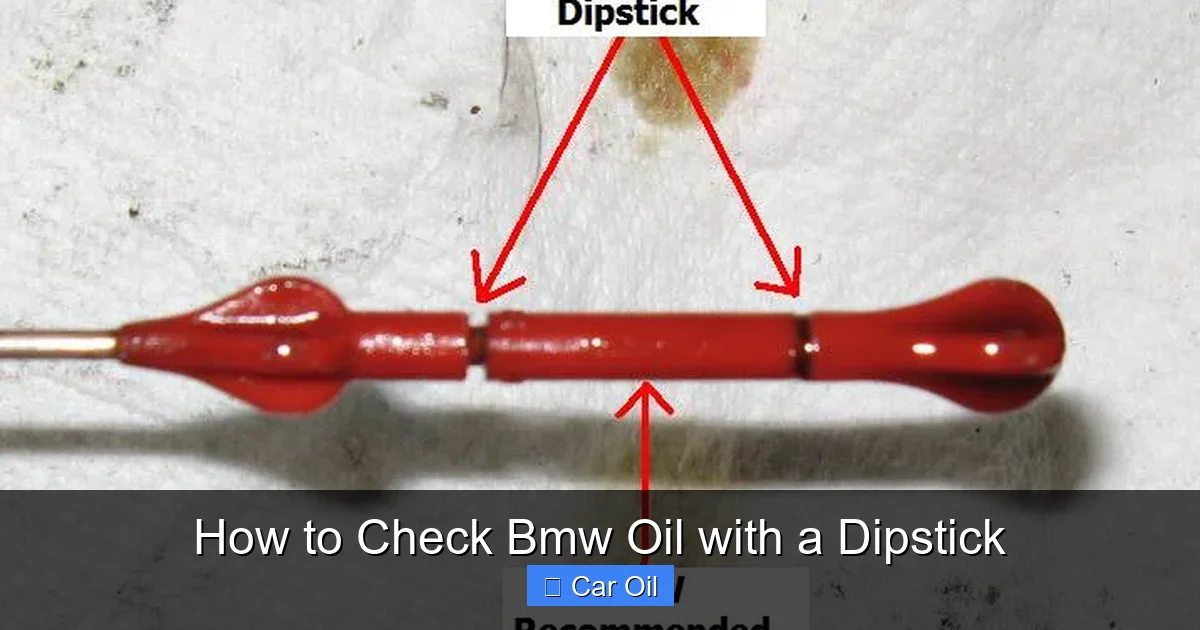
- Read: Hold the dipstick vertically and look at the oil line. The rod will have two notches, dots, or lines etched into it, labeled “MIN” (or “L”) and “MAX” (or “F”). The oil film should end somewhere between these two marks. The ideal spot is right at or just below the MAX mark.
Visual Example: Imagine the dipstick as a thermometer. The oil stain should not touch the MIN mark (too low) and should not be above the MAX mark (too full). If it’s exactly on MAX, that’s perfect. If it’s halfway between, that’s acceptable but you may want to top up soon. If it’s at or below MIN, you must add oil immediately.
Interpreting Your Findings: What the Oil Level Tells You
Reading the line is one thing; understanding what it means is another. The oil level is a direct indicator of the total volume of oil in your engine’s lubrication system. BMW engines are designed to operate with a specific oil capacity, typically between 5.5 and 7 liters for most 6-cylinder models, depending on the engine type and whether an oil cooler is present. The dipstick marks correspond to this precise capacity.
Visual guide about How to Check Bmw Oil with a Dipstick
Image source: bimmer-motors.com
Understanding the “Sweet Spot”
The space between MIN and MAX represents roughly a 1-liter difference in volume. Your goal is to keep the oil level consistently near the MAX mark. Why? Because as the engine runs, a small amount of oil is inevitably consumed (burned in the combustion chamber) or can leak slowly. Starting at MAX gives you a buffer to ensure you never dip below MIN before your next scheduled service. However, never exceed the MAX mark. Overfilling is just as dangerous as running low. Excess oil creates aeration (the oil turns to foam), which destroys its lubricating properties, leads to increased pressure, and can cause seal leaks or even engine damage.
What If the Oil Is Dirty or Smells Different?
While you have the dipstick out, take a moment to examine the oil’s condition. Rub a bit between your fingers. Fresh BMW-approved 0W-30 or 5W-30 oil should be mostly clear to amber and feel slick. If it’s pitch black, gritty, or smells strongly of gasoline, it’s a sign your oil is overdue for a change. A milky, frothy appearance suggests coolant is mixing with the oil—a serious internal leak like a blown head gasket that requires immediate professional diagnosis. For a comprehensive understanding of oil condition and change intervals, refer to your manufacturer’s guidelines or detailed resources like our article on how often to change oil in a BMW 3 Series.
When and How to Top Up Your BMW’s Oil
If your reading is at or below the MIN mark, you need to add oil immediately. Driving with low oil is the fastest way to destroy a BMW engine. But before you grab any bottle from the shelf, you must use the correct specification.
Choosing the Right Oil for Your BMW
BMW is extremely particular about oil. Using the wrong specification can damage sensitive components like the VANOS system or catalytic converters. The correct oil is defined by BMW’s own approval standards, most commonly BMW Longlife-01 (LL-01) for most models prior to 2017, or BMW Longlife-17 FE+ (LL-17 FE+) for newer engines with tighter emissions requirements. These are typically full synthetic 0W-30 or 5W-30 weights. The definitive source is your owner’s manual or the oil cap itself, which often lists the required specification (e.g., “BMW LL-04”). When in doubt, a premium brand like Castrol EDGE Professional (BMW’s longtime partner) or Mobil 1 that lists the specific BMW approval on the bottle is a safe choice. Never use generic “European car” oil without verifying the BMW standard.
The Topping-Up Procedure
- Remove the oil filler cap (it’s usually a black cap on the top of the valve cover, marked with an oil can symbol).
- Using a clean funnel, slowly add approximately 0.5 liters (about half a quart) of the correct oil.
- Wait 1-2 minutes for the oil to settle down the dipstick tube.
- Recheck the oil level using the exact same dipstick procedure described earlier. Do not assume the added oil has settled.
- If still below MAX, repeat the process in 0.5L increments. It’s easy to overfill, so patience is key.
- Once the level is between MIN and MAX (ideally just below MAX), replace the filler cap securely and close the hood.
Important: If you find yourself adding more than 1 liter between regular oil changes, it indicates your engine is burning or leaking oil excessively. This warrants a professional inspection to diagnose the cause, which could range from worn valve seals to a more serious issue. Consistent low oil levels are a red flag.
Common Mistakes and Troubleshooting
Even experienced DIYers can slip up when checking BMW oil. Avoiding these pitfalls will ensure your readings are reliable.
Mistake 1: Checking When the Engine is Stone Cold or Very Hot
As mentioned, a completely cold engine may show a level that is technically full but will read slightly low once warm and operating. A just-shut-off, scorching hot engine will show artificially low because oil is still dispersed throughout the engine. The 5-10 minute warm-up period is the golden rule.
Mistake 2: Not Wiping the Dipstick Before the First Read
Skipping the wipe means you’re reading old oil from the last time you checked or from the tube walls. You’ll get an inconsistent, often higher, reading. Always start with a clean stick.
Mistake 3: Not Reinserting the Dipstick Fully
This is the most common error. If the dipstick isn’t seated completely, it will hit a stop too early and emerge with less oil on it, showing a dangerously low level that isn’t real. You’ll then add unnecessary oil and potentially overfill.
Mistake 4: Confusing the Transmission Dipstick
In some BMWs, the transmission dipstick is located very close to the engine oil dipstick. The transmission dipstick is usually a different color (often red or black with a different handle shape) and may be labeled. Putting oil in the transmission is a severe error that can destroy the gearbox. If you’re unsure, trace the tube—the oil dipstick goes into the engine block, while the transmission one goes into the transmission housing.
Mistake 5: Ignoring the “No Dipstick” Scenario
If you own a newer BMW (like many G20 3 Series, G11 7 Series, or certain X5 models) and cannot find a dipstick after a thorough search, your vehicle uses an electronic oil level measurement system. The process is different: you must turn the ignition on (without starting), navigate through the iDrive menu to “Vehicle Info” or “Service” to check the oil level. The system requires the engine to be at operating temperature and the car to be level. It will display “OK” or a percentage. For these models, the traditional dipstick method is obsolete. You can learn more about electronic oil monitoring systems by comparing to other manufacturers’ approaches, such as how to check oil percentage in a Toyota RAV4, which also uses a sensor-based system.
Integrating Oil Checks into Your Overall BMW Maintenance Routine
Checking the oil is not a standalone task; it’s a vital data point in your overall vehicle stewardship. Making it a habit ensures you’re always aware of your engine’s fundamental need: clean, adequate lubrication.
How Often Should You Check?
For a BMW in good condition, checking the oil level once a month is a excellent baseline. If you notice a small leak, are burning oil, or drive in extremely severe conditions (very hot climates, frequent short trips where the engine doesn’t fully warm up, or dusty environments), check it every two weeks. It takes less than five minutes and should be as routine as checking your tire pressure. Speaking of which, maintaining proper tire pressure is another crucial, simple check that impacts safety and efficiency—you can learn the easy process for many models with our guide on how to check tire pressure on a 2020 Honda Civic, which illustrates the universal importance of such checks.
The Big Picture: Oil Changes and Service
Your dipstick check tells you about quantity, but not quality. Oil degrades over time due to heat, contaminants, and fuel dilution. BMW’s factory service intervals (often 12 months or 10,000-15,000 km for newer models under “Condition-Based Service”) are based on both time and the car’s own oil life sensor. However, these are maximum intervals. If your dipstick reveals the oil is dark, gritty, or has a burnt smell before the service reminder comes on, don’t wait—change it. Using high-quality oil and a premium filter is non-negotiable for a BMW. For a deep dive into optimal change schedules for specific models, our comprehensive article on how often to change oil in a BMW 3 Series provides model-specific insights and explains the CBS system.
Finally, remember that checking the oil is part of a broader “walk-around” inspection. While you’re under the hood, glance at coolant levels, check for any obvious leaks (fresh oil spots), and ensure belts and hoses look sound. This proactive approach transforms you from just a driver into a true steward of your machine.
Conclusion: Your Simple Path to Engine Peace of Mind
Learning how to check BMW oil with a dipstick demystifies one of the most important aspects of your car’s health. It’s a skill that costs nothing but time, requires no special tools, and provides immediate, actionable information. By locating your dipstick, following the precise wipe-insert-read method on a warm, level car, and interpreting the MIN/MAX marks correctly, you take control of your engine’s lubrication. You’ll know when to top up with the correct oil, when the oil itself needs changing, and you’ll have early warning of potential consumption issues. For the minority of newer BMWs without a dipstick, the principle remains—you must regularly verify the oil level via the electronic system. Make this check a monthly ritual. Pair it with a solid understanding of your service schedule and the correct oil specifications, and you’ll enjoy your BMW’s legendary performance and reliability for years to come, while avoiding one of the most common and costly forms of engine neglect. A healthy oil level is the foundation of a healthy engine—keep it full, keep it clean.
Frequently Asked Questions
Should I check the oil when the engine is hot or cold?
Check the oil when the engine is warm but not hot, about 5-10 minutes after a short drive. This allows oil to drain back to the sump for an accurate reading. Never check immediately after a long drive when the engine is scalding hot, or when it’s completely cold.
What if my BMW doesn’t have a dipstick?
Many newer BMWs (especially G20 3 Series and later) use an electronic oil level sensor. To check, turn the ignition on (do not start), go to iDrive menu > Vehicle Info > Service > Oil Level. The car must be parked level and the engine at operating temperature for an accurate reading.
Can I use any 5W-30 oil in my BMW?
No. BMW engines require oil that meets specific BMW Longlife approvals (e.g., LL-01, LL-17 FE+). Using non-approved oil can damage sensitive components. Always check your owner’s manual or oil cap for the correct specification and use a high-quality oil that explicitly states it meets that BMW standard.
What happens if I overfill the oil?
Overfilling is dangerous. Excess oil causes aeration (foaming), which destroys lubrication, increases engine pressure, and can lead to seal leaks or catastrophic engine failure. Always add oil gradually in small amounts and recheck the level to avoid exceeding the MAX mark.
How often should I check my BMW’s oil level?
As a general rule, check the oil level at least once a month. If your car burns or leaks oil, drive in severe conditions, or is an older model, check every two weeks. It’s a quick habit that prevents major problems.
My oil level is fine, but the oil looks very dark and gritty. What does this mean?
Dark, gritty oil indicates it’s contaminated and degraded, even if the level is adequate. It has lost its lubricating and cleaning effectiveness. This means your oil is overdue for a change. Do not wait for the service light; schedule an oil change immediately to prevent engine wear.