How to Check Bmw Coolant Level

Contents
- 1 Key Takeaways
- 2 📑 Table of Contents
- 3 Introduction: Your BMW’s Lifeline in a Bottle
- 4 Why Coolant is Non-Negotiable for Your BMW
- 5 When and How Often Should You Check?
- 6 Understanding Your BMW’s Cooling System Components
- 7 Step-by-Step: How to Check Your BMW Coolant Level
- 8 Common Mistakes and How to Avoid Them
- 9 Conclusion: A Simple Habit for Lifelong Driving Pleasure
- 10 Frequently Asked Questions



Regularly checking your BMW’s coolant level is a non-negotiable maintenance task that protects your engine from catastrophic overheating. This guide provides a clear, safe, and model-agnostic method to locate the reservoir, read the level accurately, and top up with the correct BMW-approved coolant. Mastering this simple 5-minute check can save you thousands in repairs and ensure your driving pleasure remains uninterrupted.
Key Takeaways
- Coolant is vital: It regulates engine temperature, prevents freezing, and fights corrosion. Low levels lead directly to overheating and severe engine damage.
- Check on a cold engine: Always check coolant when the engine is completely cold. Hot coolant is pressurized and can cause severe burns if the cap is removed.
- Locate the reservoir: Find the translucent white plastic tank with a blue or black cap and a warning symbol. It’s not the windshield washer fluid.
- Read the marks: Use the “MIN” and “MAX” (or “Low” and “Full”) lines on the reservoir’s side. The level should be between them, ideally at “MAX” when cold.
- Use the correct coolant: BMW requires specific phosphate-free, silicate-free coolants (like G48 or HT-12). Never mix colors or use generic green antifreeze.
- Top up carefully: If low, add a 50/50 mix of BMW-approved coolant and distilled water until it reaches the “MAX” line. Do not overfill.
- Inspect for leaks: A consistently low coolant level signals a leak. Check hoses, the radiator, water pump, and thermostat housing for visible drips or cracks.
📑 Table of Contents
- Introduction: Your BMW’s Lifeline in a Bottle
- Why Coolant is Non-Negotiable for Your BMW
- When and How Often Should You Check?
- Understanding Your BMW’s Cooling System Components
- Step-by-Step: How to Check Your BMW Coolant Level
- Common Mistakes and How to Avoid Them
- Conclusion: A Simple Habit for Lifelong Driving Pleasure
Introduction: Your BMW’s Lifeline in a Bottle
Your BMW is a masterpiece of engineering, a symphony of precision and power. But even the most finely-tuned machine needs its basic sustenance. While oil gets most of the attention, your engine’s coolant is its true lifeline, working tirelessly to pull destructive heat away from the combustion chambers. Neglecting this simple check is one of the fastest tracks to a blown head gasket, a warped block, and a repair bill that will make your eyes water. This guide is designed for every BMW owner, from the E36 3 Series to the latest iX. We’ll strip away the mystery and walk you through exactly how to check your BMW coolant level safely, correctly, and with complete confidence. It’s a five-minute task that pays for itself in peace of mind and a healthy, happy engine.
Why Coolant is Non-Negotiable for Your BMW
Before we get our hands dirty, let’s understand what we’re dealing with. Coolant, also called antifreeze, is not just for winter. Its primary job is to absorb engine heat and transfer it to the radiator, where it’s dissipated into the air. Modern BMW engines, particularly the turbocharged units common since the early 2000s, generate immense heat. They operate at very high pressures and temperatures. Without the precise 50/50 mixture of coolant and water, this heat has nowhere to go but into the metal components themselves.
Visual guide about How to Check Bmw Coolant Level
Image source: youcanic.com
The Unique Demands of a BMW Cooling System
BMW’s cooling systems are often more complex than those in many other brands. They frequently feature separate circuits for the engine, turbochargers, and even the transmission in some models. This complexity means a small leak or low level in one circuit can cause a specific component to overheat while the engine temperature gauge might still read normally. Many newer models (F-series and G-series) also have electric water pumps and thermostats controlled by the engine computer, making consistent coolant flow critical. Using the wrong coolant can damage the seals and gaskets in these sensitive components.
The Price of Ignorance: What Happens When Levels Are Low
An engine running low on coolant is a ticking time bomb. The first sign is often a temperature warning light or a message on the iDrive display. If ignored, the aluminum cylinder head can warp in minutes. This warpage destroys the head gasket—a seal between the head and engine block. The result? Coolant mixing with oil (turning it a milkshake color), oil mixing with coolant, and catastrophic engine failure. A repair involves removing the cylinder head, machining or replacing it, and reinstalling a new gasket. For a modern BMW, this labor-intensive job easily exceeds $3,000, not to mention the risk of collateral damage. Proactively checking your coolant level is the single most effective way to avoid this nightmare scenario. If you do find a leak, understanding how much it costs to fix a coolant leak on a BMW helps you budget for the necessary repair.
When and How Often Should You Check?
Consistency is key. Coolant can slowly deplete from a tiny, undetectable leak or evaporate over long periods. A regular schedule turns a potential emergency into a simple habit.
Visual guide about How to Check Bmw Coolant Level
Image source: i.ytimg.com
Establish a Monthly Routine
Treat a coolant check like checking your oil or checking your oil level. Once a month, pop the hood and glance at the reservoir. This monthly visual check takes 30 seconds and will alert you to any sudden drops before they become critical. If you live in an extremely hot climate, tow a trailer, or do a lot of spirited driving, consider checking every two weeks.
Immediate Checks: Beyond the Schedule
You must check your coolant level immediately if:
- The coolant temperature warning light illuminates on your dashboard.
- The iDrive display shows a message like “Coolant Level: Low” or “Check Engine Coolant.”
- You notice a sweet, syrupy smell (the scent of coolant) inside or outside the car.
- You see a puddle of brightly colored fluid (green, orange, pink, blue) under your parked BMW.
- The heater in the cabin suddenly blows lukewarm or cold air (a sign the system is low).
In these cases, do not start the engine. Have the car towed if the level is critically low or you suspect a major leak.
Understanding Your BMW’s Cooling System Components
Knowing the parts makes the process foolproof. You don’t need to be a mechanic, just familiar with what you’re looking at.
Visual guide about How to Check Bmw Coolant Level
Image source: i.ytimg.com
The Coolant Reservoir (Expansion Tank)
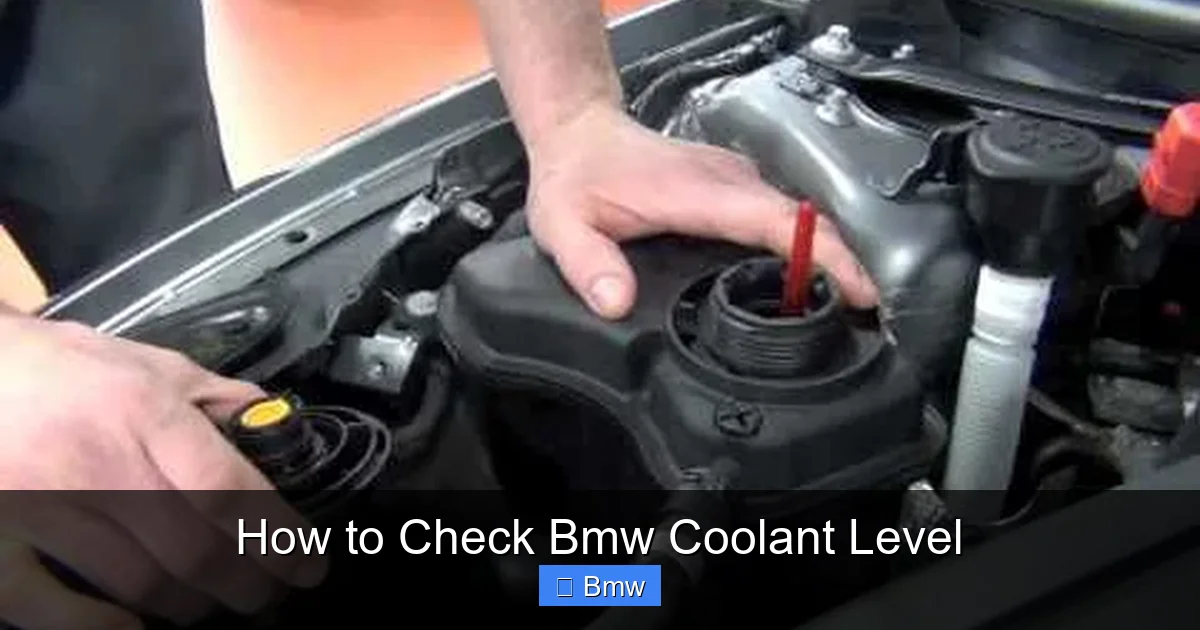
This is your primary point of inspection. It’s a translucent (see-through) plastic tank, usually located in the engine bay near the radiator. The cap is often blue, black, or yellow and has a symbol of a thermometer or a radiator with wavy lines. Important: This is NOT the white plastic reservoir for windshield washer fluid, which is usually on the other side of the engine bay. The coolant reservoir will have “MIN” and “MAX” or “Low” and “Full” marks molded into its side. On many BMWs, it’s labeled “COOLANT” or has the BMW part number on it.
The Radiator and Hoses
The radiator is the large, grid-like component at the front of the engine bay, behind the grille. It has many thin tubes and fins. You won’t check the level here directly, but you should visually inspect it during your check for any signs of damage, leaks, or debris clogging the fins. Trace the thick rubber hoses that connect the engine to the radiator and the reservoir. Look for cracks, brittleness, or wetness around the hose clamps.
The Thermostat and Water Pump
These are internal components you won’t see during a simple level check. The thermostat regulates coolant flow, and the water pump circulates it. On many modern BMWs, the water pump is electric and located on the engine block. Failure of these parts does not show as a low level initially but will cause overheating. A consistent low coolant level is your first clue that one of these components or their seals might be failing.
Step-by-Step: How to Check Your BMW Coolant Level
Now, the main event. Follow these steps exactly for a safe and accurate reading. The golden rule: THE ENGINE MUST BE COLD. “Cold” means the car has been parked for at least 3-4 hours, ideally overnight. Hot coolant is under pressure (up to 15+ psi), and opening the cap will cause it to erupt violently, causing severe scalding.
Step 1: Prepare and Position Your Vehicle
Park your BMW on a level surface. This is crucial for an accurate reading. Turn off the ignition and remove the key. Engage the parking brake. Open the hood using the interior release lever (usually near the driver’s knee) and then the front latch under the hood lip.
Step 2: Locate the Coolant Reservoir
With the hood open, look for the translucent white plastic tank described above. If you’re unsure, consult your owner’s manual—it has a diagram of the engine bay with all fluid reservoirs labeled. On some models like the 3 Series (E90/F30) or X5 (E70/F15), it’s tucked behind the engine, near the firewall. You may need a flashlight. On newer models with extensive plastic engine covers, you might need to remove the cover to access it. These covers usually just snap off or are held by a few bolts.
Step 3: Inspect the Reservoir Visually
Do not remove the cap yet. Look at the side of the reservoir. You should see the coolant inside. The level will be indicated by the “MIN” and “MAX” lines. The coolant itself is usually a vibrant color—BMW coolants are commonly blue (G48), turquoise, green, or sometimes orange/pink (older formulas). It should be clear and translucent. If it looks rusty, muddy, or has oil floating on top (a milky film), your system has a serious problem (head gasket failure or corrosion), and you should stop and call a professional.
Step 4: Interpret the Reading
The correct level is when the coolant is at or just below the “MAX” (or “Full”) line when the engine is cold. It is perfectly normal for the level to be at “MAX” when cold. As the engine heats up, the coolant expands and the level will rise slightly, but the reservoir has extra space to accommodate this. If the level is at or below the “MIN” line, you must add coolant. A level significantly below MIN indicates a leak that needs diagnosis.
Step 5: Opening the Cap and Topping Up (If Needed)
CONFIRM ENGINE IS COLD. Place a thick cloth or rag over the cap. Press down firmly and turn counter-clockwise. Some caps have a safety lock—press down while turning. If you hear hissing, stop! This means there is still pressure. Let it sit for another hour. Once open, you’ll see the reservoir neck. If adding coolant, use a funnel. Pour in the correct pre-mixed BMW coolant (50/50 with distilled water) until the level reaches the “MAX” line. Do not overfill. Reinstall the cap by pressing down and turning clockwise until it clicks securely. Wipe up any spills immediately—coolant is toxic to animals and can damage paint.
Step 6: Final Check and Clean-Up
After topping up, start the engine and let it idle until it reaches normal operating temperature (the temperature gauge needle moves from the blue zone to the middle). Watch the reservoir—the level may drop slightly as air bleeds out of the system. Turn the engine off and let it cool again for an hour. Recheck the level one final time and top up to “MAX” if it has dropped a little. This is normal for a system that was very low. If the level drops significantly after this process, you have a leak that must be found and fixed.
Common Mistakes and How to Avoid Them
Even with the best intentions, it’s easy to slip up. Here are the most frequent errors and how to sidestep them.
Mistake 1: Checking with a Hot Engine
This is the most dangerous mistake. The pressurized, boiling-hot coolant can erupt from the open cap, causing third-degree burns. Solution: Be patient. If you just drove the car, wait at least 3-4 hours. If you’re unsure, wait overnight. Your skin is not worth the risk.
Mistake 2: Using the Wrong Coolant
BMW specifies phosphate-free, silicate-free, and often hybrid organic acid technology (HOAT) coolants. Using standard green antifreeze (IAT) can cause gelling, clogging, and corrosion of the aluminum components and sensors. Solution: Only use coolant that meets BMW’s specification. The part numbers are typically: BMW G48 (blue, for most models from ~2008+), BMW HT-12 (green/blue, for older models), or BMW-specific coolants from brands like Pentosin, Mannol, or Liqui Moly that state compatibility. When in doubt, check your owner’s manual or call a BMW dealer with your VIN.
Mistake 3: Mixing Coolant Colors or Types
Different colors represent different chemical formulations. Mixing a blue G48 with an older green HT-12 can create a sludge that blocks the tiny coolant passages in the cylinder head and engine block. Solution: If you’re adding a small amount to top up, use the exact same type already in the system. If you’re doing a full flush, completely evacuate the old coolant and refill with the new, correct type. Never mix.
Mistake 4: Overfilling the Reservoir
Filling the reservoir above the “MAX” line is a common error. When the coolant heats and expands, it has nowhere to go but out through the overflow hose, leading to a loss of coolant and a potential mess (and low level). Solution: Fill slowly, watching the level. Stop at “MAX.” It’s better to be a millimeter low than a centimeter high.
Mistake 5: Ignoring Coolant Condition
Even if the level is correct, the coolant itself degrades. It loses its corrosion-inhibiting properties and its ability to resist freezing/boiling over time (typically every 3-5 years). Rusty, brown, or cloudy coolant means it’s time for a system flush. Solution: During your visual check, also note the color and clarity. Bright, clear color is good. Dark, murky, or rusty is bad. Check your maintenance schedule for the recommended coolant flush interval.
Conclusion: A Simple Habit for Lifelong Driving Pleasure
Checking your BMW’s coolant level is one of the most empowering and impactful maintenance tasks you can perform. It requires no special tools, takes less time than a coffee break, and places you firmly in control of your vehicle’s health. By making it a monthly ritual—always on a cold engine, using the correct BMW-approved coolant, and reading the marks accurately—you erect a powerful barrier against the most expensive engine failure in the book. Remember, your BMW’s temperature gauge is a warning system, not a gauge to watch. By the time it moves, damage may have already started. The proactive check in the quiet of your garage is what truly counts. Combine this with other regular checks, like your tire pressure and oil, and you have a recipe for a reliable, enjoyable, and long-lasting BMW. If you ever find the level consistently dropping despite careful topping up, do not hesitate to seek professional diagnosis—a small leak now prevents a major disaster later.
Frequently Asked Questions
Can I check my BMW coolant level when the engine is warm?
No, never. The cooling system is pressurized when hot. Removing the cap can cause boiling coolant to spray out, resulting in serious burns. Always wait until the engine is completely cold, which means at least 3-4 hours after driving or overnight.
What specific coolant should I use in my BMW?
You must use a phosphate-free, silicate-free coolant that meets BMW specification. The most common are BMW G48 (blue) for models from approximately 2008 onward, and BMW HT-12 (green/blue) for older models. Use only premixed coolant or mix concentrate with distilled water in a 50/50 ratio. Check your owner’s manual for the exact specification for your model year and engine.
How often should I check my BMW’s coolant?
You should perform a visual check of the coolant reservoir level at least once a month as part of your routine maintenance. Additionally, you must check it immediately if you see any warning lights on the dashboard, smell coolant, or notice a puddle under the car.
What should I do if my coolant level is low?
First, ensure the engine is cold. Then, locate the reservoir and add the correct BMW-approved 50/50 coolant/distilled water mix until it reaches the “MAX” line. After driving and allowing the engine to cycle, recheck the level when cold again. If the level drops significantly again within a few days or weeks, you have a leak that must be professionally diagnosed and repaired.
Why is my BMW coolant a different color than I expected?
BMW coolant color has changed over the years. Older models (pre-2008) often used a green or blue-green HT-12. Most models from 2008 onward use a distinct blue G48. Some late-model vehicles may use a turquoise or even orange/pink coolant. The color is less important than the specification. Never mix colors. If your coolant suddenly looks rusty, brown, or milky (like a milkshake), it indicates contamination or a serious problem like a head gasket failure.
What does the coolant warning light on my BMW mean?
This is a critical warning. It indicates the coolant level is low or the engine temperature is too high. Do not continue driving. Safely pull over, turn off the engine, and wait for it to cool completely (do not open the hood immediately). Once cool, you can check the reservoir level. If it’s low, you may add coolant to reach the “MAX” line, but the underlying cause of the low level (a leak) must be found and fixed. If the level seems fine, the sensor or a component like the thermostat may be faulty. Have the vehicle towed to a repair shop for diagnosis.