
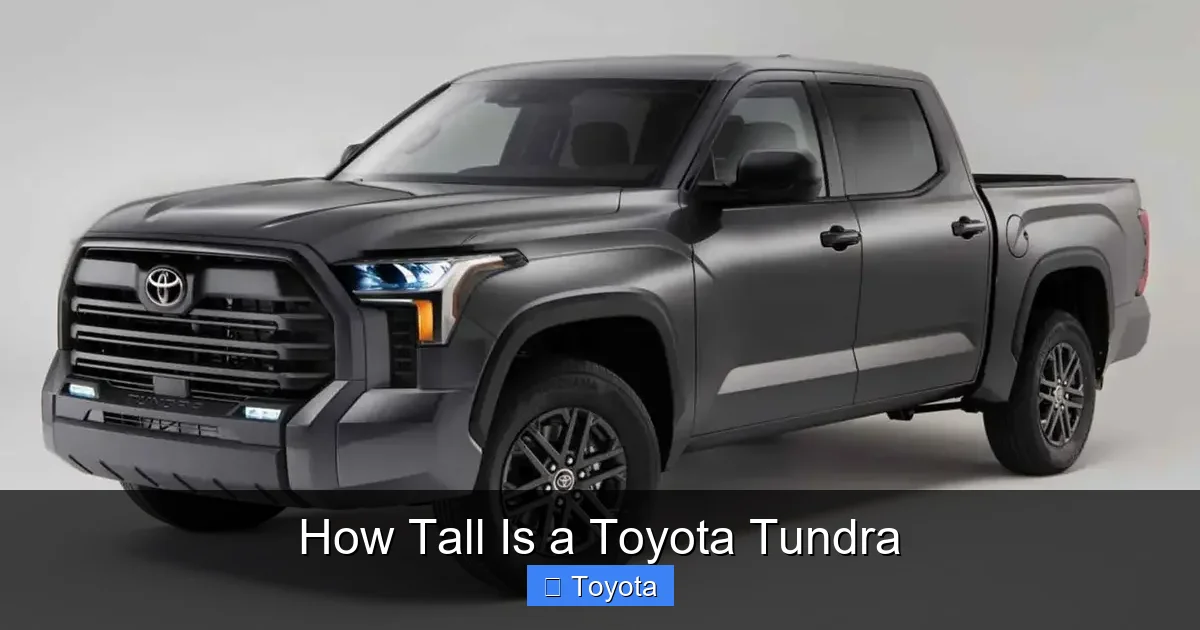
How Tall Is a Toyota Tundra

The Toyota Tundra’s height varies by model year, trim, and configuration, typically ranging from 74.6 to 78.9 inches. Whether you’re parking in a garage, navigating tight trails, or loading gear, understanding your Tundra’s exact height ensures safety and convenience.
If you’ve ever stood next to a Toyota Tundra, you know it’s not just a truck—it’s a presence. Whether you’re loading up for a weekend camping trip, hauling equipment to a job site, or simply cruising down the highway, the Tundra commands attention. But beyond its bold grille, muscular fenders, and rugged stance, one of the most practical questions truck owners and buyers ask is: *How tall is a Toyota Tundra?*
Understanding the height of your Tundra isn’t just about satisfying curiosity—it’s essential for everyday usability. From parking in a standard garage to navigating under low bridges or fitting into tight off-road trails, knowing your truck’s exact dimensions can save you from costly scrapes, parking tickets, or even accidents. The height of a Tundra varies significantly based on the model year, trim level, cab configuration, and whether it’s equipped with two-wheel drive (2WD) or four-wheel drive (4WD). Even subtle changes like tire size or suspension packages can shift the numbers.
In this comprehensive guide, we’ll break down everything you need to know about the Toyota Tundra’s height. We’ll explore how different configurations affect overall stature, compare recent model years, discuss real-world implications for drivers, and offer practical tips for measuring and managing your truck’s vertical footprint. Whether you’re a current owner, a prospective buyer, or just a truck enthusiast, this article will give you the clarity and confidence to handle your Tundra like a pro.
Key Takeaways
- Standard Height Range: Most Toyota Tundras stand between 74.6 and 78.9 inches tall, depending on trim and drivetrain.
- 4WD vs. 2WD Difference: Four-wheel-drive models are generally 1–2 inches taller than two-wheel-drive versions due to suspension and ground clearance.
- CrewMax vs. Double Cab: CrewMax models are slightly taller and longer, offering more interior space but reduced maneuverability in tight spaces.
- Model Year Changes: The 2022 redesign introduced a lower, more aerodynamic profile, reducing height compared to older generations.
- Impact on Parking & Storage: Always measure your garage or parking spot—Tundras may not fit under low-clearance structures without adjustments.
- Off-Road Considerations: Higher trims like the TRD Pro offer increased ride height for better off-road performance but require awareness in urban environments.
- Aftermarket Modifications: Lift kits can add 2–6 inches of height, affecting stability, fuel economy, and legal compliance.
📑 Table of Contents
Understanding the Toyota Tundra’s Height Variations
The Toyota Tundra isn’t a one-size-fits-all vehicle—it comes in multiple configurations, each with its own height. The most common range for the Tundra’s overall height is between 74.6 inches and 78.9 inches (about 6 feet 2.6 inches to 6 feet 6.9 inches). That might not sound like a huge spread, but in practical terms, those few inches can make a big difference when parking, loading, or driving under low-clearance obstacles.
So, what causes these variations? Several key factors come into play. First, the drivetrain—whether your Tundra is 2WD or 4WD—has a noticeable impact. Four-wheel-drive models typically sit higher off the ground due to a more robust suspension system and increased ground clearance. This extra height helps with off-road capability but can make urban driving a bit more challenging.
Next, the cab configuration plays a role. The Tundra is available in two main cab styles: Double Cab and CrewMax. The CrewMax, with its larger rear seating area and longer wheelbase, tends to be slightly taller and longer overall. While the difference in height is usually less than an inch, it’s enough to affect how the truck fits in certain spaces.
Trim level is another variable. Higher trims like the TRD Pro or Limited often come with upgraded suspensions, larger tires, or off-road packages that increase ride height. For example, the TRD Pro is designed for serious off-roading and sits noticeably higher than a base SR model. Even within the same model year, you could have two Tundras that look similar but differ in height by several inches.
Finally, model year matters. The Tundra underwent a major redesign in 2022, shifting from the older platform to a new, more modern architecture. The new generation is slightly lower and more aerodynamic than its predecessor, which means 2022 and newer models may be a couple of inches shorter than 2021 and earlier versions—even with similar trim levels.
Why Height Matters for Tundra Owners
You might be thinking, “It’s just a few inches—how much can it really matter?” But for Tundra owners, height is a daily consideration. Imagine pulling into your garage after a long day, only to hear that dreaded *screech* as the roof of your truck grazes the door frame. Or worse, getting stuck under a low-clearance parking structure because you didn’t account for your truck’s full height.
Height also affects stability and handling. A taller vehicle has a higher center of gravity, which can increase the risk of rollover in sharp turns or emergency maneuvers. While the Tundra is engineered for safety and stability, understanding your truck’s height helps you drive more confidently, especially in windy conditions or on uneven terrain.
For off-road enthusiasts, height is a double-edged sword. More ground clearance means better performance on rocky trails, muddy paths, and steep inclines. But that same height can make it harder to load heavy items into the bed or access low-hanging branches on forest roads.
Even something as simple as washing your truck becomes trickier with a taller Tundra. Many automated car washes have height restrictions, and if your truck exceeds them, you’ll need to hand-wash or find a commercial wash that accommodates larger vehicles.
Breaking Down Tundra Height by Model Year and Trim
Visual guide about How Tall Is a Toyota Tundra
Image source: images.cars.com
To truly understand how tall a Toyota Tundra is, it helps to look at specific examples across different model years and trims. Let’s dive into some real-world numbers to give you a clearer picture.
2021 Toyota Tundra (Pre-Redesign)
The 2021 Tundra was the last model year of the second-generation platform. During this time, the truck was known for its rugged, tall stance—especially in 4WD configurations. Here’s a breakdown of typical heights:
– **2WD Double Cab:** Approximately 74.6 inches
– **4WD Double Cab:** Around 76.2 inches
– **2WD CrewMax:** About 75.0 inches
– **4WD CrewMax:** Roughly 77.0 inches
The 4WD models were notably taller due to the added suspension components and increased ground clearance. The TRD Off-Road and TRD Pro trims pushed the height even higher, often reaching 77.5 to 78.9 inches, thanks to specialized shocks, skid plates, and larger tires.
2022–2024 Toyota Tundra (New Generation)
With the 2022 redesign, Toyota introduced a completely new platform based on the F1 architecture, shared with the Land Cruiser and Sequoia. This new Tundra is more aerodynamic, fuel-efficient, and slightly lower to the ground. Here’s how the heights compare:
– **2WD SR Double Cab:** 74.6 inches
– **4WD SR Double Cab:** 76.0 inches
– **2WD Limited CrewMax:** 75.2 inches
– **4WD Limited CrewMax:** 76.8 inches
– **TRD Pro (4WD only):** 78.9 inches
As you can see, the base models are similar in height to the previous generation, but the 4WD versions are slightly lower. The TRD Pro, however, remains the tallest trim, designed for maximum off-road capability. It features Fox internal bypass shocks, a lifted suspension, and aggressive all-terrain tires that add significant height.
Comparing Cab Styles: Double Cab vs. CrewMax
One of the most common questions buyers have is whether the CrewMax is taller than the Double Cab. The answer is yes—but only slightly. The CrewMax, with its extended rear cabin, has a longer wheelbase and a slightly higher roofline to accommodate the extra interior space. On average, the CrewMax is about 0.4 to 0.8 inches taller than the Double Cab in the same trim and drivetrain.
For example, a 2023 4WD Double Cab SR might measure 76.0 inches, while the 4WD CrewMax SR comes in at 76.6 inches. That half-inch difference might not seem like much, but it can be the deciding factor when parking in a tight garage or under a low roof.
How Drivetrain and Suspension Affect Height

Visual guide about How Tall Is a Toyota Tundra
Image source: goatstrail.com
The choice between 2WD and 4WD is one of the biggest factors influencing your Tundra’s height. But why does 4WD make such a difference?
The Role of 4WD in Ride Height
Four-wheel-drive systems require additional components—like a transfer case, front differential, and reinforced suspension—that take up space and add weight. To accommodate these parts and maintain proper ground clearance, 4WD Tundras are built with a higher suspension setup. This means they naturally sit 1 to 2 inches taller than their 2WD counterparts.
This extra height isn’t just for show—it’s functional. The increased ground clearance helps the truck navigate rough terrain, deep snow, or muddy trails without scraping the undercarriage. For drivers in rural areas, mountainous regions, or places with harsh weather, this added height is a major advantage.
However, it does come with trade-offs. The higher center of gravity can affect handling, especially during sharp turns or sudden lane changes. It also makes it harder to load heavy items into the bed, as you’ll need to lift them higher off the ground.
Suspension Packages and Their Impact
Beyond the standard 2WD/4WD difference, Toyota offers various suspension packages that can alter your Tundra’s height. The most notable is the TRD Off-Road package, which includes:
– Bilstein shocks
– Skid plates
– All-terrain tires
– Increased ride height
This package typically adds 0.5 to 1 inch of height compared to a standard 4WD model. The TRD Pro takes it further with a full lift kit, resulting in the tallest factory configuration.
On the flip side, some trims—like the Limited or Platinum—focus on comfort and on-road performance. These models may have slightly lower suspension tuning for a smoother ride, though the difference is usually minimal.
Real-World Implications of Tundra Height

Visual guide about How Tall Is a Toyota Tundra
Image source: goatstrail.com
Knowing your Tundra’s height isn’t just about specs—it’s about how you live with your truck every day. Let’s explore some practical scenarios where height matters most.
Parking and Garage Clearance
One of the most common challenges Tundra owners face is parking. Standard residential garages often have door heights of 78 to 80 inches. While many Tundras will fit, taller trims—especially the TRD Pro at 78.9 inches—can come dangerously close to the limit.
If your garage door is 78 inches tall and your Tundra is 78.9 inches, you’re already over by nearly an inch. That means you’ll need to either modify your garage (e.g., raise the door or install a taller opener) or park outside. Always measure your garage opening before assuming your truck will fit.
Commercial parking structures are another concern. Many have low-clearance warnings, often around 7 feet (84 inches), but some older garages or underground lots can be as low as 75 inches. A quick check of posted signs or using a height sensor app can prevent costly damage.
Driving Under Low Obstacles
Low-hanging branches, drive-thrus, and highway overpasses are everyday hazards for tall trucks. While most U.S. overpasses are built to federal standards (minimum 16.5 feet), local roads and private properties may have lower clearances.
For example, some drive-thru banks or fast-food restaurants have canopies as low as 7 feet. If you’re driving a TRD Pro, you might not fit—even with caution. Always look for clearance signs and slow down when approaching uncertain areas.
Loading and Unloading the Bed
A taller truck means a higher bed. The Tundra’s bed height typically ranges from 34 to 38 inches off the ground, depending on suspension and tire size. While this provides great ground clearance, it can make loading heavy items—like furniture, appliances, or construction materials—more difficult.
Consider using a ramp, tailgate extender, or bed step to make loading easier. Some owners install aftermarket bed steps or running boards to improve access.
Off-Road Performance
For off-road enthusiasts, height is a major advantage. The TRD Pro’s 78.9-inch height and 10+ inches of ground clearance allow it to tackle rocky trails, deep ruts, and steep inclines with confidence. The higher stance also improves approach and departure angles, reducing the risk of getting stuck.
However, taller trucks are more prone to wind sway and can be harder to control on narrow trails. Always drive within your skill level and use caution when navigating tight or technical terrain.
Aftermarket Modifications and Height Changes
Many Tundra owners love to customize their trucks—and height is one of the most popular modifications. Lift kits, leveling kits, and larger tires can dramatically change your truck’s appearance and performance.
Lift Kits: How Much Height Can You Add?
A lift kit raises your truck’s suspension, increasing both ride height and ground clearance. Common lift sizes for the Tundra include:
– **2-inch lift:** Adds about 2 inches of height, often used for leveling the front with the rear.
– **4-inch lift:** Adds 4 inches, giving a more aggressive stance and better off-road capability.
– **6-inch lift or more:** For extreme off-roading or show trucks, but can affect handling and legality.
A 4-inch lift on a 2023 Tundra SR 4WD (76.0 inches) would bring the total height to around 80 inches—taller than many parking structures and garage doors.
Leveling Kits vs. Full Lifts
A leveling kit only raises the front of the truck to match the rear, which is often higher due to the weight of the engine. This adds 1 to 2 inches of front height but doesn’t affect the overall height as much as a full lift.
Leveling kits are popular for improving appearance and allowing larger tires without major suspension changes. They’re also more affordable and easier to install.
Legal and Safety Considerations
Before modifying your Tundra’s height, check local laws. Some states have restrictions on how much you can lift a vehicle, especially if it affects lighting, emissions, or safety systems. Over-lifting can also void your warranty or make your truck harder to insure.
Additionally, a taller truck has a higher center of gravity, increasing rollover risk. Always drive cautiously and consider upgrading to wider wheels or stability bars for better control.
How to Measure Your Tundra’s Exact Height
If you’re unsure how tall your Tundra is, the best way to find out is to measure it yourself. Here’s a simple step-by-step guide:
1. Park your truck on a level surface.
2. Use a tape measure or laser height gauge.
3. Measure from the ground to the highest point on the roof (usually the center or rear).
4. Record the measurement in inches.
For accuracy, measure multiple times and average the results. Also, note whether your truck is loaded or unloaded—cargo weight can compress the suspension and lower the height slightly.
You can also check your owner’s manual or Toyota’s official website for exact specs based on your VIN.
Conclusion
So, how tall is a Toyota Tundra? The answer depends on your specific model, but most Tundras stand between 74.6 and 78.9 inches tall. Whether you drive a base SR or a rugged TRD Pro, understanding your truck’s height is essential for safe and convenient ownership.
From parking in your garage to conquering off-road trails, every inch counts. Use this guide to make informed decisions about your Tundra—whether you’re buying, modifying, or just trying to avoid that next low-hanging branch. With the right knowledge, your Tundra will be as practical as it is powerful.
Frequently Asked Questions
How tall is a 2023 Toyota Tundra TRD Pro?
The 2023 Toyota Tundra TRD Pro stands at 78.9 inches tall, making it the tallest factory configuration. This height is due to its lifted suspension, Fox shocks, and aggressive all-terrain tires designed for off-road performance.
Will a Toyota Tundra fit in a standard garage?
Most Tundras will fit in a standard garage with a 78- to 80-inch door, but taller trims like the TRD Pro (78.9 inches) may not fit in garages with lower clearances. Always measure your garage opening before assuming it will fit.
Is the CrewMax taller than the Double Cab?
Yes, the CrewMax is slightly taller—typically 0.4 to 0.8 inches—due to its extended roofline and larger rear cabin. The difference is small but can matter in tight spaces.
Does 4WD make the Tundra taller?
Yes, 4WD models are generally 1 to 2 inches taller than 2WD versions because of the added suspension components and increased ground clearance needed for off-road capability.
Can I lower my Tundra to reduce height?
Yes, you can install lowering kits or adjust suspension settings to reduce height, but this may affect ride quality, ground clearance, and warranty coverage. Consult a professional before making changes.
How does a lift kit affect my Tundra’s height?
A lift kit can add 2 to 6 inches of height, depending on the size. While this improves off-road performance, it can make parking, handling, and fuel economy more challenging.
