How Often to Change the Timing Belt on a 2006 Toyota Highlander

Contents
- 1 Key Takeaways
- 2 📑 Table of Contents
- 3 Introduction: Clearing Up a Very Common Misconception
- 4 Timing Chain vs. Timing Belt: Understanding the Difference
- 5 Factory Recommendations & The “Lifetime” Misnomer
- 6 Inspection, Maintenance, and Proactive Care
- 7 Symptoms of a Failing Timing Chain System
- 8 Related Maintenance: The Bigger Picture of Engine Care
- 9 Conclusion: A Shift in Mindset
- 10 Frequently Asked Questions


Your 2006 Toyota Highlander does not have a timing belt; it comes equipped with a timing chain designed to last the life of the engine under normal conditions. There is no factory-recommended replacement interval for the chain itself. However, related components like the tensioner and guides can wear out, typically requiring inspection and potential service around 150,000 to 200,000 miles. Proactive maintenance and watching for warning signs are key to avoiding catastrophic engine failure.
Key Takeaways
- No Timing Belt: The 2006 Highlander uses a durable timing chain, not a belt, eliminating a scheduled replacement item.
- Lifetime Design: The chain is engineered to last the engine’s lifetime, but associated parts like tensioners and guides have a finite service life.
- High-Mileage Inspection: Have a mechanic inspect the timing chain system (tensioner, guides, sprockets) around 150,000-200,000 miles.
- Heed Warning Signs: Listen for rattling noises on startup (especially when cold) and watch for check engine lights related to camshaft/crankshaft sensors.
- Maintenance is Key: Strict, on-schedule oil changes with the correct oil viscosity are the #1 thing you can do to prolong timing chain life.
- AWD Models: If you have an AWD Highlander, the transfer case and rear differential fluid services are separate but equally important drivetrain maintenance items.
- Professional Diagnosis: Diagnosing timing chain wear often requires removing components. Do not ignore symptoms, as a broken chain causes severe, expensive engine damage.
📑 Table of Contents
- Introduction: Clearing Up a Very Common Misconception
- Timing Chain vs. Timing Belt: Understanding the Difference
- Factory Recommendations & The “Lifetime” Misnomer
- Inspection, Maintenance, and Proactive Care
- Symptoms of a Failing Timing Chain System
- Related Maintenance: The Bigger Picture of Engine Care
- Conclusion: A Shift in Mindset
Introduction: Clearing Up a Very Common Misconception
If you’re a proud owner of a 2006 Toyota Highlander, you’re likely researching essential maintenance to keep your reliable SUV running for years to come. You’ve probably typed “how often to change the timing belt on a 2006 Toyota Highlander” into a search engine. Here’s the most critical piece of information you need right at the start: your 2006 Highlander does not have a timing belt. It came from the factory with a timing chain.
This is a crucial and widespread point of confusion. Many vehicles, particularly older models or some economy cars, used timing belts that needed replacement every 60,000 to 100,000 miles. Toyota equipped the 2006 Highlander’s 3.3-liter V6 engine (and the 2.4-liter 4-cylinder in some markets) with a robust timing chain system. The fundamental difference between the two is huge: a belt is a toothed rubber strip that requires periodic replacement, while a chain is a metal link system, similar to a bicycle chain but far more robust, designed to run inside the engine for its entire service life without scheduled replacement.
So, why does this matter? Because searching for a “timing belt change” interval for your Highlander will lead you down a rabbit hole of incorrect information. Instead, we need to shift our focus to the timing chain system’s health and the maintenance practices that keep it—and your entire engine—running smoothly. This article will definitively answer what you should really be doing, why your Highlander is different, and how to protect your investment from a potentially thousands-of-dollars repair.
Timing Chain vs. Timing Belt: Understanding the Difference
To fully grasp why your maintenance schedule looks different, let’s break down the two systems in simple terms. Both serve the exact same vital function: they synchronize the rotation of the crankshaft (which moves the pistons) and the camshaft(s) (which opens and closes the valves). This precise timing allows the engine to breathe and operate. If this synchronization is lost, the pistons can collide with the open valves, causing immediate and often terminal engine damage, known as an “interference engine” failure.

Visual guide about How Often to Change the Timing Belt on a 2006 Toyota Highlander
Image source: i.ytimg.com
How a Timing Belt Works
A timing belt is made of reinforced rubber with precise teeth that mesh with gears on the crankshaft and camshaft. It’s located outside the engine, typically under a plastic or metal cover. Because it’s rubber, it degrades over time due to heat, humidity, and oil contamination. It can crack, stretch, or have teeth shear off. This is why manufacturers mandate its replacement at specific mileage or time intervals, regardless of its apparent condition. A belt failure is almost always sudden and catastrophic in an interference engine.
How a Timing Chain Works
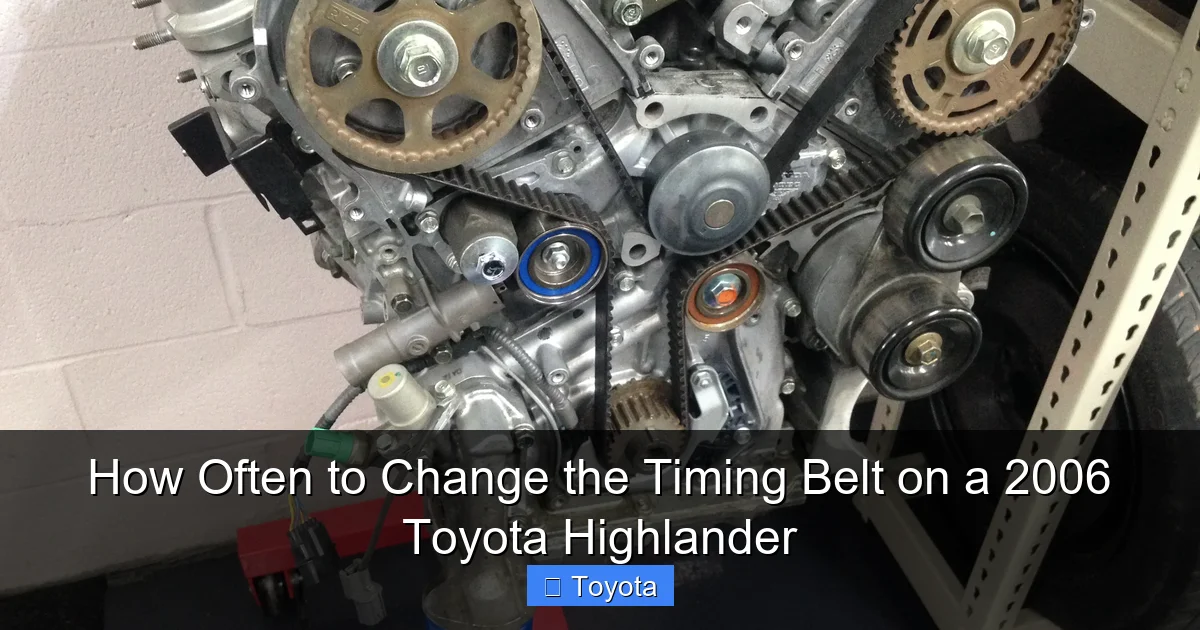
A timing chain is a continuous loop of hardened metal links. It runs inside the engine, lubricated by engine oil. It meshes with hardened steel sprockets on the crankshaft and camshaft(s). The system includes a hydraulic tensioner (which uses oil pressure to keep the chain tight) and one or more guide rails/plastics that keep the chain running straight and quiet. Chains are exceptionally strong and, when properly lubricated and maintained, can last hundreds of thousands of miles. Their failure is rarely sudden; it’s usually preceded by increasing noise and wear symptoms as tensioners and guides fail first.
For your 2006 Highlander, this means you’ve been spared a major, recurring service item. However, it doesn’t mean “set it and forget it.” The chain itself is durable, but the system that supports it has wearable parts.
Factory Recommendations & The “Lifetime” Misnomer
Let’s look at the official word. Toyota’s maintenance schedule for the 2006 Highlander does not list a timing belt replacement. It also does not list a scheduled timing chain replacement. In the owner’s manual and official technical documentation, Toyota refers to the timing chain as a “lifetime” component. This is engineering-speak for “designed to last the useful life of the engine under normal operating conditions with proper maintenance.”

Visual guide about How Often to Change the Timing Belt on a 2006 Toyota Highlander
Image source: i.pinimg.com
It is absolutely critical to understand what “lifetime” does NOT mean. It does not mean:
- You never need to think about it again.
- The chain will absolutely never stretch or wear.
- The tensioner and plastic guides will last forever.
“Lifetime” is based on ideal conditions and assumes you follow all other maintenance schedules flawlessly. In the real world, things like infrequent oil changes, using the wrong oil, or severe driving conditions (constant short trips, extreme heat, dusty environments) can accelerate wear on the entire timing chain system. The plastic guides, in particular, can become brittle and wear down over time, leading to chain noise and eventually, excessive slack.
So, while there is no mileage number in your manual that says “Replace Timing Chain at 150,000 miles,” the prudent and expert recommendation from mechanics who see these engines is to have the timing chain system inspected thoroughly at or around 150,000 to 200,000 miles. This inspection is not something you can do yourself; it requires a mechanic to remove the front engine cover and visually check the chain, tensioner, sprockets, and guides for wear, proper tension, and signs of failure.
Inspection, Maintenance, and Proactive Care
Since there’s no scheduled replacement, your strategy shifts to vigilant inspection and impeccable supporting maintenance. The goal is to catch any developing problems in the plastic guides or hydraulic tensioner before they allow the chain to become loose enough to jump a tooth or, in a worst-case scenario, break.
Visual guide about How Often to Change the Timing Belt on a 2006 Toyota Highlander
Image source: accurateautomotiverepair.com
The Golden Rule: Oil Changes Are Non-Negotiable
This cannot be overstated. The timing chain is bathed in engine oil. Clean oil at the correct viscosity provides the necessary film lubrication and hydraulic pressure for the tensioner. Using the wrong oil (e.g., a 5W-30 when Toyota specifies 5W-20 for your engine) can affect oil pressure and flow. Skipping oil changes or going far beyond the recommended interval leads to oil sludge and varnish, which can clog the tiny oil passages that feed the tensioner and cause premature wear on all lubricated parts. Always use Toyota Genuine Motor Oil or a high-quality equivalent that meets Toyota’s specifications. For the 2006 Highlander’s 3.3L V6, Toyota recommended 5W-20 or 5W-30 oil meeting API grade SL or higher. Sticking to a 5,000 to 7,500-mile oil change interval with a quality filter is the single best thing you can do for your timing chain’s longevity.
What a Professional Inspection Entails
When you take your Highlander to a trusted mechanic for a high-mileage check-up, specifically request an inspection of the timing chain system. This is a labor-intensive job as they must remove the engine’s front timing cover. They will look for:
- Chain Stretch: While minimal stretch is normal, excessive stretch indicates wear.
- Tensioner Condition: The hydraulic tensioner should extend fully and hold pressure. A weak or leaky tensioner won’t keep the chain taut.
- Guide Rail Wear: The plastic guides that the chain rides on will be checked for excessive wear, cracking, or melting (a sign of overheating/lack of lubrication).
- Sprocket Teeth: The gears on the camshaft and crankshaft should have sharp, unworn teeth. Worn “shark fin” shaped teeth indicate a problem.
- Oil Leaks: The front main seal and other seals around the timing cover area will be checked. Oil leaks can starve the chain of lubrication.
If any of these components show significant wear, the standard repair is to replace the entire timing chain kit, which includes the chain, tensioner, guides, and often the sprockets. This is a major repair, costing between $1,500 and $2,500 at a typical shop, but it is infinitely cheaper than an engine replacement after a chain failure.
Symptoms of a Failing Timing Chain System
Unlike a timing belt that can fail without warning, a failing timing chain system almost always gives you warning signs. Pay close attention to these symptoms, especially as your mileage climbs:
The Classic Rattle
The most common symptom is a distinct rattling or clattering noise coming from the front of the engine. It’s most noticeable on cold starts, when the engine is idling, or when the throttle is blipped. The noise often goes away or diminishes significantly as the engine warms up and oil circulates fully. This is the sound of a loose chain hitting the guides or the tensioner failing to take up slack. Do not ignore this noise. It is your engine’s cry for help.
Check Engine Light Codes
A stretched or loose chain can cause the camshaft and crankshaft to fall out of perfect sync. This triggers the engine control unit (ECU) to set diagnostic trouble codes (DTCs), commonly P0010, P0011, P0012, P0340, or P0345, which relate to camshaft position, crankshaft position, and their correlation. If you see these codes, especially alongside a rattle, it’s a red flag for the timing system.
Poor Performance and Fuel Economy
As timing becomes less precise, the engine’s efficiency suffers. You might notice a general lack of power, sluggish acceleration, rough idling, or a noticeable drop in miles per gallon. The engine’s computer will try to compensate, but it can only do so much.
Metal Shavings in Oil
During an oil change, if your mechanic notices an unusual amount of fine metallic particles or shavings in the oil or on the magnetic drain plug, it could be a sign of excessive wear anywhere in the engine, including the timing chain and sprockets. This is a serious diagnostic clue.
Related Maintenance: The Bigger Picture of Engine Care
Focusing solely on the timing chain is like focusing only on your heart without caring for your overall diet. The health of your timing system is intrinsically linked to other critical engine maintenance items. Neglecting these can create the conditions that lead to premature timing chain wear.
Coolant System Health
Your Highlander’s engine operates at a precise temperature. The coolant system, including the thermostat, water pump, and radiator, is responsible for this. If the engine runs too hot (due to a failing thermostat, low coolant, or a bad water pump), it superheats the oil, breaking down its lubricating properties and accelerating the degradation of plastic components in the timing system. Regular coolant flushes—every 30,000 to 50,000 miles—are essential. You can learn the proper interval and procedure for your specific model by consulting resources on how often to change antifreeze in a Toyota. Keeping your cooling system in perfect shape is a direct investment in your timing chain’s lifespan.
Engine Oil and Filter: The Lifeblood
We’ve hammered this point home, but it bears repeating. The oil’s job is to lubricate, clean, cool, and seal. For a timing chain system, its primary job is to provide a constant, clean film of lubrication and hydraulic pressure for the tensioner. Always use the correct oil specification and change it on time. A related, often-overlooked task is resetting the maintenance light after an oil change. On Highlanders, this light is a reminder for your service interval. If you change your own oil, knowing how to reset the oil light on a Toyota Highlander (the process is similar across model years) is a useful skill to keep your dash accurately reflecting your service status.
Drivetrain Maintenance (AWD Models)
If your 2006 Highlander is an AWD model, its complex drivetrain includes a transfer case and rear differential that also require periodic fluid changes. While not directly connected to the engine’s timing chain, these systems share the same principle: they contain lubricated, wearable gears and chains. Neglecting these services can lead to expensive failures that leave you stranded. It’s all part of a holistic approach to vehicle longevity. For owners of AWD Highlanders, familiarizing yourself with how to check the AWD system on a Toyota Highlander and its service intervals is highly recommended.
The Maintenance Required Light
Your Highlander’s “MAINT REQD” light is a versatile reminder. While it’s often tied to mileage-based service intervals (like oil changes), it can also be programmed to remind you of other scheduled maintenance. Understanding what it means and how to reset the maintenance light on a Toyota Highlander after the work is done is part of being an informed owner. This light is your car’s way of helping you stay on top of the service schedule that ultimately protects components like the timing chain.
Conclusion: A Shift in Mindset
So, to directly answer the question that brought you here: you do not change the timing belt on a 2006 Toyota Highlander because it does not have one. This is fantastic news, as you’ve avoided a major, recurring expense that owners of belt-driven engines face. However, this benefit comes with a different responsibility: the responsibility of understanding and maintaining the timing chain system.
Your approach should be this: commit to flawless, on-time oil changes with the correct oil. At around 150,000 miles, budget for and insist on a professional, visual inspection of the timing chain, tensioner, and guides. Listen for any cold-start rattles and investigate check engine lights immediately. By coupling the inherent durability of a timing chain with proactive, informed maintenance, your 2006 Highlander’s engine can easily surpass 300,000 miles. The goal is not to replace the chain on a clock, but to monitor its supporting cast and intervene the moment signs of wear appear. Treat your Highlander’s engine with this kind of care, and it will reward you with many more years of dependable service.
Frequently Asked Questions
Does a 2006 Toyota Highlander have a timing belt or chain?
It has a timing chain. The 2006 Highlander’s 3.3L V6 engine (and available 2.4L 4-cylinder) uses a robust metal timing chain system designed for longevity, not a rubber timing belt that requires scheduled replacement.
What is the official replacement interval for the timing chain?
There is no factory-recommended replacement interval. Toyota lists the timing chain as a “lifetime” component, meaning it’s designed to last the engine’s life under normal maintenance. However, the tensioner and guides are wear items and should be inspected around 150,000-200,000 miles.
What are the signs that my timing chain might be failing?
The primary symptom is a distinct rattling or clattering noise from the front of the engine, especially on cold starts. Other signs include check engine lights with camshaft/crankshaft sensor codes (P0010-P0012, P0340), poor performance, and decreased fuel economy.
Can I replace the timing chain myself?
This is an extremely complex and labor-intensive repair for a DIYer. It requires removing the front engine cover, harmonic balancer, and multiple components. Incorrect installation can destroy the engine. This job is best left to experienced professional mechanics.
What happens if the timing chain breaks while driving?
In the Highlander’s interference engine design, a broken timing chain will cause the pistons to collide with the open valves. This results in catastrophic, bent valves, damaged pistons, and a likely destroyed cylinder head. The engine will require a complete rebuild or replacement, which costs several thousand dollars.
What maintenance helps my timing chain last the longest?
The single most important thing is strict, on-schedule oil changes with the correct viscosity oil (5W-20 or 5W-30 for the 3.3L). This ensures proper lubrication and hydraulic pressure for the tensioner. Also, maintain the cooling system with regular coolant flushes to prevent overheating, which damages all internal components.