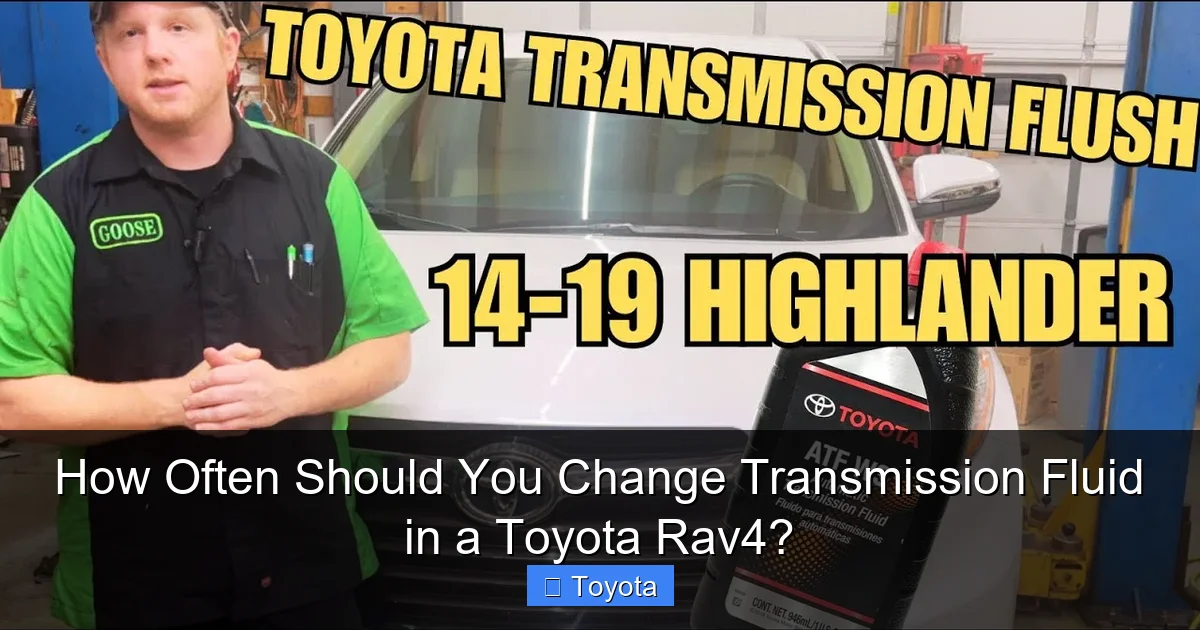
How Often Should You Change Transmission Fluid in a Toyota Rav4?

Contents
- 1 Key Takeaways
- 2 📑 Table of Contents
- 3 Understanding Transmission Fluid: It’s Not Just Oil
- 4 RAV4 Generations & Their Fluid Specifications
- 5 How Often Should You Change It? The Practical Answer
- 6 The Tell-Tale Signs Your Fluid is Past Its Prime
- 7 DIY vs. Professional: Which Route Should You Take?
- 8 Cost Considerations: The Price of Prevention
- 9 Conclusion: Your Action Plan
- 10 Frequently Asked Questions

Car Wireless Charger Mount

Car Armrest Cushion

Reflective Stickers

Radiator Coolant
The truth about Toyota RAV4 transmission fluid changes is more complex than you think. While older models have clear 60,000-mile intervals, many modern RAV4s use “lifetime” fluid, a term that often misleads owners. Proactive maintenance, including a fluid change around 60,000-100,000 miles, is crucial to prevent expensive transmission failure. Always use the specific Toyota WS fluid and consider your driving conditions, as severe service shortens fluid life significantly.
Let’s have a real talk about your Toyota RAV4’s transmission. You love your RAV4. It’s the perfect family hauler, the reliable adventure companion, the SUV that just seems to keep going. But what makes it keep going? Underneath, a complex network of gears, clutches, and pumps works in harmony, all bathed in a special liquid: transmission fluid. This fluid is the lifeblood of your transmission. It lubricates, cools, cleans, and transmits hydraulic pressure to make shifts happen. So, the big question—how often should you change it?—is one of the most important (and confusing) maintenance items for your RAV4. The answer isn’t a simple number, and the word “lifetime” thrown around by manufacturers is the source of much debate and many costly mistakes. Grab a coffee, and let’s break it down, generation by generation, myth by myth.
Key Takeaways
- The “Lifetime” Fluid Myth: Many post-2006 RAV4s specify “lifetime” transmission fluid, but this refers to the warranty period, not infinite life. The fluid degrades, and changing it around 60k-100k miles is a wise, cost-saving insurance policy.
- Intervals Vary by Model Year & Transmission: Older 4-speed automatics (pre-2006) need changes every 60k miles. Newer 6/8-speed automatics (2006+) use Toyota WS fluid and have official “lifetime” specs, but real-world evidence supports a change at 60k-100k miles, especially with heavy use.
- Correct Fluid is NON-NEGOTIABLE: Using the wrong fluid (like Dexron instead of Toyota WS) can cause immediate damage. Always consult your owner’s manual for the exact specification: Toyota Genuine ATF WS is standard for most modern models.
- Watch for Symptoms of Degraded Fluid: Delayed shifts, harsh engagement, slipping, or a burnt smell are red flags. Catching these early can save your transmission. Don’t wait for a major failure.
- DIY vs. Professional: A simple drain-and-fill is manageable for DIYers but only replaces about 1/3 of the fluid. A full professional flush is recommended for neglected systems. Factor in your skill, time, and the risk of improper procedure.
- Cost is an Investment, Not an Expense: A fluid change costs $150-$300. A transmission rebuild or replacement costs $3,000-$5,000+. The choice is clear for long-term value.
- Your Driving Style Dictates Service: Frequent towing, mountainous driving, extreme temperatures, or mostly short trips constitute “severe service,” which accelerates fluid breakdown and warrants earlier changes.
[FEATURED_IMAGE_PLACEHOLDER]
📑 Table of Contents
- Understanding Transmission Fluid: It’s Not Just Oil
- RAV4 Generations & Their Fluid Specifications
- How Often Should You Change It? The Practical Answer
- The Tell-Tale Signs Your Fluid is Past Its Prime
- DIY vs. Professional: Which Route Should You Take?
- Cost Considerations: The Price of Prevention
- Conclusion: Your Action Plan
Understanding Transmission Fluid: It’s Not Just Oil
Before we talk intervals, we need to understand what transmission fluid actually does and why it fails. Engine oil and transmission fluid (ATF) are not the same. ATF has a much tougher job. It must operate under extreme pressure within a torque converter and valve body, maintain precise frictional properties for clutch packs to grip without slipping, and resist foaming. Over time, this takes a toll.
The Silent Killers: Heat and Shear
Two main things destroy transmission fluid: heat and shear stress. Every time your transmission shifts, clutches engage and disengage under pressure. This creates microscopic shear forces that gradually break down the long polymer chains in the fluid, reducing its viscosity and lubricating ability. Heat is the other enemy. Normal driving generates heat, but towing, mountain driving, or even a slightly clogged transmission cooler can push temperatures too high. Heat causes the fluid to oxidize, turning it dark brown or black and creating varnish and sludge that can clog tiny passages. This is why your driving habits are the single biggest factor in determining fluid life, more so than just mileage.
RAV4 Generations & Their Fluid Specifications
The RAV4 has evolved significantly since its 1994 debut, and so has its transmission technology. The fluid type and recommended service interval are directly tied to the model year and transmission type. Let’s segment them clearly.
Visual guide about How Often Should You Change Transmission Fluid in a Toyota Rav4?
Image source: testingautos.com
First & Second Generation (1994-2005): The “Drain & Fill” Era
These early RAV4s, especially the popular 4-speed automatic (A340F, etc.), are straightforward. They require a conventional automatic transmission fluid, typically Dexron-III or a Toyota-specific equivalent. The maintenance schedule is clear and conservative: change the fluid every 60,000 miles (or 60,000 km). This is a hard-and-fast rule for these models. The fluid is not “lifetime” specified. If you own a first or second-gen RAV4 and have never changed the fluid, doing so now is one of the best things you can do for its longevity. A simple drain-and-fill (which replaces about 40-50% of the total fluid) is sufficient at this interval if done regularly.
Third & Fourth Generation (2006-Present): The “Lifetime Fluid” Controversy
Starting with the 2006 redesign, Toyota introduced the A760E/A760F 6-speed automatic (and later the 8-speed Direct Shift-8AT in some models). With these came a new, proprietary fluid: Toyota Genuine ATF WS (World Standard). This fluid is exceptionally stable and designed for longer life. Crucially, Toyota’s official maintenance schedule for these models (2006-2018) lists the transmission fluid as “lifetime.” This does not mean it lasts the life of the car. In engineering terms, “lifetime” typically refers to the warranty period (e.g., 5 years/60,000 miles). It means you won’t be told to change it during scheduled maintenance. However, the community of mechanics and long-term owners overwhelmingly agrees: ATF WS degrades. For normal driving, a change at 100,000 miles is a very safe and common recommendation. For severe service (see above), 60,000 miles is prudent. The 2019+ RAV4 (fifth gen) with the K120 CVT or the 8-speed in the Prime continues this pattern—WS fluid, “lifetime” spec, but change it around 100k miles for ultimate protection. You can find the exact fluid capacity and type for your specific year in our guide on how many quarts of transmission fluid a Toyota RAV4 needs.
How Often Should You Change It? The Practical Answer
So, what do you do with this information? Here is a clear, actionable chart for your RAV4.
Visual guide about How Often Should You Change Transmission Fluid in a Toyota Rav4?
Image source: keithpiersontoyota.com
- 1994-2005 RAV4 (4-Speed Auto): Every 60,000 miles. No exceptions. This is preventative maintenance 101.
- 2006-2018 RAV4 (6-Speed Auto): Official spec: Lifetime. Recommended practice: First change at 60,000 miles if you do any severe driving, or a maximum of 100,000 miles for mostly highway, gentle use. Then, every 60,000 miles thereafter.
- 2019+ RAV4 (CVT & 8-Speed Auto): Official spec: Lifetime. Recommended practice: First change at 80,000-100,000 miles. The CVT, in particular, runs hot and benefits greatly from fresh fluid. Subsequent changes every 60,000-80,000 miles.
Think of it this way: would you rather spend $200-$300 on fluid and labor now, or $4,000 on a transmission later? The math is brutally simple. This proactive approach is a cornerstone of smart vehicle ownership, much like staying on top of your engine oil changes.
The Tell-Tale Signs Your Fluid is Past Its Prime
Even if you’re not a mileage-counter, your RAV4 will give you warnings. Don’t ignore these symptoms of degraded or low transmission fluid:

Visual guide about How Often Should You Change Transmission Fluid in a Toyota Rav4?
Image source: thecarhow.com
- Delayed or Hesitant Shifts: You feel a noticeable “push” or delay before the car downshifts when accelerating, or a jerk when it upshifts.
- Harsh or Hard Shifts: Shifts feel clunky and abrupt, especially from 1st to 2nd gear.
- Slipping: The engine revs up (RPMs spike) but the car doesn’t accelerate correspondingly. This feels like the transmission is briefly disengaging.
- Transmission Whine or Noise: A new, constant whining or humming sound that changes pitch with engine speed.
- Burnt Smell: A distinct, acrid, almost “toasted” smell from under the hood is a major red flag for overheated fluid.
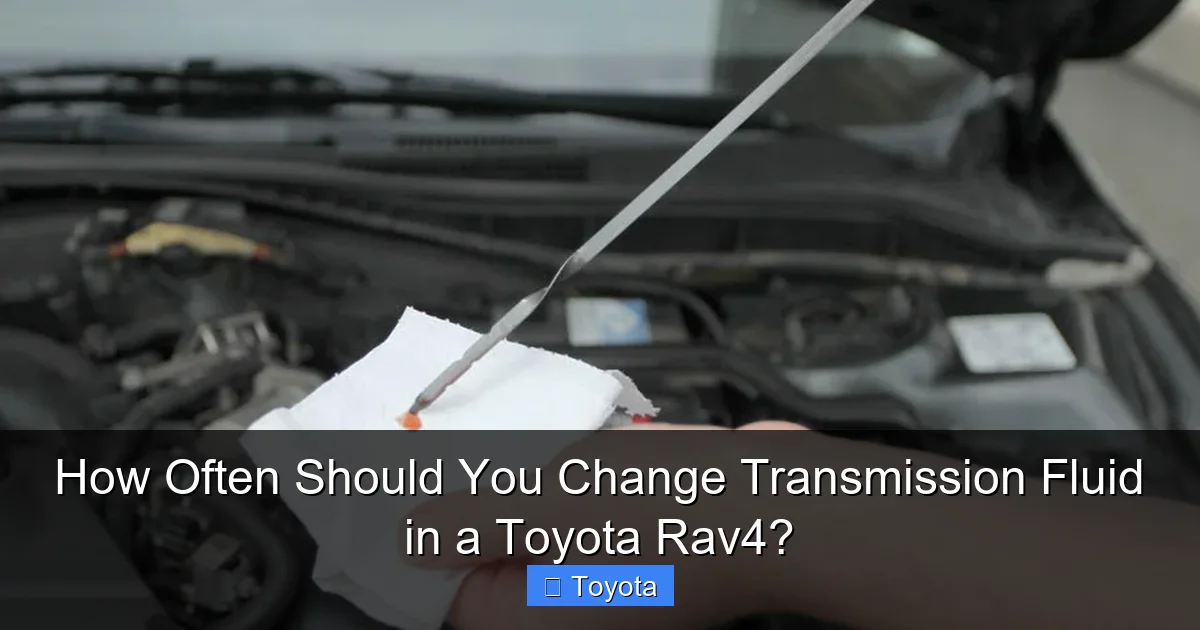
- Fluid Condition: If you check the dipstick (if your model has one—many newer ones are “sealed”), the fluid should be bright red and smell slightly sweet. If it’s dark brown/black, smells burnt, or has a gritty texture, it’s done.
If you experience any of these, check the fluid level immediately. Low fluid can cause these symptoms too. If the level is fine but the fluid looks or smells bad, a change is urgently needed. For a deeper dive into maintenance that prevents such issues, our article on Toyota antifreeze change intervals discusses another critical fluid that, like transmission fluid, is often overlooked until problems arise.
DIY vs. Professional: Which Route Should You Take?
This is a big decision. Changing transmission fluid is more involved than an oil change, but less complex than a timing belt. Here’s the breakdown.
The DIY Drain-and-Fill
This involves removing the transmission pan drain plug (if it has one—some do not), letting old fluid drain, replacing the filter (if accessible), and refilling through the dipstick tube. Pros: Relatively cheap ($50-$80 for fluid/filter), you control the quality of fluid, and it’s a great learning experience. Cons: You only replace about 30-40% of the total fluid (the rest remains in the torque converter and valve body). For a neglected transmission, this might not be enough. It’s also messy, and you must be meticulous about not overfilling or underfilling.
The Professional Fluid Exchange/Flush
Shops use a machine that connects to the transmission cooler lines. It pumps new fluid in while simultaneously pulling old fluid out, eventually replacing nearly 100% of the fluid. Pros: Complete fluid replacement, ideal for high-mileage or never-serviced transmissions. Done correctly, it’s very effective. Cons: More expensive ($200-$350). There is debate about the safety of pressure flushes on very old, neglected transmissions, so choose a reputable shop.
Our Verdict: If your RAV4 is under 120,000 miles and has been serviced before, a careful DIY drain-and-fill with genuine Toyota WS fluid is a fantastic, cost-effective option. If it’s over 120,000 miles with no history, or you’re experiencing symptoms, opt for the professional exchange. When in doubt, pay a professional. A $300 service is still cheaper than a $4,000 repair.
Cost Considerations: The Price of Prevention
Let’s talk numbers, because this is where the “lifetime fluid” myth really costs people. If you do it yourself:
- Genuine Toyota ATF WS (about 5-6 quarts): $60-$90
- Filter & Gasket (if applicable): $20-$40
- Tools (drain pan, funnel): You likely have these.
Total DIY Cost: ~$80-$130
At a dealership or independent shop:
- Fluid (marked up): $80-$120
- Labor (1-2 hours): $100-$200
- Filter/pan gasket: $30-$50
Total Professional Cost: ~$210-$370
Now, contrast that with a transmission replacement. Even a used salvage unit with installation can hit $2,500. A remanufactured unit with a warranty is $3,500-$5,000+. The “lifetime” fluid strategy is a gamble that the transmission will outlast the loan or lease term. For anyone planning to keep their RAV4 long-term (and RAV4s are known for lasting 200k+ miles), scheduled fluid changes are not optional; they are essential. This philosophy of proactive, cost-effective maintenance applies across your vehicle. Understanding how often to change your oil filter is another prime example of a small task that prevents catastrophic engine wear.
Conclusion: Your Action Plan
Your Toyota RAV4 is a fantastic vehicle built for reliability. That reliability is not automatic; it’s earned through consistent, informed maintenance. The transmission fluid question is a perfect case study in moving beyond manufacturer “lifetime” claims and into real-world, ownership-based care. Here is your simple action plan:
- Identify Your Model Year and Transmission. Check your owner’s manual or driver’s side door jamb sticker.
- Check Your Service History. Has the fluid ever been changed? If you don’t know, assume it hasn’t.
- Assess Your Driving. Are you in the “severe service” category? If yes, subtract 20,000 miles from the recommended interval.
- Make a Decision. For 2006+ models with no history, schedule a full fluid exchange at 80,000-100,000 miles. For pre-2006 models, do it at 60,000 miles if you haven’t already. Set a calendar reminder for the next interval.
- Use the Right Fluid. For 2006 and later, it must be Toyota WS. No exceptions. No “universal” substitutes.
- Inspect the Fluid. Next time you have the hood open, if your model has a dipstick, check the level and condition. Bright red and sweet-smelling is good. Dark and burnt is bad.
By following this guide, you are not just changing fluid; you are actively protecting a multi-thousand-dollar component, ensuring your RAV4 remains the dependable, fun-to-drive SUV you bought it to be. Don’t let a $200 maintenance item become a $4,000 regret. Stay proactive, stay informed, and enjoy many more miles of worry-free driving.
Frequently Asked Questions
What happens if I never change my RAV4’s transmission fluid?
The fluid will degrade, lose its lubricating and cooling properties, and turn into a sludge-like substance. This leads to increased wear, overheating, slipping, harsh shifts, and ultimately, catastrophic transmission failure. The repair cost will far exceed any preventative maintenance expense.
Can I use Dexron fluid instead of Toyota WS in my newer RAV4?
Absolutely not. Toyota WS fluid has specific friction modifiers and chemical properties engineered for Toyota’s modern transmissions. Using Dexron or any other fluid will cause clutch slippage, erratic shifting, and permanent damage within a very short time. Always use the exact specified fluid.
Is a “transmission flush” necessary, or is a drain-and-fill enough?
For a transmission that has been regularly serviced with drain-and-fills, a simple drain-and-fill is sufficient. For a high-mileage or never-serviced transmission, a full flush (exchange) is strongly recommended to remove all the degraded fluid and contaminants. A drain-and-fill only replaces about 1/3 of the total fluid.
My RAV4 has a “sealed” transmission with no dipstick. How do I check or change the fluid?
“Sealed” means no routine user-check dipstick, not that it’s a closed system. It still requires service. The fluid must be checked and changed via access plugs on the transmission itself by a technician. If you suspect a problem, have a shop check the fluid condition and level immediately. Do not ignore it.
Does towing a trailer with my RAV4 change the fluid change interval?
Yes, significantly. Towing is classified as “severe service” because it generates immense heat and stress on the transmission. If you tow regularly (even a small utility trailer), you should shorten your fluid change interval by at least 20,000-30,000 miles. For frequent towing, aim for every 50,000-60,000 miles.
Can I mix old transmission fluid with new fluid when I top it off?
You should never “top off” transmission fluid unless it is low due to a leak. If you are performing a service, all the old fluid should be removed and replaced with fresh fluid. Mixing old, degraded fluid with new fluid immediately contaminates the new fluid and reduces its effectiveness and lifespan. If the level is low, find and fix the leak first, then perform a full service.