
How to Reset the Check Engine Light on a 2015 Toyota Tacoma

Resetting the check engine light on your 2015 Toyota Tacoma is a simple process, but it’s critical to understand what you’re doing. The light is a warning, not a reminder. You should never reset it without first diagnosing and repairing the underlying problem. The proper method uses an OBD-II scanner to clear the fault code. Disconnecting the battery is a last-resort, temporary fix that can cause other issues. If the light returns immediately after a reset, you have a persistent problem that needs professional attention.
Key Takeaways
- The Check Engine Light is a serious warning: It indicates your Tacoma’s computer has detected a problem with the emission control system or engine that could increase pollution or cause damage. Ignoring it is risky.
- Always diagnose before you reset: The only safe reason to reset the light is after you have identified and repaired the issue that triggered it. Resetting without a fix is pointless and dangerous.
- An OBD-II scanner is the correct tool: This inexpensive device plugs into your Tacoma’s port under the dash, reads the trouble code (DTC), and allows you to clear it. This is the standard, recommended method.
- The battery disconnect method is unreliable: While it can turn off the light, it also resets other vehicle systems (radio, engine idle, steering angle sensor) and may not clear all codes, leading to confusion.
- Know the difference between warning lights: The check engine light (often yellow/amber) is different from the “Service Required” or “Maintenance Required” light (usually a wrench icon), which is for routine service like oil changes. The process for how to reset the maintenance required light on a Toyota Tacoma is entirely different.
- Other Toyota models have similar systems: The process for a 2015 Tacoma is nearly identical for a Toyota Corolla or Toyota Highlander, as they all use the same OBD-II standard.
- A recurring light means an unresolved issue: If the check engine light comes back on shortly after a reset, the repair was not successful or there is a new, separate problem that must be addressed.
📑 Table of Contents
- Understanding Your 2015 Toyota Tacoma’s Check Engine Light
- Critical Preparation: Safety First and Tools of the Trade
- Method 1: The Proper Way – Using an OBD-II Scanner
- Method 2: The “Last Resort” – Disconnecting the Battery
- Method 3: The “Drive Cycle” – Letting the Computer Clear Itself
- When You Should NEVER Reset the Check Engine Light
- Other Important Toyota Tacoma Warning Lights to Know
- Conclusion: A Reset is an End Step, Not a Beginning
Understanding Your 2015 Toyota Tacoma’s Check Engine Light
That little amber light on your dashboard, shaped like an engine or simply saying “Check Engine,” is one of the most misunderstood features in your 2015 Toyota Tacoma. For many, it’s an annoying distraction. For others, it’s a source of immediate anxiety. But what it truly is, is your truck’s voice. It’s the onboard computer, officially called the Powertrain Control Module (PCM), trying to tell you something is wrong with the engine or emissions system. Ignoring that voice is never a good idea. This guide will walk you through everything you need to know about that light, most importantly, how to reset the check engine light on a 2015 Toyota Tacoma the right way—and, more crucially, when you absolutely should not.
What the Light Actually Means
First, let’s clear up a common myth. The check engine light (CEL) is not a “service engine” light in the traditional sense. It doesn’t come on because you’re 3,000 miles past an oil change. That’s what the separate “Service Required” or “Maintenance Required” light (usually a wrench icon) is for. You can learn how to reset the maintenance required light on a Toyota Tacoma easily after an oil change, but that’s a different procedure entirely.
The check engine light is tied directly to your Tacoma’s On-Board Diagnostics II (OBD-II) system. This system constantly monitors dozens of sensors and components—oxygen sensors, catalytic converter, fuel system, ignition system, and more. When a sensor reading falls outside the acceptable range, or a component fails its self-test, the PCM stores a Diagnostic Trouble Code (DTC) and illuminates the CEL to get your attention.
Common triggers for a 2015 Tacoma can include a loose or faulty gas cap (which causes evaporative system codes like P0441 or P0455), failing oxygen sensors (P0130-P0160 series), a misfiring cylinder (P0300-P0304), or issues with the mass airflow sensor (P0100-P0104). The light itself doesn’t tell you the problem; the code does. That’s why reading the code is the mandatory first step.
Critical Preparation: Safety First and Tools of the Trade
Before you even think about touching anything, you need to prepare. Rushing into a reset without understanding the “why” is like turning off a fire alarm without checking for a fire. It might stop the noise, but you’re in serious danger.
Visual guide about How to Reset the Check Engine Light on a 2015 Toyota Tacoma
Image source: i.ytimg.com
The Golden Rule: Diagnose, Then Repair, Then Reset
This cannot be stressed enough. The sequence is:
- Scan: Use a tool to read the stored DTC(s).
- Diagnose: Research what that specific code means for your 2015 Tacoma. A P0171 (System Too Lean) has many possible causes, from a vacuum leak to a bad fuel pump.
- Repair: Fix the root cause. This might be as simple as tightening the gas cap or as complex as replacing a catalytic converter.
- Verify: Ensure the repair was successful. Sometimes a repair clears the code immediately; other times the system needs to complete its self-tests again.
- Reset: Use your scanner to clear the code and turn off the light.
Skipping steps 1-4 makes step 5 meaningless and potentially dangerous.
Essential Tools: Choosing Your OBD-II Scanner
You need a way to communicate with your Tacoma’s computer. Here are your options, from basic to advanced:
- Basic Code Reader ($20-$50): This is the minimum viable tool. It plugs into the OBD-II port (located under the dashboard, to the left of the steering column), reads generic and some manufacturer-specific codes, and has a button to clear them. Perfect for simple jobs like a loose gas cap. For a 2015 Tacoma, a basic reader from a brand like Autel, Innova, or Launch will work fine.
- Enhanced Scan Tool ($100-$300+): These, from brands like Foxwell or Autel’s higher-end lines, offer more data. They can read live sensor data, perform active tests (like cycling the radiator fan), and access more Toyota-specific codes and modules. If you’re a serious DIYer, this is a great investment.
- Smartphone Adapters ($15-$40): Devices like the OBDLink MX+ or a generic ELM327 Bluetooth/WiFi adapter pair with a free app (like Torque Pro) on your phone. They read and clear codes and show live data. Very convenient and cost-effective.
Never attempt a reset without first reading and understanding the code(s). Guessing is a waste of time and money.
Method 1: The Proper Way – Using an OBD-II Scanner
This is the professional, correct, and recommended method. It’s quick, it doesn’t mess with any other vehicle systems, and it’s what mechanics do. Here is the step-by-step process for your 2015 Tacoma.
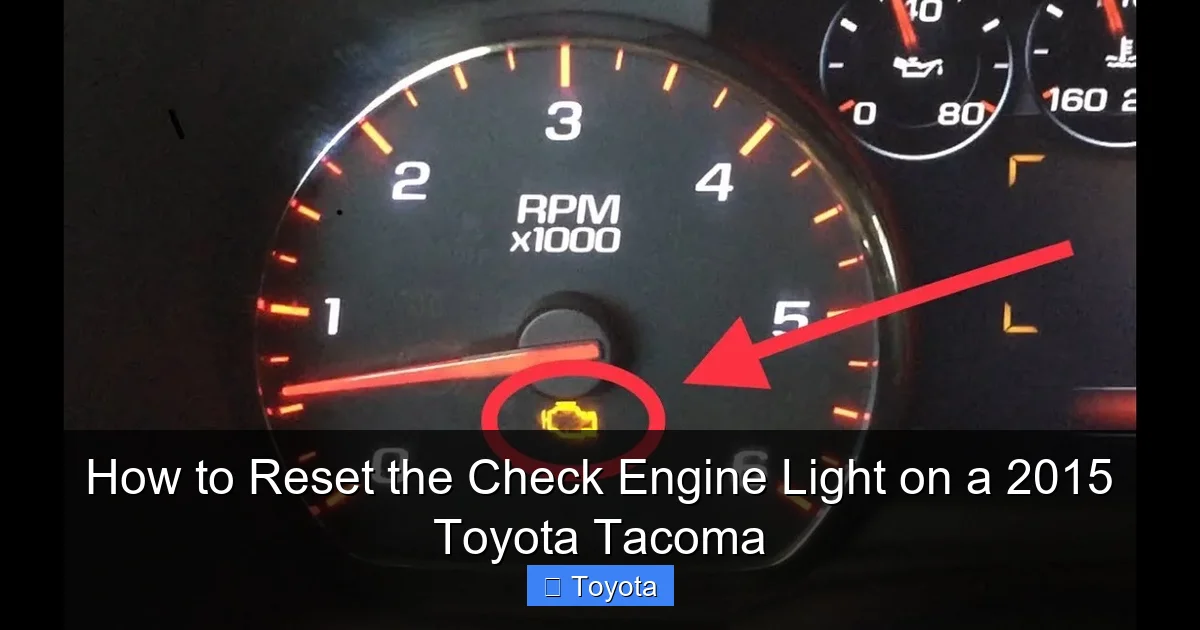
Visual guide about How to Reset the Check Engine Light on a 2015 Toyota Tacoma
Image source: i.ytimg.com
Step-by-Step Guide to Clearing the Code
1. Locate the OBD-II Port. It’s a 16-pin trapezoidal connector. In your Tacoma, it’s under the dash, just to the left of the steering wheel, near the driver’s knee. You may need to remove a plastic cover.
2. Connect Your Scanner. Turn the ignition to the “ON” position (the position right before cranking the engine, where all dash lights come on). Do not start the engine. Plug the scanner’s cable firmly into the port.
3. Establish Communication. Turn on the scanner. Most will auto-detect the vehicle. You may need to select “Toyota” and then “2015 Tacoma” from a menu. The screen should display “Vehicle Found” or similar.
4. Read the Codes. Navigate to the “Read Codes” or “Diagnose” function. The scanner will display any stored codes. They will look like “P0441” or “P0171.” Write these down. Also note if they are “Stored” or “Pending.” Pending codes mean the fault has occurred once but hasn’t yet confirmed enough to trigger the light. Stored codes are the confirmed problem.
5. Diagnose the Problem. This is the most important step you do outside the truck. Use the code as your starting point. Search online for “2015 Toyota Tacoma P0441” or consult a repair manual. Understand the possible causes. For example, P0441 is an EVAP system leak. It could be a loose gas cap, a cracked hose, or a faulty purge valve.
6. Perform the Repair. Fix the issue based on your diagnosis. Tighten the gas cap until it clicks. Replace a bad sensor. Repair a vacuum leak. This step requires mechanical skill. If you’re not comfortable, this is the time to take it to a trusted mechanic.
7. Clear the Code. Once you are confident the repair is complete, return to your scanner. Navigate to “Erase Codes” or “Clear DTCs.” The scanner may ask for confirmation. Select “Yes.”
8. Verify the Reset. The check engine light should immediately go out. The scanner should show “No Codes Detected” or “0 Codes.”
9. Test Drive and Re-check. Drive your Tacoma normally for 15-30 minutes, including both city and highway driving. This allows the PCM to run its monitors and self-tests. After driving, turn off the engine, restart it, and check if the light is still off. You can also re-scan with your tool to ensure no new codes have stored. If the light comes back on, the problem was not fixed correctly, or a new problem has developed.
Method 2: The “Last Resort” – Disconnecting the Battery
Before we go further, let’s address the old-school trick of disconnecting the negative battery terminal. We do not recommend this method for resetting a check engine light. Here’s why it’s a bad idea and what it actually does.
How It’s Done (And Why You Should Avoid It)
The process involves opening the hood, locating the battery, and using a wrench to loosen and remove the negative (black) cable clamp from the battery post. You then wait for 10-15 minutes. Some people touch the cable to the positive post to discharge residual power. Reconnect the cable, tighten it, and start the truck.
This action cuts power to the PCM, forcing it to reset and lose its memory. This includes all stored diagnostic trouble codes (DTCs). The check engine light will go out.
However, this method is problematic for several reasons:
- It Clears Everything: It doesn’t just clear check engine codes. It resets all learned data. Your Tacoma’s computer will have to re-learn your driving habits for shift points and idle control. This can cause rough idling and poor performance for the first 50-100 miles.
- It May Not Work: Some trouble codes are “non-volatile” and are designed to stay in memory even after a battery disconnect. The light might go out, but the code remains stored, and the light will return as soon as the PCM’s next self-test cycle completes.
- It Can Cause Other Issues: Disconnecting the battery can also reset the steering angle sensor (requiring a steering wheel calibration), the sunroof, and the radio presets. On some vehicles, it can trigger the security system.
- It’s Not Diagnostic: This method provides zero information about what was wrong. You’ve erased the only clue you had.
Battery disconnect is really only appropriate for clearing a “phantom” light after you’ve already fixed a problem and don’t have a scanner handy, or for clearing a “Check Hybrid System” light on a Prius after a jump-start. For a standard check engine light on a Tacoma, use a scanner.
Method 3: The “Drive Cycle” – Letting the Computer Clear Itself
Sometimes, you fix a problem (like replacing a gas cap), and the check engine light stays on. Why? Because the PCM needs to see that the problem is gone and successfully complete its internal “readiness monitors” before it will turn off the light on its own. This is where a drive cycle comes in.
What is a Drive Cycle?
A drive cycle is a specific sequence of driving conditions (speed, acceleration, engine temperature, etc.) that allows all of the OBD-II monitors to run and pass. Your 2015 Tacoma has monitors for things like the catalytic converter, oxygen sensors, and EVAP system. If a monitor hasn’t run since the code was cleared, the light may stay on even though the problem is fixed, and the scanner will show “Not Complete” for that monitor.
Generic Toyota/Tacoma Drive Cycle Procedure
While exact cycles vary, here is a reliable sequence that covers most monitors for your Tacoma. Ensure the engine is at normal operating temperature before starting.
- Start Cold: Start the engine when it’s completely cold. Let it idle for 2-3 minutes in Park/Neutral.
- Low-Speed City Driving: Drive in city traffic for about 5-10 minutes. Accelerate normally, come to several complete stops, and idle at stoplights. Keep speed under 40 mph.
- Steady Cruise: Find a safe, level stretch of road. Accelerate to 50-55 mph and maintain that steady speed for 4-5 minutes.
- Deceleration: Without shifting to neutral, slowly let off the accelerator and allow the truck to decelerate to 20 mph or a complete stop. Do not brake unless necessary for safety.
- Repeat: Perform steps 2-4 a couple more times.
- Final Idle: After the last deceleration, shift to Park/Neutral and let the engine idle for 1-2 minutes.
- Shut Down: Turn off the engine.
After this cycle, many monitors will have run. Start the engine again and check if the light is off. You can confirm with a scanner by checking the “Readiness Monitor” status. All monitors should show “Complete” or “Ready.” If the light is still on after a successful drive cycle, the fault may still be present, or a different monitor is failing.
When You Should NEVER Reset the Check Engine Light
Knowing when to reset is as important as knowing how. There are absolute red flags where your only course of action is to stop driving and seek professional help. Resetting in these scenarios is dangerous.
Flashing or Red Light – Immediate Danger
If your check engine light is flashing, or if your Tacoma has a red check engine light (some models use color coding), this indicates a severe, immediate problem. Typically, this is a misfire that is sending unburned fuel into the exhaust, which can overheat and destroy the catalytic converter in minutes. Pull over safely, shut off the engine, and have the vehicle towed. Do not drive it.
Accompanied by Other Critical Warnings
If the CEL comes on simultaneously with other dashboard lights like the oil pressure light, battery light, or temperature gauge in the red, you have a catastrophic failure. Stop driving immediately.
Persistent Codes for Critical Systems
Some codes, even if the light is steady, demand immediate attention. Codes related to:
- Catalytic Converter Efficiency (P0420, P0430): Driving with a failing cat is expensive and can lead to a complete blockage.
- Severe Misfires (P0300-P0304): Can cause engine damage and excessive emissions.
- Fuel System Leaks or Pressure Issues (P0090-P0097):strong> A fire hazard.
- Internal Engine Mechanical Problems (e.g., P0016, P0017 – Cam/Crank correlation): Can indicate serious timing component failure.
If your scan reveals these, drive only to a repair shop if absolutely necessary, and at low speed.
The Light Comes Back Immediately or Within a Few Drive Cycles
If you clear the code and the light returns on your next drive or within a day, your “repair” did not fix the problem. You have an active, ongoing fault. Continuing to reset and drive will not solve it and will likely cause more damage. Go back to diagnosis.
Other Important Toyota Tacoma Warning Lights to Know
Your Tacoma’s dash is a communication center. Confusing different lights leads to wrong actions. Let’s clarify a few that are commonly mixed up with the check engine light.
The “Service Required” or “Maintenance Required” Light (Wrench Icon)
This is your routine service reminder. It illuminates based on mileage or time intervals (e.g., every 5,000 miles) to remind you of scheduled maintenance like oil changes, tire rotations, and inspections. It is not related to engine or emission faults. The process to turn it off is a simple manual reset procedure you perform with the odometer button after completing the service. You can find the exact steps for your model year in the owner’s manual or by searching for how to reset the maintenance required light on a Toyota Tacoma. Never confuse this with the check engine light.
The Tire Pressure Monitoring System (TPMS) Light
This is a cross-section of a tire with an exclamation point. It means one or more tires is significantly under-inflated. You must inflate the tires to the correct PSI (found on the driver’s door jamb sticker). After inflation, the light should go off after a few minutes of driving. If it stays on, a sensor may be faulty. This system is separate from the engine/emissions system.
Other Models for Comparison
While the core OBD-II process is universal across all 1996+ vehicles, the location of the port and the specific menu paths on professional scan tools can vary. For example, the steps to reset a check engine light on a Toyota Corolla or a Toyota Highlander are virtually identical to your Tacoma because they share the same Toyota diagnostic architecture. Always consult your specific vehicle’s service manual if you have questions.
Conclusion: A Reset is an End Step, Not a Beginning
So, you now know how to reset the check engine light on a 2015 Toyota Tacoma. The process itself is straightforward with the right tool. But the knowledge you’ve gained here is more important than any single button press. That light is your truck’s way of asking for help. Your job as a responsible owner is to listen, diagnose, and repair. A reset is simply the final confirmation that the problem is solved and your Tacoma’s computer is once again happy and healthy. Treating the symptom (the light) without curing the disease (the underlying fault) is a recipe for expensive breakdowns, failed emissions tests, and a truck that leaves you stranded. Use your scanner as a diagnostic tool first, a reset tool second. When in doubt, the money spent on a professional diagnosis is an investment in your truck’s longevity and your peace of mind. Your reliable Tacoma deserves nothing less.
Frequently Asked Questions
Can I drive my Tacoma with the check engine light on?
It depends on the severity. If the light is steady and the truck is running normally (no strange noises, loss of power, or smoke), a short trip to a repair shop is usually okay. However, if the light is flashing, red, or accompanied by other warning lights, you should stop driving immediately and have the vehicle towed. Driving with a serious fault can cause catastrophic damage.
How much does it cost to have a mechanic read and clear a check engine code?
Many national chain auto parts stores (like AutoZone, Advance Auto Parts, O’Reilly) offer free code scanning services. A mechanic will typically charge a diagnostic fee (often $80-$150) to read the code, diagnose the cause, and perform the repair. Simply clearing the code without diagnosis is not a service reputable shops provide, as it’s irresponsible.
Can I reset the check engine light without a scanner?
Yes, the battery disconnect method is a workaround, but it is not recommended. It can cause other systems to reset and may not clear all codes. It also erases all diagnostic history, making future troubleshooting harder. The only reliable way to reset the light is with an OBD-II scanner after the repair is made.
Why does my check engine light come back on right after I reset it?
This almost always means the underlying problem has not been fixed. The PCM has detected the same fault again during its self-test. You need to re-scan for codes, re-diagnose the issue, and ensure your repair was complete and correct. A recurring light is a clear sign the issue persists.
Is it safe to reset the check engine light before an emissions test?
No, it is not safe or effective. Emissions testing stations use sophisticated scanners that will immediately see the light is off but that the readiness monitors have not run. Your vehicle will fail the test for having “incomplete” monitors. You must drive the vehicle through a complete drive cycle after any repair to set the monitors to “ready” before the test.
What’s the difference between the check engine light and the maintenance required light on my Tacoma?
The check engine light (engine icon) warns of an active problem with the engine or emissions system that needs immediate diagnosis. The maintenance required light (wrench icon) is a simple mileage/time counter reminding you of scheduled service like oil changes. The procedures to turn them off are completely separate. Resetting the wrench light does nothing for the engine light, and vice-versa.
