How Often Should You Change the Oil in a 2010 Toyota Highlander?

Contents
- 1 Key Takeaways
- 2 📑 Table of Contents
- 3 Introduction: Your Highlander’s Lifeline
- 4 Decoding the Manufacturer’s Official Guidelines
- 5 The Game-Changer: Understanding Your Oil Life Monitor
- 6 The Oil Itself: Conventional vs. Synthetic Makes a Huge Difference
- 7 The Critical Role of the Oil Filter (And Why You Can’t Skip It)
- 8 What Happens If You Delay? The Real Cost of Neglect
- 9 DIY vs. Professional: Where to Get the Job Done
- 10 Conclusion: Your Simple, Actionable Plan
- 11 Frequently Asked Questions


For a 2010 Toyota Highlander, the standard oil change interval is every 5,000 miles or 6 months under severe driving conditions, and up to 10,000 miles or 12 months under normal conditions if using synthetic oil. The vehicle’s Maintenance Required light (oil life monitor) is your primary guide. Always consult your owner’s manual, as your specific driving habits and oil type are the most critical factors in determining the right schedule.
Key Takeaways
- The “Every 3 Months/3,000 Miles” Rule is Outdated: This old standard does not apply to your 2010 Highlander with modern oil and engine technology.
- Your Oil Life Monitor is the Primary Tool: The in-cabin “Maint Req’d” light calculates oil degradation based on engine revolutions and temperature, making it the most accurate indicator.
- Driving Conditions Dictate “Severe” vs. “Normal”: Most drivers fall into the “severe” category (short trips, extreme temps, dusty roads, heavy loads), requiring changes every 5,000-7,500 miles with conventional oil.
- Synthetic Oil Extends Intervals Significantly: Using a full synthetic oil meeting Toyota’s specification can safely extend intervals to 7,500-10,000 miles, but never exceed 12 months.
- Never Ignore Time-Based Limits: Even with low mileage, oil degrades over time. The maximum interval is 12 months, as contaminants and moisture can accumulate.
- Always Use the Correct Oil Viscosity and Filter: Using 0W-20 or 5W-30 as specified and a high-quality filter is non-negotiable for engine protection and accurate oil life calculations.
- Neglecting Oil Changes Causes Costly Damage: Sludge, wear, and poor fuel economy are just the start; prolonged neglect can lead to complete engine failure.
📑 Table of Contents
- Introduction: Your Highlander’s Lifeline
- Decoding the Manufacturer’s Official Guidelines
- The Game-Changer: Understanding Your Oil Life Monitor
- The Oil Itself: Conventional vs. Synthetic Makes a Huge Difference
- The Critical Role of the Oil Filter (And Why You Can’t Skip It)
- What Happens If You Delay? The Real Cost of Neglect
- DIY vs. Professional: Where to Get the Job Done
- Conclusion: Your Simple, Actionable Plan
Introduction: Your Highlander’s Lifeline
Your 2010 Toyota Highlander is a reliable, versatile SUV built for family adventures and daily commutes. But under the hood, its heart—the engine—is a complex piece of machinery that depends on one thing above all else: clean, properly formulated oil. Thinking about oil changes might feel like a mundane chore, but getting the interval right is the single most important and cost-effective maintenance task you can perform. It’s the difference between your Highlander quietly running for 300,000 miles and facing a catastrophic, wallet-draining engine repair. So, let’s cut through the noise and old wives’ tales. How often should you change the oil in a 2010 Toyota Highlander? The answer isn’t a simple one-number-fits-all, but once you understand the factors, it becomes crystal clear.
Forget the blanket advice you might hear. The right interval for your Highlander depends on how you drive, what oil you use, and what your truck’s own computer is telling you. This guide will walk you through everything, from decoding your owner’s manual to understanding that Maintenance Required light, ensuring you make the perfect decision for your specific vehicle and lifestyle.
Decoding the Manufacturer’s Official Guidelines
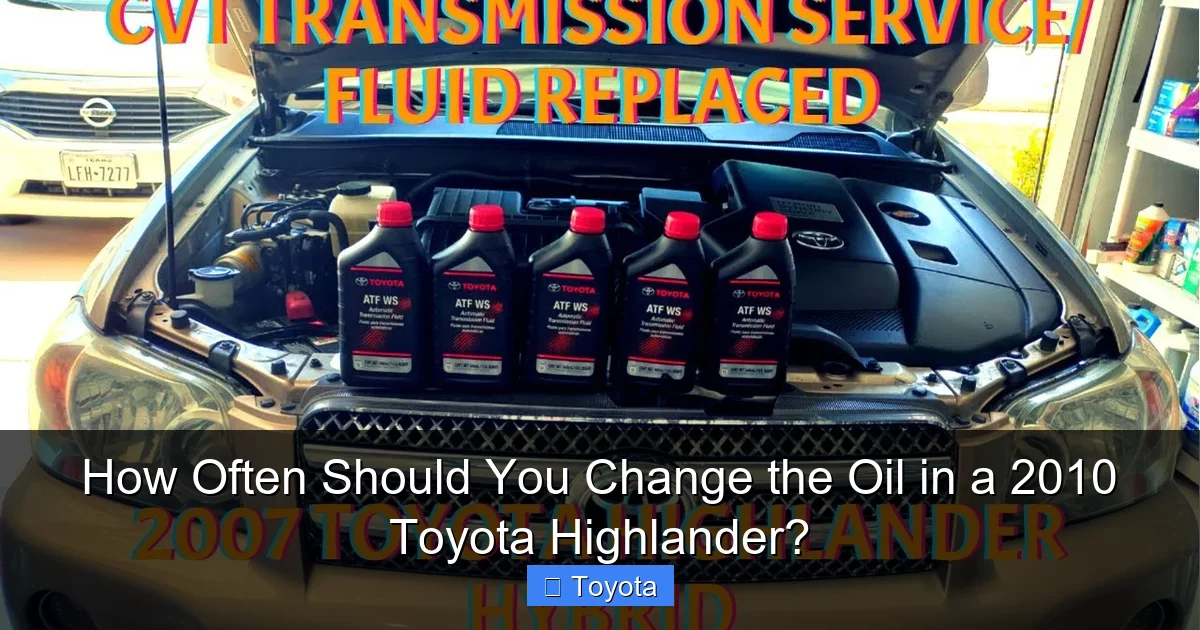
The absolute starting point for any oil change question is your vehicle’s bible: the owner’s manual. Toyota’s recommendations for the 2010 Highlander are sophisticated and based on extensive engineering. They provide two primary schedules: “Normal” and “Severe” driving conditions. It’s crucial to be honest with yourself about which category you fall into, as over 80% of drivers mistakenly classify themselves as “normal.”
Visual guide about How Often Should You Change the Oil in a 2010 Toyota Highlander?
Image source: i.ytimg.com
The “Normal” Driving Schedule
This schedule is essentially a best-case scenario, rarely met by most owners. It assumes:
- Primarily highway driving at consistent speeds.
- Ambient temperatures consistently above 20°F and below 100°F.
- Driving in areas with minimal dust and road salt.
- No excessive idling or high-speed driving.
- No towing or carrying heavy cargo.
If your Highlander truly meets all these criteria and you are using a full synthetic oil that meets Toyota’s specification (often 0W-20), the manual suggests an oil change interval of up to 10,000 miles or 12 months. Even with conventional oil under this ideal “normal” use, the interval is 5,000 miles or 6 months. But let’s be realistic: how many of us drive in perfect conditions every single week?
The “Severe” Driving Schedule (The One Most of Us Are In)
The “severe” schedule is Toyota’s catch-all for real-world driving, and it’s what applies to the vast majority of Highlander owners. Your driving is considered “severe” if you frequently experience:
- Short Trips: Driving less than 5-10 miles in cold weather (engine never fully warms up, causing fuel dilution).
- Extreme Temperatures: Consistent driving in very hot (above 100°F) or very cold (below 20°F) climates.
- Dusty or Sandy Conditions: Driving on unpaved roads, in construction zones, or areas with high pollution.
- Stop-and-Go Traffic: City commuting with frequent idying and acceleration.
- Towing or Heavy Loads: Regularly pulling a trailer or carrying a roof full of gear.
- Aggressive Driving: High-revving, rapid acceleration, and hard braking.
If any of these sound familiar—and for most, several will—your 2010 Highlander falls under the severe service schedule. For this schedule with conventional oil, the interval drops to every 5,000 miles or 6 months. With full synthetic oil, Toyota typically extends this to 7,500 miles or 6 months. The manual is explicit: when in doubt, default to the severe schedule. It’s the safer, more conservative, and ultimately more engine-friendly choice.
The Game-Changer: Understanding Your Oil Life Monitor
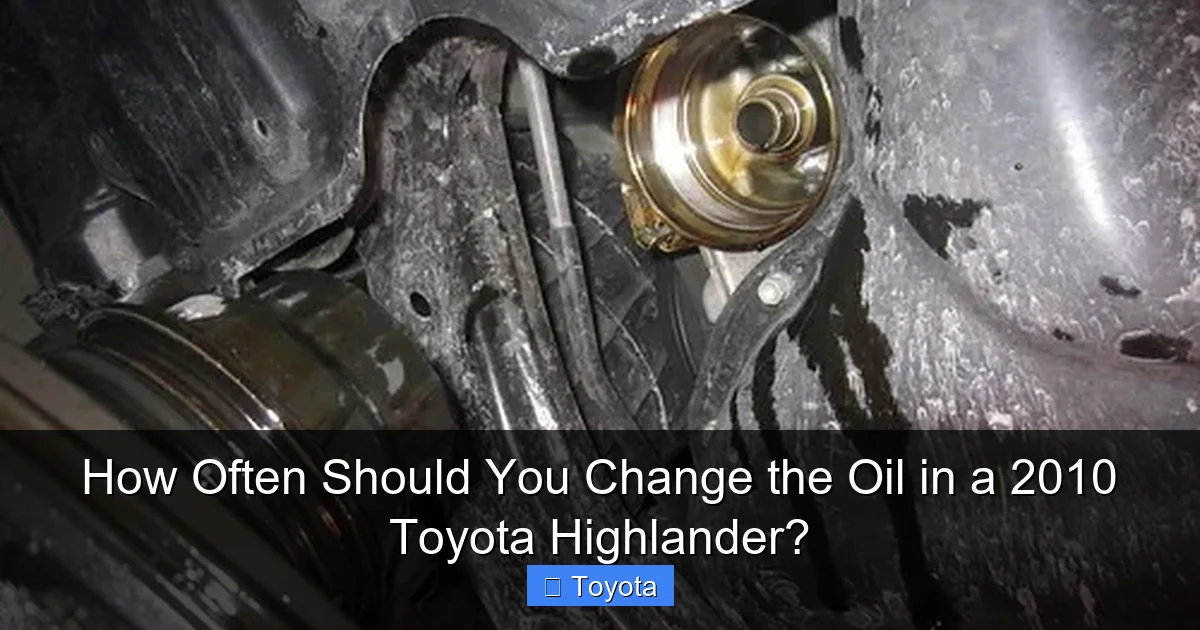
Here’s where your 2010 Highlander gets smart. Unlike older models that relied solely on a sticker in the windshield, your SUV is equipped with an Oil Life Monitor (OLM) system. This isn’t just a mileage counter; it’s an algorithm that actually monitors engine conditions like oil temperature, engine revolutions, and vehicle speed to calculate the actual degradation of your oil’s additive package and its ability to lubricate.
Visual guide about How Often Should You Change the Oil in a 2010 Toyota Highlander?
Image source: i2.wp.com
When the system calculates that the oil life has dropped to 15% or less, a “Maint Req’d” or “Oil Maintenance Required” light will illuminate on your dashboard. This light is the most accurate and personalized indicator for your specific driving habits. It will typically come on somewhere between 3,500 and 7,500 miles, depending entirely on how you’ve driven since the last reset. A week of highway cruising will let the miles pile up with little oil degradation. A month of brutal winter city commutes will burn through oil life much faster, and the light will come on sooner.
Critical Rule: You must reset the Oil Life Monitor immediately after every oil change, whether you do it yourself or have a professional do it. If you don’t reset it, the system’s calculations are completely thrown off, and the light will come on at the wrong time. The process is simple: with the ignition on (engine off), turn the odometer/trip meter button until you see the “Oil Maintenance Required” message, then hold the button for several seconds until it blinks and goes off. Your owner’s manual has the exact steps for your trim.
When to Trust the Light vs. the Manual
So, which takes precedence: the manual’s 5,000/7,500-mile rule or the OLM light? The answer is: they work together. The manual provides the safe, absolute maximum boundaries. The OLM provides the personalized, real-world calculation within those boundaries. The proper procedure is:
- Change the oil when the Maint Req’d light comes on, provided you are changing it within the manual’s maximum time limits (6 or 12 months).
- Never let the light stay on for more than 1,000 miles before changing the oil.
- Always change the oil at least once a year, even if the light hasn’t come on (time-based degradation is real).
This hybrid approach gives you the best of both worlds: the personalization of the computer system with the safety net of the manufacturer’s time-based limits. It’s the method Toyota designed you to use.
The Oil Itself: Conventional vs. Synthetic Makes a Huge Difference
The type of oil you choose is not just a preference; it’s a fundamental variable that directly changes your recommended change interval. Your 2010 Highlander’s engine (whether the 2.7L 4-cylinder or the 3.5L V6) was designed to run on oil meeting Toyota’s specification, which for most models is 0W-20 (some earlier V6 models may specify 5W-30—check your manual or oil cap). The viscosity is just the start.

Visual guide about How Often Should You Change the Oil in a 2010 Toyota Highlander?
Image source: i.ytimg.com
Conventional Mineral Oil
This is the “standard” oil, refined from crude. It works well but has a shorter molecular chain, breaks down faster under heat and shear stress, and is more susceptible to contamination. If you use a high-quality conventional oil that meets Toyota’s specs (look for the API starburst and “ILSAC GF-5” or “GF-6” on the bottle), you should adhere strictly to the 5,000-mile or 6-month interval under severe conditions. There is no safe way to extend this interval with conventional oil, regardless of what the oil life monitor might suggest, as the oil itself will have degraded.
Full Synthetic Oil
Synthetic oil is man-made from a base of highly refined and modified hydrocarbons. Its molecules are uniform, larger, and more resistant to breakdown. It handles extreme temperatures better, cleans the engine more effectively, and resists thermal degradation and oxidation for much longer. This is the key to extending your drain interval.
- Under Severe Conditions: With a full synthetic meeting Toyota’s specs, you can safely extend to 7,500 miles or 6 months. Many owners and even some mechanics feel comfortable going to 8,000-9,000 miles with a high-quality synthetic, but sticking to 7,500 is a very safe, manufacturer-aligned number.
- Under Normal Conditions: The interval can reach 10,000 miles or 12 months.
A Crucial Note on the Oil Life Monitor: The OLM system is calibrated based on the use of synthetic oil. If you use conventional oil but the system doesn’t know (because it only monitors engine parameters, not oil type), it may allow a longer interval than is safe for your conventional oil. This is another strong argument for using full synthetic—it aligns perfectly with your truck’s computer system. For a deep dive into synthetic oil intervals for all cars, you can read our comprehensive guide on how often to change synthetic oil in a car.
The Critical Role of the Oil Filter (And Why You Can’t Skip It)
An oil change is not just about draining old oil. It’s a two-part system: new oil + a new filter. The oil filter is your engine’s kidneys. It traps metal shavings, dirt, soot, and other contaminants that the oil picks up as it circulates. A clogged or low-quality filter will restrict oil flow, cause pressure problems, and allow dirty oil to circulate, negating the benefit of fresh oil.
For your 2010 Highlander, always use a filter that meets or exceeds Toyota’s specifications. Major brands like Toyota OEM (original equipment), Wix, Mobil 1, K&N, and Fram make excellent filters for this model. Don’t be tempted by the cheapest option at the big-box store. A $5 filter on a $30 oil change is a false economy. The filter’s capacity and efficiency matter. When you get your oil changed, whether at a dealership, a quick-lube, or doing it yourself, insist on a high-quality filter being installed. If you’re a DIYer, understanding how often to change the oil filter in car is simple: every single time you change the oil.
What Happens If You Delay? The Real Cost of Neglect
It’s easy to think, “I’m just 500 miles over. What’s the harm?” The harm is silent, cumulative, and eventually catastrophic. Oil is a finite resource in your engine. As it ages:
- It Loses Viscosity: It gets thinner and can’t maintain the protective film between metal parts.
- It Gets Contaminated: Fuel, water (from combustion), and soot dilute it, reducing its lubricating ability.
- Additives Deplete: The detergents, dispersants, and anti-wear agents are used up, so the oil can’t clean or protect.
- Acids Form: Sludge and varnish begin to coat internal passages and components.
The initial signs are poor fuel economy (the engine works harder), a slight increase in engine noise or tick, and eventually, the check engine light might come on. The final act is engine failure. Bearings weld to crankshafts, pistons seize in cylinders, and camshafts get chewed up. A replacement engine for a Highlander can easily cost $5,000-$8,000 installed. Compared to the $60-$100 cost of a proper oil change with synthetic, the choice is a no-brainer. Protecting your engine with timely oil changes is the ultimate financial decision. It also ties into overall engine health; for instance, neglecting oil changes can accelerate the need for other services, like a transmission fluid change in a Toyota Highlander, as overall system stress increases.
DIY vs. Professional: Where to Get the Job Done
You have options for getting this essential service done.
Do-It-Yourself (DIY)
Changing your own oil is a straightforward, satisfying task for those with basic mechanical inclination and a safe place to work. You’ll need the correct amount and type of oil (check manual—typically 5.3 quarts for the 2.7L, 6.9 quarts for the 3.5L with filter change), a high-quality filter, a socket/wrench for the drain plug and filter, a drain pan, gloves, and safety glasses. Pros: You know exactly what went in (brand, filter), it’s often cheaper, and you build knowledge. Cons: You must dispose of old oil/filter properly, it’s messy, and you must remember to reset the OLM. If you go this route, make sure you also know where to put oil in a car and how to check the level correctly.
Quick-Lube Chains (Jiffy Lube, Valvoline, etc.)
Fast, convenient, and often inexpensive. Caution: Quality control can vary wildly by location and technician. You must verify they are using the correct oil (0W-20) and a quality filter (ask to see the box). Some may try to upsell unnecessary services. They will reset your OLM, but you should always verify it’s done. Good for a quick, affordable service if you’ve found a trustworthy location.
Dealership Service Department
Typically the most expensive option. Pros: Technicians are Toyota-trained, they use OEM filters and genuine Toyota oil (or specified brand), they have a full record of your service history in their system, and they will absolutely reset the OLM correctly. They are also best equipped to handle any warranty-related concerns or technical service bulletins. This is the “peace of mind” choice.
Independent Mechanic / Trusted Local Shop
Often the best value. A reputable independent shop will use quality parts and oil, charge less than a dealer, and provide personal service. Building a relationship with a good mechanic is invaluable for your Highlander’s long-term health. They will handle the OLM reset and can often spot other potential issues during the oil change.
Bottom Line: Whichever you choose, the most important thing is that the correct oil and filter are used, and the Oil Life Monitor is reset. Keep your receipts as proof of maintenance.
Conclusion: Your Simple, Actionable Plan
So, how often should you change the oil in your 2010 Toyota Highlander? Here is your definitive, no-fluff action plan:
- Identify Your Driving: Admit it. Do you have a 15-mile commute with stops? Do you tow? Do you live where it’s brutally cold or hot? You are almost certainly a “severe” driver.
- Choose Full Synthetic Oil: For a 2010 model, this is the smart choice. It protects better, lasts longer, and works in harmony with your Oil Life Monitor. Use 0W-20 (or 5W-30 if specified on your cap).
- Heed the “Maint Req’d” Light: Let your truck’s computer be your primary guide. When it comes on, schedule your service within 1,000 miles.
- Observe the 12-Month Rule: Even if you only drive 3,000 miles a year, change the oil annually. Time degrades oil.
- Never Skip the Filter: Always replace the filter with a high-quality unit.
- Get the OLM Reset: Confirm this is done every single time. Don’t trust blindly; check your dashboard.
By following this plan, you are not just performing a routine task; you are actively investing in the longevity, reliability, and value of your 2010 Toyota Highlander. You’ll enjoy smoother runs, better fuel economy, and the confidence that your trusty SUV is ready for the next journey, wherever it may lead. A well-maintained Highlander is a happy Highlander, and a happy Highlander means happy travels for you and your family.
Frequently Asked Questions
Can I use conventional oil in my 2010 Toyota Highlander?
Yes, you can use conventional oil that meets Toyota’s specifications (correct viscosity and API/ILSAC certification). However, you must change it every 5,000 miles or 6 months, even if the oil life monitor hasn’t come on. Using full synthetic is strongly recommended for better protection and longer intervals.
How do I reset the oil maintenance required light on my 2010 Highlander?
Turn the ignition to the “ON” position (do not start the engine). Use the trip/odometer button on the gauge cluster to navigate until you see the “Oil Maintenance Required” message. Press and hold the button for about 5 seconds until the message blinks and disappears. The light is now reset. Always consult your owner’s manual for the exact procedure.
My Highlander has low mileage. Can I change the oil less often?
No. Oil degrades over time due to oxidation, moisture absorption, and additive depletion, even if the engine hasn’t run many miles. The maximum interval is 12 months, regardless of mileage. If your Highlander is a secondary vehicle or a “garage queen,” you must still change the oil at least once a year.
Is it okay to go 10,000 miles on synthetic oil in my 2010 Highlander?
Only if you are under the “normal” driving schedule (which is rare) and your oil life monitor has not come on. For most drivers (“severe” conditions), the safe maximum with synthetic is 7,500 miles or 6 months. Never exceed the 12-month time limit. The oil life monitor is your best guide—change the oil when it indicates, but always within the 6 or 12-month window.
What happens if I ignore the oil change light for too long?
Ignoring the light for more than 1,000-2,000 miles is risky. The oil has lost its ability to properly lubricate, cool, and clean the engine. This leads to increased wear, sludge buildup, poor fuel economy, and eventually, catastrophic engine failure. The cost of a new engine far exceeds the cost of regular oil changes.
Does changing my own oil void my warranty?
No. As long as you use the correct oil and filter specified in your owner’s manual and keep detailed receipts (showing oil type, filter part number, mileage, and date), you maintain your warranty. You are also responsible for properly resetting the Oil Life Monitor. If you have a certified pre-owned or remaining factory warranty, using a dealership or reputable shop can simplify record-keeping.