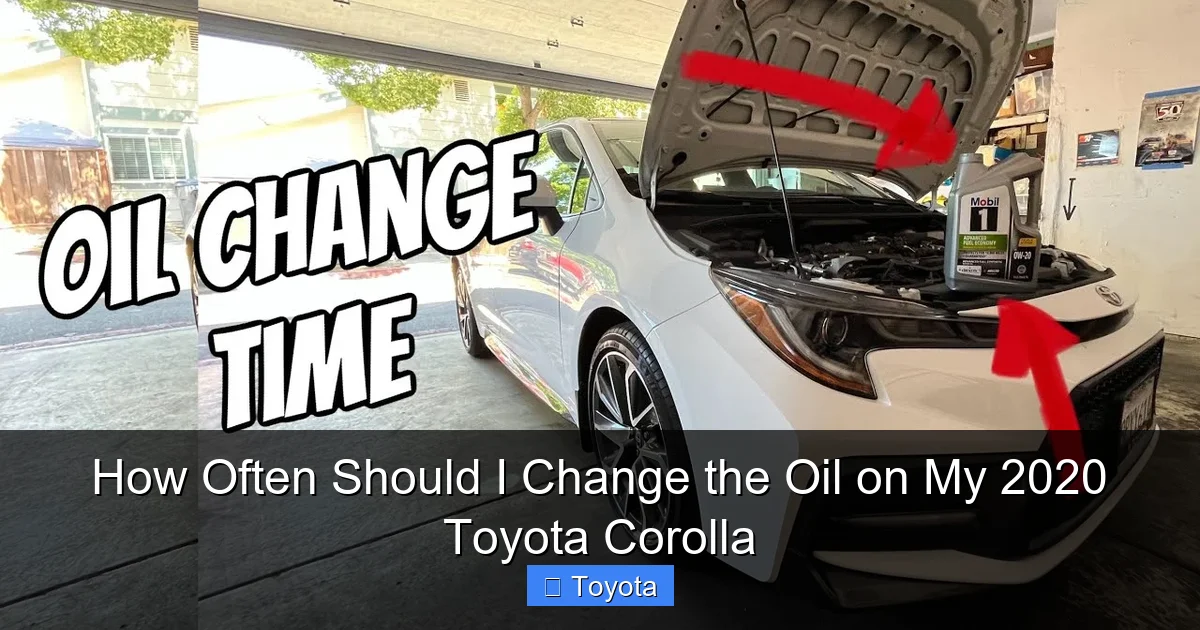
How Often Should I Change the Oil on My 2020 Toyota Corolla

Contents
- 1 Key Takeaways
- 2 📑 Table of Contents
- 3 Introduction: Your Corolla’s Heartbeat Depends on Clean Oil
- 4 Toyota’s Official Recommendation: The Gold Standard
- 5 The “Severe Service” Reality: Are You in This Category?
- 6 The Mastermind: Your Oil Life Monitor (OLM) System
- 7 Synthetic Oil: The Non-Negotiable Standard
- 8 The Step-by-Step: What to Do When the Light Comes On
- 9 The High Cost of Neglect: What Happens If You Wait Too Long?
- 10 Frequently Asked Questions


For a 2020 Toyota Corolla, Toyota recommends an oil change every 7,500 to 10,000 miles when using full synthetic oil under normal driving conditions. However, this interval can drop to 5,000 miles if you frequently drive in severe conditions like extreme temperatures, heavy traffic, or dusty environments. Your Corolla’s sophisticated oil life monitor system is the most accurate tool, automatically calculating when a change is needed based on your actual driving habits. Always use the oil viscosity specified in your owner’s manual, typically 0W-16, to ensure proper engine lubrication and fuel efficiency. Ignoring these guidelines can lead to premature engine wear, reduced performance, and costly repairs.
Key Takeaways
- Follow Toyota’s Official Guidelines: For the 2020 Corolla with synthetic oil, the standard interval is 7,500-10,000 miles, but your driving style is the ultimate decider.
- Know Your Driving Conditions: “Severe” driving—short trips, extreme temps, stop-and-go traffic, or dusty roads—means more frequent changes, often every 5,000 miles.
- Trust the Oil Life Monitor: Your Corolla’s onboard computer calculates oil degradation based on engine revolutions and temperature; change the oil when the maintenance light illuminates.
- Synthetic Oil is Non-Negotiable: The 2020 Corolla’s engine is designed for full synthetic oil (0W-16); using conventional oil can void your warranty and harm the engine.
- Reset the Light After Every Change: Failure to reset the maintenance light after an oil change will cause it to illuminate prematurely, causing confusion. You can learn the exact procedure to reset the oil light on a Toyota.
- Don’t Rely on Mileage Alone: Even if you haven’t hit the mileage limit, change your oil at least once a year, as oil degrades over time from moisture and contaminants.
- Use the Correct Oil Filter: Always replace the oil filter with a high-quality, Toyota-approved filter (often a cartridge style) to ensure proper filtration and engine protection.
📑 Table of Contents
- Introduction: Your Corolla’s Heartbeat Depends on Clean Oil
- Toyota’s Official Recommendation: The Gold Standard
- The “Severe Service” Reality: Are You in This Category?
- The Mastermind: Your Oil Life Monitor (OLM) System
- Synthetic Oil: The Non-Negotiable Standard
- The Step-by-Step: What to Do When the Light Comes On
- The High Cost of Neglect: What Happens If You Wait Too Long?
Introduction: Your Corolla’s Heartbeat Depends on Clean Oil
Your 2020 Toyota Corolla is a marvel of reliability and efficiency. It’s a car built to go the distance, to be a trustworthy companion on your daily commute and long road trips alike. But beneath that dependable exterior, a complex symphony of precision-engineered parts is hard at work. At the center of it all is your engine, and its lifeblood is the oil circulating through it. Asking “How often should I change the oil on my 2020 Toyota Corolla?” isn’t just a routine maintenance question—it’s one of the most critical things you can do to protect your investment and ensure that legendary Toyota reliability lasts for years, even decades, to come.
The answer, like many things in the automotive world, has evolved. Gone are the simple “every 3,000 miles” rules of the past. Your modern Corolla, with its advanced engine design and sophisticated electronics, operates on a different paradigm. Understanding this new paradigm is key to avoiding both unnecessary expense and potentially catastrophic engine damage. This guide will walk you through everything you need to know, from decoding your owner’s manual to interpreting the maintenance light, so you can make a perfectly informed decision for your specific driving habits.
Toyota’s Official Recommendation: The Gold Standard
When in doubt, the first place to look is the source: your vehicle’s owner’s manual. Toyota provides clear, engineering-backed guidelines for the 2020 Corolla. The standard recommendation is to change the oil every 7,500 miles or 12 months, whichever comes first, when using Toyota Genuine Motor Oil or an equivalent meeting Toyota’s specification (0W-16 viscosity). However, under what Toyota calls “Normal Driving Conditions,” this interval can be extended to every 10,000 miles or 12 months.

Visual guide about How Often Should I Change the Oil on My 2020 Toyota Corolla
Image source: images.customwheeloffset.com
What Does “Normal Driving” Really Mean?
This is where many people get tripped up. Toyota’s definition of “Normal” is quite specific and, for most drivers, a bit optimistic. It assumes:
- Trips of 10 miles or more, allowing the engine to fully warm up.
- Consistent highway driving, not prolonged stop-and-go traffic.
- Ambient temperatures consistently above 0°F and below 100°F.
- Clean, dust-free roads.
- No excessive idling or carrying heavy loads (over 1,000 lbs).
If your driving doesn’t perfectly match all these criteria, you are likely operating under “Severe” or “Special” conditions. For a deeper dive into how driving habits universally affect maintenance schedules, you can explore our comprehensive article on how often you should change the oil in your car.
The “Severe Service” Reality: Are You in This Category?
Let’s be honest: very few of us drive under truly “normal” conditions as defined by an engineer. If your Corolla is your primary vehicle for daily errands, school runs, and city commuting, you are almost certainly in the “Severe Service” category. Toyota explicitly states that for severe conditions, you should change the oil every 5,000 miles or 6 months.

Visual guide about How Often Should I Change the Oil on My 2020 Toyota Corolla
Image source: i.ytimg.com
Common severe driving scenarios include:
- Frequent Short Trips: Driving less than 5-10 miles in cold weather prevents the oil from fully heating up, allowing fuel dilution and water vapor to accumulate in the crankcase.
- Extreme Temperatures: Both scorching desert heat and frigid northern winters break down oil faster and increase engine stress.
- Heavy Traffic/Stop-and-Go: Constant idling and low-speed operation causes oil to degrade more quickly from heat and contaminants.
- Dusty or Sandy Conditions: These environments can bypass the air filter and contaminate the oil with abrasive particles.
- Towing or Roof Loads: Any time you’re putting extra strain on the engine, it generates more heat and stress on the lubricant.
For a driver in a bustling city with a 15-minute commute full of traffic lights, sticking to the 5,000-mile/6-month interval is a wise, protective choice. It’s a small, recurring cost that prevents massive engine repair bills later. Remember, an oil change is cheap insurance.
The Mastermind: Your Oil Life Monitor (OLM) System
Here’s the game-changer for 2020 Corolla owners: you don’t have to guess. Your car is smarter than a static mileage chart. The Oil Life Monitor (OLM) is an onboard computer system that doesn’t just count miles; it calculates oil degradation based on actual engine operating conditions.

Visual guide about How Often Should I Change the Oil on My 2020 Toyota Corolla
Image source: mroilguy.com
How Does the OLM Work?
The system uses algorithms that factor in:
- Engine Revolutions: High-RPM driving wears oil faster.
- Engine Temperature: How hot and for how long the oil runs.
- Driving Patterns: Data from numerous sensors to assess if conditions are “normal” or “severe.”
It continuously learns and adapts to your specific driving style. A driver who mostly cruises on the highway will see a longer interval between alerts than a city driver. The system displays the oil life as a percentage on your multi-information display. When it drops to 15% or lower, a “MAINTENANCE REQUIRED” or “OIL CHANGE” message will illuminate on your dashboard.
Your Sole Responsibility: Reset the Light
This is the most critical step. After a professional or DIY oil change, you must reset the OLM system. If you don’t, the car has no way of knowing the oil is new, and the maintenance light will illuminate again based on the old, degraded oil’s data. The reset procedure is simple but model-specific. For a 2020 Corolla, it typically involves turning the ignition on, accessing the settings menu on the steering wheel controls, and selecting “Oil Maintenance” to reset. If you’re ever unsure, a quick guide on how to reset the oil light on a Toyota will walk you through it.
Synthetic Oil: The Non-Negotiable Standard
For your 2020 Corolla, this isn’t a debate. Toyota specifies the use of full synthetic motor oil with a viscosity of 0W-16. This is a low-friction oil designed explicitly for the high-efficiency, direct-injection engines in modern Corollas.
Why 0W-16 and Why Synthetic?
The “0W” means the oil flows like a thin 0-weight oil in cold starts, providing immediate lubrication to protect your engine from the most damaging wear period. The “16” indicates its viscosity at operating temperature. This specific grade is engineered for maximum fuel efficiency, a key factor in the Corolla’s impressive MPG ratings.
Full synthetic oil is superior to conventional mineral oil in every way relevant to your engine:
- Longer Life: Resists thermal breakdown and oxidation far better, allowing for extended drain intervals.
- Better Protection: Superior film strength protects against wear, especially during cold starts and high-temperature operation.
- Cleaner Engine: Superior detergent and dispersant additives keep sludge and deposits at bay.
- Improved Efficiency: Lower friction helps maintain fuel economy.
Using conventional oil in your 2020 Corolla is strongly discouraged. It may not meet the engine’s specifications, potentially voiding your powertrain warranty. It will also break down faster, meaning you’d need to change it more often (possibly back to 3,000 miles) to avoid damage, negating any upfront cost savings. To understand the broader landscape of oil types and why synthetics dominate modern vehicles, our guide on what oil to use for your car provides excellent context.
The Step-by-Step: What to Do When the Light Comes On
So, your maintenance light is on. Now what? Here is your clear action plan:
- Confirm the Message: Check your multi-information display. Is it specifically an “OIL CHANGE” or “MAINTENANCE REQUIRED” message? Do not ignore it.
- Check Your Oil Level (Optional but Smart): Even with a good OLM, it’s wise to pop the hood monthly and check the oil level with the dipstick. Ensure it’s between the MIN and MAX marks. If it’s low, top it off with the correct 0W-16 synthetic before driving to the shop.
- Schedule or Perform the Service: You have two choices:
- Professional Service: Take it to a trusted mechanic or dealership. They will change the oil and filter, perform a basic safety inspection, and reset the OLM for you.
- DIY (If You’re Equipped): You’ll need the correct oil (typically 4.2 quarts of 0W-16), a Toyota-spec oil filter (often a cartridge style requiring a special cap wrench), a drain pan, and basic tools. The process involves safely lifting the car, draining the old oil, replacing the filter and drain plug, refilling with new oil, and finally, resetting the OLM.
- Record the Service: Note the date, mileage, and oil type/brand in your owner’s manual service log or a personal notebook. This history is valuable for resale and troubleshooting future issues.
If you choose DIY, be meticulous about disposal and resetting the light. Forgetting the reset is the most common mistake.
For a new Corolla owner, understanding the full context of manufacturer schedules and break-in periods is also useful. Our article on when to get an oil change on a new car covers those initial, crucial first services.
The High Cost of Neglect: What Happens If You Wait Too Long?
It’s easy to think, “It’s just a little over due.” This mindset is how engines are destroyed. Oil is not a “set it and forget it” fluid. As it ages and is exposed to heat, fuel, and combustion byproducts, it undergoes chemical changes:
- Viscosity Breakdown: The oil thins out and loses its ability to maintain a protective film between metal parts.
- Acid Formation: Combustion byproducts create acids that can corrode internal engine components.
- Sludge & Varnish: Additives deplete, and the oil turns into a sticky, abrasive sludge that clogs oil passages and coats critical parts.
- Contaminant Buildup: Metal shavings, soot, and unburned fuel accumulate, acting as a grinding paste.
The result of prolonged neglect is accelerated wear on bearings, piston rings, camshafts, and lifters. Symptoms can include ticking noises, loss of power, poor fuel economy, and eventually, a seized engine—a failure that costs thousands to replace or rebuild. Spending $50-$80 every 7,500 miles is a phenomenal bargain compared to a $5,000+ engine replacement. Consistent, timely oil changes are the single most effective and affordable way to ensure your Corolla’s engine reaches 300,000 miles or more.
Frequently Asked Questions
Can I use conventional oil in my 2020 Corolla?
No. Toyota specifically requires full synthetic oil meeting the 0W-16 specification for the 2020 Corolla’s engine. Using conventional oil can lead to inadequate lubrication, faster degradation, and potential damage to the engine and its sensitive components like the variable valve timing system.
My maintenance light came on, but I just changed the oil. Why?
This almost always means the Oil Life Monitor (OLM) system was not reset after the last oil change. The system has no way of knowing the oil was replaced. You must manually reset it using the menu on your steering wheel controls. A guide on resetting the oil light on your specific Toyota model can resolve this instantly.
Is 10,000 miles too long for an oil change if I mostly drive on the highway?
For a 2020 Corolla using 0W-16 synthetic oil and under truly “normal” (mostly highway) conditions, 10,000 miles is within Toyota’s extended interval. However, consider your environment. If you drive in very hot climates, occasionally tow, or have long intervals between drives, erring on the side of caution at 7,500 miles is prudent. Always let your OLM be your primary guide.
Do I need to change the oil filter every time I change the oil?
Absolutely, yes. The oil filter’s job is to trap metal shavings, dirt, and other contaminants from the circulating oil. A clogged filter restricts oil flow, causing starvation and damage. Always replace the filter with a high-quality, Toyota-approved part with every oil change.
My old 2005 Corolla needed oil every 3,000 miles. Why is the new one so different?
Engine technology and oil chemistry have advanced dramatically. Modern engines like the 2020 Corolla’s 2.0L Dynamic Force engine have tighter tolerances, direct injection, and variable valve timing. They also use advanced full synthetic oils that are far more resistant to heat and shear. These improvements allow for significantly longer drain intervals while providing better protection.
What if I don’t drive my Corolla much? Do I still need to change the oil?
Yes. Even if your annual mileage is low, oil degrades over time from moisture, fuel dilution, and the breakdown of additives. Toyota’s guideline is “every 12 months” regardless of mileage. If your car sits for long periods, consider changing the oil at least once a year to prevent acid buildup and sludge formation from condensed fuel vapors.