
How Much Weight Can a Toyota Tacoma Carry?

The Toyota Tacoma is a rugged, reliable midsize pickup built for adventure and hard work. Depending on the model year, cab style, drivetrain, and trim, it can carry between 1,100 and 1,685 pounds of payload—making it ideal for hauling gear, tools, or weekend supplies.
Key Takeaways
- Payload Capacity Varies by Model: The Toyota Tacoma’s payload ranges from 1,100 to 1,685 pounds depending on configuration, including cab type, bed length, and engine choice.
- Towing vs. Payload Are Different: Towing capacity (up to 6,800 lbs) refers to pulling a trailer, while payload is the weight the truck can carry inside the cabin and bed.
- SR5 and TRD Off-Road Offer High Payload: These trims, especially with the Access Cab and 4×2 drivetrain, often provide the highest payload ratings.
- Weight Distribution Matters: Properly distributing cargo in the bed and avoiding overloading the rear axle ensures safety and vehicle stability.
- Factory Options Affect Payload: Adding features like larger wheels, sunroofs, or towing packages reduces available payload due to increased vehicle weight.
- Check the Door Jamb Sticker: Always refer to the tire and loading information label on the driver’s door for the exact payload limit of your specific Tacoma.
- Regular Maintenance Helps Maintain Capacity: Keeping suspension, tires, and brakes in top condition ensures the truck performs safely at maximum payload.
📑 Table of Contents
- How Much Weight Can a Toyota Tacoma Carry?
- Understanding Payload vs. Towing Capacity
- Toyota Tacoma Payload Capacity by Model Year and Trim
- Factors That Affect Payload Capacity
- How to Calculate Your Tacoma’s Exact Payload
- Practical Tips for Maximizing Payload Safely
- Real-World Examples: What Can You Actually Haul?
- Conclusion: Respect the Limits, Enjoy the Ride
How Much Weight Can a Toyota Tacoma Carry?
If you’re thinking about buying a Toyota Tacoma—or you already own one—you’ve probably asked yourself: *How much weight can this truck actually carry?* Whether you’re loading up camping gear, hauling construction materials, or packing for a cross-country road trip, knowing your Tacoma’s payload capacity is essential for safety, performance, and longevity.
The Toyota Tacoma has earned its reputation as one of the most dependable midsize trucks on the market. It’s tough, capable, and built to handle everything from daily commutes to off-road adventures. But like any vehicle, it has limits. Understanding how much weight your Tacoma can safely carry isn’t just about numbers—it’s about knowing your truck’s capabilities and respecting them to avoid damage, accidents, or costly repairs.
In this guide, we’ll break down everything you need to know about the Toyota Tacoma’s payload capacity. We’ll explore how different configurations affect how much weight it can carry, explain the difference between payload and towing, and give you practical tips for maximizing your truck’s utility without overloading it. Whether you drive a 2020 SR or a 2024 TRD Pro, this article will help you make smart, safe decisions when loading up your Tacoma.
Understanding Payload vs. Towing Capacity
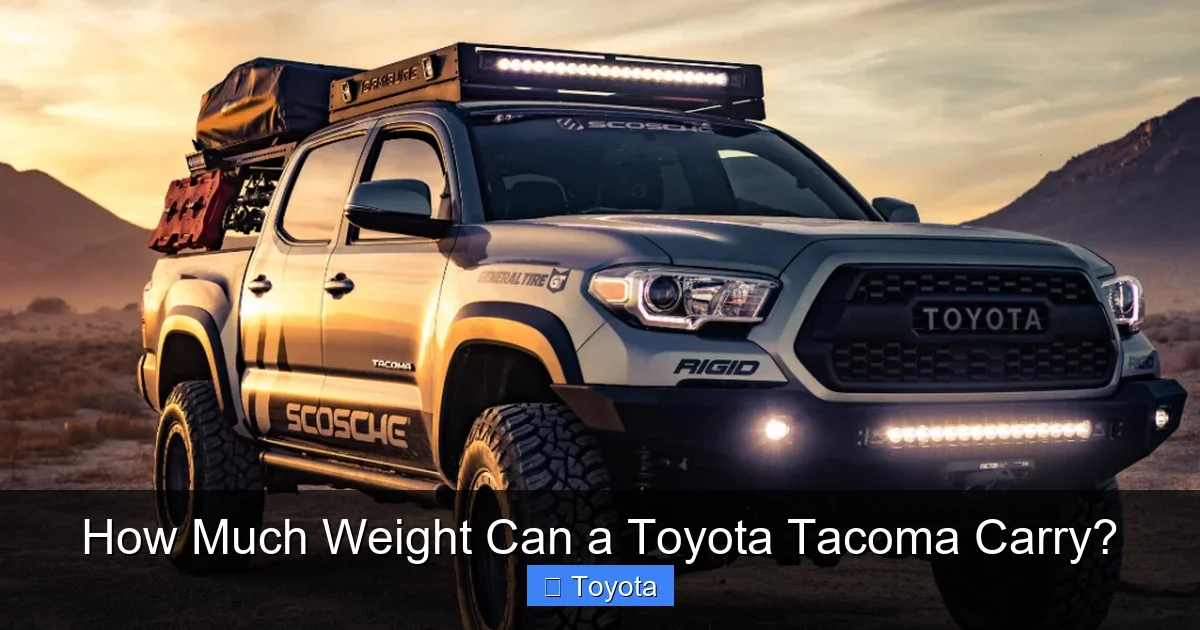
Visual guide about How Much Weight Can a Toyota Tacoma Carry?
Image source: durangovalueautos.com
Before we dive into the numbers, it’s important to clarify a common point of confusion: payload and towing capacity are not the same thing.
Payload refers to the total weight your Tacoma can carry inside the vehicle—this includes passengers, cargo in the bed, tools, coolers, and anything else you put in or on the truck. It’s the combined weight of everything that isn’t part of the truck itself.
Towing capacity, on the other hand, is how much weight your Tacoma can pull behind it, such as a trailer, boat, or camper. The Tacoma can tow up to 6,800 pounds when properly equipped, but that doesn’t mean it can carry 6,800 pounds in the bed. In fact, towing a heavy trailer often reduces your available payload because the tongue weight (the downward force on the hitch) counts toward your payload limit.
For example, if your Tacoma has a payload capacity of 1,500 pounds and you’re towing a 5,000-pound trailer with a 500-pound tongue weight, you’ve already used 500 pounds of your payload just from the trailer hitch. That leaves only 1,000 pounds for passengers, gear, and other cargo.
Why the Difference Matters
Confusing payload and towing can lead to dangerous situations. Overloading the bed or cabin can damage your suspension, strain your brakes, and make the truck unstable—especially during sudden stops or sharp turns. It can also cause excessive wear on tires and increase the risk of rollovers.
Always check your owner’s manual or the door jamb sticker for your specific payload limit. This number is calculated by subtracting the truck’s curb weight (its weight when empty) from its gross vehicle weight rating (GVWR)—the maximum total weight the truck is designed to handle.
Toyota Tacoma Payload Capacity by Model Year and Trim

Visual guide about How Much Weight Can a Toyota Tacoma Carry?
Image source: durangovalueautos.com
The payload capacity of a Toyota Tacoma isn’t a one-size-fits-all number. It varies significantly based on the model year, trim level, cab configuration, bed length, engine, and drivetrain. Let’s break it down.
2024 Toyota Tacoma Payload Ratings
The latest 2024 Tacoma models offer some of the highest payload capacities in the lineup, thanks to improved engineering and a redesigned chassis. Here’s a general overview:
- SR and SR5 (Access Cab, 4×2): Up to 1,685 pounds
- TRD Sport (Double Cab, 4×2): Around 1,400–1,500 pounds
- TRD Off-Road (Access Cab, 4×4): Approximately 1,350–1,450 pounds
- TRD Pro (Double Cab, 4×4): About 1,200–1,300 pounds
- Hybrid Models (i-FORCE MAX): Slightly lower due to added battery and motor weight—typically 1,200–1,400 pounds
The SR and SR5 trims, especially in Access Cab (extended cab) form with rear-wheel drive (4×2), tend to offer the highest payload because they’re lighter and have fewer heavy-duty features.
2020–2023 Toyota Tacoma Payload Ratings
Earlier models in the third generation (2016–2023) still deliver solid payload numbers:
- SR (Access Cab, 4×2): Up to 1,550 pounds
- SR5 (Double Cab, 4×2): Around 1,400 pounds
- TRD Off-Road (Access Cab, 4×4): Approximately 1,300–1,400 pounds
- TRD Pro (Double Cab, 4×4): About 1,150–1,250 pounds
Note that 4×4 models generally have slightly lower payload than 4×2 due to the added weight of the four-wheel-drive system.
2016–2019 Toyota Tacoma Payload Ratings
The third-generation Tacoma (2016–2023) maintained consistent engineering, so payload capacities were similar across these years:
- SR (Access Cab, 4×2): Up to 1,500 pounds
- SR5 (Double Cab, 4×2): Around 1,350 pounds
- TRD Sport (Access Cab, 4×4): Approximately 1,250–1,350 pounds
- TRD Off-Road (Double Cab, 4×4): About 1,200–1,300 pounds
2005–2015 Toyota Tacoma Payload Ratings
Older models from the second generation still hold up well, though payloads are generally lower:
- Regular Cab, 4×2: Up to 1,400 pounds
- Access Cab, 4×2: Around 1,300 pounds
- Double Cab, 4×4: Approximately 1,100–1,200 pounds
These trucks were lighter and simpler, which helped with payload, but they lacked some of the modern reinforcements and safety features of newer models.
Factors That Affect Payload Capacity
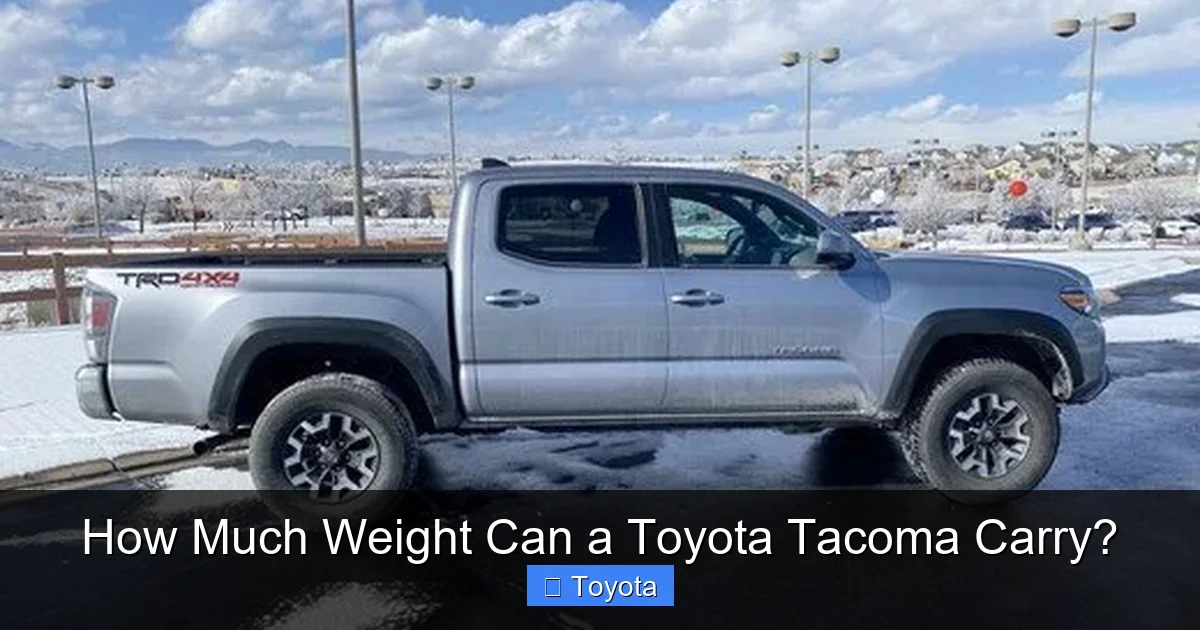
Visual guide about How Much Weight Can a Toyota Tacoma Carry?
Image source: atvhelper.com
Now that you know the general range, let’s look at what actually determines how much weight your Tacoma can carry.
Cab Configuration
The type of cab—Regular Cab, Access Cab, or Double Cab—plays a big role in payload. Regular Cab models (with just two doors and a small rear storage area) are the lightest and often have the highest payload. Access Cab (extended cab with small rear doors) offers a good balance of space and capacity. Double Cab (full four doors and rear seating) adds weight and reduces payload, especially when fully loaded with passengers.
For example, a 2024 Tacoma SR Regular Cab 4×2 might carry 1,685 pounds, while the same truck in Double Cab 4×4 might only manage 1,300 pounds.
Bed Length
Tacomas come with either a 5-foot or 6-foot bed. The 6-foot bed adds weight and can slightly reduce payload, though the difference is usually minor—around 50 pounds or less.
Drivetrain (4×2 vs. 4×4)
Rear-wheel drive (4×2) models are lighter than four-wheel drive (4×4) models because they don’t have the extra transfer case, front differential, and driveshaft. This weight difference can reduce payload by 100–200 pounds in 4×4 versions.
Engine and Transmission
The Tacoma offers different engine options, including the 2.7L 4-cylinder, 3.5L V6, and the newer 2.4L turbocharged i-FORCE and i-FORCE MAX hybrid. The hybrid system, while powerful and efficient, adds significant weight due to the battery and electric motor, which reduces payload by about 100–150 pounds compared to non-hybrid models.
Trim Level and Options
Higher trims like TRD Pro, Limited, or Trail Edition come with added features—larger wheels, sunroofs, premium audio, off-road suspensions, and skid plates—that increase the truck’s curb weight. Every extra pound the truck carries reduces the amount of weight it can safely haul.
For instance, a Tacoma with a sunroof, leather seats, and a towing package might weigh 300–400 pounds more than a base SR model, directly cutting into your payload.
Tires and Suspension
Upgraded tires, especially larger off-road tires, add unsprung weight and can affect handling and payload. Similarly, aftermarket suspension lifts or heavy-duty bumpers may look tough but can reduce your truck’s ability to carry weight safely.
How to Calculate Your Tacoma’s Exact Payload
You don’t have to guess. Toyota provides the exact payload capacity for your specific truck right on the vehicle.
Check the Door Jamb Sticker
Open the driver’s side door and look for a white or yellow sticker on the door jamb. This is the Tire and Loading Information label. It lists:
- The gross vehicle weight rating (GVWR)
- The curb weight (or front and rear axle weight limits)
- The recommended tire pressure
- The maximum number of occupants
To find your payload capacity, subtract the curb weight from the GVWR. For example, if your GVWR is 6,000 pounds and the curb weight is 4,400 pounds, your payload capacity is 1,600 pounds.
Use the Owner’s Manual
The owner’s manual includes a section on vehicle loading and payload. It often provides charts based on cab type, engine, and drivetrain. This is especially helpful if you’re comparing different configurations before buying.
Online Tools and Toyota’s Website
Toyota’s official website has a build-and-price tool that lets you configure a Tacoma and see estimated payload and towing capacities. While not always exact, it’s a great starting point for research.
Practical Tips for Maximizing Payload Safely
Knowing your payload limit is one thing—using it wisely is another. Here’s how to get the most out of your Tacoma without risking safety or damage.
Distribute Weight Evenly
Never pile all your cargo in the back of the bed. This can cause the rear end to sag, reduce traction on the front wheels, and make steering difficult. Instead, place heavier items over the rear axle and secure them properly. Use tie-downs, ratchet straps, or cargo nets to prevent shifting.
Don’t Ignore Passengers and Fuel
Remember, payload includes everything: people, pets, coolers, tools, and even a full tank of gas. A typical passenger weighs 150–200 pounds, and a full 21-gallon fuel tank adds about 125 pounds. Factor these into your total before loading cargo.
For example, if your payload is 1,500 pounds and you have three passengers (450 lbs), a full tank (125 lbs), and a dog (50 lbs), you’ve already used 625 pounds—leaving only 875 pounds for gear.
Use a Bed Liner or Mat
A spray-in bed liner or rubber mat protects the bed from scratches and dents, especially when hauling heavy or sharp objects. It also helps prevent cargo from sliding.
Consider a Bed Extender or Cargo Barrier
If you’re carrying long items like lumber or ladders, a bed extender can help secure them. A cargo barrier (or cab shield) prevents items from flying forward into the cab during sudden stops.
Avoid Overloading the Tailgate
The tailgate is not designed to support heavy weight when lowered. Never stand on it or use it as a step when loading. If you need to carry items longer than the bed, use a trailer or roof rack.
Upgrade Suspension if Needed
If you regularly carry heavy loads, consider upgrading to heavy-duty shocks, rear springs, or air helper bags. These can improve ride quality and prevent sagging, but they don’t increase your official payload rating—always stay within the manufacturer’s limit.
Weigh Your Load
If you’re unsure, visit a public scale (like a truck stop or recycling center) to weigh your loaded Tacoma. Compare the total to your GVWR to ensure you’re not overloaded.
Real-World Examples: What Can You Actually Haul?
Let’s put these numbers into practice with some common scenarios.
Weekend Camping Trip
Imagine you’re heading to the mountains for a long weekend. You’ve got two passengers, camping gear, a cooler, and a rooftop tent.
- Passengers: 300 lbs
- Fuel: 125 lbs
- Camping gear (tent, sleeping bags, stove): 200 lbs
- Cooler with food and drinks: 100 lbs
- Rooftop tent: 150 lbs
- Miscellaneous (chairs, table, clothes): 100 lbs
Total: 975 pounds. Well within a 1,500-pound payload limit.
Construction Job Site
You’re a contractor hauling tools and materials to a job.
- Driver: 180 lbs
- Fuel: 125 lbs
- Toolbox and power tools: 300 lbs
- Lumber (2x4s, plywood): 500 lbs
- Wheelbarrow and bags of concrete: 200 lbs
- Safety gear and ladder: 100 lbs
Total: 1,405 pounds. Still safe for most Tacomas, but you’re getting close to the limit—especially if you add a second passenger.
Boat or Trailer Hauling
You’re towing a 4,000-pound boat with a 400-pound tongue weight.
- Driver and passenger: 350 lbs
- Fuel: 125 lbs
- Tongue weight: 400 lbs
- Boat trailer gear (straps, life jackets): 50 lbs
Total payload used: 925 pounds. You still have room for coolers, fishing gear, or a small grill.
Conclusion: Respect the Limits, Enjoy the Ride
The Toyota Tacoma is a versatile, capable truck that can handle a surprising amount of weight—especially when properly configured. With payload capacities ranging from 1,100 to nearly 1,700 pounds, it’s more than enough for most drivers’ needs, whether you’re hauling gear for adventure or tools for work.
But capacity isn’t just about numbers. It’s about understanding your truck, respecting its limits, and loading it safely. Always check your door jamb sticker, factor in passengers and fuel, and distribute weight evenly. Avoid overloading, and consider upgrades if you regularly carry heavy loads.
Remember, the goal isn’t to max out your payload every time—it’s to use your Tacoma confidently and safely, trip after trip. Whether you’re driving a base SR or a loaded TRD Pro, your Tacoma is built to take you where you need to go, carry what you need to bring, and keep coming back for more.
So load up, hit the road, and enjoy the ride—just don’t forget to check the numbers first.
Frequently Asked Questions
What is the maximum payload for a Toyota Tacoma?
The maximum payload for a Toyota Tacoma ranges from 1,100 to 1,685 pounds, depending on the model year, trim, cab configuration, and drivetrain. The highest payload is typically found in base SR or SR5 models with Access Cab and rear-wheel drive.
Can a Toyota Tacoma carry a 4×8 sheet of plywood?
Yes, a standard 4×8 sheet of plywood weighs about 50–60 pounds and fits easily in a Tacoma’s 6-foot bed. With proper securing, you can carry multiple sheets without exceeding payload limits.
Does adding a canopy or topper reduce payload?
Yes, a fiberglass canopy or hardtop can weigh 100–200 pounds, which directly reduces your available payload. Always account for this weight when loading cargo.
Can I increase my Tacoma’s payload capacity?
No, you cannot legally increase the manufacturer’s payload rating. However, you can improve load handling with suspension upgrades like air bags or heavy-duty shocks—but always stay within the rated limit.
Is payload the same as towing capacity?
No. Payload is the weight the truck can carry inside the cabin and bed. Towing capacity is how much it can pull behind, like a trailer. Tongue weight from a trailer counts toward payload.
Where can I find my Tacoma’s exact payload limit?
Check the Tire and Loading Information label on the driver’s side door jamb. It lists the GVWR and curb weight—subtract the two to find your payload capacity.
