
How Much Is the Invoice Price of a 2025 Toyota Corolla?

The invoice price of a 2025 Toyota Corolla is the amount a dealer pays the manufacturer before any incentives or holdbacks. It’s not the final out-the-door cost, but knowing it is your #1 weapon for negotiation. For the base L trim, the invoice typically starts around $22,000-$23,000, while a loaded Limited can invoice near $28,000-$29,000. Your actual purchase price should be below the invoice when factoring in dealer cash and manufacturer incentives.
So, you’re eyeing a brand-new 2025 Toyota Corolla. Smart move. It’s the quintessential reliable, fuel-efficient compact sedan that has defined the segment for decades. But before you march into a dealership and point at a shiny model on the lot, there’s one number you absolutely must know: the invoice price. This isn’t just some industry secret; it’s your blueprint for saving thousands. Understanding what the dealer actually pays for the car you want flips the traditional negotiation script entirely. In this complete guide, we’re diving deep into the projected invoice price for every 2025 Toyota Corolla trim, explaining what that number really means, and giving you the exact strategy to use it to your advantage. Forget guessing games—let’s talk real numbers and real tactics.
Key Takeaways
- Invoice vs. MSRP: The invoice price is what the dealer pays Toyota; the MSRP (sticker price) is the manufacturer’s suggested retail price. Your goal is to pay less than the invoice.
- 2025 Corolla Invoice Range: Base models (L) invoice around $22,500, while top-trim (Limited) models invoice near $28,500. Destination fees add ~$1,000.
- Holdbacks & Incentives Matter: Dealers get a 2-3% holdback from Toyota after the sale. Combine this with available manufacturer cash to drive the price below invoice.
- Trim Level Drives Price: The huge price spread between L, LE, XLE, and XSE trims means your choice here is the biggest factor in the final invoice and sale price.
- Negotiate from the Invoice Up: Start negotiations based on the invoice price of your desired trim, then subtract known incentives. Never negotiate down from the MSRP alone.
- Regional & Dealer Variability: Invoice prices are standard, but dealer willingness to discount varies. Dealers in high-volume areas or with excess inventory often discount more aggressively.
- Final Price is Everything: Focus on the “out-the-door” total cost, including all fees, taxes, and registration, not just the agreed-upon vehicle price.
📑 Table of Contents
- What Exactly *Is* the Invoice Price? (And Why You Must Care)
- Projected 2025 Toyota Corolla Invoice Prices by Trim
- What Factors Actually Change the Invoice Price?
- How to Find the *Actual* Invoice Price for a Specific Car
- Your Negotiation Game Plan: From Invoice to Out-the-Door Price
- 2025 Corolla Invoice vs. Previous Model Years & Competitors
- Conclusion: Your Checklist for a 2025 Corolla Invoice Price Victory
What Exactly *Is* the Invoice Price? (And Why You Must Care)
Let’s clear up the biggest misconception right now: the invoice price is not the price the dealer paid for the car sitting on its lot. It’s not the dealer’s “cost.” It’s a wholesale number, a starting point for a complex financial dance between Toyota and its dealers. Think of it as the car’s wholesale invoice before any of the dealer’s profit cushions are added back in after the sale.
Here’s the simple breakdown. When a dealer orders a 2025 Corolla from Toyota, an invoice is generated. This invoice lists the base price for that specific trim, plus the cost of every option package, the destination charge, and any applicable advertising fees. This total is the invoice price. But here’s the kicker: after the dealer sells that car, Toyota typically sends them a holdback payment. This is usually 2-3% of the car’s MSRP (sometimes based on invoice), and it’s a rebate to help dealers with their flooring (financing) costs. It’s essentially profit that comes back to the dealer later.
Why does this matter to you? Because a savvy buyer uses the invoice price as a negotiation anchor. If you can get the dealer to sell you a car for, say, $500 below the invoice price, they might still make a profit when the holdback check arrives. Your goal is to find that sweet spot where the dealer still makes a reasonable (but smaller) profit, and you get a fantastic deal. It turns the negotiation from “How much off the sticker?” to “How much below the invoice can we go?” This is a much stronger position to be in. For context on how this works with other popular Toyotas, the invoice price dynamics for a model like the Toyota RAV4 follow very similar principles, just with different dollar amounts.
The Critical Difference Between Invoice, MSRP, and True Dealer Cost
It’s vital to connect these three dots:
- MSRP (Manufacturer’s Suggested Retail Price): This is the “sticker price.” It’s a suggestion. Dealers can, and do, sell above or below it. It’s the number most consumers fixate on.
- Invoice Price: The wholesale number we’re discussing. It’s typically 3-6% below the MSRP for a Toyota Corolla, which is a relatively thin margin for a high-volume model.
- True Dealer Cost: This is the invoice price minus any available manufacturer-to-dealer incentives (often called “dealer cash” or “marketing support”). If Toyota offers a $1,000 incentive on the 2025 Corolla to help move inventory, the dealer’s true cost is the invoice minus that $1,000. This is the real floor.
Your mission, should you choose to accept it, is to find out both the invoice price and any hidden dealer cash incentives for your specific trim and region. The latter is the key to getting below invoice.
Projected 2025 Toyota Corolla Invoice Prices by Trim
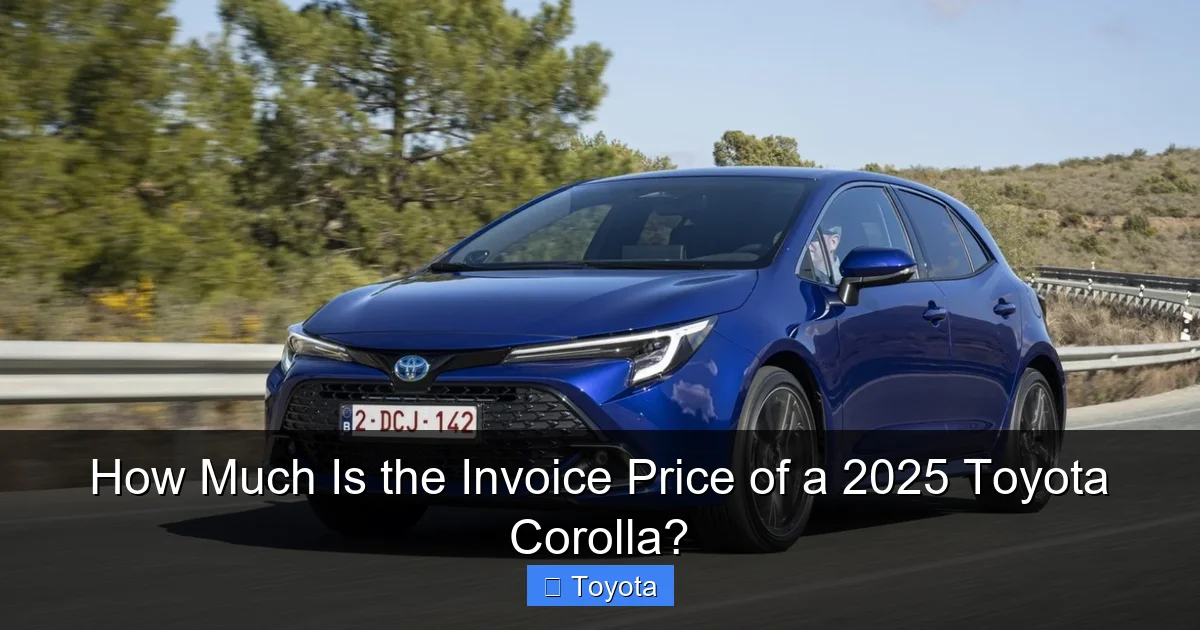
Now for the numbers you’ve been waiting for. Since the 2025 model year is just launching, official, finalized invoice figures aren’t publicly released by Toyota until closer to the on-sale date. However, based on the 2024 model’s pricing structure and typical year-over-year adjustments (usually a $100-$500 increase), we can make highly accurate projections. Remember, these are estimates for the base vehicle only, before options. All prices include the mandatory destination charge, which for 2025 is projected to be approximately $1,095 (same as 2024).
Visual guide about How Much Is the Invoice Price of a 2025 Toyota Corolla?
Image source: insidethehood.com
Base Model: 2025 Toyota Corolla L
This is your entry point. The L trim is basic but still comes with Toyota’s Safety Sense 3.0 suite and an 8-inch infotainment screen.
- Projected MSRP: ~$22,750
- Projected Invoice Price: ~$21,825 – $22,200
This trim has the smallest margin. Don’t expect massive discounts off the invoice here, but every dollar counts.
The Popular Choice: 2025 Toyota Corolla LE
The LE is the volume king. It adds keyless entry, a power driver’s seat, and more. This is the trim you’ll see most on dealer lots.
- Projected MSRP: ~$23,850
- Projected Invoice Price: ~$22,850 – $23,300
Because it’s so popular, dealers may have less incentive to discount it heavily initially. However, if you can find one on the lot with no added options, you have leverage.
The Sporty & Comfortable: 2025 Toyota Corolla XLE & XSE
These trims split the difference between comfort and sport. The XLE is comfort-focused with leatherette seats. The XSE is the sport model with a unique grille, black accents, and available 18-inch wheels.
- XLE Projected MSRP: ~$26,400
- XLE Projected Invoice Price: ~$25,300 – $25,800
- XSE Projected MSRP: ~$27,000
- XSE Projected Invoice Price: ~$25,850 – $26,350
The XSE’s invoice is often slightly higher than the XLE due to its sportier standard features. These trims have a bit more wiggle room in the margin.
The Top Dog: 2025 Toyota Corolla Limited
Loaded with leather seats, a premium audio system, and all the available tech, the Limited is the luxury of the Corolla lineup.
- Projected MSRP: ~$29,000
- Projected Invoice Price: ~$27,750 – $28,250
The highest sticker price often means the largest absolute dollar discount potential. A dealer might be willing to drop $1,500-$2,000 off the invoice on a Limited if it helps them move a slow-selling color or option package.
What Factors Actually Change the Invoice Price?
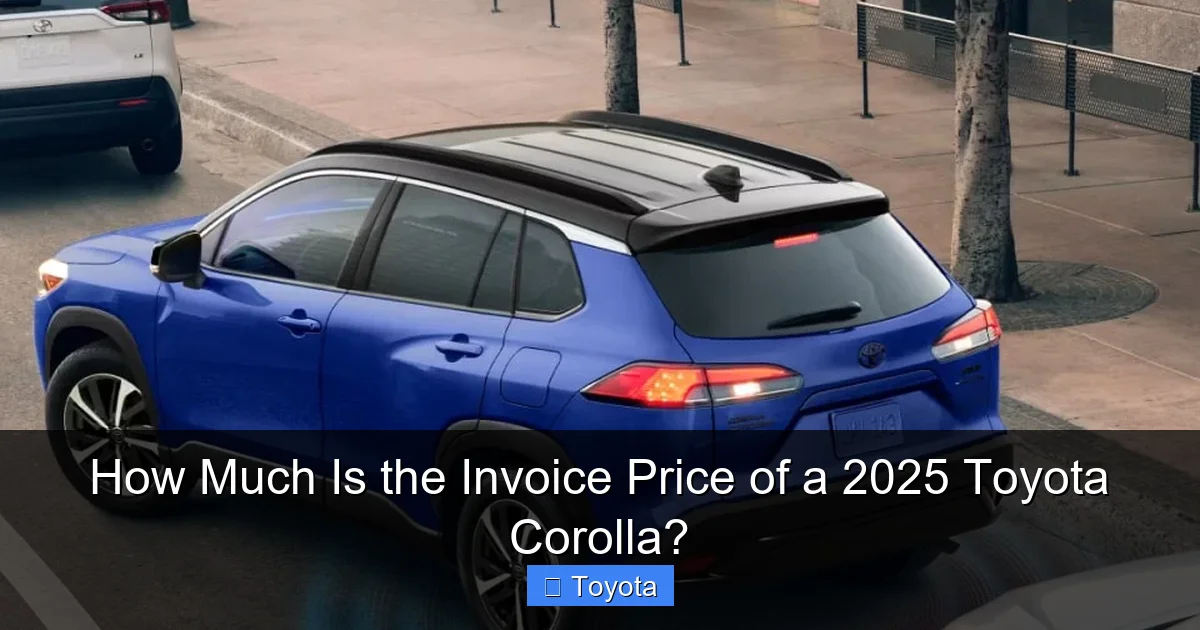
That base invoice number for the “Corolla LE” is just the starting point. Your specific car’s invoice will change based on several factors. You need to understand these to build an accurate target price.
Visual guide about How Much Is the Invoice Price of a 2025 Toyota Corolla?
Image source: di-sitebuilder-assets.dealerinspire.com
1. Options & Packages
Every single option adds to the invoice. This includes:
- Premium Audio: A JBL® system adds ~$500-$800 to invoice.
- Technology Package: Navigation, parking assist, etc., can add $1,000-$1,500.
- Wheel Upgrades: Moving from 16-inch to 17-inch or 18-inch alloys costs extra.
- Paint Color: Some “premium” colors (like sky blue or magnetic gray metallic) have a charge, often $395-$645.
Pro Tip: When researching, use online car-buying tools (like Edmunds True Market Value or Kelley Blue Book) that let you build your exact desired car and see a detailed price breakdown, including the estimated invoice. Be ruthless here. Do you really need that $1,200 sunroof? Every $1,000 in options is another $1,000 you have to negotiate down.
2. The Unavoidable Fees: Destination & Delivery
This is non-negotiable and is always included in the invoice. It’s the cost to get the car from the factory (likely Tsutsumi, Japan) to your local port and then to the dealership. For the Corolla, it’s a flat fee. You cannot negotiate this away.
3. Dealer Installed Options (The “Packages” You See on the Sticker)
Ah, the infamous dealer add-ons. Things like all-weather floor mats, nitrogen-filled tires, paint protection film, or “security” etching. These are almost always marked up astronomically (sometimes 200-300% over cost) and are pure profit for the dealer. They are NOT part of the factory invoice. Your strategy: refuse them. Say “I’m not interested in any dealer-installed options.” If they insist, ask for the separate line-item cost and negotiate it down to their actual cost, which is often very low. Better yet, buy high-quality aftermarket mats and protection later for less money.
How to Find the *Actual* Invoice Price for a Specific Car
Knowing the base invoice for a Corolla LE is good. Knowing the exact invoice for the silver 2025 Corolla XSE with the Premium Package, black wheels, and a sunroof sitting on your local dealer’s lot is power. Here’s how to get that precise number.
Visual guide about How Much Is the Invoice Price of a 2025 Toyota Corolla?
Image source: insidethehood.com
Use Subscription-Based Pricing Guides
The gold standard is Edmunds (which requires a modest subscription for its True Market Value report) and Kelley Blue Book (KBB). These services aggregate real transaction data and provide very accurate “What Others Are Paying” reports that break down the invoice, MSRP, and typical selling price for your exact configuration, down to your zip code. This is the single best tool in your arsenal. The small fee is worth thousands in savings.
Leverage Online Car Buying Services
Sites like Cars.com, AutoTrader, and TrueCar often show a “Price Breakdown” on listings that includes an estimated invoice. Be aware these estimates can be slightly off, but they give you a ballpark. TrueCar’s “Certified Price” is based on actual local transactions and is a strong starting point.
Call the Dealer’s Internet/Fleet Department
This is a classic move. Call and ask for the “Internet Sales Manager” or “Fleet Department.” These departments are geared towards volume and are often more transparent. Say: “I’m looking at a 2025 Corolla XSE with the following options [list VIN if you have it, or describe]. Can you please email me the full out-the-door price breakdown, including the vehicle invoice, all fees, and any dealer-installed accessories?” A professional will often send this. If they refuse, that’s a red flag—you’re dealing with a traditional, high-pressure sales floor.
Your Negotiation Game Plan: From Invoice to Out-the-Door Price
Armed with the exact invoice for your target car, it’s time to negotiate. Here is a step-by-step strategy.
Step 1: Get Multiple Quotes via Email
Never negotiate at the dealership first. Use the email/internet method. Contact 5-7 dealers within a 50-100 mile radius. Send the same, simple email: “I am interested in purchasing a 2025 Toyota Corolla [Trim] with [Options]. Please send me your best, all-in, out-the-door price via email. This price must include the vehicle cost, all documentation fees, title/registration, and any dealer-installed accessories. I am comparing offers and will purchase from the lowest qualified bid.”
This forces them to compete on total price, not monthly payment. It removes the emotional, face-to-face pressure. You will get a range of quotes. The lowest one is your benchmark.
Step 2: Understand the “Four-Square” and Focus on One Number
In the dealership, the salesman will use the “four-square” worksheet: Trade-in Value, Purchase Price, Monthly Payment, and Down Payment. They will try to juggle all four to confuse you. Your focus is laser-locked on the “Purchase Price” (the car’s price before your trade). Ignore the monthly payment talk until you have the rock-bottom purchase price. Then, and only then, discuss financing or your trade-in. A great deal on a car can be ruined by a lowball trade-in offer.
Step 3: The Final Math – Aim for Below Invoice
Let’s use an example. Your target car is a 2025 Corolla XLE with an invoice of $24,500. Dealer A quotes you an out-the-door price of $25,800. Dealer B quotes $25,200. You call Dealer A and say, “Dealer B offered $25,200 out-the-door. Can you beat that?” They may come down to $25,000.
Now, you check for manufacturer incentives. Let’s say Edmunds shows there is a $750 dealer cash incentive for the Corolla in your region. This means the dealer’s true cost is $24,500 – $750 = $23,750. A price of $25,000 is $1,250 above that true cost. Is that fair? Maybe. But you can push for $24,750, which is only $1,000 above true cost. That $250 is your final target. A deal at or below the true dealer cost (invoice minus incentives) is an exceptional deal. A deal $500-$1,000 above invoice but still below MSRP is a good, realistic deal for a popular model like the Corolla.
Remember, the final number you sign for is the out-the-door price. This includes:
- Agreed-upon vehicle price
- Title, registration, and license fees (set by the state/county, non-negotiable)
- Documentation fee (“doc fee” – often capped by state law, ask what it is)
- Any small, unavoidable dealer processing fees
Do not let them add “prep fees” or “advertising fees” on top of the out-the-door price you negotiated. Those should be baked into their quote.
2025 Corolla Invoice vs. Previous Model Years & Competitors
How does the 2025 Corolla’s pricing stack up? The Corolla has always been a value leader, and its pricing is very consistent year-over-year. The 2024 model saw minimal changes, so expect the 2025 invoice to be within a few hundred dollars. For comparison, the invoice on a used 2016 Toyota Corolla is, of course, a different world—you’re looking at wholesale auction prices in the $8,000-$12,000 range depending on mileage and condition. That’s a great used car benchmark, but for new, you’re in the $22k-$29k invoice zone.
Against its main rival, the Honda Civic, the Corolla typically has a slightly lower starting MSRP and invoice. The Hyundai Elantra and Kia Forte often undercut both on price, offering more features for the money, but they don’t have the Corolla’s legendary resale value reputation. When you look at the invoice, remember you’re not just buying a car; you’re buying projected reliability and high resale value. That’s worth a small premium. The Corolla’s strong residual values mean your total cost of ownership (depreciation) is lower, which can offset a slightly higher purchase price compared to a competitor.
Conclusion: Your Checklist for a 2025 Corolla Invoice Price Victory
Winning the new car buying game comes down to three things: information, patience, and discipline. The invoice price is your core piece of information. Here’s your final action plan:
- Research: Use Edmunds or KBB to build your exact 2025 Corolla (trim, options, color) and get its precise, projected invoice price. Also, check for any current manufacturer incentives (though Toyota’s are often modest).
- Shop Remotely: Get 5-7 firm, out-the-door email quotes from a wide area. Pit them against each other.
- Focus on Total Cost: Ignore monthly payments and trade-in values until the vehicle purchase price is locked in at or below your target (aim for true dealer cost if possible).
- Walk Away: The most powerful word in your vocabulary. Be prepared to leave and call the next dealer on your list. The internet quote you have is your leverage.
- Read the Fine Print: Before signing, ensure the contract matches your agreed out-the-door price. No surprise fees. Ask about the doc fee cap in your state.
By mastering the invoice price, you transform from a potential victim of dealership tactics into an informed buyer in control of the transaction. The 2025 Toyota Corolla is an excellent car. With this strategy, you can ensure you pay an excellent price for it. Now go get your quotes!
Frequently Asked Questions
Is the invoice price the same as the dealer’s actual cost?
No. The invoice price is the wholesale number before dealer holdback and manufacturer incentives. The dealer’s true cost is the invoice price minus any available dealer cash incentives from Toyota and minus the holdback (which they receive later). Your goal is to pay less than the invoice.
When is the best time to buy a 2025 Corolla to get the lowest price?
The best times are: 1) At the very end of the model year (late summer/fall) when dealers are clearing out inventory for next year’s models, 2) During major holiday sales weekends (Memorial Day, Labor Day, Black Friday), and 3) At the end of the month or quarter when sales teams are trying to hit their volume targets.
Can I get a 2025 Corolla for below invoice?
Absolutely, especially if there are manufacturer incentives (dealer cash) available. If the invoice is $24,000 and there’s a $1,000 incentive, the dealer’s cost is $23,000. Selling at $23,500 is below invoice but still profitable for them due to the holdback. Your negotiating power increases with slower sales periods or less popular colors/trims.
What’s the difference between the invoice price and the out-the-door price?
The invoice price is just for the vehicle itself. The out-the-door price is the final, total amount you will pay to drive the car off the lot. It includes the vehicle price, all government fees (tax, title, registration), dealer documentation fees, and any other agreed-upon charges. Always negotiate to the lowest possible out-the-door price.
Do all dealers get the same invoice price for the same Corolla?
Yes. The factory invoice for a vehicle with the exact same VIN (trim, options, color) is identical for every Toyota dealer in the country. Any difference in what they *pay* comes from volume-based incentives or regional programs, but the base invoice is fixed. This transparency is what makes negotiating based on invoice so effective.
Should I pay for dealer-installed options or accessories?
Generally, no. These are almost always marked up significantly. Negotiate the price of the car first, then say you’ll decline all dealer add-ons. You can usually purchase equivalent or better floor mats, window tint, and protection plans from third-party shops for much less after you buy the car. The only exception might be if a specific, hard-to-find option is already installed and deeply discounted into the car’s price.
