
How Much Is Car Insurance for a 19-year-old per Month

Car insurance for a 19-year-old typically costs between $200 and $400 per month, depending on location, driving record, and vehicle type. While young drivers face higher premiums due to inexperience, smart choices like maintaining good grades or choosing a safe car can significantly reduce costs.
Key Takeaways
- Age and inexperience drive higher premiums: 19-year-olds are considered high-risk drivers, leading to higher monthly insurance rates compared to older, more experienced drivers.
- Average monthly cost ranges from $200 to $400: This varies widely by state, insurer, and individual factors, but most 19-year-olds pay well above the national average.
- Location plays a major role: Urban areas with high traffic and crime rates often have much higher premiums than rural or suburban regions.
- Vehicle type impacts pricing: Sports cars and luxury vehicles cost more to insure than sedans or compact cars due to higher repair costs and theft risk.
- Good student discounts can lower costs: Many insurers offer discounts for full-time students with a B average or higher, potentially saving 10–25%.
- Adding a teen to a parent’s policy is usually cheaper: It’s often more affordable than getting a standalone policy, especially if the family has a strong driving record.
- Safe driving habits and telematics programs help reduce rates: Avoiding accidents and tickets, plus using usage-based insurance apps, can lead to long-term savings.
📑 Table of Contents
How Much Is Car Insurance for a 19-Year-Old per Month?
If you’re a 19-year-old looking to get behind the wheel—or a parent helping your teen navigate their first car purchase—you’ve probably asked: *How much is car insurance for a 19-year-old per month?* The short answer? It’s not cheap. But the long answer is more nuanced, and understanding the factors at play can help you find the best deal without sacrificing coverage.
At 19, you’re no longer a teenager in the eyes of the law, but to insurance companies, you’re still considered a high-risk driver. Why? Because statistically, young drivers—especially those under 25—are more likely to be involved in accidents, speeding incidents, or distracted driving crashes. This increased risk translates directly into higher premiums. While the national average for car insurance hovers around $150–$200 per month, 19-year-olds often pay double or even triple that amount.
But don’t panic just yet. While the numbers can be intimidating, there are smart strategies to reduce your monthly bill. From choosing the right vehicle to taking advantage of discounts, there are plenty of ways to make car insurance more affordable. In this guide, we’ll break down the average costs, explore the factors that influence pricing, and share actionable tips to help 19-year-olds (and their families) save money on car insurance.
Average Monthly Costs for 19-Year-Olds
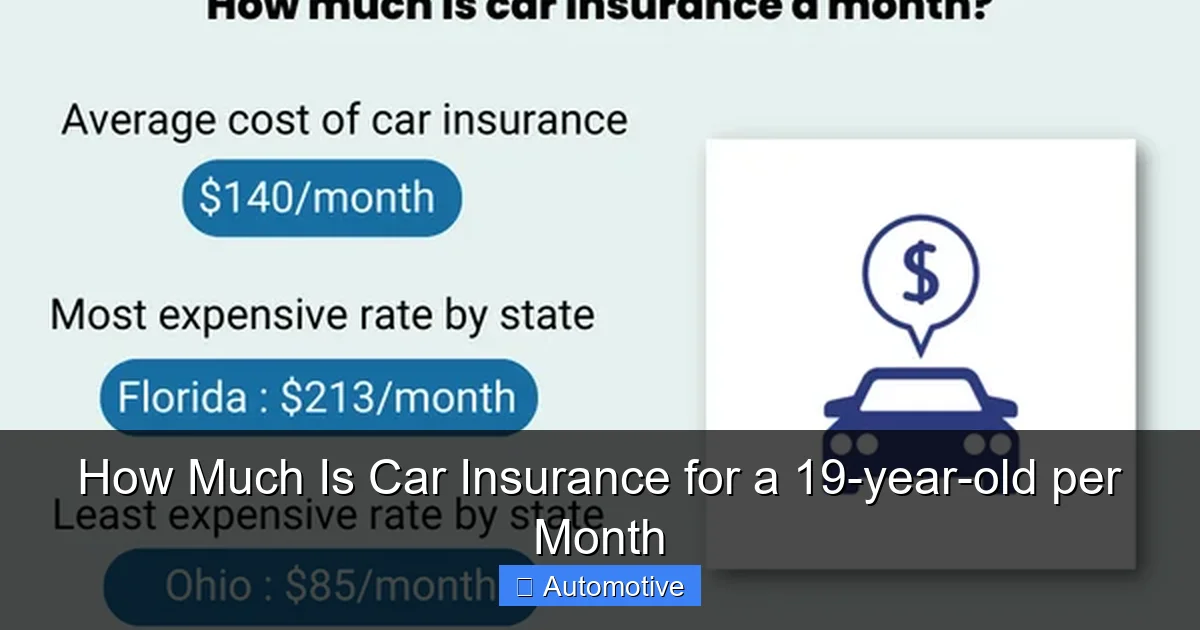
Visual guide about How Much Is Car Insurance for a 19-year-old per Month
Image source: insure.com
So, what’s the real number? How much is car insurance for a 19-year-old per month, on average? According to recent data from sources like the National Association of Insurance Commissioners (NAIC) and consumer insurance websites, the typical 19-year-old pays between $200 and $400 per month for full coverage. That’s a wide range, and your actual cost could fall anywhere within—or even outside—that bracket.
Let’s look at some real-world examples. A 19-year-old male in a high-traffic city like Los Angeles or New York City might pay closer to $350–$400 per month for a standard sedan. Meanwhile, a 19-year-old female in a smaller town in Iowa or Nebraska could pay as little as $180–$220 for similar coverage. These differences highlight how location, gender, and other variables dramatically affect pricing.
It’s also important to distinguish between liability-only and full coverage. Liability insurance—which covers damage you cause to others—is the minimum required by law in most states. For a 19-year-old, liability-only insurance might cost $150–$250 per month. But if you’re financing a car or want protection for your own vehicle, full coverage (which includes collision and comprehensive) is necessary—and that’s where the price jumps.
For instance, a 19-year-old driving a 2020 Honda Civic in Phoenix, Arizona, might pay around $280 per month for full coverage. The same driver in Detroit, Michigan—a city known for high insurance rates—could pay over $400. These examples show that while $200–$400 is a solid ballpark, your personal situation will determine the final cost.
Why Are Premiums So High for Young Drivers?
Insurance companies base their rates on risk. And when it comes to 19-year-olds, the data shows a clear trend: inexperience leads to more accidents. According to the Insurance Institute for Highway Safety (IIHS), drivers aged 16 to 19 are nearly three times more likely to be in a fatal crash than drivers 20 and older. This isn’t because teens are reckless by nature—it’s because they lack the judgment and reflexes that come with years of driving experience.
At 19, you’ve likely only been driving for a few years. You haven’t encountered every possible road scenario—like sudden weather changes, aggressive drivers, or complex intersections. This lack of experience makes insurers nervous. They see you as more likely to file a claim, which means they charge more to offset that risk.
Another factor is the type of car young drivers often choose. Many 19-year-olds are drawn to sporty or high-performance vehicles—think Mustangs, Camaros, or even used BMWs. These cars are more expensive to repair, more likely to be stolen, and often associated with speeding. All of these factors drive up insurance costs.
Additionally, credit history plays a role in many states. At 19, you may not have an established credit score, which insurers use as a predictor of claim likelihood. A poor or nonexistent credit history can lead to higher premiums, even if you’ve never had an accident.
Factors That Affect Car Insurance Rates for 19-Year-Olds
Now that you know the average cost, let’s dig into what actually determines how much you’ll pay. Understanding these factors can help you make smarter decisions and potentially lower your monthly bill.
1. Location
Where you live has a massive impact on your insurance rate. Urban areas with heavy traffic, higher crime rates, and more accidents tend to have the highest premiums. For example, drivers in Michigan, Louisiana, and Florida often pay the most due to no-fault insurance laws and high claim frequencies. In contrast, states like Maine, Vermont, and Ohio typically have lower average rates.
Even within a state, your ZIP code matters. Living in a densely populated city like Chicago or Philadelphia will cost more than a suburban or rural area. This is because urban drivers face more congestion, higher accident risks, and greater chances of theft or vandalism.
2. Driving Record
Your driving history is one of the biggest factors in determining your rate. A clean record—no accidents, tickets, or DUIs—will help keep your premiums lower. But even one speeding ticket can increase your rate by 20–30%. A DUI? That could double your premium or even lead to policy cancellation.
For 19-year-olds, maintaining a clean record is especially important. Since you’re already seen as high-risk, any blemish on your record will be magnified. On the flip side, a few years of safe driving can lead to significant discounts as you age into your mid-20s.
3. Type of Vehicle
The car you drive directly affects your insurance cost. Insurers look at safety ratings, repair costs, theft rates, and performance when setting premiums. A safe, reliable sedan like a Toyota Corolla or Honda Civic will cost less to insure than a sports car or luxury SUV.
For example, insuring a 2022 Ford Mustang GT will cost significantly more than a 2022 Hyundai Elantra. The Mustang has a higher horsepower, is more likely to be involved in speeding incidents, and costs more to repair. Even color can play a small role—bright colors like red are sometimes associated with riskier driving behavior, though this is a minor factor.
4. Coverage Level
The type and amount of coverage you choose will impact your monthly payment. Minimum liability coverage is the cheapest option, but it only covers damage you cause to others—not your own car. Full coverage includes collision (for damage to your car in an accident) and comprehensive (for theft, vandalism, weather, etc.), and it’s required if you have a car loan or lease.
While full coverage is more expensive, it’s often worth it for newer or financed vehicles. For a 19-year-old with a $20,000 car, paying $100 extra per month for full coverage could save you thousands in the event of an accident.
5. Gender
In most states, gender still affects insurance rates—though this is changing. Historically, young male drivers have paid more than young female drivers because they’re statistically more likely to engage in risky driving behaviors. However, some states (like California, Hawaii, and Massachusetts) prohibit gender-based pricing, so this factor doesn’t apply everywhere.
Even in states where it’s allowed, the gap is narrowing as driving behaviors evolve. But for now, a 19-year-old male might pay $50–$100 more per month than a female with the same profile.
6. Credit Score
In most states (except California, Hawaii, and Massachusetts), insurers use credit-based insurance scores to help determine rates. A higher credit score suggests financial responsibility, which correlates with lower claim risk. At 19, you may not have a long credit history, which can hurt your score and increase your premium.
Building good credit—by paying bills on time, keeping credit card balances low, and avoiding debt—can help lower your insurance costs over time.
Ways to Lower Car Insurance Costs for 19-Year-Olds
Now for the good news: there are several proven ways to reduce how much you pay for car insurance each month. While you can’t change your age, you *can* take control of other factors to save money.
Stay on Your Parents’ Policy
One of the easiest ways to save is by being added to a parent’s existing car insurance policy. Family plans often come with multi-car discounts, and since the primary driver (your parent) likely has a longer, cleaner driving record, the overall risk is lower. This can save you hundreds of dollars per year compared to getting your own policy.
Just make sure your parents’ insurer allows it—some companies require the primary driver to live at the same address. If you’re going to college and your car stays at home, this usually isn’t an issue.
Maintain Good Grades
Many insurers offer “good student discounts” for full-time students with a B average or higher. This can save you 10–25% on your premium. You’ll typically need to provide a transcript or report card as proof, so keep your grades up—it pays in more ways than one.
Some companies also offer discounts for students who live more than 100 miles away from home and don’t bring a car to school. If you’re in college and leave your car at home, ask your insurer about this “away at school” discount.
Choose a Safe, Affordable Car
As mentioned earlier, your vehicle choice has a big impact on insurance costs. Opt for a car with high safety ratings, low repair costs, and a low theft rate. Compact sedans, hatchbacks, and small SUVs are usually the best bets.
Avoid high-performance vehicles, luxury brands, and cars with expensive parts. Even a used Toyota or Honda can save you money compared to a flashy sports car. Use online tools like the IIHS safety ratings or Kelley Blue Book to compare insurance costs before buying.
Take a Defensive Driving Course
Completing an approved defensive driving course can lead to discounts with many insurers. These courses teach safe driving techniques, hazard recognition, and accident prevention. They’re often available online and take just a few hours to complete.
Not only can this reduce your premium, but it also makes you a safer driver—something that benefits everyone on the road.
Use Telematics or Usage-Based Insurance
Many insurers now offer usage-based insurance programs that track your driving habits through a mobile app or plug-in device. These programs monitor things like speed, braking, acceleration, and mileage. If you drive safely, you can earn discounts—sometimes up to 20% or more.
Programs like State Farm’s Drive Safe & Save, Allstate’s Drivewise, or Progressive’s Snapshot are popular options. They’re especially helpful for young drivers who want to prove they’re responsible behind the wheel.
Increase Your Deductible
Raising your deductible—the amount you pay out of pocket before insurance kicks in—can lower your monthly premium. For example, increasing your deductible from $500 to $1,000 could reduce your payment by 15–30%.
Just make sure you can afford the higher deductible if you ever need to file a claim. It’s a trade-off between lower monthly costs and higher out-of-pocket expenses when something goes wrong.
Shop Around and Compare Quotes
Never settle for the first quote you get. Insurance rates vary widely between companies, so it pays to shop around. Get quotes from at least three to five insurers, including national brands (like Geico, State Farm, and Progressive) and regional companies.
Use online comparison tools or work with an independent agent who can check multiple carriers. And remember to re-evaluate your policy every year—your rate could drop as you gain experience and build a clean record.
Real-Life Examples and Scenarios
Let’s put this all into perspective with a few real-world examples.
Example 1: Emma, 19, in Austin, Texas
Emma just bought her first car—a 2018 Honda Civic—and lives at home while attending community college. She’s added to her parents’ policy, which already covers two other vehicles. Her parents have a clean driving record and a good credit score.
Because of the multi-car discount and family plan, Emma pays $220 per month for full coverage. She also qualifies for a good student discount (she has a 3.6 GPA), which saves her an additional 15%. Without the discounts, her rate would be closer to $260.
Example 2: Jake, 19, in Miami, Florida
Jake lives in a busy urban area and drives a 2020 Ford Mustang. He’s on his own policy because his parents don’t own a car. He has one speeding ticket on his record and a limited credit history.
Due to his location, vehicle choice, and driving record, Jake pays $390 per month for full coverage. He’s considering switching to a safer car and taking a defensive driving course to lower his rate. If he makes those changes, he could save $100 or more per month.
Example 3: Sofia, 19, in Portland, Oregon
Sofia drives a 2017 Toyota Camry and lives with her parents. She’s on their policy and has a clean driving record. She also uses Progressive’s Snapshot program and has earned a 20% discount for safe driving.
Her monthly premium is $205 for full coverage. She’s planning to stay on her parents’ policy until she’s 25, when rates typically drop significantly.
These examples show how different choices lead to different outcomes. While Jake pays nearly double what Sofia does, both are 19-year-olds with similar coverage needs. The difference comes down to vehicle, location, and smart insurance decisions.
When Rates Start to Drop
The good news? Your insurance costs won’t stay high forever. As you gain driving experience and age into your mid-20s, your premiums will gradually decrease. Most insurers consider drivers “low-risk” once they reach 25, especially if they have a clean record.
For example, a 25-year-old with five years of accident-free driving might pay $150–$200 per month for the same coverage that cost $300 at age 19. That’s a savings of $100–$150 per month—or $1,200–$1,800 per year.
Other milestones can also help lower your rate:
– Completing a driver’s education course
– Maintaining continuous coverage (no lapses)
– Improving your credit score
– Moving to a safer area
The key is consistency. Safe driving, smart financial habits, and regular policy reviews will all contribute to lower costs over time.
Final Thoughts: Is It Worth It?
So, how much is car insurance for a 19-year-old per month? The answer is: more than most other age groups—but it’s a necessary expense for anyone who wants to drive legally and protect themselves financially.
While the cost can feel overwhelming, remember that insurance is about peace of mind. A single accident without coverage could cost thousands in repairs, medical bills, or legal fees. Paying $200–$400 per month is a small price to pay for that protection.
The best approach is to be proactive. Shop around, take advantage of discounts, choose a safe car, and drive responsibly. Over time, your rates will improve—and you’ll gain the confidence that comes with being a seasoned driver.
For parents, helping your 19-year-old navigate this process is an investment in their safety and financial future. For young drivers, understanding how insurance works empowers you to make smart choices now and save money later.
In the end, car insurance isn’t just a monthly bill—it’s a tool that keeps you safe, protected, and on the road.
Frequently Asked Questions
Why is car insurance so expensive for 19-year-olds?
Car insurance is expensive for 19-year-olds because they’re considered high-risk drivers due to inexperience. Statistics show that young drivers are more likely to be in accidents, which leads insurers to charge higher premiums to offset the increased risk.
Can a 19-year-old get their own car insurance policy?
Yes, a 19-year-old can get their own policy, but it’s often more expensive than being added to a parent’s plan. However, if the teen lives independently or the parents don’t have insurance, a standalone policy may be necessary.
Do good grades really lower insurance costs?
Yes, many insurers offer good student discounts for full-time students with a B average or higher. This can save 10–25% on premiums, making it a smart way for academically strong teens to reduce costs.
Does the color of my car affect insurance rates?
Car color has little to no impact on insurance rates. Insurers care more about the make, model, age, and safety features of the vehicle. However, bright colors like red are sometimes stereotypically associated with riskier driving, though this is not a major factor.
How can I lower my car insurance as a 19-year-old?
You can lower your insurance by staying on a parent’s policy, maintaining good grades, driving a safe car, taking a defensive driving course, using telematics programs, and shopping around for the best rate.
When will my car insurance rates go down?
Rates typically start to drop around age 25, especially if you have a clean driving record. Other factors like improved credit, continuous coverage, and safe driving habits can also lead to lower premiums over time.
