
How Much Is an Oil Change for a 2017 Toyota Corolla?

The average cost for a professional oil change on a 2017 Toyota Corolla ranges from $40 to $120, depending heavily on the type of oil used and where you go. A basic conventional oil change at a quick-lube chain typically runs $40-$70, while a full synthetic oil change at a dealership can cost $90-$120. Opting for a DIY approach can slash costs to just $25-$45 for materials, but requires time and basic tools. Ultimately, the best value balances upfront cost with your Corolla’s long-term engine health and your personal schedule.
Let’s be honest: talking about oil changes isn’t exactly thrilling dinner party conversation. But when it comes to your 2017 Toyota Corolla—that paragon of reliable, sensible transportation—understanding this basic service is crucial. It’s the bread and butter of engine care, the one maintenance item that, if skipped, can turn your trustworthy commuter into a very expensive paperweight. So, how much should you realistically expect to pay to keep your Corolla’s heart running smoothly? The answer isn’t a single number, but a range shaped by your choices. This guide will walk you through every factor that influences the cost, from the type of oil dripping into your pan to the shop logo on the bay door. We’ll break down DIY savings, decode professional pricing tiers, and give you the knowledge to make a smart, value-driven decision for your specific car and budget.
Key Takeaways
- Typical Price Range: Expect to pay between $40 and $120 for a professional oil change, with the final cost driven primarily by your choice between conventional, synthetic blend, or full synthetic oil.
- Oil Type is the Biggest Factor: Full synthetic oil, recommended for modern engines like the Corolla’s 2.0L, costs significantly more upfront but can extend service intervals to 10,000 miles, potentially offering long-term savings.
- DIY Saves Money, Not Time: Performing the oil change yourself costs only $25-$45 for oil and a filter, but you must factor in your time, proper disposal of old oil, and having basic tools like a wrench and drain pan.
- Dealership vs. Independent Shop: Toyota dealerships are the most expensive ($90-$120) but use OEM parts and factory-trained technicians. Independent mechanics and national chains offer more competitive pricing ($40-$90) and often have coupons.
- Location Matters: Labor rates and shop overhead vary greatly by region. An oil change in a major metropolitan area will almost always cost more than in a smaller town or suburb.
- Beware of Upsells: Many service centers will recommend additional services like fluid top-offs, cabin air filter replacement, or tire rotations. Understand what your Corolla truly needs at each service interval.
- Maintenance is an Investment: Regular oil changes are the single most important and cost-effective way to prevent catastrophic engine wear, protecting your Corolla’s reliability and resale value.
📑 Table of Contents
- Why Regular Oil Changes Are Non-Negotiable for Your 2017 Corolla
- Understanding Your 2017 Toyota Corolla’s Engine and Oil Requirements
- The Complete Cost Breakdown: DIY vs. Professional Service
- Key Factors That Influence Your Oil Change Price
- Where to Get Your Oil Changed: Dealership, Chain, or Independent Shop?
- Smart Strategies to Save Money on Your Corolla’s Oil Change
- Conclusion: Prioritizing Value and Engine Longevity
Why Regular Oil Changes Are Non-Negotiable for Your 2017 Corolla
Before we dive into dollars and cents, let’s revisit the “why.” Your 2017 Corolla’s 2.0L 4-cylinder engine (the 2ZR-FE) is a workhorse designed for efficiency and longevity. It has hundreds of moving parts—pistons, valves, camshafts—all operating at high speeds and temperatures. Engine oil is its lifeblood. It performs three critical jobs: it lubricates parts to reduce friction and wear, it helps cool the engine by carrying heat away, and it suspends dirt and combustion byproducts, carrying them to the oil filter where they’re trapped.
Over time, oil degrades. Its chemical additives break down, it gets contaminated with microscopic metal particles and soot, and it loses viscosity—its ability to flow properly and maintain a protective film. This is why the myth of “changing oil every 3,000 miles” is outdated for modern engines like the Corolla’s. Toyota’s official recommendation for normal driving is an oil and filter change every 10,000 miles or 12 months when using genuine Toyota 0W-20 synthetic oil. For severe driving conditions (frequent short trips, extreme temperatures, dusty environments), that interval drops to 5,000 miles. Sticking to this schedule prevents sludge buildup, excessive wear, and ultimately, engine failure. The cost of a few oil changes is pennies compared to the $4,000-$8,000 bill for a new engine.
The Role of Oil in Your Corolla’s Efficiency
It’s not just about preventing damage. The right oil at the right time directly impacts your fuel economy. Fresh, clean oil with the proper viscosity (the “0W-20” number) reduces internal engine drag. A clogged, sludgy oil makes your engine work harder, burning more gas. For a car praised for its excellent MPG, maintaining that efficiency starts with clean oil. This is a key reason why Toyota specifies synthetic oil for newer models; it flows better at cold starts and maintains stability at high temps, optimizing performance across all conditions.
What Happens When You Skip an Oil Change?
The consequences are gradual but inevitable. First, your oil’s lubricating properties diminish, increasing wear on cylinder walls and bearings. You might not feel it, but the damage is accumulating. Next, the oil turns dark and gritty, losing its ability to clean. This grime can clog oil passages, starving critical components like the camshaft and turbocharger (if equipped) of lubrication. Finally, the oil’s additives are exhausted, and it can no longer neutralize acids, leading to corrosion. The end result is accelerated engine wear, poor performance, and a seized engine. For a 2017 Corolla with potentially over 100,000 miles today, staying on top of oil changes is what separates a car that runs forever from one that dies prematurely.
Understanding Your 2017 Toyota Corolla’s Engine and Oil Requirements
You can’t talk cost without knowing exactly what your car needs. The 2017 Corolla comes standard with a 1.8L 4-cylinder (1ZZ-FE) in the base L and LE trims, and a more powerful 2.0L 4-cylinder (2ZR-FE) in the SE and XLE trims. Both are proven, reliable engines, but they have specific requirements.
Visual guide about How Much Is an Oil Change for a 2017 Toyota Corolla?
Image source: i.ytimg.com
Engine Type and Oil Capacity
The oil capacity is a key detail for DIYers. For the 1.8L engine, it takes 4.2 quarts (4.0 liters) of oil with a filter change. For the 2.0L engine, it takes 4.0 quarts (3.8 liters) of oil with a filter change. Always check your owner’s manual for the exact specification for your VIN. Overfilling can cause aeration (foaming), which is almost as bad as running low. If you’re curious about the precise capacity for your specific model year, we have a detailed guide on how much oil a Toyota Corolla takes that breaks it down by generation and engine.
Recommended Oil Viscosity and Type
This is the most important specification. Toyota strongly recommends—and for warranty purposes, requires—SAE 0W-20 oil meeting the Toyota Genuine Motor Oil specification or ILSAC GF-5. The “0W” means it flows like a “0-weight” oil in cold starts (critical for immediate lubrication on winter mornings), and the “20” means it behaves like a “20-weight” at operating temperature. Using the wrong weight can trigger check engine lights, reduce fuel economy, and cause long-term wear. Furthermore, Toyota specifies that full synthetic oil is required for the 10,000-mile interval. If you use conventional oil, you must change it every 5,000 miles. For a 2017 Corolla, sticking with a high-quality full synthetic 0W-20 is the best practice for performance and longevity, even if you opt for a shorter 5,000-mile interval.
The Complete Cost Breakdown: DIY vs. Professional Service
Now, to the heart of the matter: the price. The total you pay depends entirely on the path you choose. Let’s itemize both.

Visual guide about How Much Is an Oil Change for a 2017 Toyota Corolla?
Image source: davesoilchange.com
DIY Oil Change: Materials and Step-by-Step Costs
If you’re handy with a wrench, doing it yourself is the ultimate cost-saver. Here’s a realistic shopping list for a 2017 Corolla (using full synthetic as an example):
- Oil: 5 quarts of a quality full synthetic 0W-20 (e.g., Toyota Genuine, Mobil 1, Pennzoil Platinum). Price: $25-$45 for a 5-quart jug.
- Oil Filter: The correct filter for a 2017 Corolla is the Toyota Genuine Oil Filter or an equivalent from brands like WIX, Fram, or K&N. Price: $8-$15.
- Crush Washer: A new aluminum crush washer for the oil drain plug. This is critical. Reusing the old one can cause leaks. Price: $1-$3.
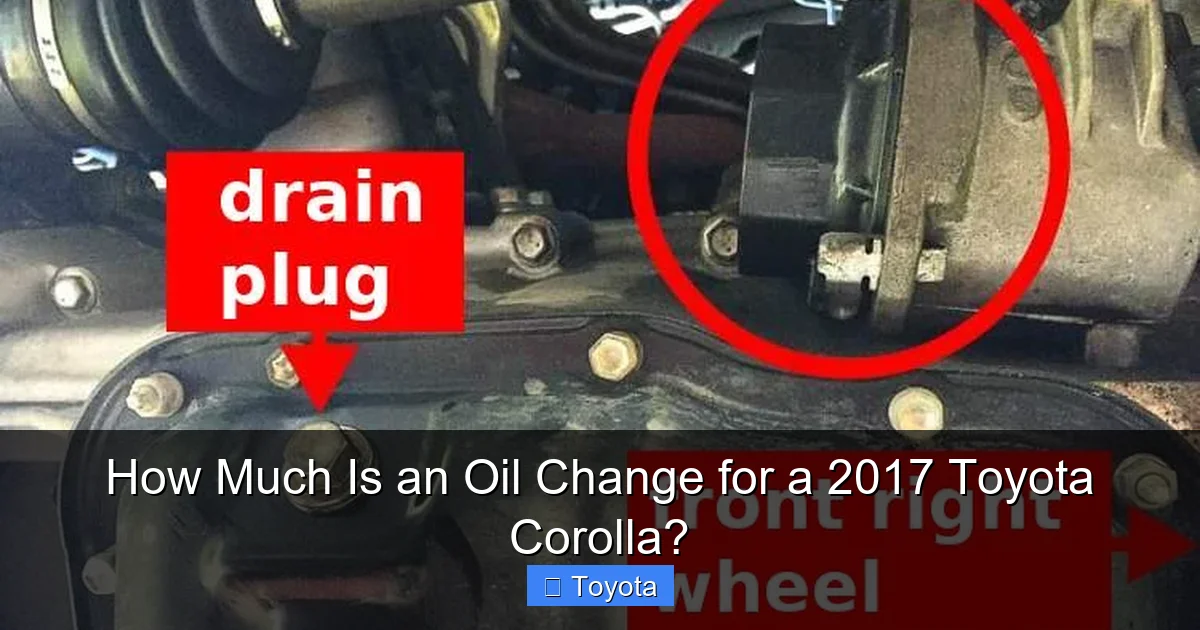
- Tools (if you don’t have them): A socket wrench and 14mm or 17mm socket (size varies by engine), an oil drain pan ($10-$20), a funnel ($5), and mechanic’s gloves.
Total DIY Material Cost: ~$35-$65. Your initial investment in tools raises the first-time cost, but those tools pay for themselves after 2-3 changes. The real “cost” is your time (30-60 minutes) and the responsibility of properly disposing of the used oil and filter at a designated recycling center (most auto parts stores take it for free).
Professional Oil Change: What’s Included in the Price?
When you pay a professional, you’re paying for labor, shop overhead, convenience, and often a multi-point inspection. The price is typically a bundled service fee. Here’s what you generally get:
- Labor: The technician’s time to drain, replace the filter and washer, refill, and reset the maintenance light.
- Parts: The oil and filter. The quality varies by shop. Dealerships use OEM (Toyota) filters and often Toyota-branded oil. Chains may use their house brand or a name brand.
- Multi-Point Inspection: Most reputable shops will check tire pressure, fluid levels (coolant, brake, washer), battery health, and look for obvious leaks or worn components. This is a valuable-added service.
- Disposal: They handle the messy cleanup and environmentally responsible disposal of the old fluids and filter.
- Convenience & Warranty: You sit in a waiting room with coffee, and the work is usually warrantied for a short period (e.g., 90 days or 4,000 miles).
The professional price spectrum is wide. We’ll break down the specifics in the next section.
Key Factors That Influence Your Oil Change Price
You might call three shops and get three different quotes. Here’s why.
Visual guide about How Much Is an Oil Change for a 2017 Toyota Corolla?
Image source: maslo-toyota.ru
Oil Type: The Primary Driver
This is the single largest variable. A 5-quart jug of conventional oil costs about $15-$20. A high-quality full synthetic like Mobil 1 or Toyota Genuine costs $25-$45 for the same quantity. Shops pass this cost directly to you. A “standard” oil change at a quick-lube is almost always conventional. If you want synthetic—which you should for your Corolla—there’s an upcharge, often $20-$40. Always ask: “What oil grade and brand are you using, and is it full synthetic?”
Your Location and Local Labor Rates
An oil change in Manhattan or San Francisco will cost 20-30% more than in Tulsa or Boise. Labor rates and commercial rent dictate the base price. National chains have set pricing but may vary slightly by region. Your best local benchmark is to call 2-3 independent shops in your immediate area and ask for a quote for a full synthetic 0W-20 oil change on a 2017 Corolla.
Additional Services and Upsells
This is where bills balloon. The technician might notice your cabin air filter is dirty and recommend replacing it ($40-$70 part + labor). They might suggest a fuel system cleaning, transmission fluid service, or a brake fluid flush. While some of these are legitimate maintenance items on a high-mileage Corolla, they are not part of a standard oil change. Know your owner’s manual maintenance schedule. Politely decline any service not due at that mileage interval. A reputable shop will provide a written estimate and explain why each item is needed.
Where to Get Your Oil Changed: Dealership, Chain, or Independent Shop?
Where you take your Corolla significantly impacts cost, experience, and perceived value.
Toyota Dealership: Pros, Cons, and Pricing
Pricing: $90 – $130 for a full synthetic oil change with OEM filter. This is the premium tier. The dealership uses genuine Toyota parts and oil, and technicians are factory-trained specifically on your model. They have direct access to technical service bulletins and use the latest diagnostic software. The multi-point inspection is often very thorough. The main downside is cost. It’s the most expensive option. However, if your Corolla is still under the original 5-year/60,000-mile powertrain warranty, having all service done at the dealership provides an unimpeachable record, which can be helpful for a future warranty claim. For out-of-warranty cars, the value proposition is weaker unless you prioritize OEM parts and brand-specific expertise. You can learn more about the specifics of what a Toyota dealership charges for an oil change and what that fee includes.
National Quick-Lube Chains (Jiffy Lube, Valvoline Instant Oil Change, etc.)
Pricing: $50 – $80 for a full synthetic oil change. These shops specialize in speed and volume. They almost always have competitive coupons (often $10-$20 off) advertised online or in mailers. The technicians are experienced with common models like the Corolla, but their training is less brand-specific. They typically use reputable name-brand oil and filters (like Valvoline, Pennzoil, or their house brand). The environment is fast-paced; you’re usually in and out in under 30 minutes. The quality is generally very good for a basic service, but complex issues might be missed compared to a dealership. They are an excellent middle-ground option for price and convenience, especially when using a coupon.
Local Independent Mechanics
Pricing: $45 – $85 for a full synthetic oil change. This is where you can often find the best value. A trusted, established independent mechanic will usually charge less than a dealership or chain. They may use high-quality aftermarket filters (like WIX or Fram) and bulk synthetic oil, keeping costs down. The relationship is key: building a rapport with a mechanic who knows your car’s history can lead to honest advice and fair pricing on larger repairs. The inspection might be less formalized than at a dealership but can be just as insightful. The challenge is finding a trustworthy shop—ask for recommendations from neighbors or check reviews meticulously. For straightforward service like an oil change on a common car like the Corolla, a good independent is hard to beat.
Smart Strategies to Save Money on Your Corolla’s Oil Change
You don’t have to overpay. Here’s how to be a savvy consumer.
Coupons, Memberships, and Package Deals
This is the easiest way to save $15-$30. Sign up for email lists from national chains like Jiffy Lube, Valvoline, or Meineke. They constantly send limited-time offers. Many also have loyalty apps with digital coupons. Some retailers, like Costco, offer synthetic oil changes to members at competitive rates using their Kirkland Signature brand (a top-rated oil). If you drive a lot, some shops offer “package deals” where you buy 3 or 5 oil changes upfront at a discounted rate. This locks in the price and guarantees your future business.
Choosing the Right Oil for Your Budget and Driving Style
You don’t always need the most expensive full synthetic. For a Corolla with under 100,000 miles driven mostly on highways, a high-quality conventional or synthetic blend oil changed every 5,000 miles is perfectly adequate and will cost less. However, if you do a lot of short trips where the engine doesn’t fully warm up, live in an extreme climate (very hot or very cold), or want the maximum 10,000-mile interval, full synthetic is worth the extra cost. A mid-tier synthetic from a brand like Castrol GTX or Mobil 1 Extended Performance offers excellent protection without the premium price of Toyota Genuine oil. Compare the cost per quart and calculate the per-mile cost; the difference is often negligible when you extend the service interval.
Consider the Filter Separately
Some shops use a cheap filter to pad margins. If you’re at an independent, you can often supply your own high-quality filter (like a WIX XP or Mobil 1) and ask them to install it for a reduced labor rate. This ensures you get a top-tier filter that will last the full oil change interval. The filter is just as important as the oil. A poor filter lets contaminants into your clean oil, negating the benefit of expensive synthetic oil. For reference on the exact part, you can look up the 2017 Toyota Corolla oil filter part number online or in your manual.
Conclusion: Prioritizing Value and Engine Longevity
So, how much is an oil change for a 2017 Toyota Corolla? The honest answer is: it depends on your priorities. The absolute minimum, DIY with conventional oil, is about $25. The typical professional price for a good full synthetic service at a chain with a coupon is $50-$70. The premium dealership experience with OEM parts is $100-$130. Your Corolla doesn’t care about the shop’s logo; it cares about clean, correct-specification oil flowing through its veins at the proper interval. The most expensive oil change is the one you skip. By understanding the factors at play—oil type, shop type, location, and upsells—you can make an informed choice that protects your investment without wasteful spending. For a car known for its bulletproof reliability, consistent, proper oil maintenance is the simplest and smartest way to ensure your 2017 Corolla delivers another 200,000 miles of dependable service.
Frequently Asked Questions
How often should I really get an oil change on my 2017 Toyota Corolla?
Follow your owner’s manual. With full synthetic 0W-20 oil under normal driving conditions, Toyota recommends every 10,000 miles or 12 months. For severe conditions (lots of short trips, extreme temps, dusty areas), change it every 5,000 miles. Never exceed the 12-month interval, even if mileage is low, as oil degrades over time.
Can I use conventional oil in my 2017 Corolla instead of synthetic?
Yes, you can use conventional oil that meets Toyota’s specifications, but you must change it every 5,000 miles or 6 months. Using conventional oil on the 10,000-mile interval is not recommended and can lead to engine wear. For the best protection and longest intervals, full synthetic is the recommended choice.
Is it worth it to pay extra for a full synthetic oil change?
For most drivers, yes. Full synthetic oil offers superior protection against high-temperature breakdown, better cold-weather flow, and improved cleansing properties. It allows for longer drain intervals (up to 10,000 miles), which can offset the higher upfront cost per quart. For a modern engine like the Corolla’s, it’s the optimal choice for longevity and efficiency.
What should I expect to be included in a standard oil change service?
A complete service should include: draining and replacing the engine oil, replacing the oil filter and drain plug washer, refilling with the correct type and amount of oil, resetting the maintenance required light, and a basic multi-point inspection (checking tire pressure, fluid levels, battery, and looking for leaks). Always ask for a written checklist of what was inspected.
What happens if I go too long without an oil change?
Oil breaks down and gets contaminated. As it loses its lubricating properties, metal-on-metal contact increases, causing accelerated wear on bearings, pistons, and camshafts. Sludge and deposits can form, clogging oil passages and leading to oil starvation. This can cause severe engine damage, reduced performance, and ultimately, catastrophic engine failure, which is far more costly than any oil change.
How do I reset the maintenance required light after an oil change?
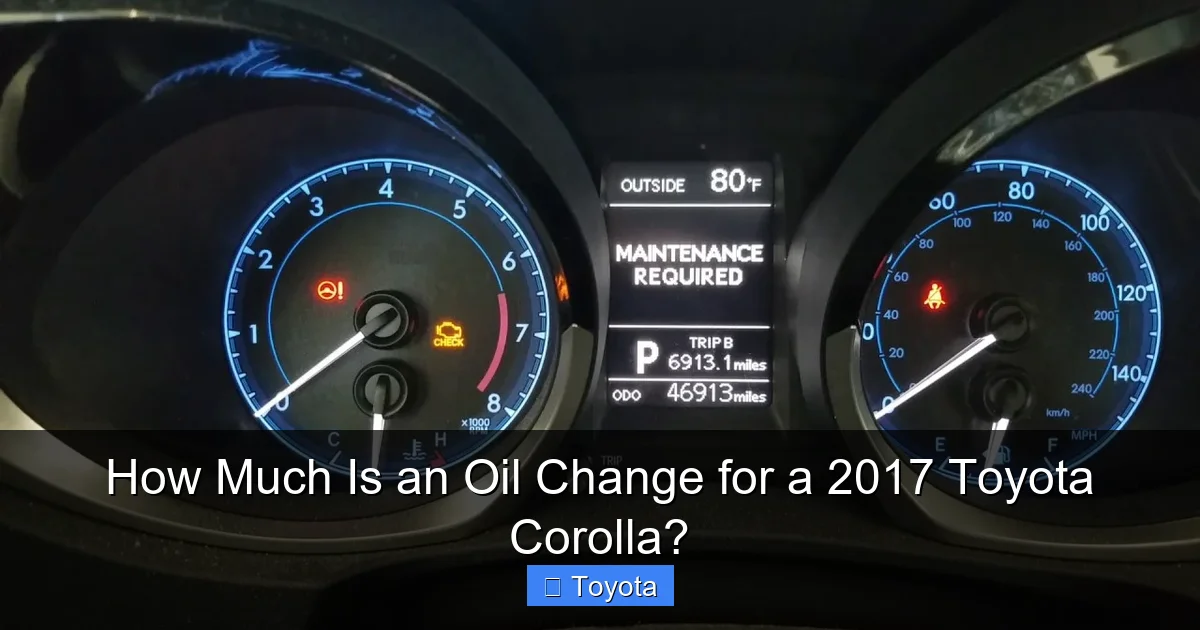
For a 2017 Corolla, turn the ignition to the “ON” position (do not start the engine). Use the odometer display button (usually on the instrument cluster) to navigate to the “Settings” menu. Find the “Maintenance Reset” or “Oil Maintenance” option, select it, and confirm the reset. The process is similar but button-specific; your owner’s manual has the exact steps. If you have it done professionally, they should reset it for you.
