How Much Is a Toyota Catalytic Converter Worth for Scrap

Contents
- 1 Key Takeaways
- 2 📑 Table of Contents
- 3 The Science Behind the Value: Precious Metals in Toyota Catalytic Converters
- 4 How to Determine Your Toyota Catalytic Converter’s Scrap Worth
- 5 Where and How to Sell Your Toyota Catalytic Converter for Scrap
- 6 Toyota Models with the Highest Scrap Value
- 7 Legal and Ethical Considerations When Selling Catalytic Converters
- 8 Tips to Maximize Your Scrap Value
- 9 Conclusion: Making the Smart, Legal Sale
- 10 Frequently Asked Questions

Car Emergency Roadside Kit
Foam Cannon

OBD2 Scanner Tool

Carburetor Cleaner
The scrap value of a Toyota catalytic converter is primarily driven by the precious metals—platinum, palladium, and rhodium—it contains. Prices fluctuate daily based on global commodity markets, so a specific figure is impossible to pin down without current quotes. Generally, Toyota converters are moderately to highly valuable, with hybrids like the Prius often fetching top dollar due to higher rhodium content.
You’re staring under your old Toyota, or maybe you have a stack of used parts from a project car. That bulky, metallic canister—the catalytic converter—suddenly looks like a potential payday. But how much is a Toyota catalytic converter worth for scrap? The answer isn’t a simple number. It’s a story of geology, global economics, and automotive engineering. Let’s break it down, piece by piece, so you know exactly what you have and how to get the best possible price for it.
First, a crucial warning: catalytic converter theft is a massive, nationwide problem. If you’re selling a converter you removed yourself from a car you legally own, you’re in the clear. If you’re buying one without ironclad proof of origin, you could be handling stolen property. Always operate legally and ethically. With that said, for the honest seller, a Toyota catalytic converter can be a surprisingly valuable piece of scrap metal.
Key Takeaways
- Precious metals are the core value: Platinum, palladium, and rhodium are the valuable metals inside every catalytic converter, and their current market prices dictate your scrap payout.
- Your specific Toyota model and year matter immensely: A catalytic converter from a 2010-2015 Toyota Prius is typically worth significantly more than one from a basic 2005 Toyota Corolla due to different emissions standards and catalyst formulations.
- Selling method affects your final cash: Selling directly to a scrap metal refinery usually pays more than using a middleman or generic salvage yard, but requires more effort and larger quantities.
- Legality is paramount: You must prove legal ownership of the converter and the vehicle. Selling a stolen converter is a serious felony. Know your state’s specific laws.
- Get multiple quotes and understand the grading: Scrap yards grade converters (e.g., “domestic,” “foreign,” “high-grade”) based on precious metal content. Always get quotes from at least 3-5 reputable buyers.
- Proper removal is crucial for value: A converter that is cut poorly, has damaged ceramic honeycombs, or is contaminated with oil/antifreeze will be severely devalued by refiners.
- Prices are volatile: The worth can change weekly. The price you see online today may be different tomorrow based on the NYMEX and London Metal Exchange markets.
📑 Table of Contents
- The Science Behind the Value: Precious Metals in Toyota Catalytic Converters
- How to Determine Your Toyota Catalytic Converter’s Scrap Worth
- Where and How to Sell Your Toyota Catalytic Converter for Scrap
- Toyota Models with the Highest Scrap Value
- Legal and Ethical Considerations When Selling Catalytic Converters
- Tips to Maximize Your Scrap Value
- Conclusion: Making the Smart, Legal Sale
The Science Behind the Value: Precious Metals in Toyota Catalytic Converters
Forget the steel shell. The real treasure is inside. A catalytic converter’s core is a ceramic honeycomb structure coated with a washcoat impregnated with platinum group metals (PGMs): platinum (Pt), palladium (Pd), and rhodium (Rh). These are rare, expensive, and act as catalysts, converting harmful exhaust gases (carbon monoxide, hydrocarbons, nitrogen oxides) into less harmful carbon dioxide, nitrogen, and water vapor.
Why These Metals Are So Valuable
Platinum and palladium are primarily used as oxidation catalysts, while rhodium is the star for reduction, especially for nitrogen oxides. Rhodium is the rarest and typically the most expensive per ounce. The amount used varies by manufacturer, model year, and engine type to meet specific emissions standards set by the EPA and CARB (California Air Resources Board). Toyota, like all automakers, constantly tweaks its catalyst recipes to balance efficiency, cost, and durability.
Toyota’s Varying Formulations
This is the key to understanding value. A 1998 Toyota Camry’s converter has a different metal load than a 2018 Camry’s. Generally, newer models, especially from 2005 onward, have higher precious metal content to meet stricter standards. Furthermore, Toyota’s hybrid vehicles, like the Prius, often use specialized catalysts with higher rhodium content to manage the unique exhaust characteristics of an engine that frequently shuts off. This makes a Prius converter one of the most valuable in the mainstream scrap market. For comparison, some European luxury brands use even heavier metal loads, but Toyota’s volume and consistent engineering make its converters a staple in the scrap industry.
How to Determine Your Toyota Catalytic Converter’s Scrap Worth
You cannot determine value by eyeballing it. You need to identify it precisely. The value is a function of: 1) The exact precious metal content, 2) Current PGM spot prices, and 3) The refiner’s processing cost and margin.

Visual guide about How Much Is a Toyota Catalytic Converter Worth for Scrap
Image source: j6p7h8r9.delivery.rocketcdn.me
Identification is 90% of the Battle
You must know the exact make, model, engine size, and year of the vehicle it came from. The converter itself may have a part number stamped on the shell or a heat shield. This information tells scrap professionals which “grade” it falls into. Common Toyota grades might be labeled as “Toyota Standard,” “Toyota High-Grade,” or “Toyota Hybrid.” A buyer will reference a database that correlates your vehicle’s VIN or part number to an estimated precious metal recovery rate. Without this info, you’re just guessing, and you’ll be offered the lowest possible price.
The Role of the Refinery and Assaying
scrap yards don’t usually refine the metals themselves. They accumulate hundreds or thousands of converters and sell them in bulk to specialized precious metal refineries. Those refineries use XRF (X-ray fluorescence) analyzers to precisely measure the metal content in a sample from each batch. They then apply the current market price for Pt, Pd, and Rh, subtract their operational costs, and determine the final payout per converter or per ounce of recovered metal. This is why quotes from different yards can vary—their relationships with refiners and their own overhead differ.
Practical Price Ranges (The Important Caveat)
Giving a specific dollar amount is risky because markets swing daily. However, based on recent historical trends, here are very broad, illustrative ranges per converter for common Toyota models in a typical market. These are NOT quotes; they are examples to understand scale.
- Older, Base Model (e.g., 2000-2004 Corolla, Camry): $20 – $60. Lower metal content, considered “domestic” grade.
- Mid-2000s to Early 2010s (e.g., 2007-2012 Camry, RAV4): $50 – $150. Increased metal load, “foreign” or “standard” grade.
- Recent Models & V6/Trucks (e.g., 2015+ Tundra, Tacoma, Highlander): $100 – $300+. Often have dual converters or higher-load single units.
- Toyota Hybrids (e.g., Prius 2004-2015): $150 – $400+. The Prius is famously valuable due to its high rhodium catalyst. A first-generation (NHW20) Prius converter can be at the very top of this range.
Remember: A “brick” or “large body” converter from a V6 truck will almost always be worth more than a small “can” from a 4-cylinder sedan, all else being equal.
Where and How to Sell Your Toyota Catalytic Converter for Scrap
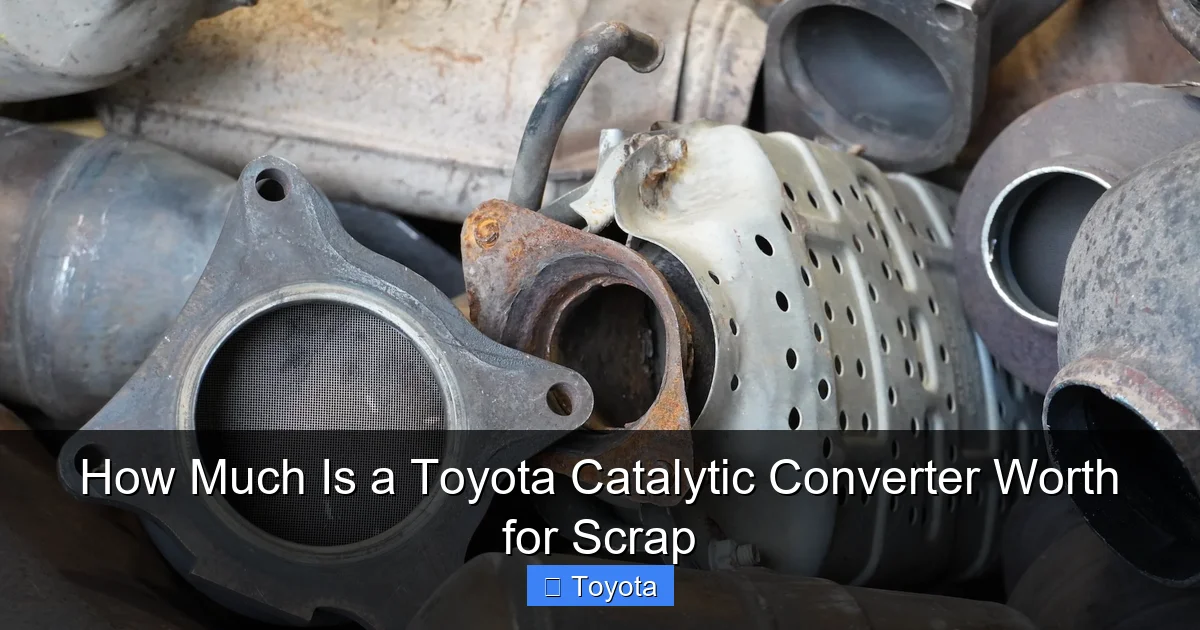
Finding the right buyer is as important as having the right converter. Your options form a spectrum from convenience to maximum payout.
Visual guide about How Much Is a Toyota Catalytic Converter Worth for Scrap
Image source: rrcats.com
Option 1: Local Scrap Yards & Auto Salvage
This is the most common route. You call or visit with your converter. They visually identify it, often using a quick-reference guide, and give you a cash offer on the spot. Pros: Instant cash, no shipping, easy. Cons: They are middlemen, so their offer is lower than what the refinery eventually pays. Prices can vary wildly between yards. Always get 3-5 quotes.
Option 2: Online Catalytic Converter Buyers
Companies like Carbuzz, CatCash, and others operate nationally. You submit photos and vehicle info online, they give a quoted price, you ship the converter (they often provide a prepaid box), and they pay after assaying. Pros: Often more competitive pricing than local yards, convenient, transparent process. Cons: You wait for payment (usually 1-3 days after receipt and assay), shipping risk is on them but still a step.
Option 3: Sell Directly to a Precious Metal Refinery
This is for serious sellers with large quantities (a full pallet or truckload). You would need to establish a business relationship. Pros: Highest possible payout, cutting out all middlemen. Cons: Requires significant volume, complex logistics, and business entity (LLC, EIN, etc.). Not feasible for someone selling one or two converters.
Pro Tips to Get More Cash
- Never show up without the vehicle info. Have the year, make, model, engine size, and VIN written down.
- Call ahead and ask if they buy catalytic converters. Some small yards don’t handle them.
- Be polite but firm. You’re selling a commodity. If one yard lowballs you, take your business elsewhere.
- Ask about their grading system. “What grade do you call a 2012 Toyota Camry 2.5L converter?”
- Consider bundling. If you have multiple converters, selling them together might get you a better bulk rate.
Toyota Models with the Highest Scrap Value
While every converter has value, some Toyota models consistently command premium prices in the scrap market due to their metal load. Here’s a breakdown based on general industry knowledge.

Visual guide about How Much Is a Toyota Catalytic Converter Worth for Scrap
Image source: autoemc.net
The Hybrid King: Toyota Prius
The undisputed leader for value in the Toyota lineup. All generations of the Prius (especially 2004-2015) use a catalyst with very high rhodium content to handle the lean-burn and frequent engine-off cycles. The converter is often a single, large, heavy unit. It’s not uncommon for a good-condition Prius converter to fetch $250-$400 in a strong market. If you have a Prius, that’s your golden ticket.
Trucks and SUVs: Tundra, Tacoma, 4Runner
These vehicles often have two catalytic converters (a “front” and “rear” cat) or a single very large “high-flow” unit. Their engines (V6, V8) produce more exhaust volume, requiring a larger catalyst. The metal mass is substantial. A complete set from a Tundra or 4Runner can be worth several hundred dollars. The rear converter on some models is particularly valuable.
V6 Sedans and Minivans: Camry, Avalon, Sienna
The 3.5L V6 engine in these models requires more robust emissions control than the 4-cylinder. Their converters are larger and contain more PGMs. Expect a V6 Camry or Sienna converter to be worth 50-100% more than its 4-cylinder counterpart from the same year.
The Mainstream 4-Cylinder: Corolla, Matrix, RAV4
These are the volume sellers. Their value is solidly in the mid-range. A 2010-2018 RAV4 or Corolla converter is a reliable, predictable product for scrap yards. It won’t make you rich, but it’s certainly not worthless. A RAV4 Hybrid, however, would jump into the higher-value hybrid category.
Older Models (Pre-2000)
These have the least value due to minimal precious metal usage by today’s standards. A converter from a 1995 Camry might only be worth $15-$40. They are often classified as “low-grade” or “domestic” scrap.
Legal and Ethical Considerations When Selling Catalytic Converters
This cannot be stressed enough. The scrap metal industry is heavily regulated because of the catalytic converter theft crisis.
Prove Your Ownership
Reputable buyers will ask for proof. This means a bill of sale for the vehicle, a title, or registration. If you’re selling a converter from a car you just junked, you should have the paperwork. If you’re a mechanic or shop, you need business records. Never sell a converter with no questions asked. If a buyer doesn’t ask for ID or proof, they are either ignorant of the law or deliberately avoiding it—both are red flags.
Know Your State Laws
Many states have specific laws governing the sale of catalytic converters. Some require the buyer to record the seller’s information, the converter’s details, and even the vehicle’s VIN. California, for example, has some of the strictest rules. Check your state’s Department of Motor Vehicles or a local scrap metal association website for regulations.
The Federal Perspective
At the federal level, the EPA regulates the sale and distribution of catalytic converters to prevent the use of non-compliant parts. While this primarily targets *new* converters, it underpins the entire regulatory framework. More directly, selling stolen property across state lines is a federal crime.
Ethical Selling: Be Part of the Solution
The high value of these parts fuels theft. By only buying and selling with full documentation, you help dry up the market for stolen converters. Support yards that follow the law. Report suspicious activity (e.g., someone selling multiple converters with no titles). Your ethical choices protect your community and your own legal standing.
Tips to Maximize Your Scrap Value
You’ve identified your converter and found a legal buyer. Now, optimize the transaction.
1. Time Your Sale with the Market
PGM prices are traded on commodities exchanges. They can have sustained up or down trends. While you can’t time the market perfectly, be aware that during a prolonged slump, quotes will be lower. During a rally (like during supply chain issues), quotes shoot up. You can monitor general trends on financial news sites for “platinum price,” “palladium price,” and “rhodium price.”
2. Sell Complete and Undamaged
A converter that has been cut poorly with a saw, has dents, or, worst of all, has had its ceramic honeycomb broken or contaminated (by oil burning, antifreeze leak, etc.) is severely devalued. Refiners can’t extract as much metal from a damaged or contaminated core. If you’re removing it, use a saw for a clean cut. Handle it carefully.
3. Don’t Strip It Yourself
Some people think they can increase value by removing the ceramic core. Do not do this. First, it’s messy and hazardous (ceramic dust is harmful). Second, you will almost certainly damage the core, reducing its metal recovery. Third, refineries are set up to process the entire assembly. Selling the intact converter is the standard and most profitable method.
4. Compare, Compare, Compare
This is the single most important action. Call five local yards. Get quotes from three online buyers. Write them all down. A difference of $50-$100 between the highest and lowest offer is common. Your goal is to find the buyer offering the fairest price for the grade you have, not just the highest initial quote (some may deduct more for weight or handling later).
5. Understand the “Per Ounce” vs. “Per Piece” Quote
Some buyers, especially refineries, will quote you a price per ounce of recovered precious metal based on the converter’s known average yield. Others will quote a flat price per converter. The per-ounce method is more transparent but requires you to trust their assay. The per-piece method is simpler but can be less precise. For a single converter, a per-piece quote is standard. For bulk sales, per-ounce becomes more common.
Conclusion: Making the Smart, Legal Sale
So, how much is a Toyota catalytic converter worth for scrap? The final number in your hand depends on a chain: your specific model/year determines the metal load, global markets set the price for those metals, and your chosen buyer’s relationship with a refinery sets their margin. A Prius converter in a hot market can approach $400. An old Corolla converter might barely cover a cup of coffee. Your job is to do the legwork: identify your part, get multiple documented quotes, and sell to a licensed, legal business. By understanding the factors at play—the precious metals, the model-specific grades, and the legal landscape—you transform a simple scrap item into a informed transaction. You’re not just selling old metal; you’re participating in a complex global recycling economy. Do it right, and you’ll be fairly compensated for your piece of it.
Frequently Asked Questions
Is it legal to sell my Toyota catalytic converter for scrap?
Yes, it is legal if you are the legal owner of the vehicle and can prove it with a title, registration, or bill of sale. Selling a stolen catalytic converter is a serious felony. Always sell to a licensed scrap yard that follows state documentation laws.
How do I know what grade my Toyota catalytic converter is?
The grade is determined by the vehicle it came from (year, make, model, engine). You cannot determine it by sight alone. You must provide this information to a scrap buyer, who will reference a industry database to classify it (e.g., “Toyota High-Grade Hybrid”). Having the vehicle’s VIN is the most accurate way.
Why is a Prius catalytic converter worth so much more than a Corolla’s?
Toyota Prius hybrids use a specialized catalyst with a much higher load of rhodium to manage the unique exhaust from an engine that frequently shuts off. Rhodium is the most expensive platinum group metal. The increased metal content in the Prius converter directly translates to a higher scrap value compared to a standard gasoline-powered Corolla.
Should I remove the ceramic honeycomb core to get more money?
Absolutely not. Removing the core yourself will almost certainly damage it, reducing its precious metal content and making it worthless to refiners. The entire assembled converter is the standard unit for sale and recycling. Selling it intact is the only way to maximize value.
What documents will a scrap yard ask for when I sell a catalytic converter?
They will ask for government-issued photo ID and proof of ownership of the vehicle the converter came from. This typically means a vehicle title, registration, or a bill of sale. Be prepared to provide the vehicle’s VIN and the converter’s part number if visible. This is required by law in most states to combat theft.
Can I sell a catalytic converter from a car that doesn’t run or is severely damaged?
Yes, absolutely. The value is in the converter itself, not the car’s operational status. As long as you have legal ownership of the vehicle (and thus the part), you can sell the converter. The car’s condition is irrelevant; the converter’s internal precious metal content is what matters.