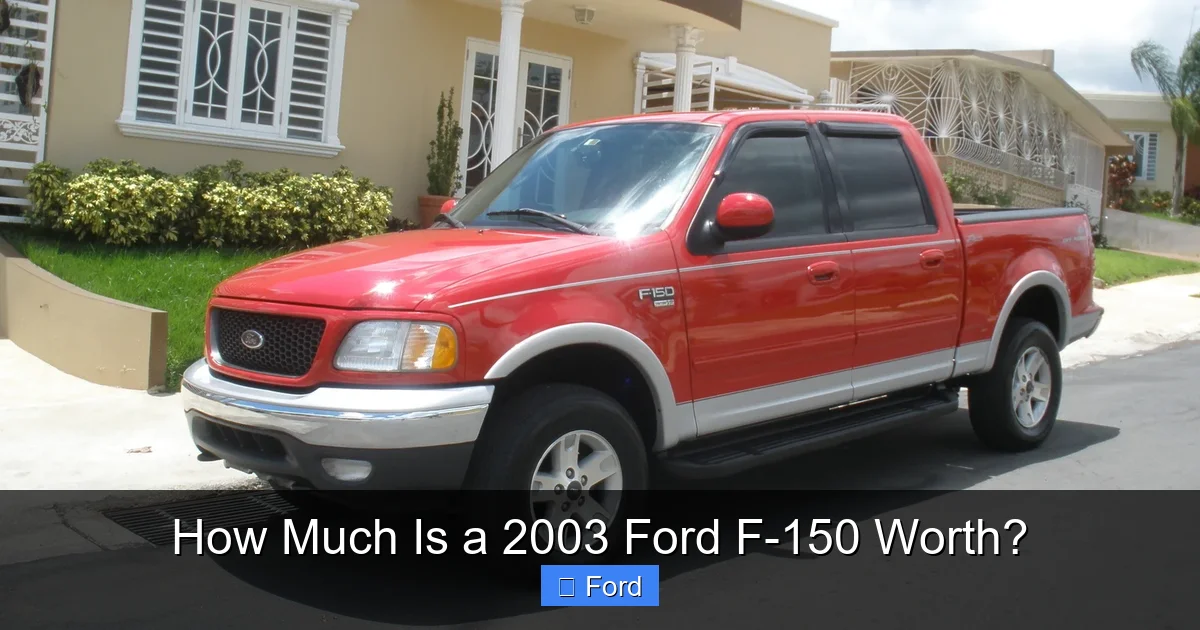
How Much Is a 2003 Ford F-150 Worth?

Contents
- 1 Key Takeaways
- 2 📑 Table of Contents
- 3 The Indomitable 2003 Ford F-150: More Than Just a Truck
- 4 What Truly Drives Value? The Core Factors
- 5 Decoding the 2003 F-150 Lineup: Trims, Engines, and Packages
- 6 Real-World Pricing: What Are People Actually Paying?
- 7 The Regional Twist: Where Your Truck Lives Affects Its Price
- 8 Buying vs. Selling: Your Action Plan
- 9 The Final Word: Is a 2003 F-150 Still a Good Buy?
- 10 Frequently Asked Questions



The value of a 2003 Ford F-150 today is heavily influenced by its specific trim, engine, mileage, and overall condition, typically ranging from $2,000 for a high-mileage, base model to over $10,000 for a pristine, low-mileage, top-trim version. Factors like regional demand, rust, and aftermarket modifications can swing the price significantly. Understanding these variables is crucial for both buyers seeking a reliable workhorse and sellers aiming to get fair market value for this classic, durable pickup.
Key Takeaways
- Condition is King: A well-maintained 2003 F-150 with a clean title, no rust, and a working powertrain will command a premium over a neglected example, often doubling the price.
- Trim Level Matters: The difference between a base XL and a loaded Lariat or King Ranch can be $3,000-$5,000 or more, as higher trims feature leather, chrome, and upgraded audio systems.
- Engine Choice is Critical: The 5.4L V8 (especially the 2-valve) is more sought-after for towing than the 4.6L V8, while the rare 5.4L 3-valve “Triton” in the SVT Lightning adds significant collector value.
- Mileage is a Major Factor: Expect a price drop of roughly $1,000-$1,500 for every 50,000 miles over 150,000 miles, assuming all else is equal.
- Rust is the Biggest Enemy: Significant frame or cab corrosion, especially in northern states, can devalue a truck by thousands and is often a deal-breaker for serious buyers.
- Regional Demand Fluctuates: Trucks hold value better in rural and Southern regions where they are used for work and play, compared to urban areas where they may be less practical.
📑 Table of Contents
- The Indomitable 2003 Ford F-150: More Than Just a Truck
- What Truly Drives Value? The Core Factors
- Decoding the 2003 F-150 Lineup: Trims, Engines, and Packages
- Real-World Pricing: What Are People Actually Paying?
- The Regional Twist: Where Your Truck Lives Affects Its Price
- Buying vs. Selling: Your Action Plan
- The Final Word: Is a 2003 F-150 Still a Good Buy?
The Indomitable 2003 Ford F-150: More Than Just a Truck
So, you’re wondering about the value of a 2003 Ford F-150. That’s an excellent question. You’re not just looking at any old truck; you’re looking at a piece of automotive lore. The 2003 model year was the final year of the tenth-generation F-150, a body style that defined American trucks for nearly a decade. It’s the truck that cemented Ford’s “Built Ford Tough” slogan in the public consciousness, known for its brute strength, immense capability, and—let’s be honest—its sometimes thirsty fuel consumption. For over two decades, these trucks have proven their worth on job sites, farms, and family drives across the country. But time hasn’t stood still. That brand-new, $25,000 truck from 2003 is now a classic—or at least, a mature used vehicle—with a value shaped by a complex mix of nostalgia, utility, and pure economics. Figuring out what yours is worth isn’t about a single number; it’s about telling its specific story.
When you ask “how much is it worth?”, the real answer is “it depends.” It depends on whether your truck is a bare-bones workhorse or a leather-lined luxury hauler. It depends on if that 5.4-liter V8 has been meticulously serviced or is on its last legs. It depends on whether it’s a pristine survivor from Arizona or a rust-belt warrior from Michigan. This guide will walk you through every single factor that twists and turns the price tag. We’ll decode the trims, demystify the engines, and give you the practical tools to find a real-world price. Whether you’re planning to sell your trusted companion or buy a capable and affordable used truck, this is your roadmap to the 2003 F-150’s true market value.
What Truly Drives Value? The Core Factors
Before we dive into specific trims and engines, you need to understand the universal pillars of value for any 20-year-old vehicle. Think of these as the foundation. Get these wrong, and no amount of rare options will save the price. Get them right, and even a modest truck can fetch a fair price.
Visual guide about How Much Is a 2003 Ford F-150 Worth?
Image source: carsfuse.com
The Unbeatable Duo: Condition & Maintenance History
This is non-negotiable. The single biggest factor is the truck’s overall physical and mechanical state. A vehicle with a complete, stamped service history from a single owner is a gold mine. It tells a buyer that the truck was cared for. Did the oil get changed every 5,000 miles? Were the transmission fluid and differential fluid serviced? Were any known issues, like the infamous spark plug problems on certain 5.4L engines, addressed proactively? A stack of receipts is worth more than a thousand polished words.
Cosmetic condition follows closely. Is the bed beat up from years of hauling gravel and tools, or is it still liner-free and pristine? Is the interior ripped, stained, and smelling of old fast food, or is the carpet clean and the seats free of major wear? A truck that looks and feels like it’s been loved will always attract more serious, willing buyers. For a practical example, two identical 2003 F-150 XLTs with 180,000 miles might sell for $3,500. But if one has a clean Carfax, new tires, and a fresh full-service, it could easily command $4,500. That $1,000 difference is the price of documented peace of mind.
The Odometer Game: Mileage and Its Weight
For a vehicle this age, mileage is less about absolute low numbers and more about perceived longevity. The average annual mileage for a 2003 truck in 2023 is about 7,000-8,000 miles, putting a “typical” example around 140,000-160,000 miles. A truck with 80,000 miles is a phenomenal find and will be priced as a “low-mileage survivor,” often 25-40% above the average. Conversely, a truck with 250,000 miles is in a different league. Buyers will assume major components (engine, transmission, rear axle) are worn and will price in a significant “high-mileage discount.” The sweet spot for value retention is often between 100,000 and 150,000 miles, where the truck has proven its durability but hasn’t yet entered the “high-risk” zone for major repairs.
The Rust Factor: The Silent Value Killer
I cannot stress this enough. Rust is the arch-nemesis of older trucks, especially those from the “Rust Belt” states that use road salt. Check the frame rails behind the front wheels, the rear axle mounting points, the cab corners, and the rocker panels. Surface rust is one thing; heavy, flaking, structural rust is another. A truck with significant frame rot will be worth thousands less than an identical truck without it. In many cases, severe rust can make a truck virtually unsellable to a knowledgeable buyer, as it compromises the entire vehicle’s structural integrity. A clean, rust-free truck from the Southwest or Pacific Northwest is a rare and valuable commodity. When in doubt, get underneath and look. A $200 inspection by a mechanic can save you from buying a $2,000 rust bucket.
Decoding the 2003 F-150 Lineup: Trims, Engines, and Packages
Now for the fun part. The 2003 F-150 came in a dizzying array of configurations. Understanding this alphabet soup is key to pinpointing value. The main trim levels, from base to luxury, were: XL, STX, SX, XLT, Lariat, and the flagship King Ranch. There was also the high-performance SVT Lightning and the off-road-focused FX4 (which was often an option package on XLT or Lariat).
Visual guide about How Much Is a 2003 Ford F-150 Worth?
Image source: carsfuse.com
Engine Options: The Heart of the Matter
Your engine choice is the first and most fundamental value driver. There were three main gasoline engines:
- 4.6L Triton V8 (2-valve): The base engine in most XL and STX models. It’s reliable, simple, and adequate for light duty, but lacks the grunt for serious towing. It’s the least desirable for buyers needing capability, but its simplicity can be a plus for ultra-low-budget buyers.
- 5.4L Triton V8 (2-valve): The workhorse. This was the standard engine in most XLT, Lariat, and King Ranch models and the optional engine in XLs. It provides solid power and torque (around 300 hp, 365 lb-ft). It’s the most common and sought-after engine for its balance of power and (relative) reliability. This is the engine that makes the F-150 a true half-ton truck.
- 5.4L Triton V8 (3-valve): A high-performance version with variable cam timing, found only in the SVT Lightning supercharged model. This is a collector’s item. With 380 hp, it’s a completely different beast. A clean, low-mileage Lightning can be worth 2-3 times a standard 5.4L truck, often trading in the $15,000-$25,000+ range for pristine examples.
There was also a 4.2L V6, but it’s extremely rare and generally not desirable in the F-150 line. Diesel was not an option in this generation.
Trim Level Breakdown: From Work Truck to Ranch Truck
Here’s a simplified hierarchy of value impact:
- XL: The no-frills work truck. Vinyl seats, basic AM/FM radio, manual windows/locks (often). Lowest starting value, but a blank canvas for work use. A clean, rust-free XL with the 5.4L can be a smart buy.
- STX/SX: Sportier appearance packages (body-colored bumpers, alloy wheels) on an XL/XLT base. Mild value increase over XL.
- XLT: The popular “middle-class” trim. Adds cloth seats, power windows/locks, keyless entry, and better sound insulation. This is the volume seller and holds value very well due to its balance of features and capability.
- Lariat: The luxury trim. Leather seats (often heated/cooled), woodgrain trim, premium audio (often with a subwoofer), dual-zone climate control, and often a moonroof. A significant jump in price over an XLT in similar condition.
- King Ranch: The top-of-the-line. Distinctive “King Ranch” leather with unique stitching, heated/cooled seats, rear-seat entertainment (on some), and every available feature. The most valuable standard production model, especially in desirable colors like “Oxford White” or “Toreador Red.”
- FX4: Not a standalone trim, but an off-road package (skid plates, off-road tires, limited-slip rear axle) added to XLT or Lariat. Adds a few hundred dollars in value to the base trim it’s on, especially in regions where off-roading is popular.
Pro Tip: The SuperCrew (4-door) cab configuration was introduced for 2001 and is highly desirable for families. A SuperCrew XLT will almost always be worth more than a Regular Cab (2-door) XLT with the same miles and condition. The Short Bed (5.5 ft) vs. Long Bed (8 ft) also plays a role; long beds are preferred by tradespeople, short beds by those wanting a more “personal use” size.
Real-World Pricing: What Are People Actually Paying?
Enough theory. Let’s talk numbers. These are national average price ranges for private party sales in good, running condition as of early 2024. Local markets can vary wildly.

Visual guide about How Much Is a 2003 Ford F-150 Worth?
Image source: richmonds.com.au
- Base Model (XL, 4.6L V8, Regular Cab, High Miles): $1,500 – $3,500. The entry point. Expect needs like tires, brakes, or minor repairs.
- Average Workhorse (XLT, 5.4L V8, SuperCab or SuperCrew, 150k-200k miles): $3,500 – $6,500. This is the meat of the market. A reliable, capable, family-friendly truck.
- Nice Condition (XLT/Lariat, 5.4L, SuperCrew, under 150k miles, clean interior): $6,500 – $9,500. A truck that needs nothing and has been well-cared for.
- Low-Mileage Survivor (Any trim, under 100k miles, rust-free, full history): $9,000 – $14,000. These are getting rare. Buyers pay for the “next owner won’t have to worry” factor.
- SVT Lightning (3-valve 5.4L, any mileage): $12,000 – $25,000+. The wild card. Value depends entirely on condition, mileage, and originality. Modified examples are worth less to collectors.
Where to Check: Always use multiple sources. Look at completed listings on eBay Motors (this shows what people actually paid, not just asking price). Use Kelley Blue Book (KBB) and NADA Guides as baseline calculators, but take their numbers with a grain of salt for a vehicle this old—they can be out of touch with the real enthusiast market. Most importantly, search Facebook Marketplace and Craigslist for your specific zip code to see local asking prices. For a comparison on how different vehicle types age in value, you might look at how a reliable sedan like a 2003 Honda Civic stacks up against a truck—it’s a completely different value story.
The Regional Twist: Where Your Truck Lives Affects Its Price
geography matters. A 2003 F-150 is a tool, and tools are worth more where they are needed. A 4×4 with a lift kit and big tires will sell faster and for more money in Texas, Colorado, or the rural Midwest than it will in downtown Miami or Boston. Conversely, a pristine, stock, two-wheel-drive truck might be perfect for a Florida retiree who wants a simple hauler for hardware store runs.
Rust belt states (Michigan, Ohio, Pennsylvania, New York, New England) have a severe price penalty for any sign of corrosion. A truck that’s spent its life in Arizona or Nevada, with its dry climate, is a unicorn. It will command a national following and premium price because of its lack of rust and often lower wear from not dealing with harsh winters and road salt. If you’re selling a rust-free truck, market it nationally. If you’re buying one in a snowy state, budget for potential frame repairs or be prepared to walk away.
Buying vs. Selling: Your Action Plan
For Buyers: How to Get a Fair Deal
Your mission is to separate emotion from value. Don’t fall in love with the first truck you see. Do your homework on local pricing first. When you find a candidate:
- Get a Pre-Purchase Inspection (PPI). This is the $150-$200 best investment you’ll make. Take it to a trusted mechanic, not the seller’s buddy. Have them check for transmission issues (these 4R75W transmissions can be weak if neglected), check for spark plug issues (the 2001-2004 5.4L 2-valve engines have aluminum heads that can strip if plugs are not removed correctly), verify 4×4 operation, and look for rust and accident damage.
- Check the Title and History. Get a Carfax or AutoCheck report. Look for red flags: salvage title, odometer rollback, frequent ownership changes, or unreported accidents.
- Inspect the Truck Yourself. Look under the cab for drips. Check the fluid levels and condition (transmission fluid should be red, not brown or burnt-smelling). Start it cold and listen for excessive valve train noise (a “tick” on the 5.4L 2-valve can be normal, but a loud clatter is not). Test every switch, window, and the HVAC system.
If you’re comparing to other used vehicles, remember that a truck’s utility is part of its value. A similarly priced 2003 Cadillac Escalade might offer luxury, but it will cost far more to maintain and repair than a simple F-150. The F-150’s parts are plentiful and cheap, which is a huge hidden value.
For Sellers: How to Maximize Your Return
Your goal is to make your truck the most attractive, worry-free option in its price bracket.
- Clean It Like You Mean It. Spend a day detailing the interior and pressure washing the engine bay and undercarriage. A clean truck looks loved and well-maintained. Remove all personal clutter.
- Fix the Obvious. Replace worn wipers, burnt-out bulbs, and cracked hoses. If you have a check engine light, fix it. A $100 sensor repair can save you $1,000 off the sale price.
- Gather Your Paperwork. Have the title, all maintenance records, and any receipts for new parts (tires, brakes, battery) ready. This is your single most powerful selling tool.
- Take Great Photos. Shoot in good light. Get pictures of the front, rear, both sides, the bed interior, the engine, and the dash (showing mileage). Be honest about any flaws—rust, dents—in the description.
- Price It Competitively. Look at 5-10 comparable trucks in your area. Price yours in the top 25% if it’s in great shape, or average if it needs work. Being the cheapest will attract low-ballers; being fairly priced attracts serious buyers.
The Final Word: Is a 2003 F-150 Still a Good Buy?
Absolutely, but with eyes wide open. For under $5,000, you can get a mechanically sound, capable pickup that can haul, tow (up to 8,000 lbs with the 5.4L and proper setup), and serve as a family hauler. Its parts are available at any auto parts store and at Walmart. Simple repairs are within the grasp of a handy owner. It is, in many ways, the last of the truly simple, rugged trucks before the tech-laden, complex models of today.
The risks are the same as any 20-year-old vehicle: unexpected failures, poor fuel economy (12-15 mpg is common), and the ever-present threat of rust. But if you find a well-maintained example with the 5.4L V8 and get a PPI, you’re buying a piece of proven machinery. Its worth isn’t just in dollars; it’s in the freedom of a open bed, the confidence of four-wheel drive in snow, and the satisfaction of turning a key and hearing a V8 rumble to life. That intangible value, for the right person, can make any price seem fair.
Frequently Asked Questions
What is the most reliable engine in a 2003 Ford F-150?
The 5.4L Triton V8 (2-valve) is generally considered the most reliable and is the most common. The 4.6L V8 is also very reliable but has less power. The supercharged 5.4L in the Lightning is robust but more complex and expensive to maintain.
How much can a 2003 F-150 with 200,000 miles be worth?
A 2003 F-150 with 200,000 miles can be worth anywhere from $2,000 to $5,000. The exact price depends entirely on its condition, trim, engine, and rust status. A clean, rust-free XLT with the 5.4L might be at the top of that range, while a rusty, base-model truck with a 4.6L will be at the bottom.
Should I buy a 2003 F-150 with over 150,000 miles?
Yes, if it has a complete service history, passes a pre-purchase inspection, and is priced appropriately for its mileage. High mileage isn’t a deal-breaker if the truck has been well-maintained. Be prepared for potential upcoming maintenance like transmission service, spark plugs, and timing chain guides.
What are the biggest problems to look for when buying?
Check for: 1) Rust on the frame and cab. 2) Transmission issues (hard shifts, slipping, delayed engagement). 3) Spark plug problems (misfires, especially on the 5.4L 2-valve; ensure they were changed correctly). 4) 4×4 operation (make sure it engages). 5) Any check engine lights or stored codes.
Is a 2003 Ford F-150 a good truck for a first-time buyer or student?
It can be, with caveats. It’s affordable to purchase and repair. However, its poor fuel economy is a significant ongoing cost. A smaller, more fuel-efficient sedan like a 2003 Honda Civic would be far cheaper to operate. An F-150 is only a good “first truck” if the buyer genuinely needs its hauling/towing capability and can afford the fuel.
How does the value of a 2003 F-150 compare to a 2007 model?
A 2007 F-150 is a completely different, redesigned generation (the “Super Duty” style). It is newer, has more modern features, and generally holds value better. A comparable 2007 model (same trim, condition, mileage) will be worth $2,000-$4,000 more than a 2003. You can see the value difference for a newer model in our guide on how much a 2007 Ford F150 is worth.