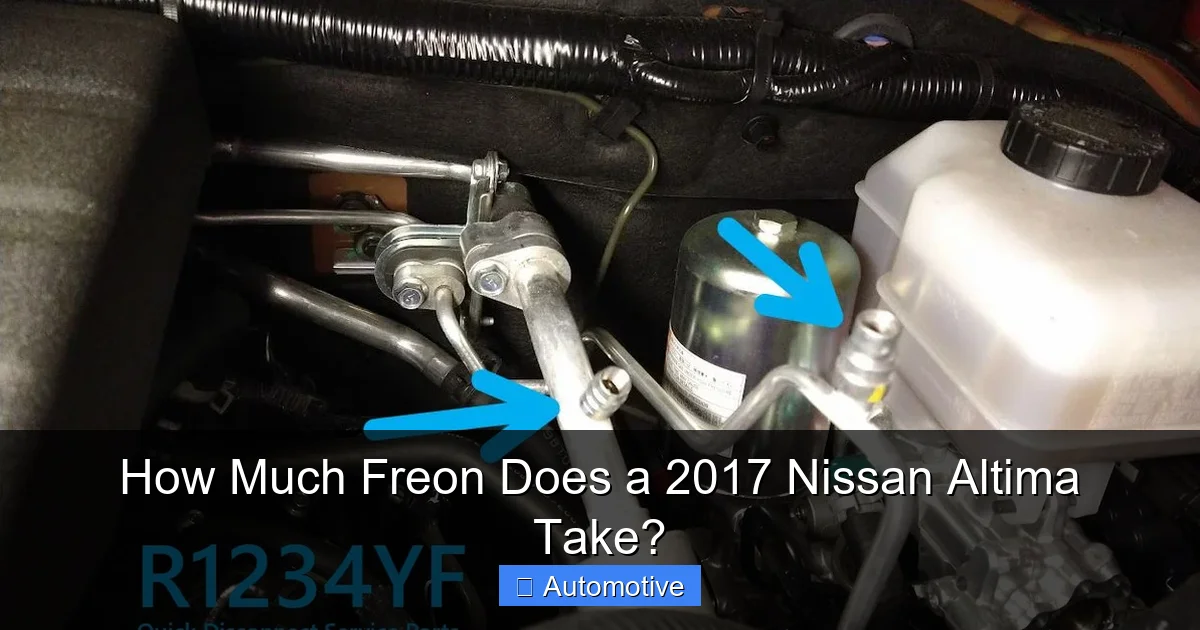
How Much Freon Does a 2017 Nissan Altima Take?

Contents
- 1 Key Takeaways
- 2 📑 Table of Contents
- 3 How Much Freon Does a 2017 Nissan Altima Take? A Complete Guide
- 4 Understanding Refrigerant and the AC System in Your 2017 Nissan Altima
- 5 Exact Refrigerant Capacity: How Much Freon Does a 2017 Nissan Altima Need?
- 6 Signs Your 2017 Nissan Altima Needs a Refrigerant Recharge
- 7 How to Safely Recharge the AC in a 2017 Nissan Altima
- 8 Maintenance Tips to Keep Your AC Running Cool
- 9 Conclusion
- 10 Frequently Asked Questions



Knowing how much Freon your 2017 Nissan Altima needs is essential for keeping the AC cool and efficient. This guide covers the correct refrigerant type, capacity, and safe recharging steps to avoid damage and ensure peak performance.
Key Takeaways
- Refrigerant Type: The 2017 Nissan Altima uses R-134a refrigerant, not the older R-12 or newer R-1234yf.
- Capacity Range: The system holds approximately 18 to 20 ounces (about 1.1 to 1.25 pounds) of refrigerant.
- Overcharging Risks: Adding too much refrigerant can damage the compressor and reduce cooling efficiency.
- Professional Service Recommended: DIY kits are available, but a certified technician ensures accuracy and safety.
- Signs of Low Refrigerant: Warm air, hissing sounds, or reduced airflow often indicate a leak or low charge.
- Leak Detection is Crucial: Low refrigerant usually means a leak—simply recharging won’t fix the root problem.
- Use Proper Tools: A manifold gauge set and UV dye help diagnose and recharge the system correctly.
📑 Table of Contents
- How Much Freon Does a 2017 Nissan Altima Take? A Complete Guide
- Understanding Refrigerant and the AC System in Your 2017 Nissan Altima
- Exact Refrigerant Capacity: How Much Freon Does a 2017 Nissan Altima Need?
- Signs Your 2017 Nissan Altima Needs a Refrigerant Recharge
- How to Safely Recharge the AC in a 2017 Nissan Altima
- Maintenance Tips to Keep Your AC Running Cool
- Conclusion
How Much Freon Does a 2017 Nissan Altima Take? A Complete Guide
Summer heat can turn your car into an oven—unless your air conditioning is working properly. If you own a 2017 Nissan Altima and your AC isn’t blowing cold air, you might be wondering: how much Freon does it actually need? The short answer is about 18 to 20 ounces of R-134a refrigerant. But the real story goes deeper than just a number. Getting the right amount matters—not just for comfort, but for the health of your entire AC system.
Many drivers assume that “adding Freon” is a quick fix, like topping off windshield washer fluid. But refrigerant isn’t something you should guess at. Too little, and your AC won’t cool. Too much, and you risk damaging the compressor, which can cost hundreds to replace. Plus, modern AC systems are sealed and sensitive. Even a small leak can cause big problems over time. That’s why understanding your 2017 Altima’s specific needs—and how to meet them safely—is so important.
In this guide, we’ll walk you through everything you need to know: the exact refrigerant type and capacity, how to identify low Freon symptoms, why professional service is often the best choice, and how to avoid common mistakes. Whether you’re a DIY enthusiast or just want to be an informed car owner, this article will help you keep your Altima cool and running smoothly.
Understanding Refrigerant and the AC System in Your 2017 Nissan Altima
What Is Freon, and Why Does It Matter?
First things first: “Freon” is actually a brand name for certain types of refrigerants, most commonly R-12, which was used in older vehicles. Today, that term is often used loosely to refer to any AC refrigerant—but it’s not technically accurate. Your 2017 Nissan Altima doesn’t use R-12. Instead, it uses R-134a, a more environmentally friendly refrigerant that’s been the standard in cars since the mid-1990s.
Visual guide about How Much Freon Does a 2017 Nissan Altima Take?
Image source: i.ytimg.com
R-134a works by absorbing heat from inside your car and releasing it outside. As it circulates through the AC system—evaporator, compressor, condenser, and expansion valve—it changes from liquid to gas and back again, pulling heat out of the cabin in the process. Without the right amount of refrigerant, this cycle breaks down, and your AC stops cooling effectively.
How the AC System Works in the 2017 Altima
The air conditioning system in your 2017 Nissan Altima is a closed loop. That means refrigerant shouldn’t escape under normal conditions. It’s designed to stay sealed and recirculate indefinitely—unless there’s a leak. The system includes several key components:
- Compressor: Often called the “heart” of the AC system, it pressurizes the refrigerant and keeps it moving.
- Condenser: Located in front of the radiator, it cools the hot refrigerant gas and turns it into a liquid.
- Receiver-Drier or Accumulator: Removes moisture and filters debris from the refrigerant.
- Expansion Valve or Orifice Tube: Controls the flow of refrigerant into the evaporator.
- Evaporator: Inside the dashboard, it absorbs heat from the cabin air, cooling it before it blows through the vents.
All these parts rely on the correct refrigerant charge to function. If the system is low, the compressor may overwork or fail. If it’s overcharged, pressure builds up, potentially causing seals to burst or components to overheat.
Why the 2017 Altima Uses R-134a (Not R-1234yf)
You might have heard about a newer refrigerant called R-1234yf, which is being used in some newer vehicles for its lower environmental impact. However, the 2017 Nissan Altima was not designed for R-1234yf. It uses R-134a exclusively. Using the wrong type of refrigerant can damage your system and void your warranty.
Always check your owner’s manual or look for the refrigerant label under the hood—usually on the radiator support or near the AC lines. It will clearly state “R-134a Only.” Mixing refrigerants is dangerous and illegal in many places due to environmental regulations.
Exact Refrigerant Capacity: How Much Freon Does a 2017 Nissan Altima Need?
Official Specifications and Capacity Range
According to Nissan’s service documentation and multiple repair databases, the 2017 Nissan Altima’s AC system holds between 18 and 20 ounces (approximately 1.1 to 1.25 pounds) of R-134a refrigerant. This is the total charge when the system is fully evacuated and recharged under proper conditions.
Visual guide about How Much Freon Does a 2017 Nissan Altima Take?
Image source: i.ytimg.com
It’s important to note that this number isn’t just a suggestion—it’s a precise specification. The system is engineered to operate optimally at this charge level. Deviating from it, even by a few ounces, can affect performance and longevity.
Why the Range Isn’t Exact
You might wonder why there’s a range (18–20 oz) instead of a single number. The reason lies in manufacturing tolerances and slight variations in AC system configurations. Some 2017 Altimas may have slightly different hose lengths, accumulator sizes, or compressor designs depending on trim level or optional equipment (like rear AC vents). However, the difference is minimal and well within safe operating limits.
When a technician services your AC, they’ll use a vacuum pump to remove all air and moisture, then recharge with the exact amount specified. This process, called “evacuation and recharge,” ensures accuracy.
What Happens If You Overcharge or Undercharge?
Let’s break down the risks:
- Undercharging (Too Little Refrigerant): The AC won’t cool properly. The compressor may run constantly, overheating and wearing out faster. You might also hear a clicking noise from the compressor clutch as it cycles on and off rapidly.
- Overcharging (Too Much Refrigerant): Excess refrigerant increases pressure in the system. This can cause the compressor to work harder, leading to premature failure. High pressure can also damage seals, hoses, or the condenser. In extreme cases, the high-pressure relief valve may activate, releasing refrigerant and creating a mess.
Neither scenario is good. That’s why guessing or “topping off” without proper tools is a bad idea.
DIY vs. Professional Charging: Why Accuracy Matters
Many auto parts stores sell DIY AC recharge kits that include a can of R-134a and a simple gauge. While these can provide temporary relief, they’re not precise. Most kits don’t measure the exact amount added—they rely on pressure readings, which can be misleading if the system has air, moisture, or a leak.
For example, if your system is low because of a slow leak, adding refrigerant without fixing the leak is like pouring water into a bucket with a hole. You’ll just lose it again. Plus, if you add too much, you could damage the compressor—costing you far more than a professional service would have.
A certified technician uses a recovery machine to safely remove old refrigerant, a vacuum pump to evacuate the system, and a digital scale to measure the exact charge. This ensures your AC operates safely and efficiently.
Signs Your 2017 Nissan Altima Needs a Refrigerant Recharge
Common Symptoms of Low Refrigerant
How do you know if your Altima’s AC needs more Freon? Look for these telltale signs:
Visual guide about How Much Freon Does a 2017 Nissan Altima Take?
Image source: cdn11.bigcommerce.com
- Warm or Weak Airflow: The most obvious sign. If the air coming from the vents isn’t cold—even on the coldest setting—your refrigerant level may be low.
- Hissing or Bubbling Sounds: These noises near the dashboard or under the hood can indicate a refrigerant leak. The sound comes from gas escaping through a small hole.
- AC Compressor Cycling Frequently: If the compressor clutch engages and disengages rapidly (you’ll hear a clicking sound), it may be due to low pressure from insufficient refrigerant.
- Ice on AC Lines or Evaporator: Paradoxically, low refrigerant can cause the evaporator to freeze up because the refrigerant isn’t absorbing heat properly. This blocks airflow and reduces cooling.
- Reduced Fuel Efficiency: A struggling AC system forces the engine to work harder, which can slightly reduce gas mileage.
If you notice any of these, don’t wait. Low refrigerant often means a leak, which can worsen over time.
Why a Leak Is Usually the Real Problem
Here’s a critical point: AC systems are sealed and should never need “topping off” under normal conditions. If your refrigerant is low, it’s almost always due to a leak. Common leak points include:
- O-rings at connection points
- Compressor shaft seal
- Evaporator core (inside the dashboard)
- Condenser (often damaged by road debris)
- Service valve cores
Ignoring a leak and just adding refrigerant is a temporary fix. The leak will continue, and you’ll lose refrigerant again—possibly within weeks or months. Worse, moisture can enter the system through the leak, causing corrosion and damaging the receiver-drier or compressor.
How to Check for Leaks
If you suspect a leak, here are a few ways to find it:
- UV Dye Test: A technician can inject UV dye into the system. After running the AC, they use a UV light to trace the dye to the leak source.
- Electronic Leak Detector: A handheld device that senses refrigerant gas in the air.
- Soapy Water Test: For accessible areas like hose connections, apply soapy water. Bubbles will form at the leak point when the system is pressurized.
DIY kits with UV dye are available, but professional tools are more sensitive and reliable.
How to Safely Recharge the AC in a 2017 Nissan Altima
Step-by-Step Professional Recharge Process
If your Altima needs a recharge, here’s what a certified technician will typically do:
- Inspect the System: Check for visible leaks, damaged hoses, or worn components.
- Recover Old Refrigerant: Use a recovery machine to safely remove all refrigerant from the system. This is required by law to prevent environmental release.
- Evacuate the System: Connect a vacuum pump and pull a deep vacuum (usually 30 minutes or more) to remove air and moisture.
- Weigh and Add New Refrigerant: Using a digital scale, add exactly 18–20 ounces of R-134a as specified.
- Test Operation: Run the AC and check vent temperatures, compressor function, and system pressures.
- Check for Leaks: Use UV dye or an electronic detector to confirm the system is sealed.
This process ensures your AC is clean, dry, and properly charged.
DIY Recharge: When It’s Okay (and When It’s Not)
If you’re determined to try a DIY recharge, here are some tips:
- Only if the system is slightly low: If your AC is still somewhat cool but not ice-cold, and you’re sure there’s no major leak, a small top-off might help temporarily.
- Use a quality kit with a gauge: Avoid cheap cans without pressure readings. Look for kits that include a low-pressure gauge.
- Add refrigerant slowly: Connect the can to the low-pressure port (usually on the suction line near the compressor) and add in short bursts. Watch the gauge—don’t exceed 35–45 psi on the low side.
- Never force it: If the can isn’t flowing, don’t shake it or heat it. That can cause overcharging or explosion.
But remember: this is a temporary fix. If the problem persists, see a professional.
Tools and Equipment You’ll Need
For a proper recharge, you’ll need:
- R-134a refrigerant (18–20 oz total)
- Manifold gauge set
- Vacuum pump
- Digital scale
- UV dye and light (optional, for leak detection)
- Safety goggles and gloves
These tools can cost $200–$500, which is why many DIYers opt for professional service instead.
Maintenance Tips to Keep Your AC Running Cool
Regular AC System Checks
To avoid refrigerant issues, follow these maintenance tips:
- Run the AC monthly: Even in winter, turn on the AC for 10 minutes to keep seals lubricated and prevent leaks.
- Replace the cabin air filter: A clogged filter reduces airflow and makes the AC work harder.
- Inspect belts and hoses: Cracked or loose components can affect compressor performance.
- Clean the condenser: Remove dirt and debris from the front of the radiator to improve heat exchange.
When to See a Professional
Schedule an AC inspection if:
- The AC hasn’t been serviced in 2+ years
- You notice any of the symptoms mentioned earlier
- You’re preparing for a hot summer
- The system has been opened for repairs
Many shops offer AC performance checks for $50–$100, which is a small price for peace of mind.
Conclusion
So, how much Freon does a 2017 Nissan Altima take? The answer is clear: 18 to 20 ounces of R-134a refrigerant. But more importantly, understanding why that number matters—and how to maintain your AC system properly—can save you time, money, and discomfort down the road.
Your Altima’s air conditioning is a精密 system that relies on the right balance of refrigerant, pressure, and cleanliness. Skipping maintenance, ignoring leaks, or guessing at refrigerant levels can lead to costly repairs. Whether you choose DIY or professional service, always prioritize accuracy and safety.
By following the guidelines in this guide, you’ll keep your 2017 Nissan Altima cool, comfortable, and reliable—no matter how high the mercury climbs. Stay cool out there!
Frequently Asked Questions
Can I use R-1234yf in my 2017 Nissan Altima?
No, the 2017 Nissan Altima is designed exclusively for R-134a refrigerant. Using R-1234yf can damage the system and is not recommended. Always check the label under the hood to confirm the correct type.
How often should I recharge the AC in my Altima?
Under normal conditions, you should never need to recharge the AC. If refrigerant is low, it usually indicates a leak that needs repair. Recharging without fixing the leak is only a temporary solution.
Is it safe to use a DIY AC recharge kit?
DIY kits can provide temporary relief if the system is slightly low and there’s no major leak. However, they lack precision and can lead to overcharging. For best results, consult a professional.
Why is my AC blowing warm air even after recharging?
Warm air after recharging often means there’s still a leak, a faulty compressor, or a clogged expansion valve. A full diagnostic is needed to identify the root cause.
How much does a professional AC recharge cost?
A professional recharge typically costs $100–$200, including evacuation, recharge, and leak check. Prices vary by location and shop.
Can low refrigerant cause the compressor to fail?
Yes. Low refrigerant reduces lubrication and increases compressor strain, leading to overheating and eventual failure. Always address low refrigerant promptly.