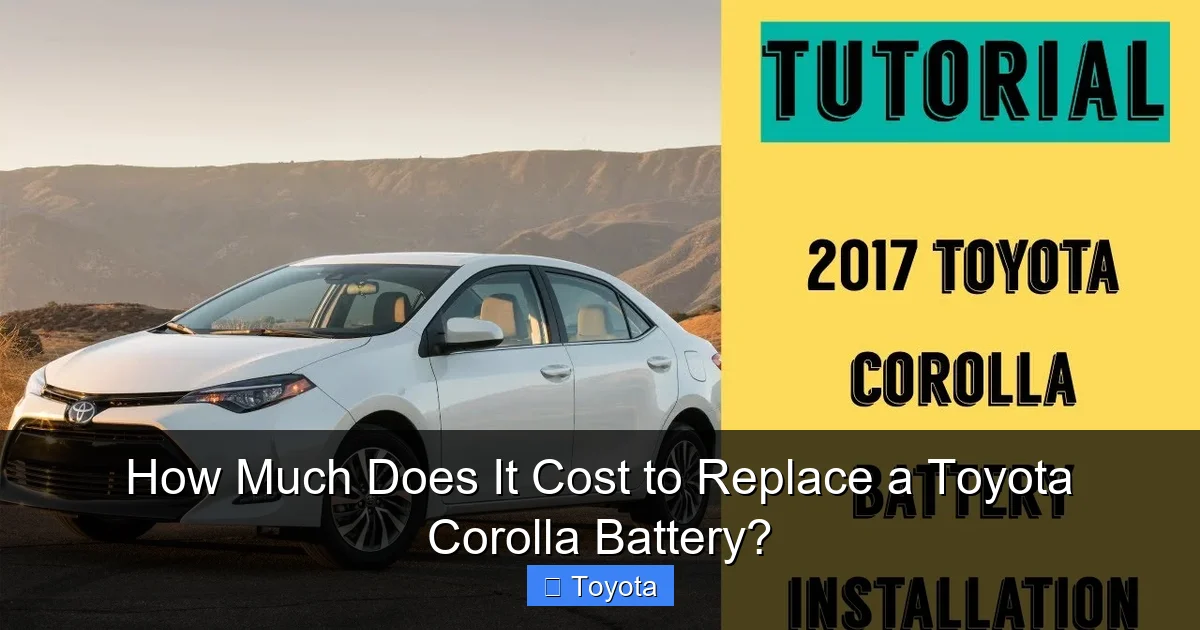
How Much Does It Cost to Replace a Toyota Corolla Battery?

Contents
- 1 Key Takeaways
- 2 📑 Table of Contents
- 3 Understanding Your Corolla’s Battery System
- 4 Recognizing a Weak or Dead Battery
- 5 Battery Replacement Options and Typical Costs
- 6 Key Factors That Influence the Price
- 7 DIY vs. Professional Installation: Which is Right for You?
- 8 Pro Tips to Make Your New Battery Last Longer
- 9 Conclusion
- 10 Frequently Asked Questions

Torque Wrench Set

Car MP3 Player

Car Seat Organizer
Wiper Blade Refills
Replacing a Toyota Corolla battery typically costs between $100 and $300 for the part alone, with total expenses reaching $200-$500 when including professional installation. Factors like battery type, your Corolla’s model year, and where you purchase the battery all influence the final price. Whether you DIY or hire a pro, understanding these variables helps you budget effectively and avoid unexpected costs.
Let’s be honest. That moment when your Toyota Corolla sputters, the dash lights dim, and the engine refuses to turn over is one of the most frustrating—and universally understood—car owner experiences. It’s rarely a surprise, but it always feels like an inconvenience. The culprit is almost always the battery. But before the panic sets in about towing costs and unexpected bills, take a breath. Replacing a Toyota Corolla battery is one of the most common and straightforward maintenance tasks you’ll encounter. It’s also one of the most affordable when you understand the landscape. The cost to replace a Toyota Corolla battery is not a single number; it’s a range influenced by your specific car, your location, and your choice to do it yourself or call for help. This guide will walk you through every detail, from identifying a failing battery to selecting the right replacement and deciding who should install it. By the end, you’ll know exactly what to expect and how to save money.
Key Takeaways
- Total cost ranges from $200 to $500: This includes $100-$300 for a standard battery and $80-$200 for professional labor.
- Your Corolla’s model year matters: Newer models with start-stop systems or more electronics often require more expensive AGM or EFB batteries.
- DIY can save $80-$200 in labor: But you’ll need basic tools and proper disposal knowledge; it’s a straightforward job for most.
- Where you buy is key: Dealerships are pricest; big-box stores and online retailers offer better deals, often with core charges.
- Proper maintenance extends life: Regular terminal cleaning and avoiding short trips can add 1-2 years to your battery’s lifespan.
- Watch for warning signs: Slow cranking, dim lights, or a battery warning light mean it’s time for a test, not necessarily a replacement yet.
- Warranty is important: Quality batteries offer 3-5 year pro-rated warranties; always keep your receipt.
📑 Table of Contents
Understanding Your Corolla’s Battery System
Before we talk money, we need to understand what we’re buying. Your Toyota Corolla, like most modern cars, uses a 12-volt lead-acid battery. Its primary job is to provide a massive burst of power to the starter motor to crank the engine. Once the engine is running, the alternator takes over, powering the car’s electronics and recharging the battery. But the job has gotten more complex. Today’s Corolla is packed with electronics—infotainment systems, multiple control modules, safety sensors, and in newer models, a start-stop system that automatically shuts off the engine at red lights. All these accessories draw small amounts of power even when the car is off, a phenomenon called “parasitic drain.” This is why battery technology has evolved.
The Standard Flooded Battery vs. Advanced Options
For decades, the standard “flooded” or “SLI” (Starting, Lighting, Ignition) battery was the only game in town. It’s filled with liquid electrolyte and is very affordable. However, it has limitations. It doesn’t like deep discharges (like leaving your lights on) and it requires occasional maintenance in older models (checking fluid levels). For many base-model Corollas, especially those from the early 2000s to mid-2010s, this is still the correct and most cost-effective choice.
Then came the Absorbent Glass Mat (AGM) battery. This is a sealed, maintenance-free unit where the electrolyte is soaked into fiberglass mats. AGM batteries are more expensive, but they are superior in several ways: they are more resistant to vibration, have a lower self-discharge rate, can handle deeper cycles, and are essential for cars with start-stop systems. If your Corolla has a start-stop button (push-to-start) and the engine shuts off at traffic lights, you almost certainly have an AGM battery from the factory. Using a standard battery in its place will lead to a very short lifespan and potential electrical gremlins. Some higher-trim Corollas with lots of factory accessories (like premium sound systems) also use AGM batteries. The Enhanced Flooded Battery (EFB) is a middle ground—a slightly improved flooded battery that offers some AGM benefits at a lower cost, but it’s less common in the Corolla.
So, step one in determining your cost is identifying your current battery type. Look for a label on the battery itself. It will say “AGM,” “EFB,” or “Flooded.” If you’re unsure, any reputable auto parts store will test your old battery and recommend the correct replacement. This is a crucial step. Installing the wrong type won’t just be a waste of money; it can cause your car’s charging system to work improperly and damage other components.
Battery Group Size: The Physical Fit
Beyond chemistry, batteries are categorized by “group size,” which defines their physical dimensions, terminal placement, and post type. A Corolla typically uses a Group 24F, 35, or 48 (depending on the model year and engine). This is non-negotiable. The new battery must fit perfectly in the battery tray. A larger group might not fit under the hood, while a smaller one could rattle around and damage the terminals. The group size is always printed on your old battery. When shopping, you’ll filter by year, make, model, and engine size to get the correct group. Some retailers’ websites have excellent fitment tools that take the guesswork out. Getting the group size wrong is a common DIY mistake that leads to returns and wasted time.
Recognizing a Weak or Dead Battery
Knowing the signs of a failing battery can save you from being stranded and help you plan a replacement during normal business hours, not in a panic at 2 AM. The most obvious sign is a slow crank. When you turn the key (or push the button), the engine turns over sluggishly, like it’s tired. You might hear a clicking sound from the starter solenoid—that’s the starter trying to engage but not getting enough voltage. Dim headlights, especially when the car is idling, are another clue. If your interior dome light looks noticeably dimmer when you turn on the headlights, your battery is struggling.

Visual guide about How Much Does It Cost to Replace a Toyota Corolla Battery?
Image source: carpursuits.com
Modern cars make this even easier with a dedicated battery warning light on the dash, usually shaped like a little battery. This light is controlled by the car’s computer monitoring the battery’s voltage. If it comes on while driving, it means the charging system isn’t keeping up. It could be the battery, the alternator, or a loose belt. Don’t ignore it. Finally, if your car has sat for a week or more and won’t start, that’s a classic sign of a battery that can no longer hold a charge. A simple test at any auto parts store (they’ll do it for free) will confirm if it’s time to replace a Toyota Corolla battery or if another issue is at play. This test measures Cold Cranking Amps (CCA)—the battery’s ability to start the car in cold weather—and its overall health. A reading below 70-80% of its original CCA rating means it’s on its last legs.
Battery Replacement Options and Typical Costs
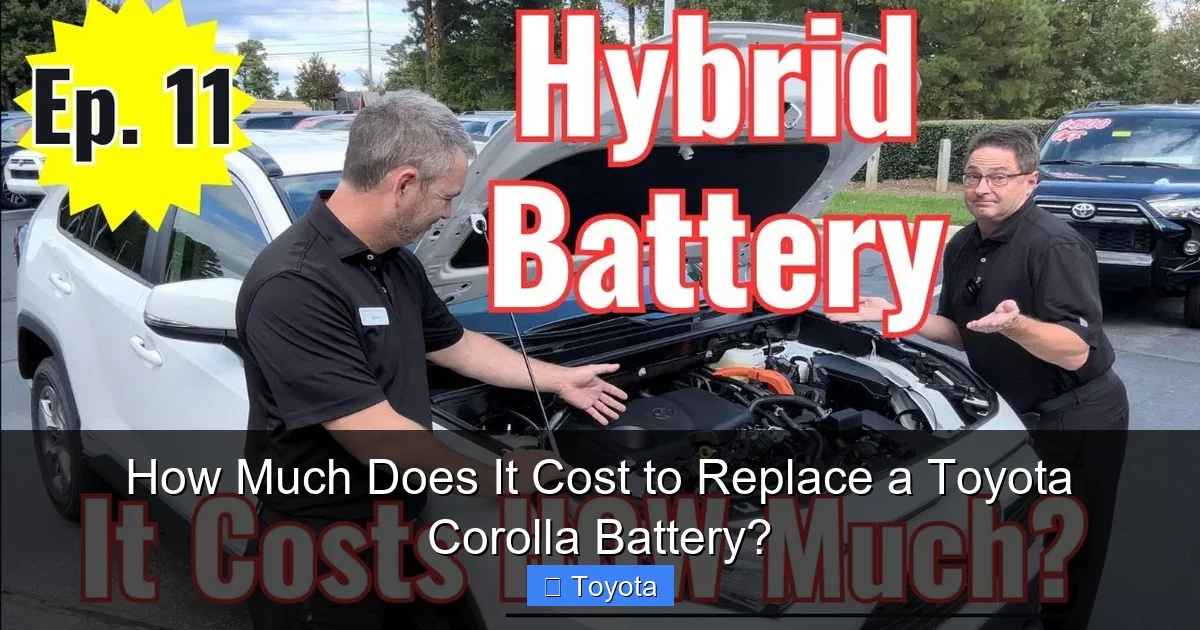
Now, the numbers. The cost to replace a Toyota Corolla battery breaks down into two main categories: the part itself and the labor to install it. Let’s examine the part cost first, as it’s the biggest variable.
Visual guide about How Much Does It Cost to Replace a Toyota Corolla Battery?
Image source: i.ytimg.com
Part Cost: The Battery Itself
For a standard flooded battery compatible with older Corollas (pre-2014, non-start-stop), you can expect to pay $80 to $150 from a major retailer. Brands like Duralast (AutoZone), EverStart (Walmart), and Interstate are reliable and come with decent warranties (often 3-5 years pro-rated). If you opt for a premium brand like Odyssey or Optima, which offer superior performance and longer warranties, you’re looking at $150 to $250.
For Corollas requiring an AGM battery (most 2014+ models with push-button start), the baseline price starts higher. A decent AGM from a big-box store will run $150 to $220. Premium AGM brands like Bosch, Odyssey, or the OEM (Original Equipment Manufacturer) Toyota battery can cost $200 to $300 or more. The OEM battery is made by a major manufacturer (like Panasonic or GS Yuasa) to Toyota’s exact specifications and is branded with the Toyota logo. It’s often the safest bet for warranty and compatibility, but you pay a premium for the name.
A critical cost-saving note: when you purchase a new battery, you will almost always pay a “core charge” (typically $15-$25). This is a deposit you get back when you return your old battery. This is an environmental law in most states to ensure proper recycling. So your out-the-door price at the register includes this, but you recoup it later. When comparing prices, make sure you’re looking at the “with core” or “after core” price.
Labor Cost: Professional Installation
If you have a professional install the battery, labor costs add $80 to $150 at a typical repair shop or dealership. This seems high for a 15-minute job, but it covers shop overhead, diagnostics (a good shop will test your charging system to ensure the new battery isn’t immediately killed by a bad alternator), and proper disposal of the old battery. Dealerships are at the high end of this range. Independent mechanics and some chain stores (like Pep Boys or Midas) may be on the lower end. Some big-box retailers like Walmart and AutoZone offer free battery installation with purchase, but they often have limitations—they may not service all makes/models, or they might charge for “difficult” installations (like if the battery is under a seat or in the trunk, which is rare for a Corolla but common in some European cars). For a Corolla, the battery is almost always in the engine bay, making it a very quick job. Calling ahead to ask about their installation policy and any potential fees is always wise.
Total Cost Scenarios
Let’s put it all together for a clear picture:
- Scenario 1 (Budget DIY): You buy a standard flooded battery (e.g., Duralast) for $110. You install it yourself in 20 minutes with a socket wrench. Total: ~$110.
- Scenario 2 (Premium DIY): You buy an AGM battery (e.g., Bosch) for $200 for your 2020 Corolla. DIY install. Total: ~$200.
- Scenario 3 (OEM Professional): You buy the OEM Toyota AGM battery for $250 and have the dealership install it. Labor @ $120. Total: ~$370.
- Scenario 4 (Convenience Professional): You call a mobile mechanic who comes to your home/office. They supply a mid-range AGM battery ($180) and charge $100 labor. Total: ~$280.
As you can see, the range is wide. The most common total cost for a typical 2018-2022 Corolla with an AGM battery, done professionally at a reputable shop, falls between $250 and $400.
Key Factors That Influence the Price
Why such a range? Several factors specific to your vehicle and your choices determine the final bill. Understanding these helps you make an informed decision and potentially save money.
Visual guide about How Much Does It Cost to Replace a Toyota Corolla Battery?
Image source: motorbiscuit.com
Model Year and Engine Type
The single biggest factor is whether your Corolla uses a standard flooded battery or an AGM. This changed around the 2014-2015 model year when Toyota introduced the push-button start system across most trims. If your Corolla has a traditional key ignition, you likely have a flooded battery. If it has a start button, you have an AGM. Double-check by looking under the hood. AGM batteries cost 50-100% more than their flooded counterparts. Additionally, some Corollas with the larger 2.0L engine (in certain markets) or high-trim packages with extra accessories might have slightly higher power demands, influencing the recommended battery’s CCA rating and price.
Retailer vs. Dealer vs. Online
Where you shop dramatically changes the price. Dealerships offer the OEM battery with full warranty compatibility, but at a significant markup. It’s the most expensive path. Big-box retailers (AutoZone, Advance Auto Parts, O’Reilly, Walmart, Costco) are the sweet spot for most people. They have competitive pricing, frequent sales (especially around holidays like Memorial Day or Black Friday), and often include free installation or a substantial core discount. Online retailers (Amazon, BatteryStuff.com, TireRack) can have the lowest part prices, but you must factor in shipping and the fact that you’ll be responsible for installation and core return yourself. You also lose the benefit of an in-person, free battery test before you buy.
Geographic Location and Climate
If you live in a very hot climate (like Arizona or Florida), heat is the number one killer of batteries. The chemical reaction inside happens faster, leading to a shorter lifespan. Mechanics in these areas often recommend a higher-quality battery with better heat resistance, which costs more. Conversely, if you live in a very cold climate (Minnesota, Canada), CCA (Cold Cranking Amps) is king. You need a battery with a high CCA rating to start the engine in freezing temperatures. High-CCA batteries are typically more expensive. The “best” battery for your Corolla might be a different spec based on your zip code.
Additional Services and Warranties
Some shops bundle the battery cost with a charging system test. A reputable mechanic won’t just sell you a new battery; they’ll check the alternator output and voltage regulator to ensure the new battery won’t be murdered by a faulty charging system the next day. This diagnostic is often free or included with installation. Always ask. Also, pay close attention to the warranty. A “pro-rated” warranty means if the battery fails in year 4, you get a discount on a new one based on how long it lasted. A “free replacement” warranty is stronger. Keep your receipt! The warranty is tied to the proof of purchase.
Core Charge and Environmental Fees
As mentioned, the core charge is a refundable deposit. It’s usually not a profit center for the retailer, but it adds to your upfront cost. Some states have additional small environmental fees for battery recycling. These are typically $1-$3 and are non-refundable. They are part of the cost of doing business responsibly.
DIY vs. Professional Installation: Which is Right for You?
This is the decision point that swings the total cost the most. Replacing a Corolla battery is one of the easiest DIY car repairs. But is it right for you?
The DIY Approach: Savings and Simplicity
Pros: You save the entire labor cost ($80-$150). You have complete control over the part you buy. It’s empowering and takes less time than driving to a shop, waiting, and driving back. For a Corolla, the battery is right up front in the engine bay, usually held down by a simple metal clamp. You need one basic tool (a 10mm socket wrench is most common) and maybe a socket extension. The process is: 1) Disconnect the NEGATIVE (black) cable first, 2) Disconnect the POSITIVE (red) cable, 3) Remove the hold-down clamp, 4) Lift out the old battery, 5) Place the new battery, 6) Reinstall the clamp, 7) Reconnect POSITIVE first, then NEGATIVE. That’s it. It’s a 10-15 minute job for a first-timer.
Cons: You are responsible for the old battery. You must take it to a retailer for recycling (they’ll take it and refund your core charge). You have no professional diagnostics. If your alternator is failing, the new battery will die quickly, and you’ll be back at square one. You also assume all risk—if you short the terminals with a tool, you can cause sparks, damage the car’s computer, or even burn yourself. Finally, if you buy the wrong battery type or size, you’re stuck with it.
The Professional Approach: Peace of Mind and Expertise
Pros: The biggest benefit is the bundled diagnostic. A good mechanic will perform a charging system test to ensure the alternator is functioning correctly. They will also clean your battery terminals and check for corrosion, which can impede starting. You get a warranty on both the part and the labor. If something goes wrong with the installation (e.g., a loose connection causes a problem), they fix it. It’s hassle-free. You drop the car off or wait a short time, and it’s done. They handle all disposal.
Cons: Cost. You pay a significant premium for the convenience and expertise. You also have less control over the exact battery brand/model installed unless you supply your own part (some shops allow this for a reduced labor rate).
The Verdict
For a Toyota Corolla, DIY is a very viable and cost-effective option for anyone with basic mechanical inclination and a socket set. The job is simple, the part is accessible, and the savings are substantial. However, if you are completely new to car maintenance, if you suspect other electrical issues (like the battery warning light is on), or if you simply value convenience and a professional guarantee, paying for installation is money well spent. A good middle ground: buy the battery yourself from a retailer that offers free installation (call to confirm for your Corolla’s year). This gets you the part you want at a good price with professional installation at no extra labor cost.
Pro Tips to Make Your New Battery Last Longer
Whether you spend $110 or $370, you want that battery to last as long as possible. The average lifespan is 3-5 years. You can push it to the upper end with good habits.
Tip 1: Avoid Short Trips. The alternator needs time to fully recharge the battery after a start. If you only drive 2-3 miles to the store and back, the battery is constantly in a partially discharged state, which shortens its life. Combine errands. Take the occasional longer highway drive.
Tip 2: Keep Terminals Clean and Tight. Corrosion (that white, crusty stuff) on the terminals creates resistance, preventing the battery from charging properly and making it harder to start the car. Every 6-12 months, disconnect the cables (negative first!), clean the terminals and cable ends with a battery terminal brush and a baking soda/water solution, and re-tighten. A little dielectric grease on the terminals after reconnection helps prevent future corrosion.
Tip 3: Ensure the Battery is Secure. The hold-down clamp must be tight. A loose battery can vibrate, which damages the internal plates and leads to premature failure. Check it during your oil change.
Tip 4: Limit Parasitic Drain. Don’t leave interior lights, dome lights, or the radio on with the engine off. Modern cars have a small, acceptable drain from computer memory, but an interior light left on overnight will kill a battery fast. If your Corolla sits for weeks unused, consider a smart battery tender/maintainer to keep it topped off.
Tip 5: Get a Charging System Test Annually. When you have your oil changed, ask them to do a quick battery and charging system test. It’s often free. It’s better to know your battery is at 75% health and plan for a replacement in 6 months than to be stranded.
Tip 6: Choose the Right Replacement. Don’t cheap out. Buying the absolute cheapest battery might save $20 now but cost you a tow and a replacement in 18 months. Stick with reputable brands and the correct type (AGM for start-stop). The longer warranty is often worth the small upcharge.
Conclusion
The cost to replace a Toyota Corolla battery is as reliable as the car itself—predictable, manageable, and largely within your control. For the vast majority of Corolla owners, the total investment will land between $200 and $400 when all is said and done. You can lean toward the lower end by purchasing a quality battery from a retailer like Walmart or AutoZone and installing it yourself in under 20 minutes. You’ll land in the middle by using a local mechanic or a store’s installation service. You’ll be at the higher end by going to the dealership for an OEM part and labor. The key takeaway is knowledge. By understanding your battery type (flooded vs. AGM), your model year’s requirements, and the true value of a charging system diagnostic, you can make a smart choice that balances cost, convenience, and long-term reliability. A dead battery is a universal frustration, but with this guide, it’s a frustration you’re now fully equipped to handle without stress or surprise. Remember: listen to your car, test before you replace, and don’t be afraid to get your hands dirty on a simple job that will have you back on the road quickly.
Frequently Asked Questions
How often does a Toyota Corolla battery need replacement?
Most automotive batteries last between 3 and 5 years. Factors like extreme heat or cold, frequent short trips, and a faulty charging system can shorten this lifespan. It’s wise to have your battery tested annually after the 2-year mark.
Can I replace the Toyota Corolla battery myself?
Yes, absolutely. The Corolla’s battery is located in the engine bay and is one of the easiest DIY battery replacements. You only need basic tools like a socket wrench. Just remember to disconnect the negative terminal first and reconnect it last to avoid electrical shorts.
What type of battery does a Toyota Corolla use?
It depends on the model year and trim. Corollas with traditional key ignitions (pre-2014/2015) typically use a standard flooded (SLI) battery. Models with push-button start and start-stop systems require an AGM (Absorbent Glass Mat) battery. Check your old battery’s label for the exact type.
Is an OEM Toyota battery worth the extra cost?
An OEM (Toyota-branded) battery guarantees perfect compatibility and comes with a solid warranty. However, reputable aftermarket brands like Interstate, Bosch, or Odyssey offer equivalent or better performance at a lower price. For most drivers, a high-quality aftermarket AGM battery is the better value.
What happens if I install the wrong battery type?
Installing a standard flooded battery in a car that requires an AGM (like a Corolla with start-stop) will cause the battery to fail prematurely, often within 12-18 months. It can also confuse the car’s charging system, leading to poor performance and potential electrical issues. Always match the original specification.
Do I need to program or register a new Toyota Corolla battery?
Generally, no. Unlike some European luxury brands, most Toyota Corollas do not require battery registration or coding with a scan tool when replacing the 12V battery. Simply connect the new battery, and the car’s system will recognize it. However, if your car has a sophisticated battery management system, a quick scan with a basic OBD2 tool after installation can clear any residual fault codes.