
What Does the Maintenance Required Light Mean on a 2008 Toyota Corolla?

The “Maintenance Required” light on a 2008 Toyota Corolla is a friendly reminder from your car’s computer that it’s time for scheduled, routine maintenance based on your driving mileage or time since the last service. It is not an emergency warning like a check engine light. This light typically illuminates after you’ve driven about 5,000 miles since the last reset, signaling it’s time for an oil change and a multi-point inspection. Ignoring it can lead to premature wear and costly repairs. The good news is that once the recommended service is performed, the light can be easily reset by you or your technician.
That little wrench icon glowing on your dashboard can be a source of confusion for many 2008 Toyota Corolla owners. Is it serious? Do I need to pull over? What does it even mean? Take a deep breath. In the world of dashboard warning lights, the “MAINTENANCE REQUIRED” light on your Corolla is one of the most straightforward and least alarming. It’s not a cry for help; it’s a polite, electronic nudge from your car, saying, “Hey, it’s been a while since my last check-up. Let’s schedule some routine care.” Understanding this light is a fundamental part of being a responsible Corolla owner and is key to keeping your trusted sedan on the road for hundreds of thousands of miles.
This article will demystify everything about that wrench symbol. We’ll dive into the engineering behind it, explain exactly what services it’s calling for, walk you through the simple reset process step-by-step, and debunk common myths. By the end, you’ll look at that light not with dread, but with a clear understanding of the simple, proactive step it’s suggesting. Let’s get into it.
Key Takeaways
- It’s a Mileage/Time Reminder: The light is triggered by the car’s odometer or a internal timer, not by a sensor detecting a problem. It comes on at preset intervals, usually every 5,000 miles.
- Not an Emergency Signal: Unlike the check engine light, this light does not indicate an immediate, dangerous fault. It means your car is due for preventative care.
- Standard Service Includes: The primary service is an oil and filter change, along with a comprehensive multi-point inspection of belts, hoses, brakes, tires, and fluids.
- You Must Reset It Manually: The light will not turn off on its own after you drive. It must be reset using a specific procedure with your ignition and odometer button after the maintenance is completed.
- Ignoring It Risks Damage: Skipping these scheduled services can lead to engine sludge, worn-out parts, and reduced fuel efficiency, ultimately costing more in repairs.
- It’s Part of Toyota’s Reliability: This system is a key reason for Toyota’s reputation for longevity, ensuring owners don’t forget critical, periodic maintenance.
📑 Table of Contents
- The Philosophy Behind the “Maintenance Required” Light
- The Science of the Interval: Why 5,000 Miles?
- What Exactly Does “Service” Mean? Breaking Down the 5,000-Mile Checklist
- How to Reset the Maintenance Required Light Yourself
- Debunking Myths and Addressing Common Concerns
- Putting It All Together: A Proactive Maintenance Mindset
The Philosophy Behind the “Maintenance Required” Light
Before we talk about the what, let’s discuss the why. Toyota, like many manufacturers, installs this maintenance reminder system to combat a simple human failing: forgetting. Life gets busy. You might remember to fill up with gas every week, but remembering that oil change you did 14 months and 4,800 miles ago? That’s a lot harder. The “Maintenance Required” light is an automated, fail-safe system designed to take that mental load off your shoulders.
It’s Not a Sensor; It’s a Timer
This is the most critical concept to grasp. The light is not activated by a sensor checking your oil quality, brake pad thickness, or tire pressure. Instead, it’s controlled by your Corolla’s Engine Control Unit (ECU), which is essentially the car’s brain. The ECU tracks two primary things: the total distance you’ve driven (odometer reading) and the time that has passed since the last maintenance reset. When either of those values reaches a predetermined threshold—typically 5,000 miles or 6 months, whichever comes first—the ECU flips a switch and illuminates the wrench icon on your dash.
Think of it like a calendar reminder on your phone, but one that’s hardwired into your car’s computer. It’s a predictive tool based on Toyota’s engineering data suggesting when certain fluids degrade and components wear to a point that needs attention. This system is part of Toyota’s legendary reliability strategy: consistent, scheduled maintenance prevents small issues from becoming big, expensive problems.
How It Differs From the Check Engine Light
New drivers often conflate these two lights, but they communicate entirely different things.
- Maintenance Required Light (Wrench Icon): Proactive, scheduled, non-emergency. It’s saying, “Time for your 30,000-mile service.”
- Check Engine Light (Engine Icon): Reactive, diagnostic, potentially urgent. It’s saying, “Something in my emissions or engine management system has deviated from normal parameters. Please scan me for trouble codes.”
The check engine light can come on for something as minor as a loose gas cap or as major as a failing catalytic converter. It requires immediate diagnostic attention. The maintenance light requires planned, routine attention. You can (and should) continue driving normally with the maintenance light on to get your service appointment scheduled, but you should not ignore a flashing check engine light.
The Science of the Interval: Why 5,000 Miles?
For the 2008 Corolla, and most Toyota models of that era, the default maintenance interval is 5,000 miles. But why that specific number? It’s a balance between modern engine tolerances, typical oil chemistry, and real-world driving conditions.
Visual guide about What Does the Maintenance Required Light Mean on a 2008 Toyota Corolla?
Image source: i.ytimg.com
Modern Oil vs. Old Conventional Wisdom
Gone are the days when the universal rule was “change your oil every 3,000 miles.” Today’s engines, including the 1ZZ-FE or 2ZR-FE engine likely in your 2008 Corolla, are built with tighter clearances and operate more efficiently. They also benefit from modern synthetic-blend and full synthetic oils that resist thermal breakdown and sludge formation much longer than the mineral oils of yesteryear.
Toyota’s engineering team, through extensive testing, determined that under “normal” driving conditions (a mix of city and highway), the 5,000-mile interval is optimal for:
- Oil and Filter: Ensuring the oil retains its lubricating, cooling, and cleaning properties.
- Air Filter: Replacing a clogged air filter improves fuel economy and performance.
- Cabin Air Filter: (If equipped) Maintaining clean air inside your car.
- Comprehensive Inspection: Giving a technician a regular, scheduled opportunity to check all critical wear-and-tear items before they fail.
“Severe” vs. “Normal” Driving Conditions
Your owner’s manual defines “severe” driving conditions, which are actually quite common. These include: frequent short trips (under 5 miles), extreme temperatures (very hot or very cold), dusty or sandy environments, stop-and-go traffic, and towing. If your driving fits this description, you may need to perform the 5,000-mile service more frequently, perhaps every 3,750 miles. The maintenance reminder system, however, is generally set to the “normal” interval. It’s up to you, the driver, to adjust your service schedule based on your actual driving habits. When in doubt, following the more frequent “severe” schedule is a safe bet for longevity.
What Exactly Does “Service” Mean? Breaking Down the 5,000-Mile Checklist
So the light is on. You call your mechanic or dealership. What should they be doing? A proper “Maintenance Required” or “A” service (as Toyota sometimes categorizes it) is more than just an oil change. It’s a health check for your vehicle. Here’s a detailed look at what should be included.
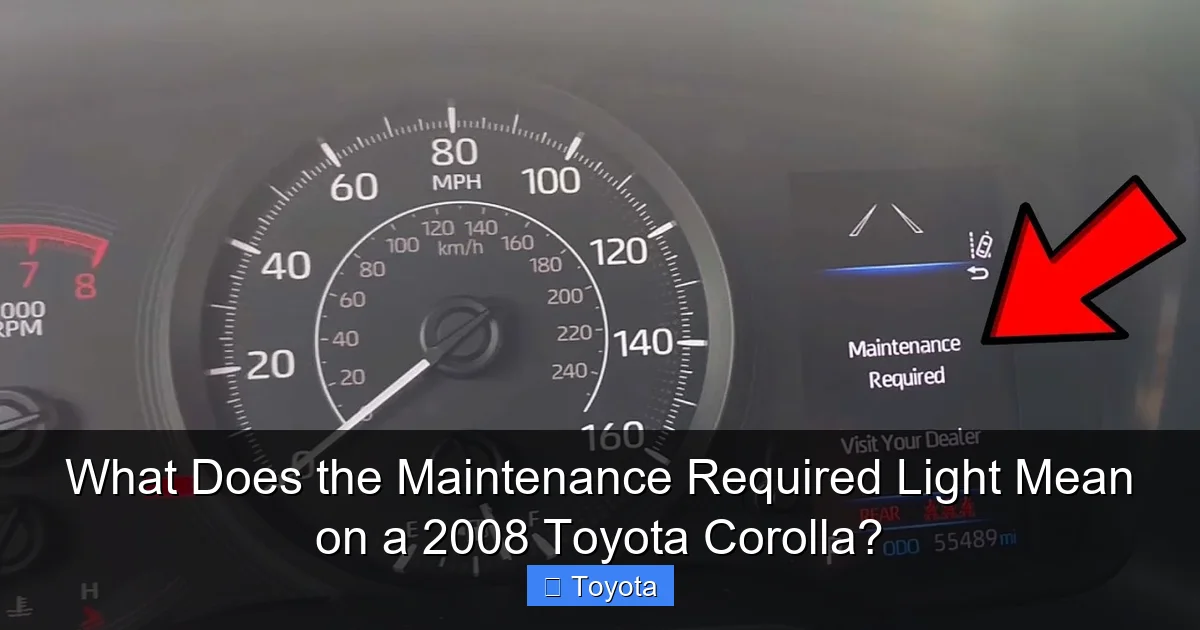
Visual guide about What Does the Maintenance Required Light Mean on a 2008 Toyota Corolla?
Image source: i.ytimg.com
The Core: Oil and Filter Change
This is the heart of the service. The technician will:
- Drain the old engine oil completely.
- Replace the oil filter with a new, OEM-specification filter.
- Refill the engine with the correct viscosity and type of oil (for a 2008 Corolla, this is typically 5W-20 or 5W-30, but always check your owner’s manual).
- Reset the maintenance required light (more on this later).
The Essential Multi-Point Inspection
A reputable shop will perform a thorough visual and physical check of dozens of components. Key items on the list for your Corolla should include:
- Fluids: Check and top off engine coolant, power steering fluid, brake fluid, and windshield washer fluid. Inspect for leaks.
- Tires: Check inflation pressure, measure tread depth, and inspect for uneven wear (which can indicate alignment issues). A tire rotation is often recommended at this interval.
- Brakes: Inspect brake pad/shoe thickness, brake rotor/drum condition, and brake lines for wear or leaks.
- Battery: Check terminals for corrosion, test battery voltage and cold cranking amps (CCA).
- Lights: Verify all exterior and interior lights are functioning.
- Belts and Hoses: Look for cracks, fraying, or wear on the serpentine belt and critical engine hoses.
- Wiper Blades: Check for deterioration and streaking.
- Air Filter: Visually inspect the engine air filter; replace if dirty.
- Cabin Air Filter: If your Corolla has one, it should be inspected and replaced if clogged (this is a common, inexpensive item that greatly affects HVAC performance).
You should receive a report or checklist from your technician detailing the condition of these items and any recommended repairs. Don’t be afraid to ask questions about anything on the list.
How to Reset the Maintenance Required Light Yourself
After you’ve completed the service—whether you did it yourself or had a professional do it—the light will still be on. You must manually reset it. The process for a 2008 Corolla is simple and requires no special tools. Here is the definitive, step-by-step guide.
The Official Toyota Reset Procedure
Follow these steps precisely. The light must be off for the reset to work.
- Turn the Ignition On: Insert your key and turn it to the “ON” or “ACC” position (the position right before the engine starts, where all dashboard lights come on). Do not start the engine.
- Locate the Odometer Button: Find the small button, usually on the instrument cluster or on the end of the turn signal stalk, that you use to toggle between odometer and trip meter readings. On a 2008 Corolla, it’s typically the “trip/odometer” reset button on the gauge cluster.
- Turn the Key Off: While still holding down the odometer button, turn the ignition key to the “OFF” position.
- Turn the Key Back On: While continuing to hold the button, turn the key back to the “ON” position (the same as step 1).
- Watch the Display: The odometer display should change from showing the mileage to showing a series of dashes “—–” or a reset counter. Keep holding the button.
- Release and Verify: After a few seconds (5-10), the display will change back to the normal odometer reading, and the maintenance required wrench icon should be extinguished. You can now release the button.
- Start the Engine: Start your car. The light should remain off. If it comes back on immediately, the reset procedure wasn’t successful; try again from step 1.
Pro Tip: If the light comes back on after just a few hundred miles, it means the reset didn’t take. Double-check that you held the button long enough for the dashes to appear and disappear. If it persists, there may be an electrical issue, though this is rare.
What If I Don’t Reset It?
Nothing bad will happen to the car’s mechanics if you don’t reset it. However, the light will remain illuminated constantly, which is annoying and defeats the purpose of the reminder system. More importantly, you lose the ability for it to accurately remind you for the next service interval. The clock starts ticking from the moment you reset it, not from the moment you finish the service. So always reset it immediately after completing the work.
Debunking Myths and Addressing Common Concerns
This simple system spawns a lot of questions and misinformation. Let’s clear the air.
Myth: “The Light Means My Oil is Low or Dirty.”
False. The light has no connection to an oil level or quality sensor. It is purely a mileage/time counter. Your oil could be brand new, and the light would still come on at 5,000 miles if you haven’t reset it. However, the service it reminds you of includes an oil change, so when you follow the reminder, you are addressing oil quality.
Myth: “I Can Just Reset the Light Without Doing the Service.”
Technically, yes, you can follow the reset procedure without changing your oil or inspecting your brakes. But this is like erasing a task from your to-do list without actually doing it. You are only fooling yourself and putting your car at risk. The reminder exists for your benefit. By not performing the service, you are gambling with engine longevity and safety. The cost of an oil change and inspection is trivial compared to an engine rebuild or a brake failure.
Concern: “The Light Came On After I Just Got an Oil Change!”
This is a very common occurrence and almost always means one thing: the technician who changed your oil forgot to reset the maintenance light. It is not a sign that something is wrong with your car or that the oil change was unnecessary. Simply call the shop, explain the situation, and ask them to reset it for you. Most will do this gladly as a courtesy. If you can’t get back to them, follow the reset procedure above. This is why learning the reset process is so valuable.
Concern: “How Far Can I Drive With It On?”
Since it’s not an emergency, you can drive until it’s convenient to get service—a few hundred miles, even a thousand, won’t cause immediate catastrophe. However, you are driving with potentially degraded oil and uninspected critical systems. The safest approach is to schedule your service within one or two fill-ups of the gas tank after the light illuminates. Think of it as a “soft deadline.” If you need to drive a bit further to reach your trusted mechanic, that’s okay, but don’t let it become a “someday/maybe” item that gets forgotten for months.
Putting It All Together: A Proactive Maintenance Mindset
Owning a 2008 Toyota Corolla is about enjoying reliable, low-cost transportation for years. The maintenance required light is your co-pilot in that mission. It transforms vague, open-ended maintenance (“I should probably get my oil changed sometime…”) into a clear, objective trigger (“My light is on, it’s time to act”).
When that wrench icon glows, here is your ideal action plan:
- Acknowledge and Schedule: Note the mileage. Call your preferred mechanic or dealership and schedule an appointment for the 5,000-mile service.
- Get the Full Service: Ensure the shop performs the oil change and the full multi-point inspection. Ask for the inspection report.
- Review the Report: Understand what was checked and what, if anything, needs future attention. This is your window into your car’s health.
- Reset the Light: Either have the technician reset it or do it yourself using the steps above before you leave the shop or when you get home.
- Drive with Confidence: The light is off. Your service is complete. Your maintenance clock has been reset. You’re good for another 5,000 miles.
By treating this light as a helpful tool rather than an annoyance, you invest in your car’s future. A well-maintained 2008 Corolla with 200,000+ miles is a common sight, and that longevity is no accident. It’s the direct result of owners who heeded these simple, periodic reminders. So the next time you see that little wrench, smile. It’s your Corolla’s way of thanking you for taking good care of it, and it’s your first step toward many more miles of trouble-free driving.
Frequently Asked Questions
Is the Maintenance Required light the same as the Check Engine light?
No, they are completely different. The Maintenance Required light (wrench icon) is a pre-programmed reminder for scheduled service like oil changes. The Check Engine light (engine icon) indicates a problem with the engine or emissions system that needs immediate diagnostic scanning. You can safely drive with the maintenance light on, but a flashing Check Engine light requires urgent attention.
Can I reset the Maintenance Required light without changing the oil?
Yes, you can follow the reset procedure without performing the service. However, this is strongly discouraged. You are simply turning off the reminder without addressing the underlying need for oil, filter, and inspection changes, which can lead to engine wear and missed safety issues. The reset should only be done after the maintenance is completed.
Why did my Maintenance Required light come on right after an oil change?
This almost always means the previous technician forgot to reset the maintenance reminder system after performing the service. The light is based on mileage since the last reset, not on the condition of the oil. Simply have the shop reset it for you, or use the manual reset procedure described in this article.
How long can I drive after the Maintenance Required light comes on?
Since it’s a reminder and not an emergency, you have some flexibility. It’s best to schedule your service within 500-1,000 miles of the light illuminating. Driving significantly beyond the 5,000-mile interval with old oil and uninspected components increases the risk of premature wear and breakdowns.
What is the typical cost to turn off the Maintenance Required light?
The cost to “turn it off” is the cost of the service it’s reminding you of—primarily an oil and filter change and multi-point inspection. This typically ranges from $40 to $80 at a quick-lube shop and $70 to $120+ at a dealership or independent mechanic, depending on the oil type and any additional services recommended from the inspection. The reset procedure itself is free.
Does the Maintenance Required light affect my car’s performance or emissions?
No. The light itself has no effect on how the car runs. It is simply an indicator on the dashboard. However, the neglected maintenance it represents (old oil, dirty filters, worn parts) can negatively impact performance, fuel economy, and emissions over time. The light is a symptom of a needed service, not the cause of any problem.
