
How Much Does a Hyundai Elantra Weigh?

The Hyundai Elantra weighs between 2,800 and 3,100 pounds depending on the model year, engine, and trim level. Understanding its weight helps with fuel efficiency, performance, and safety insights.
[FEATURED_IMAGE_PLACEHolder]
If you’re considering buying a Hyundai Elantra—or you already own one—you might be wondering, “How much does a Hyundai Elantra weigh?” It’s a great question, and not just for curiosity’s sake. Knowing your car’s weight can affect everything from fuel efficiency and acceleration to safety and handling. Whether you’re comparing trims, planning a road trip, or just trying to understand your vehicle better, weight is a key factor.
The Hyundai Elantra has been a popular compact sedan for decades, known for its reliability, modern design, and strong value. Over the years, it’s evolved significantly—from a basic economy car to a tech-savvy, fuel-efficient ride with sporty options. With each redesign, Hyundai has tweaked the materials, engineering, and features, all of which influence the car’s overall weight. So, the answer to “How much does a Hyundai Elantra weigh?” isn’t a single number—it depends on several variables.
In this guide, we’ll break down the weight of the Hyundai Elantra across different model years, trims, and engine types. We’ll explain what curb weight means, how hybrid versions differ, and why weight matters for your driving experience. By the end, you’ll have a clear picture of what to expect—and how to use that information to your advantage.
Key Takeaways
- Weight varies by model year and trim: Newer Elantras (2021–2024) are lighter and more efficient, while older models (2011–2016) tend to be heavier due to added features.
- Curb weight ranges from 2,800 to 3,100 lbs: This is the standard weight measurement including all fluids and a full tank of gas, but no passengers or cargo.
- Engine type affects weight: Models with larger engines like the 2.0L or turbocharged 1.6L add extra pounds compared to the base 1.8L or 2.0L naturally aspirated engines.
- Hybrid models are slightly heavier: The Elantra Hybrid includes a battery and electric motor, adding around 100–150 lbs over gas-only versions.
- Weight impacts fuel economy and handling: Lighter models generally offer better gas mileage and more responsive steering, especially in city driving.
- Gross Vehicle Weight Rating (GVWR) is around 4,000 lbs: This is the maximum safe weight including passengers, luggage, and fuel—never exceed this limit.
- Weight distribution is near 60/40 front/rear: This balanced setup contributes to stable handling and confident cornering.
📑 Table of Contents
Understanding Car Weight: Curb Weight vs. Gross Weight
Before diving into specific numbers, it’s important to understand the different ways car weight is measured. Not all “weight” is created equal, and confusing the terms can lead to misunderstandings—especially when it comes to safety and performance.
The most common measurement you’ll see is curb weight. This refers to the weight of the vehicle with all standard equipment, a full tank of gas, and all necessary fluids (oil, coolant, brake fluid, etc.), but with no passengers or cargo. Think of it as the car’s “ready-to-drive” weight. For the Hyundai Elantra, curb weight typically ranges from about 2,800 to 3,100 pounds, depending on the model.
Then there’s gross vehicle weight rating (GVWR). This is the maximum total weight your car is designed to safely carry, including the vehicle itself, passengers, luggage, and any additional accessories. For most Elantra models, the GVWR is around 4,000 pounds. Exceeding this limit can strain the suspension, brakes, and tires, and may even be illegal in some areas.
Another term you might encounter is dry weight, which excludes fuel and fluids. This is less commonly used for consumer vehicles but can be helpful for performance comparisons. Finally, payload capacity is the difference between GVWR and curb weight—essentially, how much you can safely load into the car. For the Elantra, this is usually around 1,100 to 1,200 pounds.
Understanding these distinctions helps you make smarter decisions. For example, if you frequently travel with multiple passengers and luggage, knowing your payload capacity ensures you don’t overload the vehicle. Similarly, if you’re comparing fuel efficiency, curb weight gives you a baseline for how heavy the car is under normal conditions.
Hyundai Elantra Weight by Model Year

Visual guide about How Much Does a Hyundai Elantra Weigh?
Image source: trucksauthority.com
The weight of the Hyundai Elantra has changed over time, reflecting advancements in materials, safety features, and technology. Let’s take a look at how the weight has evolved across recent generations.
2011–2016 Hyundai Elantra (Fifth Generation)
The fifth-generation Elantra, introduced in 2011, was a major redesign that emphasized fuel efficiency and modern styling. These models came with a 1.8L four-cylinder engine and were praised for their light weight and impressive gas mileage.
– Curb weight: Approximately 2,800 to 2,900 lbs
– Engine: 1.8L inline-4 (148 hp)
– Transmission: 6-speed manual or automatic
– Notable features: Lightweight unibody construction, improved aerodynamics
This generation was one of the lightest in Elantra history, which contributed to its excellent fuel economy—up to 28 mpg city and 38 mpg highway. The lower weight also made the car feel nimble and responsive, especially in city driving.
2017–2020 Hyundai Elantra (Sixth Generation)
In 2017, Hyundai introduced a completely redesigned Elantra with a more aggressive look, updated interior, and improved safety tech. This generation saw a slight increase in weight due to added features like advanced driver-assistance systems (ADAS), larger infotainment screens, and reinforced safety structures.
– Curb weight: Approximately 2,900 to 3,000 lbs
– Engine options: 2.0L inline-4 (147–162 hp), 1.6L turbo (201 hp in the Elantra Sport)
– Transmission: 6-speed manual, 6-speed automatic, or 7-speed dual-clutch (Sport trim)
– Notable features: Forward collision warning, lane departure warning, Apple CarPlay/Android Auto
The base 2.0L models weighed around 2,900 lbs, while the sportier 1.6L turbocharged version added about 100 lbs due to the more powerful engine and performance-oriented components. Despite the added weight, Hyundai maintained strong fuel efficiency, thanks in part to aerodynamic improvements and engine tuning.
2021–2024 Hyundai Elantra (Seventh Generation)
The current-generation Elantra, launched in 2021, features a bold, futuristic design inspired by Hyundai’s “Parametric Dynamics” styling language. It’s built on a new platform that’s both lighter and stronger, thanks to high-strength steel and aluminum components.
– Curb weight: Approximately 2,850 to 3,100 lbs
– Engine options: 2.0L inline-4 (147 hp), 1.6L turbo (180 hp in N Line), hybrid (139 hp combined)
– Transmission: Smartstream CVT, 7-speed dual-clutch (N Line), or 6-speed automatic (hybrid)
– Notable features: 10.25-inch digital cluster, wireless Apple CarPlay/Android Auto, Hyundai SmartSense safety suite
Interestingly, despite more tech and safety features, the 2021+ Elantra is slightly lighter than the previous generation in some trims. For example, the base SE trim with the 2.0L engine weighs around 2,850 lbs—lighter than the 2017 base model. This is due to smarter engineering and material use. However, the N Line performance trim, with its turbocharged engine and sport suspension, tips the scales at around 3,100 lbs.
Weight Differences by Trim and Engine

Visual guide about How Much Does a Hyundai Elantra Weigh?
Image source: trucksauthority.com
Not all Elantras are created equal—even within the same model year. Trim level and engine choice play a big role in determining how much your Elantra weighs. Let’s break it down.
Base Trims (SE, SEL, Value Edition)
These are the most affordable and lightweight versions of the Elantra. They come with the 2.0L naturally aspirated engine and fewer luxury features, which helps keep the weight down.
– Weight: 2,850–2,950 lbs
– Engine: 2.0L inline-4 (147 hp)
– Features: Basic infotainment, cloth seats, manual climate control
– Best for: Budget-conscious buyers, commuters, first-time car owners
The SE trim is the lightest, often coming in at just under 2,850 lbs. This makes it the most fuel-efficient option in the lineup, with EPA estimates of up to 33 mpg city and 43 mpg highway.
Mid-Level Trims (Limited, Preferred)
These trims add more comfort and tech features, such as leather seats, heated front seats, a larger touchscreen, and advanced safety systems. The added components increase the weight slightly.
– Weight: 2,950–3,050 lbs
– Engine: 2.0L inline-4 (147 hp)
– Features: Leather upholstery, dual-zone climate control, wireless charging, blind-spot monitoring
– Best for: Families, long-distance drivers, tech lovers
The Limited trim, for example, includes a sunroof, premium audio, and more sound insulation—all of which add weight. But the trade-off is a more refined and comfortable ride.
Performance Trims (N Line)
Introduced in 2021, the N Line is Hyundai’s sporty version of the Elantra. It features a turbocharged 1.6L engine, sport-tuned suspension, and aggressive styling. Naturally, it’s heavier due to the performance upgrades.
– Weight: ~3,100 lbs
– Engine: 1.6L turbo inline-4 (180 hp)
– Transmission: 7-speed dual-clutch automatic
– Features: Sport seats, paddle shifters, larger wheels, performance exhaust
– Best for: Driving enthusiasts, those who want a fun-to-drive compact car
The N Line is about 150–200 lbs heavier than the base model, but the extra power and handling make it a standout in the compact segment. It’s not the lightest Elantra, but it’s one of the most exciting.
Hybrid Models (Hybrid, Hybrid Blue)
The Elantra Hybrid combines a 1.6L gasoline engine with an electric motor and battery pack. While it’s more efficient, the hybrid system adds weight.
– Weight: ~3,000–3,100 lbs
– Combined power: 139 hp
– Transmission: 6-speed automatic (with e-CVT logic)
– Features: Regenerative braking, eco-driving modes, hybrid-specific instrumentation
– Best for: Eco-conscious drivers, city commuters, those wanting top fuel economy
The hybrid system adds roughly 100–150 lbs compared to the gas-only 2.0L models. However, the extra weight is offset by the electric motor’s instant torque, which improves low-speed responsiveness. The Elantra Hybrid achieves up to 54 mpg city, making it one of the most fuel-efficient non-plug-in cars on the market.
Why Weight Matters: Performance, Efficiency, and Safety
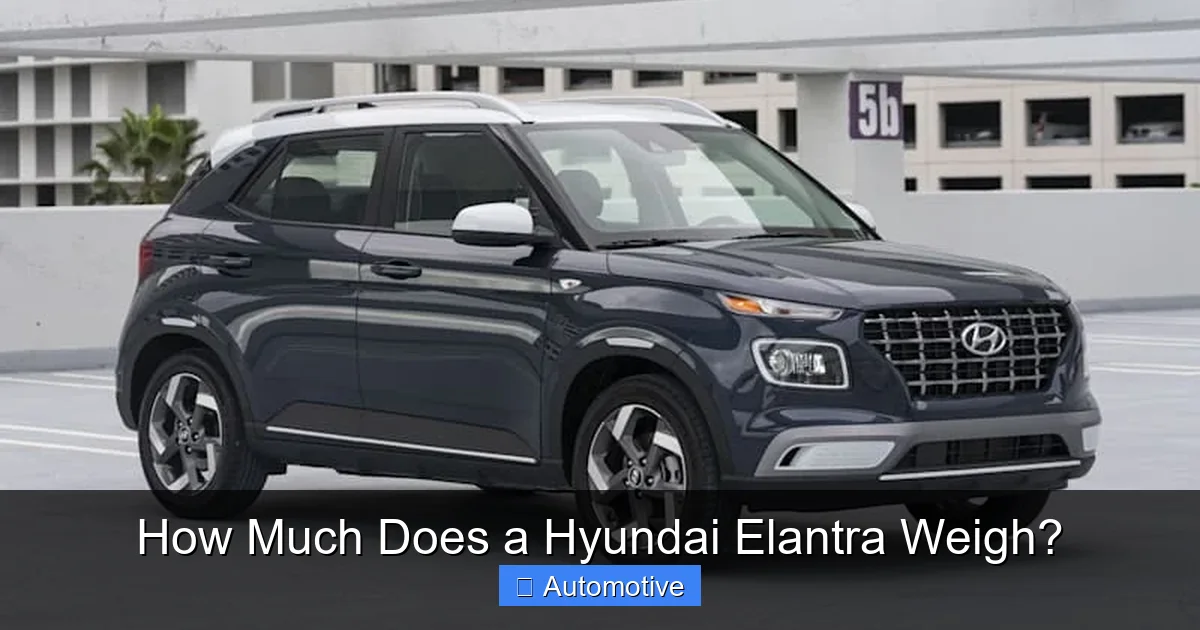
Visual guide about How Much Does a Hyundai Elantra Weigh?
Image source: trucksauthority.com
So, why should you care how much a Hyundai Elantra weighs? It’s not just a number—it has real-world implications for how your car performs, how much it costs to operate, and how safe it is.
Fuel Efficiency
Weight is one of the biggest factors affecting fuel economy. Heavier cars require more energy to accelerate and maintain speed, which means more fuel consumption. That’s why lighter Elantra models—like the base SE trim—tend to have better gas mileage.
For example, the 2023 Elantra SE with the 2.0L engine and CVT weighs about 2,850 lbs and gets an EPA-estimated 33 mpg city / 43 mpg highway. In contrast, the heavier N Line (3,100 lbs) gets 28 mpg city / 36 mpg highway—still good, but noticeably less efficient.
If you drive mostly in the city or prioritize fuel savings, choosing a lighter trim can make a meaningful difference over time.
Acceleration and Handling
A lighter car generally accelerates faster and handles more responsively. The Elantra’s near 60/40 front-to-rear weight distribution (meaning 60% of the weight is over the front wheels, 40% over the rear) contributes to balanced handling and stable cornering.
The N Line, despite being heavier, feels agile thanks to its sport-tuned suspension and sticky tires. But the base model, with less weight to move, feels quicker off the line in everyday driving. This makes it a great choice for urban environments where quick merges and lane changes are common.
Brake Performance
Heavier vehicles require more braking force to stop safely. The Elantra’s braking system is designed to handle its weight range, but if you frequently carry heavy loads or drive in hilly areas, you may notice longer stopping distances.
That’s why it’s important not to exceed the GVWR. Overloading the car not only increases wear on brakes and suspension but can also compromise safety in emergency situations.
Safety and Structural Integrity
Modern Elantras are built with high-strength steel and advanced safety features, which add weight but significantly improve crash protection. The 2021+ models earned top safety ratings from the IIHS (Insurance Institute for Highway Safety), thanks in part to their robust construction.
While lighter cars can be more efficient, safety often requires a bit more mass. Hyundai strikes a balance by using lightweight materials where possible without sacrificing structural strength.
Towing and Payload Capacity
The Elantra is not designed for towing—its maximum towing capacity is 0 lbs. However, it can carry a decent amount of cargo. With a payload capacity of around 1,100–1,200 lbs, you can comfortably transport four adults (average weight 150–200 lbs each) plus luggage.
Just remember: payload includes everything—passengers, pets, groceries, roof racks, etc. Always check your owner’s manual for exact limits.
Comparing the Elantra to Competitors
How does the Hyundai Elantra’s weight stack up against rivals like the Toyota Corolla, Honda Civic, and Mazda3? Let’s take a quick look.
– Toyota Corolla: Curb weight ranges from 2,850 to 3,000 lbs. The Corolla Hybrid is slightly lighter than the Elantra Hybrid, thanks to Toyota’s efficient hybrid system.
– Honda Civic: Weighs between 2,800 and 3,100 lbs. The Civic Si performance model is heavier than the Elantra N Line but offers more power.
– Mazda3: Ranges from 2,900 to 3,200 lbs. The Mazda3 is generally heavier due to its premium materials and all-wheel-drive option (not available on the Elantra).
Overall, the Elantra is competitively light, especially in base trims. It’s lighter than the Mazda3 and on par with the Corolla and Civic. This helps it stand out in terms of efficiency and agility.
Practical Tips: Managing Your Elantra’s Weight
Now that you know how much a Hyundai Elantra weighs, here are some practical tips to make the most of it:
– Choose the right trim for your needs: If you prioritize fuel economy, go for the base SE or SEL. If you want performance, the N Line is worth the extra weight.
– Avoid unnecessary cargo: Remove heavy items from your trunk when not needed. Even 50 lbs can reduce fuel efficiency by 1–2%.
– Check tire pressure regularly: Underinflated tires increase rolling resistance, which makes the engine work harder—especially in a lighter car.
– Use the correct fuel: The Elantra is designed to run on regular unleaded gas. Using premium won’t improve performance unless you’re driving the turbocharged N Line under heavy load.
– Maintain your vehicle: Regular oil changes, brake inspections, and suspension checks help ensure your car handles its weight safely and efficiently.
Conclusion
So, how much does a Hyundai Elantra weigh? The answer depends on the model year, trim, and engine—but generally, it ranges from 2,800 to 3,100 pounds. This weight is carefully balanced to deliver a blend of fuel efficiency, performance, and safety.
From the lightweight 2011–2016 models to the tech-packed 2021–2024 versions, the Elantra has evolved to meet modern demands without sacrificing its core strengths. Whether you’re driving a base SE, a sporty N Line, or an eco-friendly Hybrid, understanding your car’s weight helps you make smarter decisions about maintenance, fuel use, and driving habits.
Ultimately, the Elantra proves that a compact car can be both light on its feet and full of features. It’s a smart choice for drivers who want value, efficiency, and a touch of style—all without breaking the bank or the scale.
Frequently Asked Questions
What is the curb weight of a 2023 Hyundai Elantra?
The 2023 Hyundai Elantra has a curb weight ranging from approximately 2,850 to 3,100 pounds, depending on the trim and engine. The base SE model with the 2.0L engine weighs around 2,850 lbs, while the N Line performance trim is closer to 3,100 lbs.
Does the Hyundai Elantra Hybrid weigh more than the gas model?
Yes, the Elantra Hybrid is slightly heavier due to the battery and electric motor. It typically weighs about 100–150 pounds more than the standard 2.0L gas model, coming in around 3,000–3,100 lbs.
How does weight affect the Elantra’s fuel economy?
Heavier Elantra models tend to have slightly lower fuel efficiency because more energy is needed to move the vehicle. Lighter trims like the SE offer better gas mileage, while performance and hybrid models balance weight with power and efficiency.
What is the GVWR of a Hyundai Elantra?
The Gross Vehicle Weight Rating (GVWR) for most Hyundai Elantra models is around 4,000 pounds. This includes the vehicle, passengers, cargo, and fuel—never exceed this limit for safety and legal compliance.
Is the Elantra N Line heavier than other trims?
Yes, the N Line is the heaviest trim due to its turbocharged 1.6L engine, sport suspension, and performance components. It weighs about 3,100 lbs, roughly 150–200 lbs more than the base model.
Can I tow with a Hyundai Elantra?
No, the Hyundai Elantra is not designed for towing. Its maximum towing capacity is 0 pounds. However, it has a solid payload capacity of around 1,100–1,200 lbs for passengers and cargo.