
How Much Are Toyota Catalytic Converters Worth Scrap?

The scrap value of a Toyota catalytic converter is primarily driven by the precious metals (platinum, palladium, rhodium) inside it. Prices vary wildly based on the specific Toyota model, engine size, and whether it’s an original OEM part or an aftermarket replacement. Expect anywhere from $50 to over $500 per converter, with common sedans and SUVs on the lower end and performance trucks on the higher end. Getting multiple quotes from reputable scrap yards is the only way to know your exact worth.
So, you’ve got a old Toyota sitting in the driveway, maybe a project car, a totaled vehicle, or just one that’s finally given up the ghost. As you’re parting it out, your eyes land on that bulky, honeycomb-laden component under the car: the catalytic converter. A friend mentioned they got a few hundred bucks for one. You wonder, how much are Toyota catalytic converters worth scrap? The answer isn’t simple, but it’s fascinating. It’s not about the weight of the steel can; it’s about the microscopic treasure chest of precious metals sealed inside. This guide will pull back the exhaust pipe on the entire process, giving you a clear, honest picture of what your Toyota’s “cat” is really worth in the scrap metal market.
Let’s be clear from the start: we are talking about the scrap value, not the retail replacement cost. A new catalytic converter for a Toyota can cost anywhere from $500 to over $2,000 because it’s a complex, emissions-controlled component. Its scrap value is a fraction of that, but for a part you might otherwise throw away, it can be a nice bonus. The value is tied to the global commodities market for platinum group metals (PGMs). This means prices can change weekly, sometimes daily. Your goal is to understand the factors that influence that price so you can time your sale and find an honest buyer. We’ll walk through everything from the science inside the converter to the paperwork you’ll need to legally sell it.
Key Takeaways
- Precious Metals Are Key: The value comes from tiny amounts of platinum, palladium, and rhodium used as catalysts. Their fluctuating commodity prices directly determine your payout.
- Toyota Model Matters Enormously: A converter from a V8 Tundra or Sequoia is worth significantly more than one from a 4-cylinder Corolla due to higher metal content and different emissions standards.
- OEM vs. Aftermarket is a Huge Difference: Original Equipment Manufacturer (OEM) converters contain far more precious metal loadings than cheaper aftermarket replacements, making them much more valuable for scrap.
- You Sell by the Ounce/Gram, Not by the Piece: Scrap yards pay based on the weight of the precious metal “biscuit” or honeycomb after it’s refined, not for the entire heavy metal shell.
- Legality is Crucial: It is illegal in all 50 states to sell a stolen catalytic converter. You must prove lawful ownership, typically through a vehicle title or bill of sale.
- Get Multiple Quotes: Prices vary dramatically between scrap yards. Always get at least 3 written quotes, and be wary of prices that seem too good to be true over the phone.
- Preparation Increases Value: Carefully removing the ceramic honeycomb/biscuit from the metal canister and selling it separately (if the yard allows) can yield a higher price, as the steel shell has minimal value.
📑 Table of Contents
- The Science of Value: What’s Inside a Catalytic Converter?
- Toyota-Specific Factors That Drive Scrap Prices
- How Many Converters Does Your Toyota Have?
- How to Determine the Current Scrap Value
- Selling Your Toyota Catalytic Converter: A Practical Guide
- Market Trends and the Future of Catalytic Converter Scrap
The Science of Value: What’s Inside a Catalytic Converter?
Before we talk dollars and cents for Toyota parts, we need to understand what we’re actually selling. A catalytic converter is essentially an emissions control device. Its job is to transform harmful gases from your engine’s exhaust—carbon monoxide, hydrocarbons, and nitrogen oxides—into less harmful carbon dioxide, nitrogen, and water vapor. It does this through a chemical reaction, and the chemicals that make this reaction happen are the source of all the value.
The Precious Metal Catalyst
Inside the stainless steel shell of every catalytic converter is a ceramic or metallic substrate, often called a “honeycomb” or “biscuit.” This substrate is coated with a washcoat that is impregnated with the precious metals: platinum (Pt), palladium (Pd), and rhodium (Rh). These are the catalysts. They aren’t consumed in the reaction; they just sit there, facilitating the chemical change. This is why they can be recovered and reused. The amount of each metal varies dramatically by manufacturer, vehicle type, and emissions standard.
- Platinum (Pt): The most common of the three in automotive catalysts. It’s excellent for oxidation (turning CO and HC into CO2 and H2O).
- Palladium (Pd): Often used in place of or alongside platinum for oxidation. Its price has historically been more volatile than platinum.
- Rhodium (Rh): The most valuable per ounce and the key for reduction (turning NOx into N2 and O2). It’s used in much smaller quantities but is often the biggest driver of a converter’s high value.
The exact “recipe” or “loading” of these metals is a closely guarded secret by automakers like Toyota. They balance performance, durability, and cost. A converter designed for a stricter emissions standard (like California’s LEV III) will have a higher precious metal loading than one for a less stringent standard. This is the core reason a Toyota catalytic converter’s worth for scrap isn’t a single number.
Toyota-Specific Factors That Drive Scrap Prices
Now we get to the heart of your question. Not all Toyota catalytic converters are created equal. Several Toyota-specific factors create a huge spectrum of values, from the price of a cheap dinner to a substantial down payment on a used car.
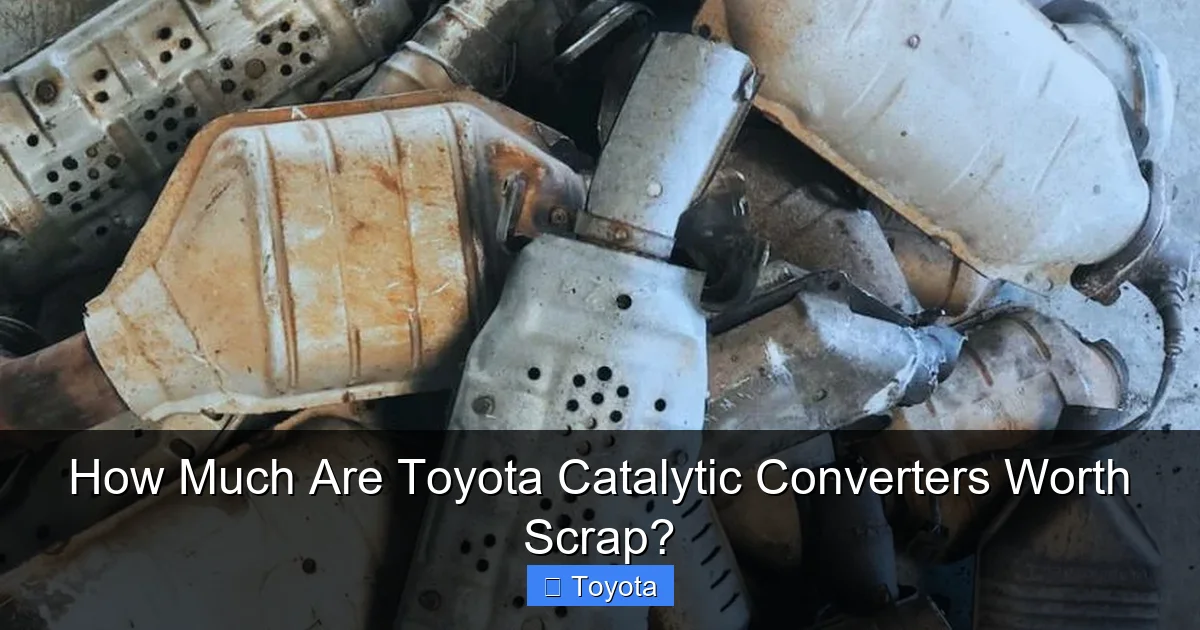
Visual guide about How Much Are Toyota Catalytic Converters Worth Scrap?
Image source: roadsumo.com
Model, Engine, and Year Are Everything
This is the single most important factor. A converter’s precious metal content is directly tied to the engine’s displacement and the emissions standards it was built to meet.
- Engine Size & Cylinders: A larger engine, especially a V6 or V8, burns more fuel and produces more exhaust gases. To treat that larger volume, the catalytic converter needs a larger substrate and more catalyst coating. Therefore, a Toyota Tundra or Sequoia with a 5.7L V8 will have a converter worth 3-5 times more than a Toyota Corolla with a 1.8L 4-cylinder. If you’re curious about a specific truck, you can read about how many catalytic converters are in a Toyota Tundra to understand the setup.
- Model Year & Emissions Regulations: As emissions laws tightened over the years (from OBD-I to OBD-II, and through various LEV, ULEV, SULEV standards), automakers had to use more sophisticated and precious-metal-rich catalysts. A 2005 Toyota Avalon will have a more valuable converter than a 1995 model. Hybrids, like the Prius, have unique systems and their converter values can be different from conventional gas models.
- OEM vs. Aftermarket: This is a critical distinction. An OEM converter (the one that came on the car from the factory) is engineered for maximum longevity and minimal backpressure, using higher precious metal loadings. A replacement aftermarket converter (often called a “universal” or “direct fit” from brands like Bosal, AP, etc.) is built to meet minimum EPA standards at the lowest cost. They use far less platinum group metal. Scrapping an aftermarket cat will yield a fraction of the price of an OEM unit. A visual inspection often reveals this; OEMs have specific, complex shapes and are branded with the Toyota logo or part number.
The Diesel Difference
This is a major point. Toyota diesel vehicles in North America are rare (mostly limited to some trucks and the now-discontinued Land Cruiser Diesel), but they exist globally. Diesel engines have a completely different exhaust treatment system. They use a Diesel Particulate Filter (DPF) and often a Selective Catalytic Reduction (SCR) system with AdBlue/DEF. The SCR catalyst uses a different precious metal mix (often more platinum) and can be very valuable. If you’re dealing with a diesel Toyota, you must identify the specific component, as a “catalytic converter” on a diesel may refer to an SCR module worth a different amount than a gas cat.
How Many Converters Does Your Toyota Have?
Modern vehicles, especially larger ones, often have more than one catalytic converter. This isn’t just for redundancy; it’s for efficiency. A common setup is a “front” or “pre-cat” located close to the engine (often in the exhaust manifold) and a “rear” or “main” cat further down the exhaust system. The front cat lights off and reaches operating temperature faster, reducing cold-start emissions. The rear cat finishes the job.
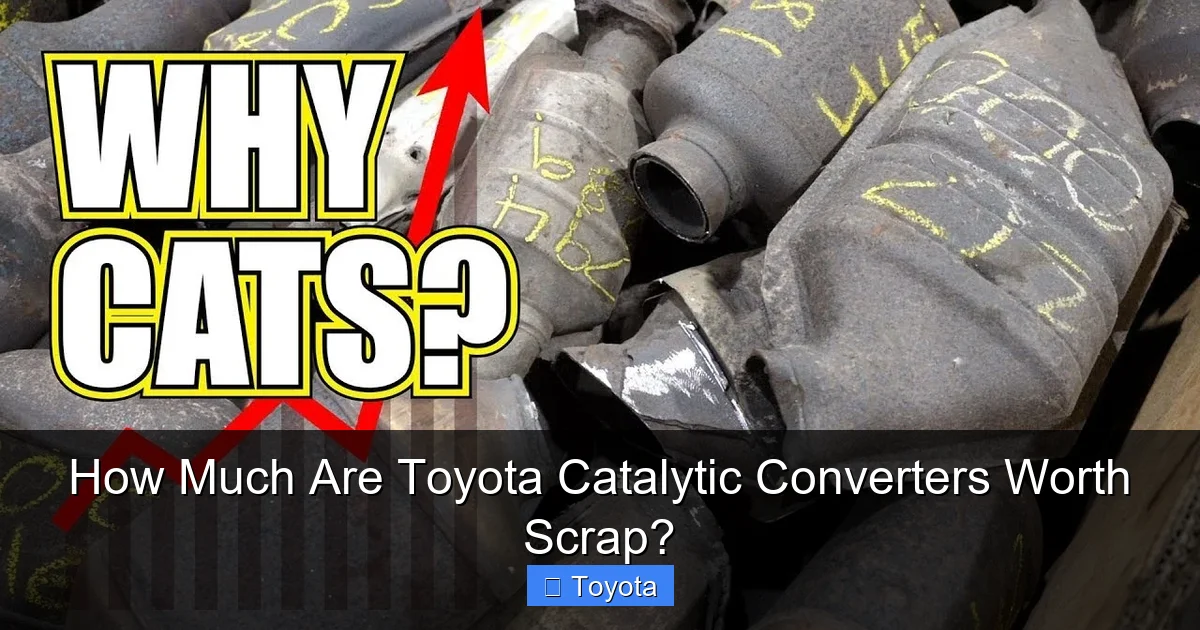
Visual guide about How Much Are Toyota Catalytic Converters Worth Scrap?
Image source: i.ytimg.com
For your scrap value calculation, you need to know how many you have. Here are common Toyota configurations:
- Most 4-Cylinder Cars (Corolla, Camry, RAV4): Typically have one main catalytic converter. Some newer models with transverse engines might have a dual-canister system, but it’s still considered one system.
- V6 Models (Highlander, Sienna, older Camry V6): Often have two converters. With a V6 engine, there are two exhaust banks (left and right). Each bank will have its own catalytic converter, usually combined into a single “Y-pipe” assembly. You may need to separate them for a higher price.
- V8 Trucks & SUVs (Tundra, Sequoia, Land Cruiser): Almost always have two large, heavy-duty catalytic converters, one for each exhaust bank. These are among the most valuable Toyota scrap parts. You can find specifics for models like the Toyota Tundra or Toyota 4Runner in our detailed guides.
- Performance Models (Supra, GR models): These often have high-flow, performance-oriented cats with even higher precious metal content. They can be exceptionally valuable.
Practical Tip: Look under your Toyota. Count the exhaust pipes coming from the engine. One pipe usually means one converter. A “Y” shaped pipe that splits into two mufflers usually means two converters that may be welded together. You’ll need to cut them apart to sell as two separate units, which requires skill and tools but dramatically increases value.
How to Determine the Current Scrap Value
Okay, you’ve identified your Toyota converter(s). Now, how do you put a dollar sign on them? There are three main methods, and you should use a combination.
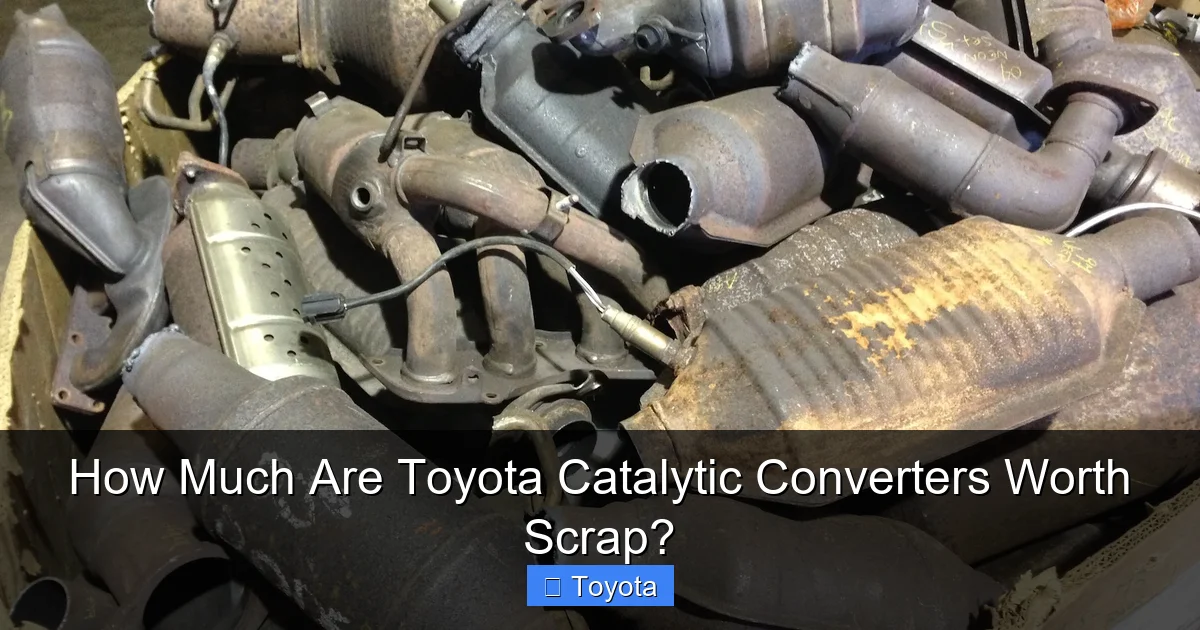
Visual guide about How Much Are Toyota Catalytic Converters Worth Scrap?
Image source: removemycar.co.uk
Method 1: The “By the Piece” Phone Quote (The Least Accurate)
You call a scrap yard and say, “I have a 2012 Toyota Tacoma catalytic converter.” They might give you a ballpark of “$150-$250.” This is a starting point, but it’s unreliable. They haven’t seen it, don’t know if it’s OEM or aftermarket, and can’t assess its condition. These quotes are often lowballed to get you in the door. Never rely solely on this.
Method 2: The “By the Ounce/Gram” Refining Quote (The Industry Standard)
This is how the serious business is done. Reputable scrap yards that deal in catalytic converters don’t pay you for the whole part. They pay you for the recoverable precious metals. Here’s the process:
- Decanning: The yard cuts open the steel shell and removes the ceramic or metallic honeycomb core (the “biscuit”).
- Assaying: The biscuit is sent to a laboratory (an “assay lab”) that grinds up a sample and precisely measures the parts per million (PPM) of platinum, palladium, and rhodium.
- Pricing: The yard uses current spot prices for Pt, Pd, and Rh (readily available on financial websites) and subtracts their refining costs, overhead, and profit margin. They then multiply the metal content by these adjusted prices to get a value per ounce or gram of catalyst material.
- Weighing: They weigh your specific biscuit (often in grams) and multiply by their per-gram rate.
Your job is to find a yard that is transparent about this process. Ask them: “Do you pay by assay value?” and “What is your current rate per gram for Toyota converter material?” A good yard will give you a range (e.g., “$18-$35 per gram depending on the specific model”). They may also offer a flat “by the piece” price based on their historical assay data for that specific converter type. This is where knowledge of your exact Toyota model and engine is powerful.
Method 3: Recent Sold Listings & Market Boards
Some online platforms and industry boards show what converters are selling for in bulk. However, these are wholesale prices between large dealers and refiners, not what a consumer with one or two converters will get. Still, they provide a ceiling to understand the maximum potential value. Use these to sanity-check a yard’s offer. If a yard is offering $50 for a known high-value Tundra cat, and the market board shows them selling for $300 each, that yard is lowballing you.
Selling Your Toyota Catalytic Converter: A Practical Guide
You have the converter, you have an idea of its value. Now, how do you turn it into cash safely, legally, and for the best price?
Step 1: Preparation and Documentation
First, remove the converter carefully. If you’re scrapping a whole vehicle, the junkyard will often handle it. If you’re removing it yourself from a parts car, your goal is to keep the ceramic biscuit intact and separate it from the steel shell if possible. This is a skilled job—the biscuit is brittle. Wear safety glasses and gloves. If you can’t separate it, that’s fine; most yards will do it for a small fee.
Most importantly: Gather proof of ownership. This is non-negotiable. You will need the vehicle title (in your name) or a bill of sale from the person who owned the car. Scrap yards are under intense scrutiny from law enforcement due to the national catalytic converter theft epidemic. They will ask for ID and documentation. Have it ready.
Step 2: Finding a Reputable Buyer
Not all scrap yards are created equal. You need a “non-ferrous” or “precious metals” yard that specifically deals in catalytic converters. General scrap yards that just take iron and copper often don’t have the refining relationships and will offer you a low, flat “by the pound” price for the whole heavy unit (which is a terrible deal).
- Search Online: Look for “catalytic converter recycling [Your City/State]” or “precious metal scrap yard.”
- Call and Ask Questions: A good yard will answer your questions about assay, pricing, and documentation requirements. A bad one will be vague or refuse to give any numbers over the phone.
- Check Reviews: Look for Google/Yelp reviews mentioning “catalytic converter” or “fair price.”
- Get Multiple Quotes: Take your converter (or clear photos and exact vehicle info) to 3-5 yards. Get the offer in writing if possible. This is the only way to know the true market value for your specific item.
Step 3: The Sale and What to Avoid
When you find a buyer, you’ll sign a bill of sale. They will likely weigh the entire unit first (for their records) and then either decant it on-site or send it to a regional processor. You should receive a receipt.
Major Red Flags & Pitfalls to Avoid:
- The “Over-the-Phone” Highball: “Yeah, that cat’s worth $400, bring it in!” Then when you arrive, they say, “Oh, the assay came back low, it’s $50.” This is a classic bait-and-switch. Never accept a final price without them seeing and potentially testing the unit.
- Yards That Won’t Explain Their Pricing: If they can’t tell you how they price cats (assay vs. flat rate), walk away. They are making money on your ignorance.
- No Documentation Request: If a yard doesn’t ask for your title or ID, they are either ignorant of the law or willfully ignoring it. This is a risk for you, as you could be implicated in handling stolen property.
- Cash-Only “Too Good to Be True” Deals: A guy in a parking lot offering $300 cash for your cat with no questions is either a thief or a scammer. The metal alone isn’t worth that much to a legitimate refiner. He’s either selling stolen property or planning to rip you off with counterfeit scales.
For more general advice on scrapping vehicle parts, you might find our piece on how much a scrap BMW is worth helpful, as the principles of dealing with high-value auto parts apply across brands.
Market Trends and the Future of Catalytic Converter Scrap
The value of your Toyota catalytic converter isn’t static. It’s a living number tied to global economics and environmental policy.
The Precious Metals Market Rollercoaster
Track the prices of platinum, palladium, and rhodium. In the last decade, palladium surged past gold in value due to massive demand from the auto industry. Rhodium has seen even more extreme volatility, spiking to over $30,000 per ounce in 2021 due to supply constraints and diesel emissions regulations, then falling sharply. These swings have a direct, immediate impact on converter prices. A converter worth $300 one month might be $150 the next if rhodium prices crash. There is no “average” price; there is only the “current” price.
The Electric Vehicle (EV) Threat and Opportunity
This is the long-term story. As Toyota and the entire industry shift to battery electric vehicles (BEVs), which have no internal combustion engine and therefore no catalytic converter, the long-term demand for new automotive catalysts will decline. This could eventually reduce the overall volume of converters entering the scrap stream. However, the existing fleet of over 250 million gasoline vehicles in the US alone will be on the road for at least 15-20 more years, providing a steady supply of end-of-life converters. In the medium term, tightening emissions regulations on remaining gas/hybrid models might actually increase the precious metal loading per converter, potentially offsetting some volume loss.
Recycling Technology Advances
The recycling process itself is becoming more efficient and environmentally friendly. New hydrometallurgical and electrochemical processes can recover a higher percentage of PGMs from the complex ceramic matrix. This could improve the margins for refiners and, in theory, lead to slightly higher payouts for suppliers like you over time, as more metal is recovered from the same weight of biscuit.
Frequently Asked Questions
Is it legal to sell my Toyota catalytic converter?
Yes, it is legal to sell a catalytic converter you lawfully own, typically from a vehicle you have titled in your name. You must provide proof of ownership, such as the vehicle title or a bill of sale, to a licensed scrap dealer. Selling a stolen converter is a serious crime.
Which Toyota models have the most valuable catalytic converters?
Generally, the largest V8-powered trucks and SUVs have the highest value due to their larger converter size and higher precious metal content. This includes the Toyota Tundra, Sequoia, and Land Cruiser with the 5.7L V8 engine. Performance models like the Supra also tend to have valuable, high-flow units.
How can I tell if my Toyota catalytic converter is OEM or aftermarket?
Look for the Toyota logo or a long part number stamped on the heat shield or the canister itself. OEM converters are usually built to a very specific, complex shape for that exact model and year. Aftermarket “universal” converters are often simpler, cylindrical, and lack brand markings. The easiest way is to compare it to photos of the OEM part for your specific vehicle online.
Should I remove the ceramic honeycomb from the steel shell before selling?
If you have the skill and tools to do it safely without breaking the brittle ceramic, yes. The steel shell is worth very little as scrap metal (pennies per pound). The entire value is in the catalyst-coated biscuit. Many yards will decant it for you for a small fee ($10-$20), which is often worth it to avoid the risk of injury or damaging the valuable core.
Why do prices for the same Toyota model vary so much between scrap yards?
Variation comes from three sources: 1) The yard’s relationship with refiners and their assay results (some yards get better recovery rates or have lower refining fees). 2) Their overhead and profit margin. 3) Their business model—some focus on high-volume, low-margin, while others pay more to secure supply. This is why getting multiple quotes is essential.
What happens to the catalytic converter after I sell it?
It enters the recycling supply chain. The yard will either “decant” it (cut open and remove the biscuit) or sell whole units to a larger processor. That processor then mills the ceramic into a powder, which is sent to a specialized precious metals refinery. The refinery uses chemical processes to leach out and purify the platinum, palladium, and rhodium, which are then sold to manufacturers to make new catalytic converters, electronics, jewelry, and more.