
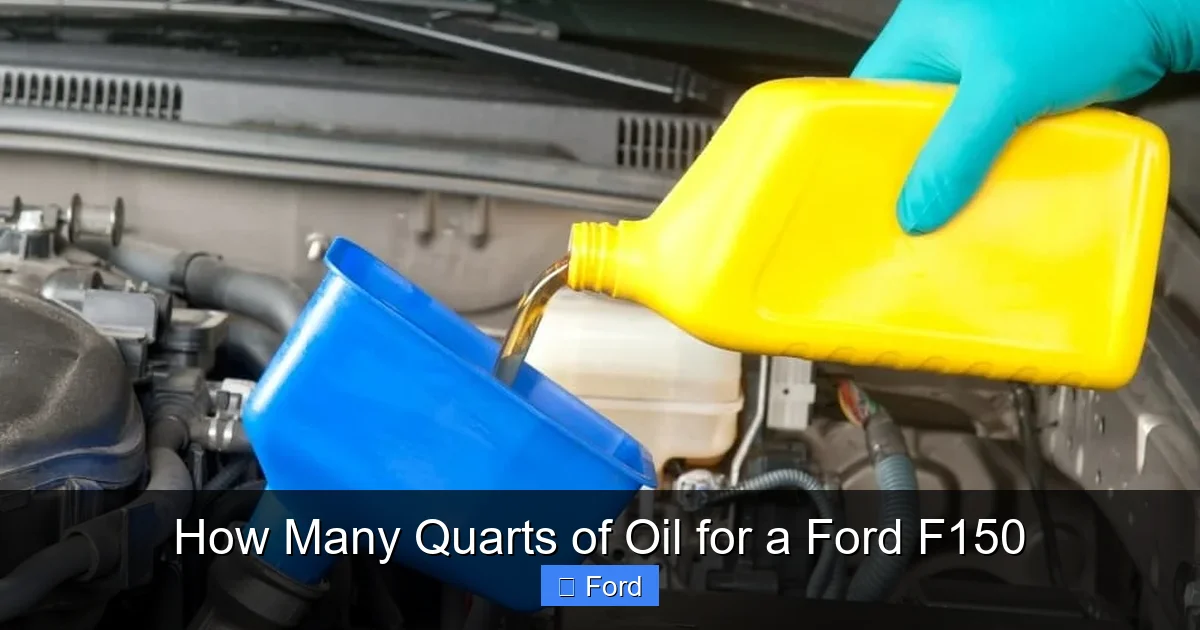
How Many Quarts of Oil for a Ford F150

Contents
- 1 Key Takeaways
- 2 📑 Table of Contents
- 3 Why Knowing the Exact Oil Capacity for Your Ford F150 is Non-Negotiable
- 4 The F150 Engine Lineup: A Breakdown of Oil Capacities
- 5 How to Find the EXACT Oil Capacity for Your Specific Truck
- 6 Your Step-by-Step Guide to a Perfect F150 Oil Change
- 7 Critical Mistakes That Can Wreck Your F150’s Engine
- 8 The Bottom Line: Professional vs. DIY Oil Changes
- 9 Conclusion: Knowledge is the Best Maintenance Tool
- 10 Frequently Asked Questions

Car GPS Navigator

Microfiber Car Cleaning Cloth

Car Shampoo Concentrate

Pressure Washer for Car
The amount of oil a Ford F150 needs isn’t a one-size-fits-all number. It varies significantly based on the engine size and model year, typically ranging from 6 to 8 quarts. Always confirm the exact capacity for your specific truck using the owner’s manual or a reliable lookup guide before adding oil.
Key Takeaways
- Oil capacity is engine-specific: Your Ford F150’s oil capacity depends entirely on its engine displacement (e.g., 3.5L V6 vs. 5.0L V8) and whether it’s a standard or hybrid model.
- The owner’s manual is your ultimate source: The factory-specified capacity listed in your vehicle’s manual is the only definitive answer for your truck.
- Modern F150s generally require more oil: Newer generations (2015+) and especially the PowerBoost hybrid engines often have larger oil capacities than older models.
- Overfilling is as dangerous as underfilling: Too much oil can cause foaming, increased pressure, and seal leaks, leading to severe engine damage.
- Oil type matters alongside quantity: Using the correct viscosity (like 5W-30 or 0W-40) and specification (Ford WSS-M2C947-A/B) is just as critical as the correct volume.
- Always check the dipstick: After an oil change, always verify the level with the dipstick, as filters can hold varying amounts of oil and minor measurement errors can occur.
- Resetting the oil life monitor is a mandatory step: After changing the oil, you must reset the vehicle’s intelligent oil life monitoring system for it to function accurately.
📑 Table of Contents
- Why Knowing the Exact Oil Capacity for Your Ford F150 is Non-Negotiable
- The F150 Engine Lineup: A Breakdown of Oil Capacities
- How to Find the EXACT Oil Capacity for Your Specific Truck
- Your Step-by-Step Guide to a Perfect F150 Oil Change
- Critical Mistakes That Can Wreck Your F150’s Engine
- The Bottom Line: Professional vs. DIY Oil Changes
- Conclusion: Knowledge is the Best Maintenance Tool
Why Knowing the Exact Oil Capacity for Your Ford F150 is Non-Negotiable
Let’s talk about your Ford F150. It’s a workhorse, a family hauler, an adventuremobile. Keeping its heart—the engine—beating strong starts with one of the most fundamental maintenance tasks: the oil change. But here’s the critical first question you must answer correctly: how many quarts of oil does a Ford F150 take? Guessing or using a generic number is a fast track to expensive trouble. The correct oil capacity ensures proper lubrication, cooling, and cleaning of your engine’s internal components. Too little oil leads to catastrophic friction and wear. Too much oil causes aeration, foaming, and can blow seals, creating a different kind of mess. Getting this number right is step one of a perfect oil change.
The Ford F150’s legendary versatility extends to its engine lineup. Over its many generations, Ford has offered a wide array of powerplants, from efficient EcoBoost V6s to burly V8s and now a groundbreaking hybrid. Each engine has a unique design, requiring a specific volume of oil to function optimally. Therefore, the answer to “how many quarts for a Ford F150” is always prefaced with “it depends on your engine.” This guide will strip away the confusion, giving you the precise capacities for every major F150 engine from recent years, plus the essential knowledge to perform the job correctly or communicate intelligently with your mechanic.
The F150 Engine Lineup: A Breakdown of Oil Capacities
To give you the right answer, we must first identify your engine. The 13th generation F150 (2015-2020) and the 14th generation (2021-present) have the most common configurations on the road today. Below, we detail the standard oil capacity (with filter) for each major engine option. Remember, these are baseline figures. Always double-check for your specific VIN, as special packages (like the Raptor) or minor running changes can sometimes alter specs.
Visual guide about How Many Quarts of Oil for a Ford F150
Image source: vehiclefreak.com
Gasoline Engines: EcoBoost and V8
The F150’s gasoline lineup is dominated by Ford’s turbocharged EcoBoost V6 engines and the iconic Coyote 5.0L V8. Here’s where they stand:
- 3.5L EcoBoost V6 (2015-2020): This is the most common engine. It requires 6.0 quarts (5.7 liters) of oil when changing the filter. Without the filter, it’s 5.7 quarts.
- 3.5L EcoBoost V6 (2021-Present): The current generation model maintains the same capacity: 6.0 quarts (5.7 liters) with filter.
- 2.7L EcoBoost V6 (2015-2020): The smaller, more efficient twin-turbo V6 takes 6.4 quarts (6.0 liters) with a new filter.
- 2.7L EcoBoost V6 (2021-Present): Capacity remains 6.4 quarts (6.0 liters).
- 5.0L V8 (Coyote): The naturally aspirated V8, a favorite for towing, needs 7.7 quarts (7.3 liters) of oil with the filter changed.
- 5.0L V8 (2021-Present): The current model year V8 also specifies 7.7 quarts (7.3 liters).
The PowerBoost Hybrid: A Special Case
The 2021+ F150 PowerBoost hybrid combines a 3.5L EcoBoost V6 with an electric motor and a 1.5 kWh battery. This complex system has unique lubrication needs. The PowerBoost engine requires 7.0 quarts (6.6 liters) of oil when replacing the filter. It’s vital not to confuse this with the standard 3.5L EcoBoost’s 6.0-quart capacity. The hybrid system’s additional components and different operating parameters necessitate this extra oil volume.
Diesel and Past Generations (For Context)
While less common today, the previous 6.7L Power Stroke V8 Turbo Diesel (2011-2016) had a massive capacity of 13 quarts (12.3 liters). For older trucks, like the 2004-2008 models with the 4.6L or 5.4L engines, capacities were lower, typically in the 5-6 quart range. If you own an older F150, your manual or a reputable forum for your specific model year is your best friend.
How to Find the EXACT Oil Capacity for Your Specific Truck
So you’ve looked at the lists above and have a good guess. But how do you get 100% certainty? Relying on memory or a generic internet list can lead to a one-quart mistake. Here is your foolproof, three-step verification process.

Visual guide about How Many Quarts of Oil for a Ford F150
Image source: vehiclefreak.com
Step 1: The Owner’s Manual – Your Bible
The first and most authoritative source is your vehicle’s owner’s manual. In the “Capacities and Specifications” or “Lubricant Specifications” chapter, you will find a chart that lists the exact oil capacity for your engine, often broken down by “with filter change” and “without filter change.” This is the manufacturer’s official word. If you’ve lost your manual, Ford often has PDFs available online through their owner portal.
Step 2: The Dipstick and Fill Hole – The Physical Check
Even with the manual number, the final arbiter is the dipstick. After draining the old oil and replacing the filter (which you should prime with new oil first), you begin by adding about 0.5 to 1 quart less than the manual’s “with filter” capacity. Then, check the dipstick, let the oil settle for a minute, and add in small increments (0.25 quarts at a time) until the level is precisely on the “FULL” mark, not below or above. This accounts for any minor differences in filter oil-holding capacity or residual oil in the engine. If you’re ever unsure during a DIY job, it’s better to be a hair low and top up than to overfill.
Step 3: Reputable Online Lookup Tools
Websites like this comprehensive guide on general car oil capacity can provide a quick reference. However, you must input your exact year, make, model, and engine. These tools aggregate manufacturer data. For the F150, you must select the correct engine option. A 2018 F150 XLT with a 2.7L EcoBoost has a different capacity than a 2018 Lariat with a 5.0L V8. The key is specificity.
Your Step-by-Step Guide to a Perfect F150 Oil Change
Knowing the correct quarts is half the battle. The other half is the procedure. Here’s a simplified, professional-grade process for a Ford F150 oil change.

Visual guide about How Many Quarts of Oil for a Ford F150
Image source: carglassadvisor.com
Gather Your Tools and Materials
You’ll need: the correct amount and type of oil (e.g., SAE 5W-30 meeting Ford spec WSS-M2C947-A/B for most 2015-2020 engines), a new oil filter (Motorcraft is the OEM brand), a socket and ratchet for the drain plug (usually 13/16″ or 21mm), a drain pan, a funnel, gloves, and safety glasses. For some models, you may need a special filter cap wrench for the cartridge-style filter (common on 2.7L and 3.5L EcoBoosts).
The Process: Drain, Replace, Fill, Verify
- Warm the Engine: Run the truck for 5-10 minutes to warm the oil, which helps it drain more thoroughly.
- Lift and Secure: Use jack stands on solid frame rails. Never rely on the jack alone. Safety first.
- Drain the Oil: Place your pan under the oil pan drain plug. Remove the plug and let it drain completely. This can take 5-10 minutes.
- Replace the Filter: Locate the oil filter. For a cartridge filter (common on EcoBoosts), you’ll need a special cap wrench. Remove the old filter, clean the sealing surface on the cap, install the new filter O-ring (lubricated with fresh oil), and tighten the cap to spec (usually hand-tight plus 3/4 turn). For a spin-on filter, lubricate the new filter’s gasket with oil, screw it on by hand until snug, then give it an additional 3/4 turn.
- Reinstall Drain Plug: Clean the drain plug and its washer (replace the washer if it’s a crush type). Reinstall and torque to specification (typically 20-25 ft-lbs, but check your manual).
- Fill with Oil: Remove the engine oil fill cap. Using a funnel, pour in approximately 90% of your calculated capacity (e.g., for a 6.0-quart engine, start with about 5.5 quarts).
- Check and Top Off: Wait 60 seconds for oil to settle. Pull the dipstick, wipe it, reinsert it fully, and pull it again to check. Add oil in 0.25-quart increments until the level is at the “FULL” mark. Do not overfill.
- Run and Re-check: Start the engine, let it idle for 30 seconds. Check for leaks around the filter and drain plug. Turn off the engine, wait another minute, and re-check the dipstick. Top off if necessary.
- Reset the Oil Life Monitor: This is crucial. Use the steering wheel controls to navigate to the “Settings” > “Vehicle” > “Oil Life” menu on your dashboard display. Follow the prompts to reset it to 100%. If your truck has a key-based reset procedure, the manual will detail it.
Critical Mistakes That Can Wreck Your F150’s Engine
Even with the right oil and quarts, simple errors can undo all your good work. Here are the most common pitfalls to avoid.
Mistake 1: Overfilling the Crankcase
This is the #1 DIY error. Overfilling by even a quart can cause the crankshaft to whip through the oil, creating foam. Aerated oil cannot lubricate properly, increases pressure (blowing seals and gaskets), and can cause aeration-related engine damage. Always fill conservatively and verify with the dipstick.
Mistake 2: Using the Wrong Oil Specification
Modern F150 engines, especially turbos, have tight tolerances and specific requirements. Using a generic 5W-30 that isn’t certified to Ford’s WSS-M2C947-A/B (or the newer -C for 2021+) specification can lead to premature wear, turbo coking, and poor performance. The oil cap or manual will state the required specification. When in doubt, use a high-quality oil that explicitly lists this Ford specification on the bottle.
Mistake 3: Forgetting to Prime the Oil Filter
For spin-on filters, pre-filling them with a little fresh oil and lubricating the gasket prevents a dry start and makes installation easier. For cartridge filters, lubricating the new O-ring is essential. A dry filter can hold a significant amount of oil initially, causing a brief moment of low oil pressure at startup if not accounted for.
Mistake 4: Neglecting the Oil Life Monitor Reset
The intelligent oil life monitor in your F150 calculates when an oil change is needed based on your driving habits. If you don’t reset it after an oil change, it will continue to count down from its previous percentage, eventually giving you a false “change oil” warning too soon or, worse, not warning you at all when it truly should. Resetting the oil life system is a universal step across modern vehicles, though the procedure varies by make and model.
Mistake 5: Using the Wrong Filter or a Low-Quality Filter
An oil filter is not just a can; its internal media and relief valve design are engineered for your engine’s specific needs. A cheap, poorly made filter can allow debris into your engine or have a faulty anti-drain back valve, causing premature wear. Stick with Motorcraft (OEM) or other reputable brands like Wix, Mobil 1, or Purolator that are known for quality.
The Bottom Line: Professional vs. DIY Oil Changes
Now that you know the exact quarts and the process, should you do it yourself? For the mechanically inclined, a DIY oil change on an F150 is a straightforward, satisfying task that can save you $40-$70 per service. It gives you control over the quality of oil and filter you use. However, it requires tools, space, and proper disposal of the used oil. If you lack any of these, or if your truck is under warranty and you want to avoid any potential “improper maintenance” disputes, a professional service at a dealership or reputable shop is the way to go. The cost difference is the price for convenience and peace of mind. Just because you know how many quarts of oil for a Ford F150 doesn’t mean you have to be the one to pour it. What matters is that the job is done correctly with the specified volume and product.
Conclusion: Knowledge is the Best Maintenance Tool
Your Ford F150 is an investment in capability and reliability. Protecting that investment starts with understanding its fundamental needs. The question “how many quarts of oil for a Ford F150” has a precise, engine-dependent answer. From the 2.7L EcoBoost’s 6.4 quarts to the 5.0L V8’s 7.7 quarts and the PowerBoost’s 7.0 quarts, each number is a critical specification. Bookmark this guide, but more importantly, internalize the process: identify your engine, consult your manual, use the correct oil type and filter, add oil conservatively, verify with the dipstick, and reset the monitor. Whether you choose the rewarding DIY route or trust a professional, this knowledge ensures your F150’s engine will deliver years of faithful service. For more tips on maintaining your vehicle, explore our guides on cleaning up oil spills or understanding general oil fill procedures.
Frequently Asked Questions
What happens if I put too much oil in my Ford F150?
Overfilling causes the crankshaft to aerate the oil, creating foam. This foamy oil cannot properly lubricate the engine, leading to increased friction, heat, and potential seal and gasket failure due to excessive crankcase pressure. It can cause severe engine damage quickly.
Can I use 5W-30 oil in my F150 if it calls for 0W-40?
You should always use the exact oil viscosity and specification listed in your owner’s manual. While 5W-30 and 0W-40 are both common for F150s, they are not universally interchangeable. The 0W-40 is often specified for the 5.0L V8 and some higher-performance applications for better high-temperature protection. Using the wrong weight can affect fuel economy, cold-start performance, and engine wear protection.
How often should I change the oil in my Ford F150?
Follow the Intelligent Oil Life Monitor (IOLM) in your dashboard. This system calculates the ideal change interval based on your actual driving conditions, which can range from 5,000 to 10,000 miles or more. Do not rely on a fixed mileage interval. If you do a lot of severe driving (towing, extreme temps, dusty conditions), the monitor will shorten the interval accordingly.
My 2021 F150 PowerBoost takes 7 quarts, but my old 2015 with a 3.5L EcoBoost took 6. Why the difference?
The PowerBoost hybrid system has different lubrication demands. The hybrid powertrain includes an electric motor-generator and a more complex transmission integrated with the engine, requiring a larger oil sump to ensure all components are properly bathed in oil under all operating conditions, including frequent electric-only driving.
Is the oil capacity different if I don’t change the filter?
Yes. A new oil filter holds approximately 0.2 to 0.5 quarts of oil. The capacity listed in your manual is almost always the “with filter change” capacity. If you are only adding oil between changes without replacing the filter, you would use the slightly lower “without filter” capacity, but you should always replace the filter with a new one during a full oil change.
How do I know if my oil level is correct after filling?
After adding oil, always use the dipstick. With the engine off and on level ground, pull the dipstick, wipe it clean, reinsert it fully, and then pull it again. The oil film should be between the “MIN” (or “ADD”) and “MAX” (or “FULL”) marks. The ideal level is right at the “FULL” mark. Never fill above this mark.