
How Many Quarts of Oil Does a 2017 Toyota Tundra Take

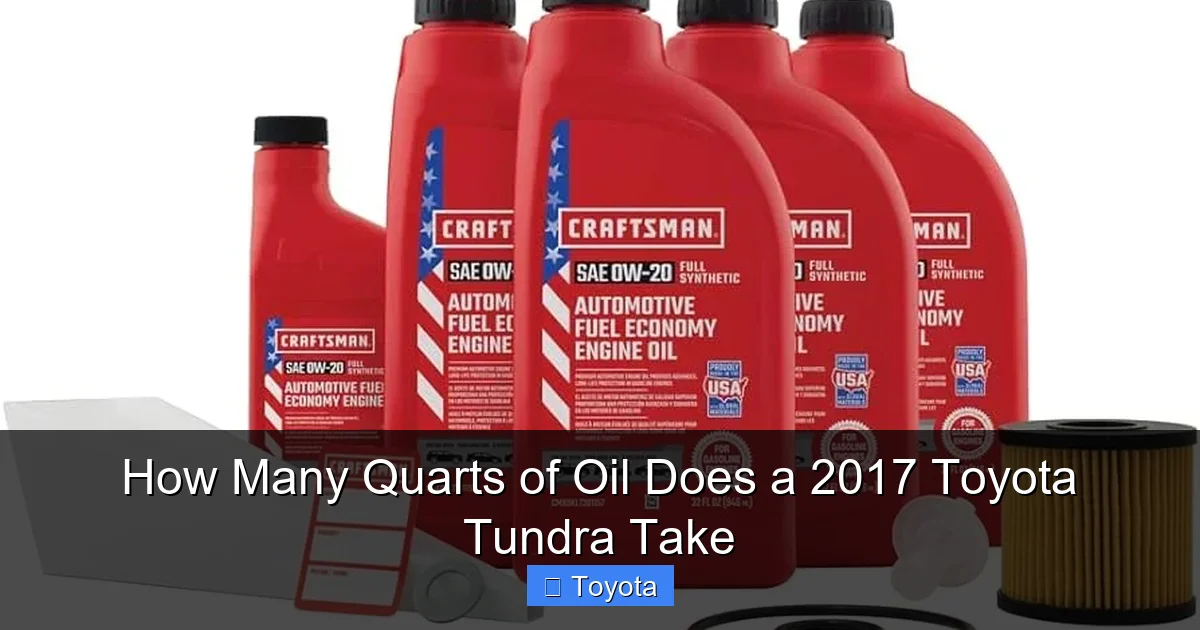
Knowing the precise oil capacity for your 2017 Toyota Tundra is non-negotiable for engine health. The two available engines—the powerful 5.7L V8 and the 4.6L V8—have different requirements, with the 5.7L needing 6.8 quarts (6.4 liters) and the 4.6L requiring 6.4 quarts (6.0 liters) with a filter change. Always use Toyota-approved 0W-20 synthetic oil and consult your owner’s manual. Proper oil level checking and avoiding common mistakes like overfilling are critical to protecting your Tundra’s robust engine from premature wear.
So, you’re standing in the auto parts aisle, a fresh jug of oil in one hand and a wrench in the other, staring at your formidable 2017 Toyota Tundra. The big questions loom: “How many quarts of oil does this beast actually take?” and “What kind should I use?” Getting this wrong isn’t just a minor inconvenience; it’s a direct line to potential engine damage, poor performance, and a very expensive repair bill. Your Tundra’s engine is a workhorse, and like any workhorse, it needs the right fuel—in this case, lubrication—to perform at its peak and last for the long haul. This guide will walk you through everything you need to know, from the exact numbers for your specific engine to the why behind the specifications, ensuring you can confidently perform this critical maintenance task.
Key Takeaways
- Two Engine, Two Capacities: The 2017 Tundra’s 5.7L V8 takes 6.8 quarts (6.4L) while the 4.6L V8 requires 6.4 quarts (6.0L) when replacing the filter. Never guess—confirm your engine size.
- Oil Type is Mandatory: Toyota specifies 0W-20 full synthetic oil (ILSAC GF-6) for both engines. Using the wrong viscosity can harm fuel economy and engine protection.
- The Dipstick is Your Best Friend: After an oil change, always verify the level using the dipstick. The “full” mark is a target range, not a maximum; slightly below is safer than overfilling.
- Always Replace the Filter: The capacity figures are for a standard oil change with a new filter. Reusing the old filter leaves old oil in the system, reducing the new oil’s effectiveness.
- Don’t Rely on Memory: Even if you’ve owned a Tundra for years, always check the owner’s manual for the current specification. Service bulletins or regional variations can occur.
- Capacity vs. Total System Volume: The “quarts” figure is what you pour in. The engine’s total oil system volume is slightly higher to account for oil retained in the filter, galleries, and turbocharger (if equipped).
- Maintenance is Holistic: Correct oil capacity is just one part of engine care. Proper coolant levels, as detailed in our guide on what kind of coolant a Toyota Tundra takes, are equally vital for temperature regulation.
📑 Table of Contents
- Understanding Your Tundra’s Heart: The 2017 Engine Options
- The Exact Numbers: Oil Capacity Charts and Specifications
- Rolling Up Your Sleeves: The Step-by-Step Oil Change Guide
- Common Mistakes and Pitfalls to Avoid
- Beyond the Oil Change: Holistic Tundra Maintenance
- Conclusion: Confidence Through Knowledge
Understanding Your Tundra’s Heart: The 2017 Engine Options
Before we can talk about quarts, we must talk about cubic inches—or, more accurately, liters. The 2017 Toyota Tundra came with two gasoline engine options, and their oil capacities are not the same. This is the first and most crucial piece of information you need. Assuming both engines take the same amount of oil is a common and costly mistake.
The Standard-Bearer: 5.7-Liter V8 (3UR-FE)
This is the iconic, legendary engine that powers the majority of Tundra models. It’s the 5.7L V8, known for its robust torque, towing prowess, and characteristic growl. For the 2017 model year, this engine requires 6.8 quarts (6.4 liters) of oil when performing a standard oil and filter change. This figure accounts for the oil that will be retained in the new oil filter, the engine’s internal passages, and the turbocharger housing (if your specific trim includes the TRD Pro or similar package with a turbo). It’s a substantial amount, reflecting the engine’s large displacement and the need for a full oil film on all its moving parts. When you see that big 5.7L badge on the fender, you know you’re dealing with the 6.8-quart requirement.
The Efficient Alternative: 4.6-Liter V8 (1UR-FE)
Less common but still a capable and more fuel-efficient option, the 4.6-liter V8 was available on certain Tundra trims. While smaller, it’s still a serious V8 engine. Its oil capacity is slightly less. For the 4.6L engine, you will need 6.4 quarts (6.0 liters) of oil during a filter change. The difference of 0.4 quarts might not seem like much, but in the precise world of engine lubrication, it’s a significant margin. Overfilling the 4.6L by using the 5.7L’s capacity can lead to aeration (foaming) of the oil, increased pressure, and seal leaks.
How to Identify Your Engine Quickly
If you’re unsure which engine is under your hood, don’t worry. There are three foolproof methods. First, open the hood and look for the engine cover. It almost always has the displacement emblazoned on it—either “5.7 L” or “4.6 L”. Second, check your driver’s side door jamb sticker; the engine size is listed there alongside tire pressure and VIN info. Finally, your vehicle’s title, registration, or insurance documents will list the engine displacement. This step is non-negotiable before you buy a single quart of oil.
The Exact Numbers: Oil Capacity Charts and Specifications
Now that we’ve separated the engines, let’s lay out the specifics in black and white. But remember, the “quarts” number is part of a larger system of specifications that work together.

Visual guide about How Many Quarts of Oil Does a 2017 Toyota Tundra Take
Image source: psychoautos.com
Capacity Table at a Glance
Here is the definitive breakdown for a 2017 Toyota Tundra:
- Engine: 5.7L V8 (3UR-FE)
- Oil Capacity (w/ Filter): 6.8 quarts (6.4 liters)
- Recommended Oil: 0W-20 Full Synthetic (API SN or higher, ILSAC GF-6)
- Engine: 4.6L V8 (1UR-FE)
- Oil Capacity (w/ Filter): 6.4 quarts (6.0 liters)
- Recommended Oil: 0W-20 Full Synthetic (API SN or higher, ILSAC GF-6)
A critical note: These capacities are for a standard drain and fill with a new oil filter. If you are only adding oil to top off a low level, add slowly and continuously check the dipstick. Never assume the total system capacity is the same as the “fill” capacity.
Why 0W-20? The Science of Toyota’s Specification
Toyota’s insistence on 0W-20 for the 2017 Tundra isn’t arbitrary marketing. The “0W” means the oil flows like a “0-weight” oil at cold startup temperatures (measured in “Winter”). This is crucial for a large V8. On a cold morning, the oil needs to reach the top of the engine and lubricate critical bearings and camshafts within seconds of startup. Thicker oil would struggle to flow quickly, causing increased “dry start” wear. The “20” indicates the oil’s viscosity at 100°C (212°F), the standard operating temperature. A 20-weight oil at heat provides a thin, efficient film that reduces internal friction, directly improving fuel economy—a key factor for a heavy truck. Using a heavier oil like 5W-30 can void your warranty and reduce efficiency. For a deeper dive into oil types across the Toyota lineup, you can see how this compares to other models in our piece on what kind of oil a Toyota Tacoma takes.
Rolling Up Your Sleeves: The Step-by-Step Oil Change Guide
Armed with the correct oil and filter, let’s walk through the process. This is a straightforward DIY job for a Tundra, thanks to good under-hood access.

Visual guide about How Many Quarts of Oil Does a 2017 Toyota Tundra Take
Image source: i.ebayimg.com
Gather Your Tools and Materials
You’ll need: The correct amount of 0W-20 full synthetic oil (buying a 6-quart jug plus a single quart is usually perfect for the 5.7L). A high-quality oil filter—use the OEM Toyota part number or a reputable brand like Mobil 1, WIX, or Fram with the correct specifications for your 5.7L or 4.6L. A socket wrench and 14mm or 15mm socket (check your specific model) for the oil drain plug. A drain pan (at least 8 quarts capacity). A new drain plug washer/gasket (this is a must—reuse is a leak waiting to happen). Gloves and safety glasses. A funnel for clean pouring.
The Process: Drain, Replace, Fill, Verify
1. Warm the Engine: Run the engine for 5-10 minutes. Warm oil flows out faster and carries more sludge with it. Be careful—engine components will be hot.
2. Lift and Secure: Use jack stands on solid frame rails. Never rely on the jack alone. Ensure the truck is level.
3. Drain the Oil: Place your drain pan under the oil pan plug. Use the socket to remove the plug. Let it drain completely (15-20 mins). The oil will be HOT.
4. Replace Filter: The filter is typically located behind and slightly below the engine, accessible from the top or side. Use an oil filter wrench. Before installing the new filter, lightly coat the rubber gasket with fresh oil. Hand-tighten, then give it a 3/4 turn with the wrench. Do not overtighten.
5. Reinstall Drain Plug: Clean the plug and install it with a brand new washer. Torque to specification (usually around 30 ft-lbs, but check your manual). This prevents leaks.
6. Fill with New Oil: Remove the oil filler cap (usually marked with an oil can icon). Place your funnel and pour in one quart less than the total capacity (e.g., 5.8 quarts for a 5.7L). Wait 2-3 minutes for the oil to settle.
7. Check the Level: Pull the dipstick, wipe it clean, reinsert it fully, and pull it again. Check the level. It should be between the MIN and MAX marks, ideally right on the full mark. If it’s low, add oil in 0.25-quart increments, rechecking each time, until it hits the mark. Do not fill to the top of the dipstick tube.
8. Final Steps: Replace the filler cap. Start the engine and let it idle for 30 seconds. Check for leaks around the drain plug and filter. Turn off the engine, wait a minute, and re-check the dipstick. Top off if necessary. Reset your maintenance reminder system.
Common Mistakes and Pitfalls to Avoid
Even with the right oil, errors during the change can cause problems.
Visual guide about How Many Quarts of Oil Does a 2017 Toyota Tundra Take
Image source: thecarhow.com
The Overfill Danger Zone
This is the #1 mistake. Adding that extra quart “just to be safe” is a terrible idea. Overfilled oil creates a frothy, aerated mixture in the oil pan. The oil pump cannot pump foam effectively, leading to a loss of oil pressure, especially on sharp turns. This results in catastrophic engine wear. If you overfill, you must drain the excess immediately. The dipstick’s “Full” mark is the absolute maximum safe level; aiming for the midpoint is a safer practice.
Wrong Filter or Gasket
Using an incorrect filter can cause leaks, poor fitment, or even internal bypass of filtration. Ensure the filter matches your exact engine and model year. Similarly, neglecting to replace the drain plug washer is a classic shortcut that leads to a slow, messy drip that can ruin your driveway and eventually your oil level.
Ignoring the “Check Engine” Light After an Oil Change
If your check engine light comes on immediately after an oil change, do not ignore it. It could be a loose oil filler cap (causing a vacuum leak), a sensor issue from the tech disconnecting the battery, or—rarely—a sign you caused a problem like a disconnected sensor or overfill. Scan for codes or have a professional check it.
Beyond the Oil Change: Holistic Tundra Maintenance
Engine oil is the lifeblood, but it’s part of a circulatory system. Proper maintenance is interconnected.
Why Oil and Coolant are a Team
Your Tundra’s cooling system protects the engine from overheating, while oil protects from friction. Both systems can fail independently, but their health is linked. A coolant leak can cause the engine to run hot, thinning the oil and breaking it down prematurely. Conversely, an oil leak can lead to friction and excess heat. Always ensure your coolant is at the proper level and mix. Understanding what kind of coolant your Tundra takes and maintaining it is just as important as the oil change schedule.
Oil Change Interval: The 10,000-Mile Question
Toyota’s official recommendation for the 2017 Tundra under “normal” driving is 10,000 miles or 12 months. However, “normal” is a specific term. If you frequently tow, drive in dusty conditions, make very short trips (where oil doesn’t fully warm up), or experience extreme temperatures, you should shorten this interval to 5,000-7,500 miles. The 0W-20 synthetic oil is robust, but severe service degrades it faster. When in doubt, change it sooner. The cost of an extra oil change is trivial compared to an engine rebuild.
Weighty Considerations: Your Tundra’s Mass and Fluid Demands
It’s helpful to remember you’re maintaining a very heavy vehicle. The 2017 Tundra’s curb weight ranges from 5,000 to over 5,800 lbs depending on configuration. All that mass means the engine works hard, especially when accelerating or towing. This places greater demands on the lubrication system. Ensuring you have the exact oil capacity and the right oil helps manage the heat and friction generated by moving such a substantial truck. You can see the full weight specs for different trims in our detailed article on how much a Toyota Tundra weighs.
Conclusion: Confidence Through Knowledge
So, how many quarts of oil does a 2017 Toyota Tundra take? The answer is clear: 6.8 quarts for the 5.7L V8, and 6.4 quarts for the 4.6L V8, both requiring a filter change and 0W-20 full synthetic oil. This simple piece of knowledge is the cornerstone of a fundamental maintenance task that will directly impact your truck’s longevity, reliability, and performance. By identifying your engine, using the specified oil, following a careful procedure to avoid overfilling, and pairing this with a holistic approach to all fluid maintenance, you are taking proactive, powerful control over your vehicle’s health. Don’t let uncertainty lead to guesswork. With this guide, you can walk out to your garage, open the hood, and know exactly what your Tundra needs to keep running strong for another 200,000 miles.
Frequently Asked Questions
Can I use 5W-30 oil in my 2017 Tundra instead of 0W-20?
No. Toyota specifically engineered the 5.7L and 4.6L engines for 0W-20. Using a thicker oil like 5W-30 can reduce fuel economy, increase wear during cold starts, and may void your powertrain warranty. Always adhere to the manufacturer’s specification.
What happens if I accidentally overfill the oil by half a quart?
Even a slight overfill can be problematic. The crankshaft can whip through the oil in the pan, causing aeration (foam). Foamy oil cannot be pumped properly, leading to low oil pressure and potential engine seizure. If you overfill, drain the excess immediately until the level is at or slightly below the full mark on the dipstick.
Is the oil capacity different if I don’t change the filter?
Yes. The standard capacity figures (6.8L or 6.4L) are for a full drain and fill with a new filter. If you only drain the oil from the pan and reuse the old filter (which still holds about 0.5-1 quart of old oil), you would need to add approximately 10-15% less new oil to reach the correct level. However, reusing a filter is poor practice and not recommended.
How do I know if my 2017 Tundra has the turbocharged engine?
The 2017 Tundra did not have a turbocharged gasoline engine from the factory. The standard engines are the naturally aspirated 5.7L V8 and 4.6L V8. Some trims (like the TRD Pro) may have a TRD supercharger kit installed as an accessory, but this is not a factory turbo. Your engine size is clearly labeled on the engine cover and door jamb sticker.
Should I use a magnetic drain plug?
Magnetic drain plugs can be a good idea. They attract tiny ferrous metal particles that circulate in your oil, keeping them out of the oil pump and bearing surfaces. If you use one, ensure it is the correct thread pitch and torque specification for your Tundra’s oil pan. It’s a low-cost insurance policy for your engine.
My Tundra burns oil. Is that normal for this engine?
Some oil consumption is normal for any engine, but the 5.7L V8 in the 2017 Tundra is not known for excessive burning. If you are adding more than one quart between 3,000-5,000 mile intervals, you likely have a problem. Common causes include worn piston rings, valve stem seals, or a PCV system issue. Have a mechanic perform a diagnosis instead of just adding oil.
