How Many People Does a Hyundai Santa Fe Seat?

Contents
- 1 Key Takeaways
- 2 📑 Table of Contents
- 3 Understanding the Hyundai Santa Fe’s Core Identity
- 4 Seating Configurations by Trim Level
- 5 The Third-Row Experience: A Detailed Look
- 6 Cargo Space: The Inevitable Trade-Off
- 7 Safety and Comfort Features for All Rows
- 8 How the Santa Fe Stacks Up Against Competitors
- 9 Practical Tips for Choosing Your Santa Fe Seating
- 10 Frequently Asked Questions


The Hyundai Santa Fe typically seats five people in its base configuration, but higher trims offer an optional third row for up to seven passengers. However, the third row is best suited for children or short trips due to limited legroom. Understanding your trim’s specific seating setup is key to matching your family’s needs and ensuring comfort on every journey.
Key Takeaways
- Base Seating is Five: The standard Hyundai Santa Fe configuration comfortably seats five passengers across two rows.
- Optional Third-Row Availability: The third-row seating option is not available on all trims; it’s primarily found on higher-end models like the Limited and Calligraphy.
- Third-Row Size Limitations: The third row is compact, making it most suitable for children or adults on short trips; it’s not ideal for long-distance adult comfort.
- Cargo Space Trade-Offs: Adding the third-row seat significantly reduces cargo volume behind the last row, a key factor for families with lots of gear.
- Comprehensive Safety Features: The Santa Fe’s LATCH system and available safety tech protect all passengers, regardless of seating configuration.
- Competitive Positioning: Against rivals like the Dodge Journey and Nissan Rogue, the Santa Fe offers a balanced blend of passenger space and value.
- Customization and Protection: Consider accessories like high-quality seat covers to protect your Santa Fe’s interior, especially with frequent passenger use.
📑 Table of Contents
- Understanding the Hyundai Santa Fe’s Core Identity
- Seating Configurations by Trim Level
- The Third-Row Experience: A Detailed Look
- Cargo Space: The Inevitable Trade-Off
- Safety and Comfort Features for All Rows
- How the Santa Fe Stacks Up Against Competitors
- Practical Tips for Choosing Your Santa Fe Seating
Understanding the Hyundai Santa Fe’s Core Identity
When you start shopping for a family SUV, one of the very first questions that pops up is practical and crucial: “How many people does a Hyundai Santa Fe seat?” The answer isn’t as simple as a single number because Hyundai designed the Santa Fe with flexibility in mind. At its heart, the Santa Fe is a two-row midsize SUV that prioritizes comfort, technology, and style for the typical family of four or five. But for those needing a little more space, Hyundai offers an intriguing twist—an optional third row that pushes its capacity to seven. This dual nature means you must pay close attention to the specific trim level you’re considering. The seating configuration you choose will define your vehicle’s personality, from a spacious five-seater hauler to a seven-seater people mover. It’s a decision that impacts everything from daily school runs to cross-country vacations. So, let’s break down exactly what you get, trim by trim, and explore what that third row is really like.
The Standard-Bearer: Five-Seater Configurations
For the vast majority of Santa Fe buyers, the five-seat layout is the default and often the preferred choice. This configuration eliminates the third-row seat, creating a vast, open cabin behind the second row. The benefit is enormous cargo space and arguably the most comfortable second-row seating in the class. With no third-row mechanism to accommodate, the floor is flat, and the seatbacks recline further, offering near-lounge-like comfort for adult passengers on long drives. This setup is perfect for families with younger children who use bulky car seats and booster seats, as the wide opening and flat load floor make loading and unloading much easier. If your typical passenger load is four adults or two adults with three kids in car seats, the five-seater is the most sensible, no-compromise option. It represents the purest expression of the Santa Fe’s design philosophy: a premium, spacious cabin without the packaging compromises of a third row.
The Seven-Seat Option: Who Is It For?
The availability of a third row transforms the Santa Fe’s mission. This option, bundled with specific powertrains and higher trim levels (like the Limited and Calligraphy), allows you to squeeze in two additional passengers. But it’s essential to manage expectations. This is not a large, SUV-style third row like you’d find in a full-size SUV or a dedicated minivan. It’s a compromise position, best described as “occasional adult or child-sized.” The seat is positioned close to the floor, meaning adults will have their knees elevated, and headroom is limited. For children under 10 or for quick trips across town, it works perfectly. For a cross-country road trip with two teenagers back there? They might be less enthusiastic. The magic of this option is its existence, not its daily comfort. It’s a “just-in-case” feature for carpooling, unexpected passengers, or families whose kids are growing out of booster seats but aren’t quite ready for the front seat. Deciding if you need it is a crystal ball moment about your family’s future needs over the next 3-5 years.
Seating Configurations by Trim Level
Hyundai doesn’t scatter its seating options randomly across the Santa Fe lineup. There’s a clear logic that helps you narrow your search. Understanding which trim offers which configuration is the first step in answering “how many people does a Hyundai Santa Fe seat?” for your specific desired vehicle.
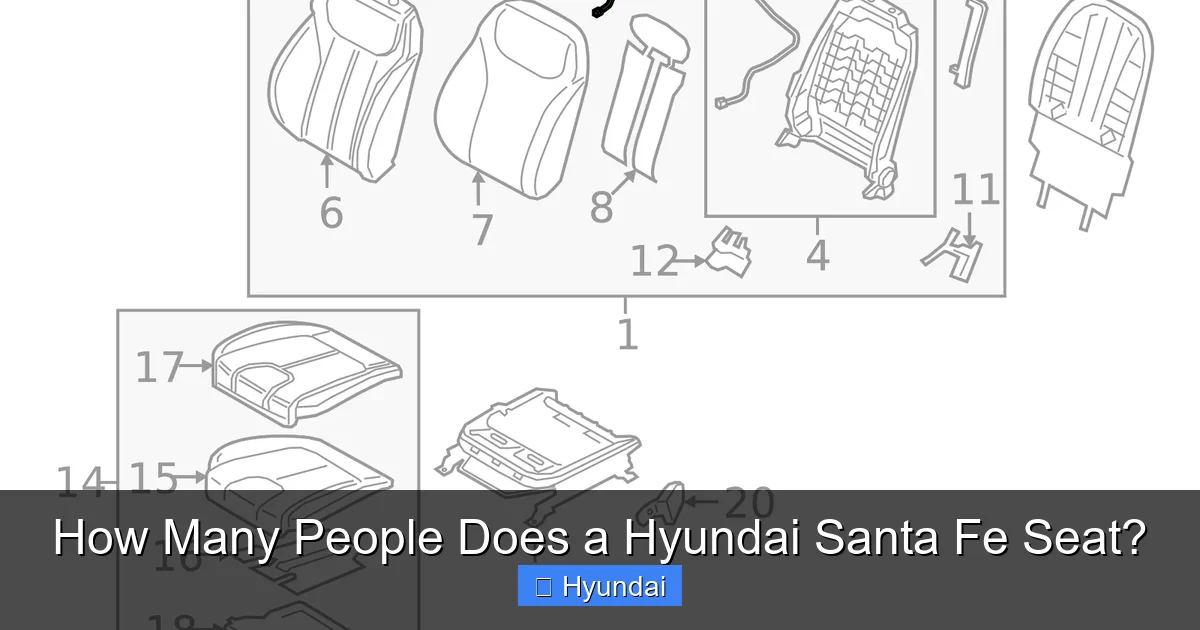
Visual guide about How Many People Does a Hyundai Santa Fe Seat?
Image source: cdn-illustrations.revolutionparts.io
SE, SEL, and SEL Plus: The Five-Seater Stronghold
The entry-level SE, the popular mid-grade SEL, and the feature-enhanced SEL Plus trims are exclusively five-seaters. Hyundai dedicates these trims to maximizing the experience for five people. You get the full, flat cargo floor, the most rear legroom, and the simplest, most robust interior. If you know you’ll never regularly need more than five seats, targeting one of these trims is smart. You avoid the cost and complexity of the third-row mechanism, and you get a vehicle that’s optimized for your primary use case. For these models, the answer to our key question is a firm and consistent five.
Limited and Calligraphy: The Seven-Seater Flagships
The story changes when you look at the range-topping Limited and Calligraphy trims. These are the models where Hyundai makes the third-row seating available, often as a no-cost option when paired with the more powerful 2.5T engine. On these trims, you must specifically choose the “7-passenger” seating option at the time of order. If you select the five-passenger layout on a Limited or Calligraphy, you get the same spacious, flat-floor cargo area as the lower trims. This choice gives you ultimate flexibility: you can have a luxurious, spacious five-seater or a seven-seater with all the premium features (like heated and ventilated seats, premium audio, and advanced safety tech) for the extra passengers. It’s a package of convenience and capability, but you must actively select it.
The Third-Row Experience: A Detailed Look
So, you’ve chosen a Limited or Calligraphy with the third-row option. Now what? Let’s get into the nitty-gritty of what climbing into that back row is really like. This section is all about managing expectations and providing practical advice.
Visual guide about How Many People Does a Hyundai Santa Fe Seat?
Image source: laxmihyundai.com
Access and Ease of Use
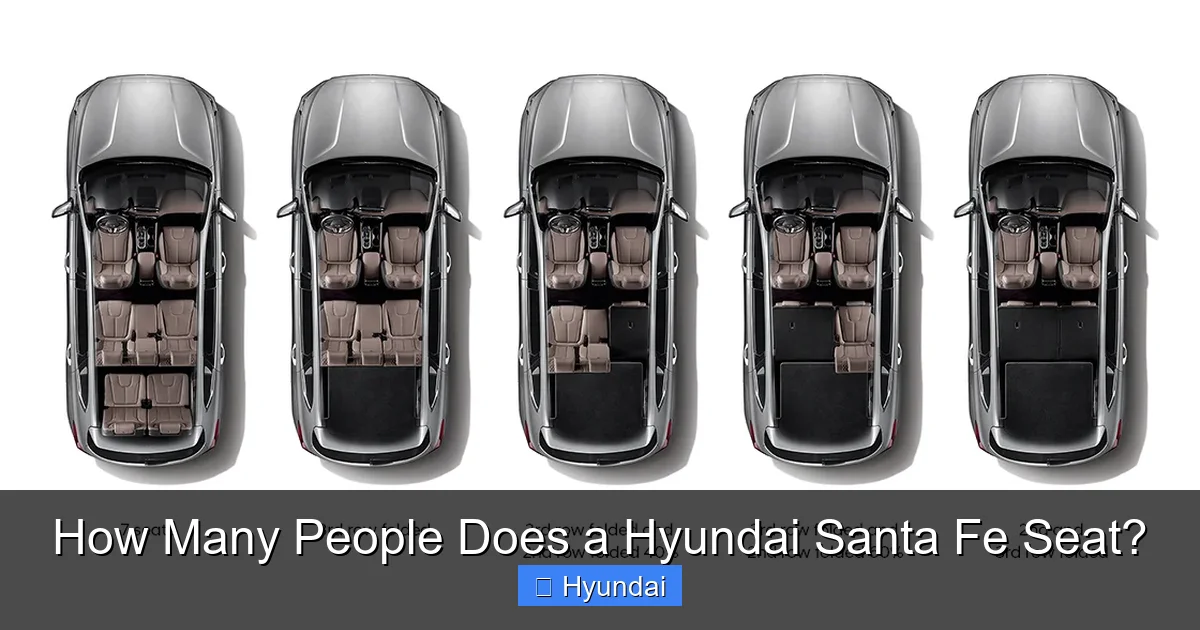
Getting to the third row is a one-touch operation. A lever or button on the second-row seatback releases and tips the entire seat forward, creating a decent-sized pathway. The mechanism is smooth and requires minimal effort, which is important for parents managing kids and gear. However, the movement of the second-row seat does eat into its own legroom when stowed, so if you frequently have second-row passengers *and* third-row passengers, you’ll need to negotiate space. The second-row captain’s chairs (available on some trims) can make access slightly easier than a bench seat, as you only need to fold one seat. It’s a well-thought-out system for its class, but it’s not as effortless as the wide, tall doors and flat floors of a minivan.
Space and Comfort Metrics
We can talk in feelings, but measurements are more objective. The third row typically offers about 25-26 inches of headroom and a mere 33-35 inches of legroom (with the second-row seat adjusted for a typical adult). For comparison, the second row often has over 38 inches of legroom. This means the average adult will be knees-up, with limited recline. The seat cushion itself is thin and placed low to the ground, which can feel like sitting on a low stool. Shoulder and hip room are also tight, making it best for two children or one adult on a shorter journey. The key takeaway is to use this row for kids or as emergency seating for adults. It does the job it’s designed for, but it’s not a living room on wheels back there.
Child Seats and Booster Seat Realities
This is where the third row shines for many families. Installing a booster seat or a high-back booster is relatively straightforward, as the seat is at a good height relative to the belt path. However, installing a rear-facing convertible car seat is a challenge. The low seat position and limited space mean you’ll likely have to move the second-row seats all the way forward, sacrificing second-row comfort. Furthermore, once a large convertible is installed, there may be no room for a passenger in the third row at all. For families with multiple young children in car seats, the five-seat model is almost always the better choice, as the second row offers vastly more space for three-across car seat installations. Always bring your specific car seats to the dealership to test fit before buying a seven-seater Santa Fe if this is your primary use case.
Cargo Space: The Inevitable Trade-Off
You cannot add seats without losing cargo room. This is the fundamental law of automotive physics, and it’s especially true for the Santa Fe. The choice between passengers and cargo is a daily reality for seven-seater owners.
Visual guide about How Many People Does a Hyundai Santa Fe Seat?
Image source: vehq.com
Behind the Third Row: Grocery Run or Suitcase?
With all seats upright, the Santa Fe’s cargo volume behind the third row is modest. You’re looking at roughly 10-13 cubic feet, depending on the exact model year and trim. This is enough for a few grocery bags, a couple of small suitcases, or a stroller. It’s not “road trip for seven” territory. If you regularly need to carry seven people *and* their luggage, you will be creatively packing or using a rooftop carrier. For the daily school run with a few backpacks, it’s perfectly adequate. This limited space is the primary reason many families who occasionally need a third seat still opt for the five-seat model—they prioritize having a usable cargo area every day over the rare need for two extra seats.
Folding the Third Row: Maximum Capacity
The third-row seats fold flat into the floor, a feature that is absolutely essential for a versatile SUV. When folded, you reclaim a significant amount of cargo space, bringing the total capacity closer to that of the five-seat model (around 35-40 cubic feet behind the second row). The folding process is manual but straightforward, involving a simple lever or pull strap. The seats don’t disappear completely magically; there is a slight step up into the cargo area, but it’s a minor inconvenience. This flexibility is the Santa Fe’s superpower. One day it’s a seven-seater for a soccer team, the next it’s a cargo van for a trip to the hardware store. This ability to transform is what makes the optional third row a compelling feature for the right buyer.
Safety and Comfort Features for All Rows
A vehicle’s seating capacity is only as good as the safety and comfort it provides to every occupant. Hyundai doesn’t neglect this in the Santa Fe, regardless of which row your passengers are in.
Comprehensive Airbag and LATCH Coverage
The Santa Fe comes standard with a full suite of airbags, including front, side-impact, and curtain airbags that run the length of the cabin, offering vital protection for third-row passengers in a collision. For child safety, the LATCH (Lower Anchors and Tethers for Children) system is excellent in the second row, with multiple easy-to-access positions. The third row, however, typically has LATCH anchors only for the outboard positions, and sometimes only a top tether for the center. This is common in vehicles with compact third rows and means you’ll likely be using the vehicle’s seat belts to install car seats back there. Always verify the exact LATCH configuration for your specific model year on the NHTSA website or with your dealer.
Climate Control and Rear-Seat Amenities
Higher trims offer dual- or tri-zone automatic climate control, which is a godsend for keeping the third row comfortable on hot days. The rear vents are strategically placed to blow air toward the back seats. Additionally, many Santa Fes come with rear-seat USB charging ports, a feature that keeps devices powered and backseat occupants happy. Some models even offer rear-seat entertainment system options. These features directly enhance the livability of the third row, making it more tolerable for older kids and teens on longer drives. When evaluating a Santa Fe, check which rear comfort features are standard on your chosen trim.
How the Santa Fe Stacks Up Against Competitors
The midsize three-row SUV segment is crowded. How does the Santa Fe’s seating proposition compare? It’s a story of balance versus specialization.
Vs. The Dodge Journey: A Study in Contrasts
The Dodge Journey is another American offering that provides three-row seating in a similar footprint. However, the Journey is an older, value-oriented model with a much more basic interior and less advanced safety features. The Santa Fe’s third row is similarly sized, but the Santa Fe’s overall interior quality, noise insulation, and technology are significantly superior. If raw, affordable passenger space is your only goal, the Journey might look tempting. But for a safer, more comfortable, and more modern experience for all seven passengers, the Santa Fe is the clear winner. You can learn more about the Journey’s specific capacity in our detailed comparison of how many seats does a Dodge Journey have.
Vs. The Nissan Rogue: Efficiency vs. Space
The Nissan Rogue is a top seller and a direct competitor. Interestingly, the current generation Rogue is a strict five-seater. It has no third-row option, choosing instead to maximize space and comfort for five people and their cargo. This makes the Santa Fe unique—it offers a pathway to seven seats where the Rogue cannot. The trade-off is that the Rogue’s five-seat cabin is arguably more spacious and versatile for its primary mission. For families who know they will never need more than five seats, the Rogue’s focused design is excellent. For those who want the *option* of more, the Santa Fe provides that flexibility. When considering a family road trip with a full load, you might also compare the fuel efficiency of these loaded SUVs; you can see how the Rogue performs in our guide on how many MPG does a Nissan Rogue get.
Vs. The Hyundai Palisade: The Big Brother
You cannot discuss the Santa Fe’s seating without mentioning its corporate cousin, the Hyundai Palisade. The Palisade is Hyundai’s dedicated three-row SUV, built on a longer wheelbase. Its third row is genuinely usable for adults, with more legroom and headroom. If your need for seven seats is frequent and involves adults, the Palisade is the superior choice. The Santa Fe’s third row is an “option” on a vehicle not primarily designed for it; the Palisade’s third row is a “core feature” of its design. The Santa Fe’s advantage is its slightly smaller, more maneuverable size and potentially lower price point when comparing similarly equipped models. It’s the difference between a minivan substitute (Palisade) and a versatile midsize SUV with an occasional extra seat (Santa Fe).
Practical Tips for Choosing Your Santa Fe Seating
Now that you have all the facts, how do you decide? Here is your actionable checklist.
- Do a Real-World Test: Never buy a seven-seater without bringing your family and your car seats to the dealership. Install them, have people sit in the third row, and load some cargo. Feel the compromise.
- Think 3-5 Years Ahead: Your kids will grow. That third row that’s perfect for 8-year-olds will be cramped for 13-year-olds. Project your family’s size and needs.
- Prioritize Your Most Common Trip: Is it a daily school run with 2 kids and gear? Or a weekly carpool with 6 kids? Optimize for the 80% use case. The five-seater is better for the former; the seven-seater for the latter.
- Consider Protection: If you opt for the seven-seater with frequent third-row use, especially by kids, invest in durable, easy-to-clean seat covers. Check out our recommendations for the best seat covers for Hyundai Santa Fe to keep your interior looking new.
- Engine and Package Linkage: Remember, the third-row option is often tied to the more powerful 2.5-liter turbocharged engine. Be prepared for the associated price increase and potential change in fuel economy.
Frequently Asked Questions
Does every Hyundai Santa Fe come with a third-row seat?
No. The third-row seat is an optional feature available only on the Limited and Calligraphy trims, and typically only when paired with the 2.5T engine. The SE, SEL, and SEL Plus trims are strictly five-seaters.
Can I fit three child car seats across the second row?
Yes, the Santa Fe’s second row is wide enough to accommodate three child car seats or boosters in most cases, making it an excellent choice for families with young children. This is one of its key advantages over many competitors.
How much cargo space is left with all seven seats in use?
With all seats upright, cargo space is very limited, typically around 10-13 cubic feet. This is enough for a few small bags or a stroller but not for full luggage for a seven-person trip. You would need to use a rooftop carrier or pack very lightly.
What’s the main difference between the Santa Fe and Palisade for seating?
The Hyundai Palisade has a larger, more comfortable third row designed for regular adult use, thanks to its longer body. The Santa Fe’s third row is an option on a vehicle primarily designed for five, so it’s more compact and best for children or occasional adult use.
Can adults comfortably ride in the third row for a long trip?
For most adults, the Santa Fe’s third row is not comfortable for long-distance travel due to its low seat height and limited legroom. It’s perfectly acceptable for trips of an hour or two, but for cross-country journeys, adults will likely feel cramped and prefer to rotate with second-row passengers.
Does adding the third-row seat affect towing capacity?
Yes. The maximum towing capacity for the Santa Fe is generally higher when the vehicle is configured for five passengers (as it has a lower base weight). With seven passengers and their gear, the available payload for towing is reduced. Always check your specific model’s manual for precise ratings based on your configuration.