How Many O2 Sensors Does a 2012 Nissan Altima Have?

Contents
- 1 Key Takeaways
- 2 📑 Table of Contents
- 3 Understanding Oxygen Sensors: What They Do and Why They Matter
- 4 How Many O2 Sensors Does a 2012 Nissan Altima Have?
- 5 Location of O2 Sensors in the 2012 Nissan Altima
- 6 Function of Upstream vs. Downstream O2 Sensors
- 7 Common Symptoms of a Failing O2 Sensor
- 8 Replacing O2 Sensors in a 2012 Nissan Altima
- 9 Maintenance Tips to Extend O2 Sensor Life
- 10 Conclusion
- 11 Frequently Asked Questions


The 2012 Nissan Altima typically has four oxygen (O2) sensors—two upstream and two downstream—ensuring optimal fuel efficiency and emissions control. These sensors monitor exhaust gases before and after the catalytic converter, helping your engine run smoothly and pass emissions tests.
If you own a 2012 Nissan Altima—or you’re thinking about buying one—you’ve probably wondered about the inner workings of its engine system. One of the most important yet often overlooked components is the oxygen (O2) sensor. These small but mighty devices play a huge role in keeping your car running efficiently, reducing harmful emissions, and helping you pass that dreaded smog check. But how many O2 sensors does a 2012 Nissan Altima actually have?
The short answer? Four. But there’s a lot more to it than just a number. Understanding where these sensors are located, what they do, and why they matter can save you time, money, and frustration down the road. Whether you’re a DIY mechanic, a first-time car owner, or just curious about how your Altima works, this guide will walk you through everything you need to know about the O2 sensors in your 2012 Nissan Altima.
From explaining the difference between upstream and downstream sensors to diagnosing common problems and offering practical replacement tips, we’ll cover it all. So buckle up—let’s dive into the world of oxygen sensors and discover why they’re such a big deal for your Altima’s performance and longevity.
Key Takeaways
- Total O2 Sensors: The 2012 Nissan Altima is equipped with four oxygen sensors—two upstream (before the catalytic converter) and two downstream (after the catalytic converter).
- Engine Configuration Matters: Both the 2.5L 4-cylinder and 3.5L V6 engines in the 2012 Altima use the same four-sensor setup, ensuring consistent emissions monitoring.
- Upstream Sensors Control Fuel Mix: The front O2 sensors (Bank 1 and Bank 2 Sensor 1) measure oxygen in the exhaust to help the engine computer adjust the air-fuel ratio in real time.
- Downstream Sensors Monitor Catalytic Converter: The rear O2 sensors (Bank 1 and Bank 2 Sensor 2) check if the catalytic converter is working properly by comparing exhaust levels before and after treatment.
- Location Varies by Engine Layout: On the V6 model, sensors are split between two exhaust manifolds (banks), while the 4-cylinder uses a single bank with two sensors.
- Faulty Sensors Trigger Check Engine Light: A failing O2 sensor often causes poor fuel economy, rough idling, or failed emissions tests—prompt diagnosis is key.
- Replacement Tips: Use OEM or high-quality aftermarket sensors and ensure proper installation to avoid error codes and performance issues.
📑 Table of Contents
- Understanding Oxygen Sensors: What They Do and Why They Matter
- How Many O2 Sensors Does a 2012 Nissan Altima Have?
- Location of O2 Sensors in the 2012 Nissan Altima
- Function of Upstream vs. Downstream O2 Sensors
- Common Symptoms of a Failing O2 Sensor
- Replacing O2 Sensors in a 2012 Nissan Altima
- Maintenance Tips to Extend O2 Sensor Life
- Conclusion
Understanding Oxygen Sensors: What They Do and Why They Matter
Before we get into the specifics of the 2012 Nissan Altima, let’s take a step back and talk about what oxygen sensors actually do. Think of them as the “ears and eyes” of your engine’s computer system. They constantly monitor the amount of oxygen in your car’s exhaust gases and send that information to the engine control unit (ECU). Based on this data, the ECU adjusts the air-fuel mixture to ensure your engine runs as efficiently as possible.
Why is this important? Because the ideal air-fuel ratio for combustion is about 14.7 parts air to 1 part fuel—known as the stoichiometric ratio. If there’s too much oxygen (a lean mixture), your engine might run hot and lose power. If there’s too little oxygen (a rich mixture), you’ll waste fuel, increase emissions, and possibly damage your catalytic converter over time.
O2 sensors are typically made of zirconium dioxide or titanium dioxide and are mounted directly into the exhaust system. They generate a small voltage signal based on the oxygen content in the exhaust. A high voltage (around 0.8–0.9 volts) indicates a rich mixture, while a low voltage (around 0.1–0.3 volts) suggests a lean mixture. The ECU uses these signals to make real-time adjustments, keeping your engine in the sweet spot.
In modern vehicles like the 2012 Nissan Altima, multiple O2 sensors are used to monitor different parts of the exhaust system. This allows for more precise control and helps detect issues with emissions components like the catalytic converter. Without functioning O2 sensors, your car would struggle to maintain fuel efficiency, produce higher emissions, and likely trigger the check engine light.
How Many O2 Sensors Does a 2012 Nissan Altima Have?
Visual guide about How Many O2 Sensors Does a 2012 Nissan Altima Have?
Image source: lh3.googleusercontent.com
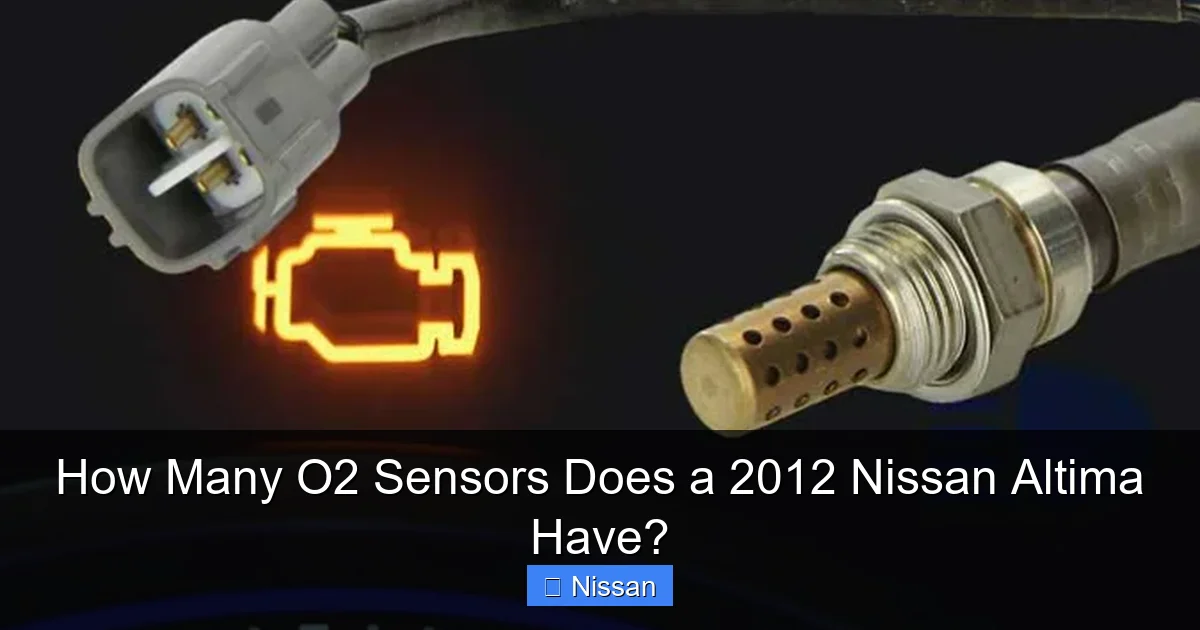
Now, let’s get to the heart of the question: how many O2 sensors does a 2012 Nissan Altima have? The answer is four. Yes, you read that right—four oxygen sensors in total. This setup is consistent across both engine options available in the 2012 model year: the 2.5L inline-4 (QR25DE) and the 3.5L V6 (VQ35DE).
But why four? It all comes down to the vehicle’s exhaust system design and emissions requirements. The 2012 Altima uses a dual-sensor configuration per exhaust bank: one upstream (before the catalytic converter) and one downstream (after the catalytic converter). Since the V6 engine has two exhaust manifolds (or “banks”), it requires two upstream and two downstream sensors. The 4-cylinder engine, while only having one bank, still uses two upstream and two downstream sensors due to the way the exhaust manifold and catalytic converter are configured.
Let’s break it down:
– **Bank 1 Sensor 1 (Upstream):** Located before the catalytic converter on the side of the engine with cylinder #1. On the 4-cylinder, this is the only bank. On the V6, it’s the left side (driver’s side in the U.S.).
– **Bank 1 Sensor 2 (Downstream):** Located after the catalytic converter, monitoring the efficiency of the emissions treatment.
– **Bank 2 Sensor 1 (Upstream):** Only present on the V6 model, this sensor is on the right side (passenger side) of the engine, before the second catalytic converter.
– **Bank 2 Sensor 2 (Downstream):** Also V6-only, this sensor sits after the second catalytic converter.
Even though the 4-cylinder engine doesn’t have a “Bank 2,” it still uses two upstream and two downstream sensors because the exhaust system is designed to monitor both the primary and secondary catalytic converters. This ensures accurate feedback for emissions control and helps the vehicle meet strict environmental standards.
Location of O2 Sensors in the 2012 Nissan Altima
Visual guide about How Many O2 Sensors Does a 2012 Nissan Altima Have?
Image source: guidemechanic.com
Knowing how many O2 sensors your Altima has is one thing—finding them is another. The location of these sensors varies slightly depending on whether you have the 4-cylinder or V6 engine, but the general principles remain the same.
2.5L 4-Cylinder Engine (QR25DE)
On the 2.5L inline-4 engine, you’ll find:
– **Bank 1 Sensor 1 (Upstream):** Mounted on the exhaust manifold, just before the first catalytic converter. It’s usually accessible from underneath the vehicle, near the front of the engine. You’ll need to crawl under the car and look for a sensor with a wiring harness connected to it, threaded into the exhaust pipe.
– **Bank 1 Sensor 2 (Downstream):** Located after the main catalytic converter, further back in the exhaust system. This sensor is often harder to reach and may require lifting the vehicle or removing heat shields for access.
Even though this engine only has one bank, it still uses two downstream sensors because the catalytic converter system is split into two stages. The second downstream sensor monitors the efficiency of the secondary catalytic converter, ensuring that emissions are being properly treated.
3.5L V6 Engine (VQ35DE)
The V6 engine adds complexity due to its dual exhaust banks. Here’s where you’ll find the sensors:
– **Bank 1 Sensor 1 (Upstream):** On the driver’s side (left side) of the engine, mounted on the exhaust manifold before the first catalytic converter.
– **Bank 2 Sensor 1 (Upstream):** On the passenger’s side (right side), similarly positioned on the second exhaust manifold.
– **Bank 1 Sensor 2 (Downstream):** After the driver’s side catalytic converter.
– **Bank 2 Sensor 2 (Downstream):** After the passenger’s side catalytic converter.
Because the V6 has two separate exhaust manifolds and two catalytic converters, it requires four sensors to monitor both sides independently. This allows the ECU to detect imbalances between the two banks and make precise adjustments.
Tips for Locating O2 Sensors
If you’re planning to inspect or replace an O2 sensor, here are a few practical tips:
– **Use a flashlight and mirror:** Some sensors are tucked away behind heat shields or near the firewall. A mirror can help you see into tight spaces.
– **Look for the wiring harness:** Each sensor has a distinctive electrical connector. Follow the wire from the sensor back to the harness to confirm you’ve found the right one.
– **Lift the vehicle safely:** Use jack stands or a hydraulic lift to access sensors underneath the car. Never rely solely on a jack.
– **Consult a repair manual:** Nissan’s factory service manual or aftermarket guides like Haynes or Chilton provide detailed diagrams and torque specifications.
Function of Upstream vs. Downstream O2 Sensors

Visual guide about How Many O2 Sensors Does a 2012 Nissan Altima Have?
Image source: i.ytimg.com
Not all O2 sensors are created equal. While they all measure oxygen levels, their roles in the engine management system are quite different. Understanding the difference between upstream and downstream sensors is key to diagnosing issues and maintaining your Altima’s performance.
Upstream O2 Sensors (Sensor 1)
The upstream sensors—also known as Sensor 1—are located before the catalytic converter. Their primary job is to monitor the oxygen content in the exhaust gases right after they leave the engine. This information is used by the ECU to adjust the air-fuel mixture in real time.
For example, if the upstream sensor detects a lean mixture (too much oxygen), the ECU will inject more fuel to compensate. If it detects a rich mixture (too little oxygen), it will reduce fuel delivery. This constant feedback loop ensures optimal combustion, better fuel economy, and lower emissions.
In the 2012 Altima, both the 4-cylinder and V6 engines use upstream sensors on each bank. On the V6, this means two upstream sensors working in tandem to provide balanced data from both sides of the engine.
Downstream O2 Sensors (Sensor 2)
The downstream sensors—Sensor 2—are positioned after the catalytic converter. Their main purpose is to monitor the efficiency of the catalytic converter. By comparing the oxygen levels before and after the converter, the ECU can determine whether the converter is effectively reducing harmful emissions.
A properly functioning catalytic converter should “clean” the exhaust, reducing oxygen fluctuations. So, if the downstream sensor shows similar voltage patterns to the upstream sensor, it’s a sign that the converter isn’t working properly. This triggers a diagnostic trouble code (DTC), such as P0420 or P0430, indicating catalytic converter inefficiency.
In the 2012 Altima, the downstream sensors also help the vehicle meet OBD-II (On-Board Diagnostics II) requirements. These regulations mandate that vehicles monitor emissions components and alert the driver if something goes wrong.
Why Both Are Important
Having both upstream and downstream sensors allows the ECU to:
– Maintain the correct air-fuel ratio for performance and efficiency.
– Detect malfunctions in the fuel system, ignition system, or exhaust components.
– Ensure the catalytic converter is working as intended.
– Pass emissions inspections and avoid fines or registration issues.
Without functioning O2 sensors, your Altima could experience reduced fuel economy, increased emissions, rough idling, hesitation during acceleration, and even engine damage over time.
Common Symptoms of a Failing O2 Sensor
Even though O2 sensors are built to last, they don’t last forever. Over time, they can become contaminated with oil, coolant, or fuel additives, or simply wear out due to heat and exposure to exhaust gases. When an O2 sensor starts to fail, it can cause a range of problems that affect your driving experience.
Here are the most common signs that one or more O2 sensors in your 2012 Nissan Altima may be going bad:
1. Check Engine Light Is On
This is the most obvious symptom. The check engine light (CEL) will illuminate when the ECU detects an issue with the O2 sensor or its circuit. Common trouble codes include:
– P0130–P0135: Issues with Bank 1 Sensor 1
– P0150–P0155: Issues with Bank 2 Sensor 1 (V6 only)
– P0136–P0138: Problems with Bank 1 Sensor 2
– P0156–P0158: Problems with Bank 2 Sensor 2 (V6 only)
– P0420/P0430: Catalytic converter efficiency below threshold
If you see any of these codes, it’s time to investigate the O2 sensors.
2. Poor Fuel Economy
A faulty upstream O2 sensor can cause the engine to run rich (too much fuel) or lean (too little fuel). Either way, your fuel economy will suffer. You might notice that you’re filling up more often than usual, even if your driving habits haven’t changed.
3. Rough Idling or Engine Misfires
If the ECU can’t accurately adjust the air-fuel mixture, the engine may idle roughly, hesitate, or even misfire. This is especially noticeable when the car is cold or under light load.
4. Failed Emissions Test
Since O2 sensors are critical for emissions control, a failing sensor will likely cause your Altima to fail a smog check. High levels of hydrocarbons (HC) or carbon monoxide (CO) in the exhaust are common indicators.
5. Rotten Egg Smell
A sulfur-like or “rotten egg” odor from the exhaust can indicate a clogged or failing catalytic converter, often caused by a malfunctioning O2 sensor that allowed the engine to run too rich for too long.
6. Reduced Engine Performance
You might notice a lack of power, especially during acceleration. This happens when the engine isn’t getting the right fuel mixture, leading to inefficient combustion.
Diagnosing the Problem
If you suspect an O2 sensor issue, start by scanning for trouble codes using an OBD-II scanner. This will tell you which sensor is affected. From there, you can inspect the sensor, its wiring, and the exhaust system for damage or contamination.
Keep in mind that not all check engine lights are caused by O2 sensors. Other issues—like a loose gas cap, faulty mass airflow sensor, or bad spark plugs—can also trigger similar symptoms. Always verify the root cause before replacing parts.
Replacing O2 Sensors in a 2012 Nissan Altima
If you’ve confirmed that one or more O2 sensors need replacement, the good news is that it’s a job many DIYers can handle with the right tools and preparation. However, it’s not always a quick fix—especially if the sensor is seized or hard to reach.
Tools You’ll Need
– OBD-II scanner (to clear codes after replacement)
– O2 sensor socket (typically 7/8” or 22mm)
– Ratchet and extension
– Penetrating oil (like PB Blaster)
– Jack and jack stands (for under-car access)
– Safety glasses and gloves
– Wire brush (to clean threads)
Step-by-Step Replacement Guide
1. **Locate the faulty sensor:** Use your OBD-II scanner to identify which sensor is causing the issue. Refer to the locations we discussed earlier.
2. **Disconnect the battery:** For safety, disconnect the negative terminal of the battery to prevent electrical shorts.
3. **Spray penetrating oil:** Apply penetrating oil to the sensor threads and let it sit for 15–30 minutes. This helps loosen rust and corrosion.
4. **Disconnect the electrical connector:** Unplug the sensor’s wiring harness. Some connectors have a locking tab that needs to be pressed.
5. **Remove the sensor:** Use the O2 sensor socket and ratchet to carefully unscrew the sensor. Turn counterclockwise. If it’s stuck, apply more penetrating oil and gently work it back and forth.
6. **Install the new sensor:** Thread the new sensor in by hand first to avoid cross-threading. Then tighten it to the manufacturer’s torque specification (usually around 30–50 ft-lbs).
7. **Reconnect the wiring:** Plug in the electrical connector and secure any loose wires.
8. **Reconnect the battery and clear codes:** Reconnect the battery and use your OBD-II scanner to clear the trouble codes.
9. **Test drive:** Take your Altima for a short drive to ensure the check engine light stays off and the engine runs smoothly.
Tips for Success
– **Use OEM or high-quality aftermarket sensors:** Cheap sensors may fail prematurely or give inaccurate readings.
– **Don’t overtighten:** Over-tightening can damage the threads or the sensor itself.
– **Replace in pairs (if needed):** If one upstream sensor is bad, consider replacing the other, especially on high-mileage vehicles.
– **Check the catalytic converter:** If you’re replacing downstream sensors frequently, have the catalytic converter inspected—it may be failing.
Maintenance Tips to Extend O2 Sensor Life
While O2 sensors will eventually wear out, you can take steps to prolong their life and keep your Altima running smoothly.
– **Use quality fuel:** Low-quality or contaminated fuel can leave deposits on the sensor, reducing its effectiveness.
– **Fix engine problems promptly:** Oil leaks, coolant leaks, or rich-running conditions can damage O2 sensors quickly.
– **Avoid short trips:** Frequent cold starts prevent the sensor from reaching operating temperature, leading to faster wear.
– **Replace spark plugs and air filters on schedule:** A well-maintained engine produces cleaner exhaust, reducing sensor contamination.
– **Inspect wiring:** Damaged or corroded wiring can cause false readings or sensor failure.
Conclusion
So, how many O2 sensors does a 2012 Nissan Altima have? The answer is four—two upstream and two downstream—regardless of whether you have the 2.5L 4-cylinder or the 3.5L V6 engine. These sensors are essential for maintaining fuel efficiency, reducing emissions, and ensuring your engine runs smoothly.
Understanding their locations, functions, and common failure symptoms can help you diagnose issues early and avoid costly repairs down the line. Whether you’re replacing a sensor yourself or taking your Altima to a mechanic, knowing what to look for makes all the difference.
Remember, O2 sensors are small components with a big impact. By keeping them in good working order, you’re not just protecting your engine—you’re also doing your part for the environment and keeping your car road-legal for years to come.
Frequently Asked Questions
How many O2 sensors does a 2012 Nissan Altima 2.5L have?
The 2012 Nissan Altima with the 2.5L 4-cylinder engine has four O2 sensors: two upstream (before the catalytic converter) and two downstream (after the catalytic converter). Even though it has only one engine bank, it uses multiple sensors to monitor emissions effectively.
Where are the O2 sensors located on a 2012 Nissan Altima V6?
On the 3.5L V6 engine, there are two upstream sensors—one on each exhaust manifold (driver and passenger sides)—and two downstream sensors, one after each catalytic converter. They are accessible from underneath the vehicle, though some may require removing heat shields.
Can I drive my 2012 Altima with a bad O2 sensor?
Yes, you can drive with a faulty O2 sensor, but it’s not recommended. It can lead to poor fuel economy, increased emissions, rough idling, and potential damage to the catalytic converter. It’s best to replace it as soon as possible.
How often should O2 sensors be replaced in a Nissan Altima?
O2 sensors typically last between 60,000 and 100,000 miles. However, they can fail earlier due to contamination or engine issues. If you notice symptoms like poor fuel economy or a check engine light, have them inspected.
What happens if I don’t replace a bad O2 sensor?
Ignoring a bad O2 sensor can lead to reduced fuel efficiency, higher emissions, engine performance issues, and eventual catalytic converter failure—which is much more expensive to repair than the sensor itself.
Are all O2 sensors the same on a 2012 Nissan Altima?
No, upstream and downstream sensors are not interchangeable. They have different designs and functions. Always use the correct sensor for the specific location (Bank 1 Sensor 1, Bank 1 Sensor 2, etc.) to ensure proper operation.