
How Many Miles per Gallon Does a 2025 Toyota Sequoia Hybrid Get

The 2025 Toyota Sequoia Hybrid delivers an impressive EPA-estimated 22 mpg combined (21 city / 24 highway), a significant leap from its non-hybrid predecessor. This full-size SUV achieves its excellent miles per gallon through a sophisticated hybrid powertrain, offering substantial fuel savings without sacrificing capability. Real-world results may vary, but owners can expect a substantial range from its 22.5-gallon tank, making it a leader in efficiency for its class.
Key Takeaways
- Understanding How Many Miles Per Gallon Does a 2025 Toyota Sequoia Hybrid Get: Provides essential knowledge
📑 Table of Contents
- Introduction: The New Benchmark for Full-Size SUV Efficiency
- Under the Hood: The Powertrain That Makes the MPG Possible
- Official EPA Ratings vs. Real-World Miles Per Gallon
- Head-to-Head: How the Sequoia Hybrid’s MPG Stacks Up
- The Ownership Equation: Cost, Range, and Practicality
- Maximizing Your 2025 Sequoia Hybrid MPG: Practical Tips
- Conclusion: The New Reality of Full-Size SUV Ownership
Introduction: The New Benchmark for Full-Size SUV Efficiency
If you’re in the market for a massive, three-row SUV that can haul a family, a trailer, and still be somewhat gentle on your wallet at the pump, the 2025 Toyota Sequoia Hybrid is your answer. For years, the full-size SUV segment was a domain of thirsty V8 engines where double-digit city miles per gallon was considered acceptable. Toyota has completely rewritten that rulebook. The 2025 Sequoia Hybrid isn’t just an add-on; it’s a ground-up redesign that places a twin-turbo V6 hybrid powertrain at its heart, fundamentally changing the conversation around capability and efficiency.
So, how many miles per gallon does a 2025 Toyota Sequoia Hybrid get? The official numbers are outstanding for a vehicle of this size and capability. But the real story is deeper. It’s about understanding what those numbers mean in daily life, how they compare to the old Sequoia and its rivals, and what you can do to eke out every last drop of fuel. This article will dive deep into the fuel economy of the 2025 Sequoia Hybrid, separating the EPA sticker from the real-world experience and giving you the complete picture.
Under the Hood: The Powertrain That Makes the MPG Possible
The i-FORCE MAX Hybrid System Explained
To understand the miles per gallon figures, you must first understand the engineering. Toyota has ditched the old 5.7-liter V8 for the all-new i-FORCE MAX hybrid system. This is not a mild hybrid; it’s a full hybrid system similar to what you’d find in a Toyota RAV4 Hybrid or Prius, but scaled up for a 6,000-pound-plus vehicle.
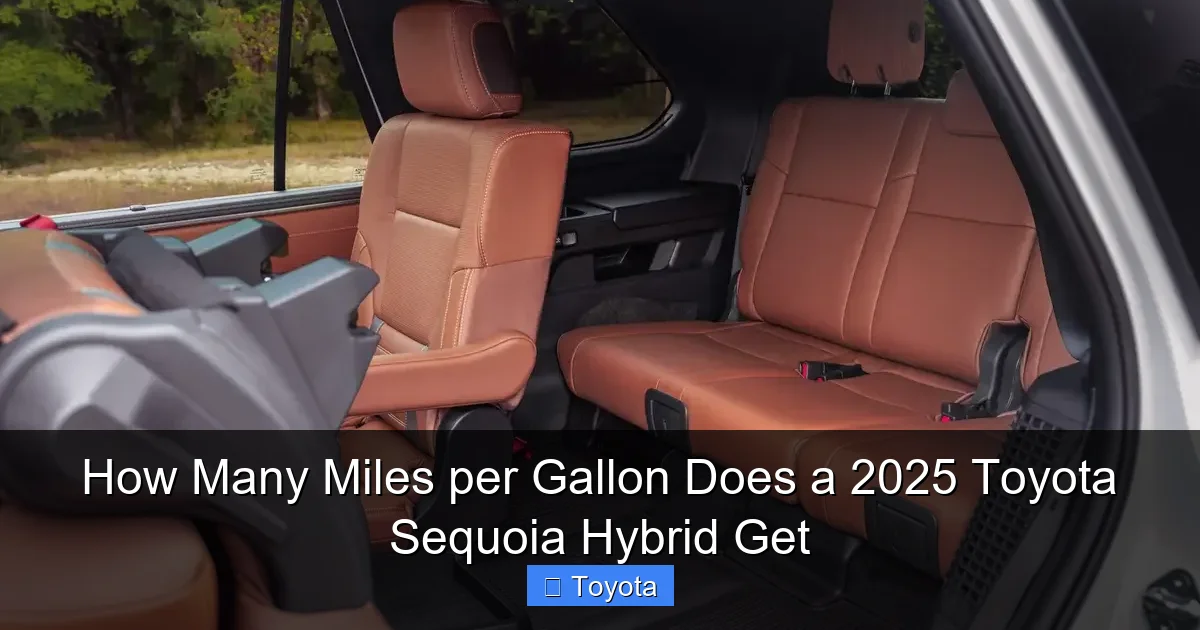
Visual guide about How Many Miles per Gallon Does a 2025 Toyota Sequoia Hybrid Get
Image source: images.cars.com
The system centers on a 3.4-liter twin-turbo V6 gasoline engine. This engine alone produces a healthy 354 horsepower and 400 lb.-ft. of torque. But it’s paired with a powerful electric motor/generator (MG2) that’s integrated into the 10-speed automatic transmission. This motor adds an additional 83 horsepower and 150 lb.-ft. of torque. The combined system output is a stout 437 horsepower and 590 lb.-ft. of torque—more power and vastly more torque than the old V8.
How the Hybrid System Saves Fuel
The magic of the MPG boost happens in several ways:
- Electric-Only Driving: At low speeds and light loads (like in a parking lot or stop-and-go traffic), the Sequoia can drive on electric power alone from its 1.87 kWh nickel-metal hydride battery, using zero gasoline.
- Engine Start-Stop Perfection: The engine shuts off completely at red lights and in traffic, restarting seamlessly and instantly when needed, thanks to the motor.
- Regenerative Braking: Every time you brake or coast, energy is captured and fed back into the battery, reducing the need for the engine to run just to recharge it.
- Optimal Engine Loading: The system constantly works to keep the V6 engine in its most efficient RPM range. The transmission and motor manage the load so the engine isn’t struggling, which is a common fuel-waster in large, non-hybrid vehicles.
- Atkinson Cycle Operation: The gasoline engine uses the Atkinson cycle during light load conditions, which improves thermal efficiency and reduces fuel consumption.
This sophisticated dance between gasoline and electric power is why a vehicle weighing over 6,000 pounds can achieve 22 mpg combined. For comparison, you can look at how other Toyotas leverage hybrid tech; the efficiency gains in the Sequoia are on a similar principle but a much larger scale as seen in the Toyota Venza’s hybrid system, just applied to a far heavier platform.
Official EPA Ratings vs. Real-World Miles Per Gallon
Decoding the EPA Sticker
The official EPA estimates for the 2025 Toyota Sequoia Hybrid are:

Visual guide about How Many Miles per Gallon Does a 2025 Toyota Sequoia Hybrid Get
Image source: img.sm360.ca
- City: 21 mpg
- Highway: 24 mpg
- Combined: 22 mpg
These numbers are determined through a standardized laboratory test procedure. For a full-size, body-on-frame SUV with 4WD capability, these are genuinely revolutionary figures. The previous 2022 Sequoia with its V8 managed just 15 mpg combined. This isn’t an incremental improvement; it’s a paradigm shift.
What Real Owners Are Seeing
While the EPA provides a baseline, real-world miles per gallon is a personal number. It depends on your right foot, your commute, your climate, and how much stuff (and people) you carry. Early owner reports and professional reviews suggest a realistic range:
- Mixed Driving (Typical Suburban/Family Use): Most owners report between 19 and 23 mpg. This is the most common scenario and aligns closely with the combined rating.
- Heavy City/Stop-and-Go Traffic: Here, the hybrid system shines. The electric motor does more work, and you can see 22-25 mpg in aggressive urban environments, sometimes even exceeding the EPA city rating.
- Steady Highway Cruising (70-75 mph): At constant high speeds, the aerodynamics of a large box become the primary enemy. Expect 21-23 mpg. The 24 mpg highway rating is achievable at more modest speeds (65 mph).
- Mountainous or Hilly Terrain: Climbing grades taxes the system. MPG can drop into the 17-20 mpg range, though regenerative braking on descents helps recapture some energy.
- Full Load + Towing: This is the biggest drain. Towing a 6,000-8,000 lb. trailer can reduce fuel economy to 14-18 mpg, depending on trailer aerodynamics and terrain. However, this is still markedly better than any gasoline-only competitor would achieve under the same load.
Pro Tip: The Sequoia Hybrid’s trip computer is generally accurate. Use it to track your personal miles per gallon over several tanks to get your true baseline. Factors like tire pressure (keep them at the recommended 35 PSI), using the correct oil (0W-20), and minimizing weight can push your numbers toward the higher end of the spectrum.
Head-to-Head: How the Sequoia Hybrid’s MPG Stacks Up
Vs. The Old Toyota Sequoia
The comparison is almost not fair. The 2022 Sequoia with its 5.7L V8 was rated at a dismal 13 mpg city / 17 mpg highway / 15 mpg combined. The 2025 Hybrid’s 22 mpg combined is a 46% improvement. For the average driver covering 12,000 miles a year, that’s a savings of roughly 500-600 gallons of gasoline, translating to over $2,000 in fuel costs (at $4.00/gal). This is the single greatest argument for the hybrid model.

Visual guide about How Many Miles per Gallon Does a 2025 Toyota Sequoia Hybrid Get
Image source: img.sm360.ca
Vs. Key Competitors (Full-Size SUVs)
The full-size SUV segment is notoriously inefficient. Let’s see how the Sequoia Hybrid compares to its closest rivals in terms of miles per gallon:
- Chevrolet Tahoe/Suburban (5.3L V8): 15-16 mpg combined. The Sequoia Hybrid beats this by 6-7 mpg.
- Ford Expedition (3.5L Twin-Turbo V6): 17-18 mpg combined. The Sequoia Hybrid outperforms it by 4-5 mpg.
- Nissan Armada (5.6L V8): A paltry 14 mpg combined. The Toyota is in a different league.
- GMC Yukon XL (6.2L V8): 14 mpg combined. Again, a massive gap.
The only direct competitor with a hybrid option is the Chevrolet Tahoe/Suburban Hybrid (discontinued after 2023), which achieved 20-21 mpg combined. The Sequoia Hybrid edges it out. There is no current hybrid version of the Ford Expedition or Nissan Armada. This makes the Sequoia Hybrid a unique offering: a full-size, body-on-frame, high-towing-capability SUV with class-leading fuel economy.
Vs. Other Toyota Hybrids
How does it compare within Toyota’s own family? The Sequoia Hybrid’s 22 mpg combined is lower than smaller, more aerodynamic crossovers like the Toyota Venza (40 mpg combined) or the RAV4 Hybrid (40 mpg combined). This is expected due to the Sequoia’s size, weight, and boxier shape. However, its efficiency is remarkable for its class and size. For context, the Toyota Highlander Hybrid, a smaller 3-row crossover, gets 36 mpg combined. The Sequoia Hybrid’s mission is different: maximum space and towing with the best possible MPG in the truck-based segment.
The Ownership Equation: Cost, Range, and Practicality
Fuel Costs and Tank Range
The Sequoia Hybrid has a large 22.5-gallon fuel tank. Using the EPA combined rating of 22 mpg, that gives a theoretical range of 495 miles. On the highway (24 mpg), that stretches to an impressive 540 miles. This means fewer stops on long family road trips compared to many of its competitors with smaller tanks and worse MPG. For perspective, a Ford Expedition might need a fuel stop every 350-400 miles.
Let’s calculate annual fuel costs. Assuming 12,000 miles per year, the national average gas price of $3.50/gallon, and the combined MPG:
- Sequoia Hybrid (22 mpg): 12,000 / 22 = 545 gallons. Cost: ~$1,908.
- Ford Expedition (17 mpg): 12,000 / 17 = 706 gallons. Cost: ~$2,471.
- Chevrolet Tahoe (15 mpg): 12,000 / 15 = 800 gallons. Cost: ~$2,800.
The Sequoia Hybrid owner saves over $500-$900 per year compared to its closest V8-powered rivals. Over five years of ownership, that’s $2,500-$4,500 back in your pocket, not to mention the reduced carbon footprint.
Maintenance and Long-Term Considerations
A common question is: “Does the hybrid system add complexity and cost?” Toyota’s hybrid systems are renowned for their reliability, with millions on the road for over 20 years. The Sequoia Hybrid’s powertrain is warrantied for 5 years/60,000 miles (or 8 years/100,000 miles for the hybrid battery in some states). There is no traditional transmission service needed for the e-CVT. Maintenance is similar to a conventional vehicle: regular oil changes (every 10,000 miles with synthetic), tire rotations, and brake inspections. However, regenerative brakes mean brake pad wear is significantly reduced, potentially lasting 100,000+ miles. The hybrid battery is designed to last the life of the vehicle. For more on Toyota hybrid battery longevity, resources like the one on Camry hybrid battery costs provide insight into the durability and eventual replacement scenarios, though such replacements for the Sequoia are a very long-term prospect.
Maximizing Your 2025 Sequoia Hybrid MPG: Practical Tips
The beauty of a hybrid is that your driving habits directly influence your miles per gallon. Here’s how to optimize:
1. Drive with “Eco” in Mind
Use the Sequoia’s selectable drive modes. The “Eco” mode softens throttle response, optimizes the air conditioning, and encourages the most efficient use of the hybrid system. It’s perfect for daily commuting. “Normal” mode offers a good balance, while “Sport” mode holds gears longer for more responsive power—use it when needed, but know it will reduce MPG.
2. Master the Regenerative Braking
Get familiar with the steering wheel-mounted paddle shifters that adjust the level of regenerative braking. Using a higher regen setting (like “B” mode) when you know you’re approaching a stop or descending a long hill captures more energy, feeds the battery, and reduces friction brake wear. This is one of the most effective ways to boost city MPG.
3. Plan Your Trips and Reduce Weight
The Sequoia is a heavy vehicle. Every extra 100 pounds reduces MPG by about 1-2%. Remove unnecessary cargo from the vehicle. Combine errands to reduce cold-start trips, which are less efficient. A warm engine and hybrid battery operate more efficiently.
4. Maintain Proper Tire Pressure
Under-inflated tires increase rolling resistance, killing fuel economy. Check your tire pressure monthly and keep them inflated to the door jamb placard recommendation (typically 35 PSI for the Sequoia). Consider low-rolling-resistance tires when it’s time for replacements.
5. Use Cruise Control on Flat Highways
On long, flat stretches, cruise control helps maintain a steady speed, which is optimal for fuel economy. However, on hilly terrain, manual control can sometimes be more efficient as you can use momentum and regen on descents.
6. Be Mindful of A/C Use
The air conditioning compressor is powered by the engine (or battery in some modes). At low speeds, using the “Eco” A/C setting or max vent with fan can be sufficient. On the highway, the aerodynamic penalty of open windows can outweigh A/C use, so use the climate system as needed.
Conclusion: The New Reality of Full-Size SUV Ownership
So, how many miles per gallon does a 2025 Toyota Sequoia Hybrid get? The official EPA answer is a class-leading 22 mpg combined. The real-world answer is a range, typically 19-23 mpg for most drivers, with the potential for higher numbers in city traffic and lower numbers when heavily loaded or towing. What is undeniable is the transformation. Toyota has taken a segment synonymous with fuel guzzling and injected it with genuine efficiency.
The 2025 Sequoia Hybrid proves you no longer need to choose between a spacious, powerful, tow-ready family hauler and reasonable fuel costs. Its hybrid powertrain delivers more power, more torque, and dramatically better miles per gallon than the V8 it replaced. When you factor in the long range from its large tank, the significant annual savings at the pump, and Toyota’s reputation for hybrid reliability, the MPG story becomes a central part of the Sequoia Hybrid’s value proposition. It sets a new benchmark that competitors will struggle to match for years to come. For the modern family that needs serious space and capability without wanting to constantly watch the fuel gauge, the 2025 Toyota Sequoia Hybrid isn’t just a good choice—it’s the only rational choice in its category.
Frequently Asked Questions
Does the 2025 Toyota Sequoia Hybrid require premium gasoline?
No. The Sequoia Hybrid is designed to run on regular unleaded gasoline (87 octane). Using premium fuel will not improve its miles per gallon or performance and is not recommended by Toyota.
How much does towing affect the Sequoia Hybrid’s MPG?
Towing significantly increases fuel consumption. While exact numbers depend on trailer weight and aerodynamics, expect a drop of 4-8 mpg when towing near the maximum 9,500-lb capacity. However, its hybrid MPG while towing will still likely exceed the non-hybrid ratings of its competitors when they are similarly loaded.
Is the hybrid battery going to be expensive to replace in the long run?
Toyota’s hybrid batteries are among the most reliable in the industry, often lasting 150,000-200,000+ miles. The Sequoia Hybrid’s battery is warrantied for 8 years/100,000 miles in California and other ZEV states. While eventual replacement is a long-term cost, the reliability record suggests it’s a rare event, and costs have decreased over time as hybrid technology matures.
Does cold weather reduce the Sequoia Hybrid’s fuel economy?
Yes, cold weather reduces the miles per gallon of any vehicle, hybrids included. The engine runs longer to warm up, cabin heating demands more energy, and cold air is denser. You can expect a 10-25% drop in MPG during very cold winters. Using the seat heaters instead of the cabin heater and allowing the vehicle to warm up briefly before driving can help mitigate this.
Can I drive the Sequoia Hybrid in EV mode?
The Sequoia Hybrid has an EV mode button, but it’s very limited. It allows for short distances (under 1 mile) at very low speeds (under 5 mph) in a parking lot or driveway. It cannot sustain electric-only driving at normal road speeds or under acceleration. The system automatically uses the electric motor as much as possible, but you cannot manually select a dedicated EV mode for normal driving like in some plug-in hybrids.
How does the Sequoia Hybrid’s MPG compare to a non-hybrid Highlander’s fuel tank capacity?
The Sequoia Hybrid has a 22.5-gallon tank, while a non-hybrid Toyota Highlander has a 17.1-gallon tank. Even though the Highlander gets better MPG (around 22-23 mpg combined for the V6), the Sequoia Hybrid’s superior MPG combined with its much larger tank gives it a significantly longer total driving range—often over 500 miles versus the Highlander’s ~390 miles. This is a key practical advantage for long-distance family travel. You can learn more about the Highlander’s fuel tank capacity for direct comparison.
