
How Many Miles Is Too Much for a Used Toyota Tacoma?

For a used Toyota Tacoma, mileage over 200,000 miles can be too much if not well-maintained, but many last beyond 300,000 with proper care. Always check the vehicle’s history and condition alongside mileage. A lower-mileage truck isn’t always better if it lacks documentation.
You’re scrolling through used truck listings, and the Toyota Tacoma keeps popping up. It’s the go-to compact truck for a reason—reliable, capable, and holds value like few others. But then you see the odometers: 180,000 miles, 220,000 miles, even 250,000 miles. How many miles is too much for a used Toyota Tacoma? It’s a critical question that can mean the difference between a trustworthy workhorse and a costly mistake. Let’s break it down honestly, without the fluff.
First, let’s squash a myth: there’s no universal “too many miles” number for a Tacoma. These trucks are famously tough. I’ve seen Tacomas with 300,000+ miles still on the road, chugging along thanks to obsessive care. Conversely, I’ve seen 120,000-mile examples already on their last legs due to neglect. Mileage is just a number; it’s the story behind that number that tells the real tale. In this guide, we’ll explore what makes a high-mileage Tacoma a gem or a grenade, and how to spot the difference.
Key Takeaways
- Mileage Threshold: While Toyotas are durable, over 200,000 miles on a Tacoma warrants extreme caution unless comprehensive maintenance records exist.
- Maintenance is Key: A well-maintained high-mileage Tacoma can outperform a neglected low-mileage one; always check service history.
- Inspection Essential: Regardless of mileage, a pre-purchase mechanical inspection by a trusted mechanic is non-negotiable.
- Cost vs. Value: High-mileage trucks may have lower upfront costs but higher long-term repair expenses; budget accordingly.
- Usage Matters: Highway miles are less taxing than city or off-road use; ask about the truck’s typical driving conditions.
- Model Year Differences: Newer Tacomas (2016+) have improved features but older models (2005-2015) are simpler and may be cheaper to repair.
📑 Table of Contents
The Toyota Tacoma: A Legend of Reliability
Since 1995, the Tacoma has ruled the midsize truck segment. Its reputation isn’t hype—it’s built on decades of proven performance. From job sites to off-road trails, Tacomas just seem to keep going. This legendary reliability is why used Tacomas often cost more than rivals with similar years and conditions. But what exactly fuels this reputation?
Why the Tacoma Holds Its Value
Tacomas depreciate at a snail’s pace. A 2010 Tacoma might still fetch 60% of its original value, while a comparable Ford Ranger or Chevrolet Colorado could be worth half as much. Why? Because they rarely die. The powertrains—especially the 2.7L 4-cylinder and 3.5L V6—are engineered for longevity. Parts are plentiful and many are shared across Toyota’s lineup, keeping repair costs reasonable. This resilience means that even a used Tacoma with 200,000 miles can be a solid investment if it’s been cared for.
To understand this, look at other Toyota models. The 2015 Toyota Rav4, for instance, is another longevity champion. Its value retention mirrors the Tacoma’s, showing that Toyota’s build quality isn’t limited to trucks. When you buy a high-mileage Tacoma, you’re buying into a brand known for outlasting the competition.
Common Myths About Tacoma Longevity
Myth #1: All Tacomas can hit 500,000 miles. While some do, this is rare. Most will need major overhauls—like timing belts or transmissions—between 200,000 and 300,000 miles. Myth #2: Manuals are always more reliable than automatics. In early Tacomas (1995-2004), manuals were simpler, but later automatics (especially the 5-speed in 2005-2015 4-cylinders) have known issues. Always research the specific generation. Myth #3: Low mileage equals good condition. A Tacoma that’s sat unused for years can have dry seals, battery issues, and tire rot, while a high-mileage daily driver with regular service might be in better shape.
Decoding Mileage: What’s Too Much?
So, what’s the magic cutoff? Industry-wide, 100,000 miles is a psychological barrier, but for a Tacoma, it’s just getting started. Most experts agree that 200,000 miles is the point where you should start sweating, but even that isn’t a deal-breaker. It’s about context.
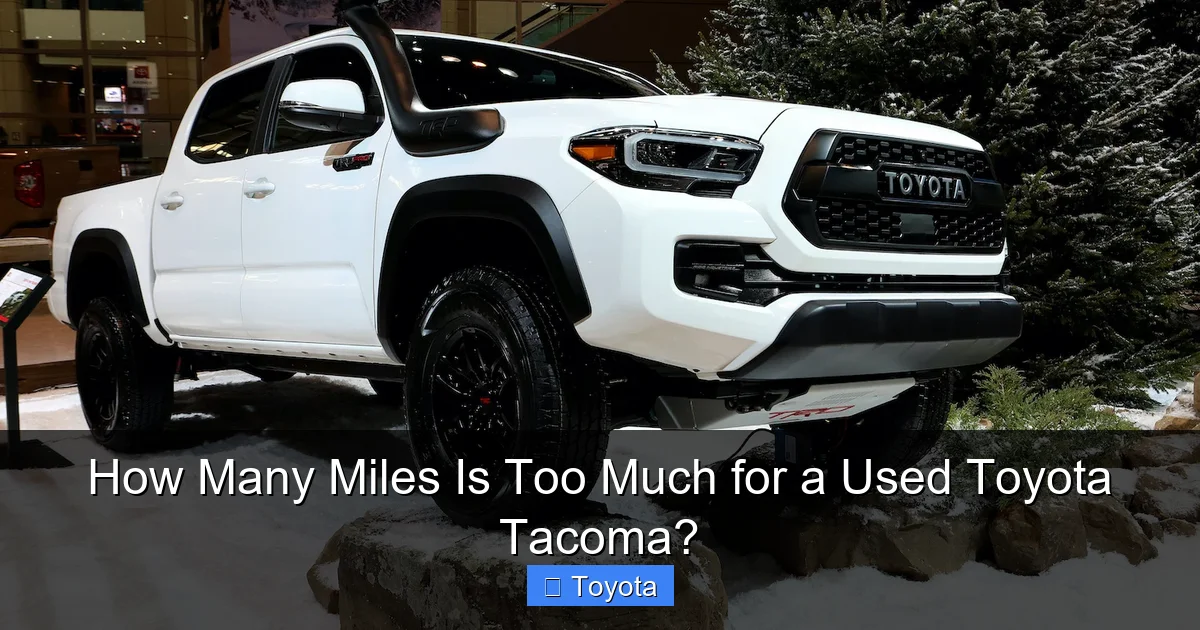
Visual guide about How Many Miles Is Too Much for a Used Toyota Tacoma?
Image source: motorbiscuit.com
Industry Standards for High Mileage
For average passenger cars, 150,000-200,000 miles is considered high. But trucks like the Tacoma are built heavier-duty. A 2012 Tacoma with 180,000 miles isn’t necessarily on death’s door if it’s a highway-driven, regularly serviced model. Beyond 250,000 miles, you’re venturing into territory where major components—engine, transmission, transfer case—are likely to need attention soon. However, with the soaring prices of new trucks, many buyers are intentionally seeking 200,000+ mile Tacomas, banking on their durability to save thousands upfront.
Real-World Tacoma Mileage Examples
Let’s look at actual listings. A 2008 Tacoma with 220,000 miles might list for $8,000, while a 2019 with 60,000 miles asks $28,000. The price gap is massive, but the older truck could have a decade of life left if it’s been maintained. On owner forums, you’ll find stories of 300,000-mile Tacomas still daily-driven, but these are often enthusiast-owned with meticulous records. Compare this to other Toyotas: the Toyota Avalon routinely hits 300,000+ miles, proving that Toyota’s engineering excellence extends beyond trucks. This means high mileage on a Tacoma shouldn’t scare you off automatically—it’s about the truck’s story.
Beyond the Odometer: Key Factors to Consider
Mileage is a starting point, not the final verdict. To truly judge a used Tacoma, you need to dig into its history and usage. Here are the non-negotiable factors that can make a high-mileage truck a smart buy or a sinkhole.

Visual guide about How Many Miles Is Too Much for a Used Toyota Tacoma?
Image source: fourwheeltrends.com
Service History and Documentation
A complete service record is worth more than a low odometer. Look for consistent oil changes, transmission fluid swaps, and timing belt replacements (on 2005-2015 4-cylinders). The Toyota Tacoma’s oil capacity varies by engine, but regular changes are critical for engine longevity. If the seller has folders of receipts from a reputable shop, that’s a huge green flag. No records? Walk away. A 200,000-mile Tacoma with documented maintenance is often a better bet than a 120,000-mile one with a blank history.
Driving Conditions: Highway vs. City vs. Off-Road
Not all miles are equal. Highway miles are gentle—steady speeds, less brake wear. City miles are brutal: constant stop-and-go strains transmissions and brakes. Off-road use, common with Tacomas, punishes suspension and drivetrains. A Tacoma with 150,000 highway miles might be in better shape than one with 80,000 mixed city and off-road miles. Ask the seller: “What was the primary use?” If they say “mostly highway,” that’s a plus. If they say “I used it for rock crawling,” inspect the undercarriage carefully.
Previous Ownership and Usage Patterns
Single-owner trucks are gold. You can track care habits over time. Multiple owners might indicate neglect or hidden problems. Also, consider if the Tacoma was used for towing or hauling heavy loads. Frequent heavy use accelerates wear on clutches, transmissions, and axles. Check for rust—especially in snowy regions—as frame corrosion can be a structural nightmare. A quick walk-around with a magnet (to check for bondo) and a flashlight under the truck can reveal secrets.
Inspecting a High-Mileage Tacoma: A Buyer’s Guide
You’ve vetted the history; now it’s inspection time. Even with 200,000+ miles, a thorough check can confirm a truck’s health or expose hidden issues. Don’t skip this step.
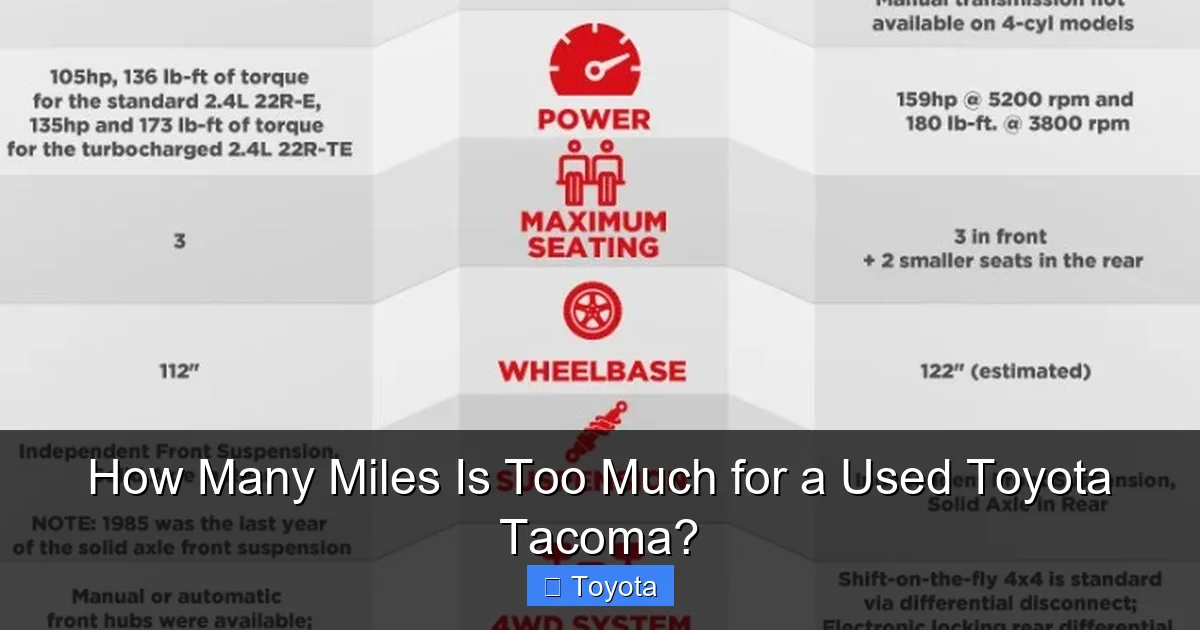
Visual guide about How Many Miles Is Too Much for a Used Toyota Tacoma?
Image source: s1.cdn.autoevolution.com
Critical Components to Check
Start with the engine. Look for leaks, listen for ticks or knocks. Check the transmission fluid—it should be clean and red, not burnt or low. On 2005-2015 4-cylinders, verify if the timing belt was replaced (typically every 90,000-120,000 miles). If it’s original at 180,000 miles, budget for immediate replacement. Inspect the suspension: worn bushings, leaking shocks, and rusted bolts are red flags. Rust on the frame or cab mounts is a deal-breaker—it compromises safety and is costly to repair.
Test Driving Tips for High-Mileage Trucks
During the test drive, feel for smooth shifts. Automatics should shift firmly without slipping; manuals shouldn’t grind. Accelerate hard and brake firmly—watch for vibrations, noises, or pulling. Listen for differential whine or wheel bearing hum. Engage 4WD (if equipped) on a slippery surface; it should engage without grinding. Check all accessories: windows, locks, HVAC, and infotainment. Electrical gremlins can be expensive to fix.
Using Vehicle History Reports
Always run a Carfax or AutoCheck. Look for title issues, accidents, and odometer rollbacks. For Tacomas, pay attention to recalls: the 2005-2015 frame rust recall and 2016-2023 transmission software updates are common. A clean report doesn’t guarantee perfection, but a flagged history is a warning. Cross-reference the report with the seller’s story—discrepancies mean trouble.
The Real Costs of High Mileage: Repairs and Maintenance
Buying a high-mileage Tacoma saves money upfront, but you must budget for the long haul. Understanding common repair costs helps you avoid surprises and negotiate a fair price.
Common High-Mileage Issues for Tacomas
For 2005-2015 models with the 2.7L 4-cylinder, head gasket failures are notorious around 150,000-200,000 miles. The 3.5L V6 (2016+) is more reliable but can have fuel pump and variable valve timing issues. Automatic transmissions, especially the 5-speed in older 4-cylinders, often need rebuilds after 200,000 miles. Other frequent items: water pumps, radiators, and suspension bushings. Regular diagnostics can catch these early; a pre-purchase inspection at a shop (costing $150-$300) is cheap insurance. For reference, diagnostic test costs at Toyota vary but are worth it for peace of mind.
Routine maintenance is your friend. Knowing how much oil a Toyota Tacoma takes helps you budget for $50 oil changes, which prevent engine wear. Similarly, timing belts cost $500-$1,000 to replace but save you from a $5,000 engine rebuild.
Budgeting for Future Repairs
Set aside at least $1,000-$2,000 annually for a high-mileage Tacoma. Major services like timing belts ($600-$1,200) or transmission rebuilds ($3,000-$5,000) can hit hard. However, Tacoma parts are often shared with other Toyotas (like the Rav4), making them affordable and available. Factor these costs into your offer. If a Tacoma needs $2,000 in immediate repairs, subtract that from the asking price. A $10,000 truck with $2,000 in needed work is really a $12,000 truck.
Making the Right Choice: When High Mileage Might Be Okay
High mileage isn’t automatically bad. With the right research, a 250,000-mile Tacoma can be a steal. Here’s how to spot a winner and negotiate smartly.
The Well-Maintained High-Mileage Gem
Look for obsessive care: a pristine engine bay, original paint with no rust, and an interior that’s worn but not torn. Owners who keep every receipt and perform preventive maintenance are your best bet. These trucks often have had major components replaced already—timing belts, water pumps, clutch kits—so you’re getting a refreshed vehicle at a discount. For example, a Tacoma with 250,000 miles that just had a new timing belt, transmission service, and brakes might have another 100,000 trouble-free miles left. It’s like buying a truck with a reset clock.
Negotiating a Fair Price for High-Mileage Trucks
Use comparable sales to set a baseline. Check local listings for similar Tacomas by year, mileage, and trim. Resources like Kelley Blue Book help, but remember Tacomas hold value stubbornly. For high-mileage trucks, use needed repairs as leverage. “This needs a timing belt and new brakes—that’s $1,500 in work, so I’ll offer $X less.” Also, consider the truck’s specs: 4WD, TRD packages, and bed length affect price. A short bed might be cheaper than a long bed, depending on your needs. Don’t be afraid to walk away if the price doesn’t match the condition.
Ultimately, your risk tolerance matters. If you’re handy and can do basic maintenance, a high-mileage Tacoma is a cost-effective workhorse. If you want a worry-free daily driver, aim for under 150,000 miles with a solid history. But never ignore mileage entirely—it’s a vital piece of the puzzle, just not the whole picture.
Conclusion: The Toyota Tacoma’s legendary durability means “too many miles” is a personal call, not a fixed number. Focus on service records, inspection results, and intended use. A 200,000-mile Tacoma with receipts can outlast a 100,000-mile orphan. By prioritizing history over odometer readings, you can find a used Tacoma that serves you faithfully for years. Remember, it’s not about the miles—it’s about the miles left. Happy hunting!
Frequently Asked Questions
What is considered high mileage for a Toyota Tacoma?
High mileage for a Tacoma is generally over 200,000 miles. However, with excellent maintenance, many Tacomas remain reliable beyond this point. Always evaluate the truck’s overall condition and service history alongside the odometer reading.
Can a Toyota Tacoma last over 300,000 miles?
Yes, a Tacoma can last over 300,000 miles with proper care. Regular maintenance, timely repairs, and gentle driving are essential. Some owners report Tacomas reaching 400,000 miles, but this requires exceptional upkeep and a bit of luck.
Should I avoid buying a Tacoma with over 150,000 miles?
Not necessarily. A Tacoma with over 150,000 miles can be a great value if it has a detailed service history and has been well-maintained. Focus on documentation and mechanical inspection rather than just the mileage number.
What are the most common repairs for high-mileage Tacomas?
Common repairs include timing belt or chain replacement, water pump, transmission services, and suspension components. For 2005-2015 models with the 2.7L engine, watch for head gasket issues. Budgeting for these can prevent costly surprises down the road.
How can I verify the maintenance history of a used Tacoma?
Ask the seller for all service records and receipts. Use vehicle history reports like Carfax to see documented maintenance. A pre-purchase inspection by a certified mechanic is also crucial to uncover any neglect or hidden problems.
Is a lower-mileage Tacoma always a better choice?
No, a lower-mileage Tacoma isn’t automatically better. If it lacks maintenance records or has been sitting idle, it might develop issues like dry seals or battery problems. A higher-mileage truck with consistent care is often the smarter buy.