How Many Miles Does a Toyota Avalon Get on a Full Tank?

Contents
- 1 Key Takeaways
- 2 📑 Table of Contents
- 3 Introduction: The Comfortable Cruiser’s Secret Weapon
- 4 The Foundation: Fuel Tank Capacity and EPA Ratings
- 5 Crunching the Numbers: Theoretical Maximum Range
- 6 Real-World vs. EPA: Why Your Mileage Will Be Different
- 7 Practical Examples: What Real Drivers Are Getting
- 8 How to Maximize Your Avalon’s Range: Pro Tips
- 9 Comparison and Context: How Does the Avalon Stack Up?
- 10 Conclusion: Know Your Number
- 11 Frequently Asked Questions

Car Vacuum Cleaner (Portable)

Jack Stands

Car Mud Flaps (Universal)

Car Battery Charger
The Toyota Avalon, a full-size sedan known for comfort and reliability, typically offers a substantial driving range on a single tank. With a large fuel tank and efficient V6 engine, most model years can travel between 450 to over 600 miles before needing a refill, depending heavily on driving conditions and specific trim. Real-world range often varies from EPA estimates, making understanding your vehicle’s actual MPG key to planning long trips.
Key Takeaways
- Large Fuel Tank Capacity: The Avalon’s fuel tank is one of the largest in its class, usually holding between 15.8 and 18.5 gallons, which is the primary factor enabling its long range.
- EPA-Estimated MPG is a Baseline: EPA ratings (22-23 city / 32-33 highway MPG for recent models) provide a useful starting point, but real-world mileage is often lower, especially in heavy city traffic.
- Highway Driving Maximizes Range: Steady highway cruising at or near the speed limit can help you achieve or even exceed the EPA highway MPG figure, stretching your tank the farthest.
- Driving Habits Have a Major Impact: Aggressive acceleration, speeding, and frequent short trips with a cold engine can significantly reduce your miles per gallon and overall range.
- Vehicle Maintenance is Crucial: Proper tire inflation, regular oil changes, and a clean air filter are simple, effective ways to maintain optimal fuel efficiency and range.
- Model Year Matters: Newer Avalon models (2019+) have slightly more efficient powertrains and transmission tuning compared to older models, offering marginal MPG improvements.
- Calculate Your Personal Range: The most accurate way to know your Avalon’s range is to track your own average MPG over several tanks and multiply it by your tank’s actual usable capacity.
📑 Table of Contents
- Introduction: The Comfortable Cruiser’s Secret Weapon
- The Foundation: Fuel Tank Capacity and EPA Ratings
- Crunching the Numbers: Theoretical Maximum Range
- Real-World vs. EPA: Why Your Mileage Will Be Different
- Practical Examples: What Real Drivers Are Getting
- How to Maximize Your Avalon’s Range: Pro Tips
- Comparison and Context: How Does the Avalon Stack Up?
- Conclusion: Know Your Number
Introduction: The Comfortable Cruiser’s Secret Weapon
If you’ve ever been behind the wheel of a Toyota Avalon, you know it’s a special kind of car. It’s the kind of vehicle that swallows highway miles with the quiet grace of a luxury sedan, yet carries the bulletproof reliability and reasonable ownership costs of a Toyota. For families, commuters, and road-trippers alike, one question often bubbles up after the initial “how comfortable is it?” and “is it reliable?” That question is: “Just how far can I actually go on a single tank of gas?”
Understanding your Avalon’s fuel range isn’t just about avoiding gas stations; it’s about planning, budgeting, and truly getting to know your vehicle. It transforms a mundane chore like refueling into a predictable part of your journey. This guide will dive deep into the numbers, the variables, and the practical realities of the Toyota Avalon’s fuel tank range, giving you a clear, confident answer backed by data and real-world experience.
The Foundation: Fuel Tank Capacity and EPA Ratings
To calculate potential distance, we need two core pieces of information: how much fuel the tank holds, and how efficiently the engine uses that fuel. Let’s break down the hardware first.

Visual guide about How Many Miles Does a Toyota Avalon Get on a Full Tank?
Image source: motorbiscuit.com
How Many Gallons Does the Tank Hold?
The Toyota Avalon is not a small car, and it doesn’t have a small gas tank. Over its production run, the tank capacity has been consistently generous. For the most common model years on the road today (2013-2018 and 2019+), the capacity is as follows:
- 2013-2018 Avalon: 18.0 gallons (some sources cite 18.5 gallons for specific trims/years, but 18.0 is the standard).
- 2019-Present Avalon (including TRD and Hybrid): 15.8 gallons. The hybrid model also has a 15.8-gallon tank. The reduction in capacity for the newer generation is offset by slightly improved engine efficiency.
This is a significant amount of fuel. For comparison, a midsize sedan like the Toyota Camry holds about 15.8 gallons, while some compact cars might only hold 12-13 gallons. That extra 2-3 gallons in the older Avalons is a direct contributor to its exceptional highway range. You can find the exact capacity for your specific vehicle on the manufacturer’s sticker inside the fuel door or in your owner’s manual.
What Do the EPA MPG Numbers Mean?
The Environmental Protection Agency (EPA) puts every new vehicle through standardized tests to estimate its city and highway fuel economy. These are the numbers you see on the window sticker. For the Toyota Avalon, the estimates have been remarkably consistent:
- 2013-2018 Models (3.5L V6): 21 MPG city / 31 MPG highway / 25 MPG combined.
- 2019-Present Models (3.5L V6): 22 MPG city / 32 MPG highway / 26 MPG combined.
- 2019-Present Hybrid Model: 43 MPG city / 44 MPG highway / 44 MPG combined.
Important: The EPA explicitly states that these are estimates. “Your mileage may vary” isn’t just a legal disclaimer; it’s a fundamental truth. The combined number is a weighted average, but most drivers will see a number somewhere between their city and highway averages based on their personal driving mix.
Crunching the Numbers: Theoretical Maximum Range
Now for the fun part. Let’s do the simple math using the best-case scenario: the EPA highway number and a full tank. This gives us the absolute theoretical maximum range under ideal, controlled conditions.

Visual guide about How Many Miles Does a Toyota Avalon Get on a Full Tank?
Image source: autozonic.com
Calculating for the V6 Models
For a 2019+ Avalon V6 with a 15.8-gallon tank and an EPA highway rating of 32 MPG:
15.8 gallons x 32 MPG = 505.6 miles.
For a 2013-2018 Avalon V6 with an 18.0-gallon tank and an EPA highway rating of 31 MPG:
18.0 gallons x 31 MPG = 558 miles.
These are the headline-grabbing numbers. They represent a best-case, steady-state highway cruise at 65 mph on a flat, windless day with a perfectly tuned car. It’s a fantastic benchmark, but it’s not the daily reality for most.
Calculating for the Hybrid Model
The hybrid changes the game entirely. With a 15.8-gallon tank and an EPA rating of 44 MPG combined (and nearly identical city/highway), the math is straightforward:
15.8 gallons x 44 MPG = 695.2 miles.
This is an exceptional range, putting the Avalon Hybrid in a league with some plug-in hybrids for pure distance between fill-ups. The hybrid’s strength is its consistent efficiency in both city and highway driving, making its real-world range often much closer to the theoretical maximum than its V6 sibling.
Real-World vs. EPA: Why Your Mileage Will Be Different
This is the most critical section. If you’ve ever looked at your car’s trip computer and thought, “I’m not getting 32 MPG!”, you’re not alone. The gap between EPA estimates and real-world MPG can be 10-20% or more. Here’s what sips your fuel (and shrinks your range).
Visual guide about How Many Miles Does a Toyota Avalon Get on a Full Tank?
Image source: measuringstuff.com
The Highway Illusion
The EPA highway test is a specific, gentle cycle. It does not account for:
- Speed: Aerodynamic drag increases exponentially with speed. Driving 75 mph instead of 65 mph can reduce your MPG by 10-15% or more. That 505-mile theoretical range for a new Avalon could drop to 430 miles at sustained higher speeds.
- Terrain: Mountains and hills are the enemy of efficiency. Climbing grades forces your engine to work much harder, consuming more fuel. The descent helps with regenerative braking (in hybrids) but doesn’t fully offset the climb.
- Wind: A strong headwind is like driving uphill. A crosswind increases drag. Both will hurt your MPG.
The City Reality
City driving is where fuel economy plummets. Stop-and-go traffic means:
- Idling: You’re getting 0 MPG while stopped.
- Acceleration: Moving a heavy car from a stop uses a huge burst of fuel. The more stops, the more fuel burned.
- Short Trips: Your engine is least efficient when cold. A 5-mile trip to the store might only achieve 15-18 MPG because the engine never reaches its optimal operating temperature. If your driving is 80% city, your combined average could easily fall to 18-20 MPG in a V6 Avalon.
Other Key Variables
- Vehicle Load and Cargo: An extra 200 lbs of passengers and luggage reduces efficiency. A fully loaded Avalon on a family road trip will get fewer MPG than a solo driver.
- Tire Pressure: Under-inflated tires increase rolling resistance. A 5 PSI drop can reduce MPG by 2-3%. Check your tires monthly.
- Fuel Quality: Using regular 87-octane is fine and recommended for the Avalon. However, very low-quality fuel with poor detergents can lead to carbon buildup over time, slightly hurting efficiency.
- Climate Control: Running the A/C compressor puts a significant load on the engine, especially in city driving. In the winter, a cold engine takes longer to warm up, and cabin heating uses engine heat (free), but defrosters use the A/C compressor to dehumidify air.
Practical Examples: What Real Drivers Are Getting
Let’s translate this into tangible miles. Based on owner forums, long-term reviews, and our own calculations, here are realistic range estimates for a typical mixed driving scenario (about 60% highway, 40% city).
V6 Avalon (2013-2018)
- Realistic Average MPG: 20-24 MPG combined.
- Usable Fuel (18 gal tank): You’ll typically refill with about 16-17 gallons to avoid running the pump dry.
- Practical Range: 16.5 gallons x 22 MPG (a good average) = ~363 miles.
- Best-Case Scenario (Long Highway Cruise): On a dedicated highway trip with gentle driving, achieving 28-29 MPG is possible. 17 gallons x 28.5 MPG = ~485 miles.
V6 Avalon (2019-Present)
- Realistic Average MPG: 21-25 MPG combined.
- Usable Fuel (15.8 gal tank): ~15 gallons.
- Practical Range: 15 gallons x 23 MPG = ~345 miles.
- Best-Case Scenario: 15 gallons x 30 MPG = ~450 miles.
Avalon Hybrid
- Realistic Average MPG: 40-44 MPG combined. This model is far less sensitive to driving style. City MPG is almost as good as highway.
- Usable Fuel (15.8 gal tank): ~15 gallons.
- Practical Range: 15 gallons x 42 MPG = ~630 miles. This is a very achievable number for most owners.
- Best-Case Scenario: 15 gallons x 44 MPG = ~660 miles.
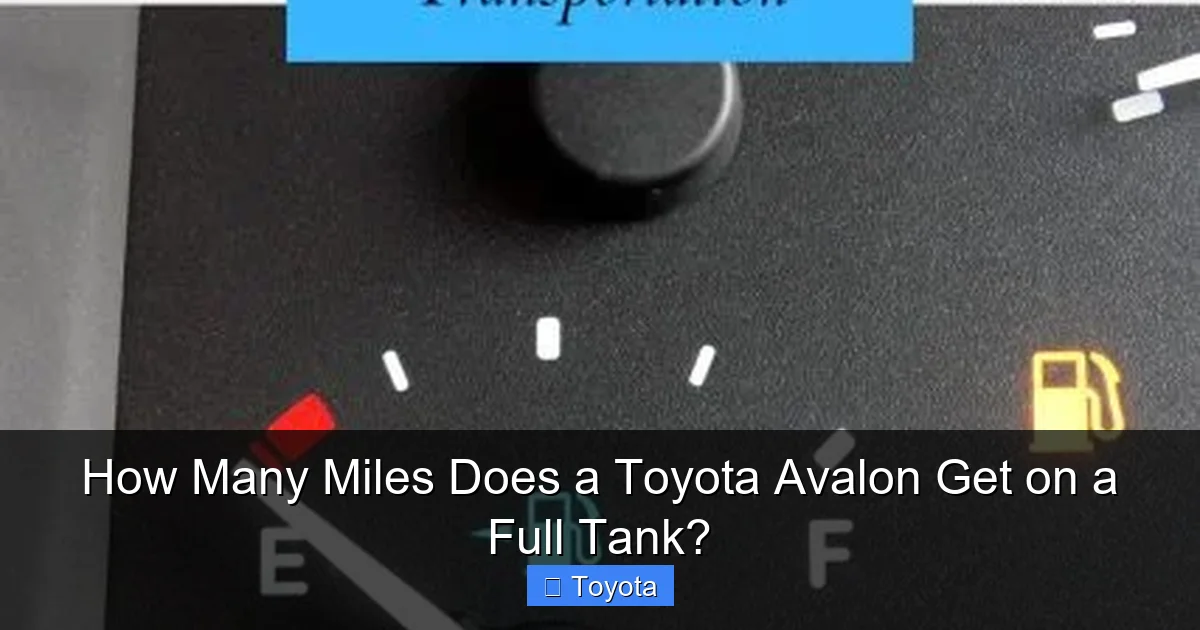
What About the Gas Light? Like most Toyotas, the Avalon’s low-fuel warning typically illuminates with about 2.5-3.0 gallons remaining. This is your “reserve.” Using the V6 practical average above, that’s an extra 60-75 miles after the light comes on. However, it’s best practice to treat the gas light as a “plan to refuel soon” signal, not a “you have an hour” signal, to avoid stressing the fuel pump and risking sediment ingestion.
How to Maximize Your Avalon’s Range: Pro Tips
You can’t change the tank size, but you can absolutely influence your MPG. Here’s how to squeeze every last mile from your fill-up.
Drive Like a Grandma (In a Good Way)
This is the #1 factor. Smooth, predictable driving is the holy grail of fuel economy.
- Accelerate Gradually: Pretend there’s an egg under your foot. It takes less fuel to gently move a heavy car than to launch it.
- Observe and Anticipate: Look far ahead at traffic lights and stop signs. Ease off the throttle early and let the car’s momentum carry you, minimizing braking.
- Use Cruise Control on Flat Highways: It maintains a constant speed, which is more efficient than the slight speed variations of your right foot. But turn it off in hilly terrain; letting the car slow slightly uphill and gain speed downhill is more efficient than the cruise control constantly throttling.
Maintenance is Non-Negotiable
- Tire Pressure: Check monthly. Inflate to the cold pressure listed on the driver’s door jamb sticker, not the max on the tire sidewall.
- Oil Changes: Use the recommended 0W-16 or 0W-20 oil (check manual). Fresh, correct-viscosity oil reduces internal engine friction.
- Air Filter: A clogged air filter makes the engine work harder to breathe. Replace it as per your maintenance schedule, or sooner if you drive in dusty conditions.
- Spark Plugs: Worn plugs cause misfires and poor combustion. Replace them on schedule (often 120k miles on modern Avalons, but verify).
Reduce Parasitic Drag
- Remove Roof Racks/Cargo Boxes: Even an empty roof rack creates significant wind resistance. Take it off when not in use.
- Keep Windows Closed at High Speed: At highway speeds, open windows create more drag than using the A/C. At low city speeds, open windows instead of A/C to save fuel.
- Lighten the Load: Clean out unnecessary items from the trunk. Every 100 lbs costs about 1-2% in MPG.
Comparison and Context: How Does the Avalon Stack Up?
The Avalon’s range is impressive, but context helps. How does it compare to other vehicles?
vs. Other Full-Size Sedans
In its class (full-size sedans), the Avalon is a range champion. Competitors like the Chrysler 300 (17-19 gallon tank, ~19-30 MPG) or the Nissan Maxima (18 gallon tank, ~20-30 MPG) have similar tank sizes but often slightly lower efficiency, resulting in comparable or slightly less real-world range. The Avalon consistently leads or ties in combined MPG ratings for V6 full-sizers. For a direct comparison with another popular Toyota, you might wonder how many gallons a Toyota Camry holds. The Camry’s tank is smaller (15.8 gal), and while its 4-cylinder models are more efficient, the V6 Camry’s range is very similar to the V6 Avalon due to the smaller tank, making the Avalon the clear winner for maximum distance between stops in the Toyota sedan lineup.
vs. SUVs and Crossovers
This is where the Avalon’s efficiency shines. A midsize SUV like a Toyota Venza (a hybrid crossover) might get excellent MPG (around 40) but has a smaller tank (~14 gallons), giving it a similar ~560-mile range. A larger, non-hybrid SUV like a Toyota Highlander (tank ~19.2 gal, MPG ~21-28) will have a comparable *theoretical* range but will almost always achieve lower real-world MPG than the Avalon due to its greater weight and less aerodynamic shape, meaning you’ll likely refuel more often. For a non-Toyota example, a Nissan Rogue has a 14.5-gallon tank and gets about 26-27 MPG combined, leading to a real-world range of ~350 miles—noticeably less than a well-driven V6 Avalon.
The Hybrid Difference
The Avalon Hybrid isn’t just a little more efficient; it’s in a completely different category. Its 40+ MPG real-world capability and 15.8-gallon tank give it a 600+ mile range that few gas-only vehicles can match. It essentially combines the range of a large sedan with the fuel bills of a compact car. For drivers who do a lot of highway miles, this is the ultimate “stop less, drive more” configuration.
Conclusion: Know Your Number
So, how many miles does a Toyota Avalon get on a full tank? The honest, useful answer is: it depends, but you can plan for 350-450 miles in typical mixed driving with the V6, and 600+ miles with the Hybrid. The theoretical 500+ mile high-water mark for older V6 models is achievable on long, solitary highway trips, but daily driving with traffic, errands, and A/C will pull that number down.
The most powerful tool in your arsenal is knowledge. Take the time to calculate your personal fuel economy. Reset your trip odometer at each fill-up, note the gallons added, and do the math. After 3-5 tanks, you’ll have a rock-solid average MPG that reflects your car, your roads, and your driving style. Multiply that by your tank’s usable capacity (about 15-17 gallons), and you have your true, reliable range. This simple habit turns guesswork into certainty, letting you plan cross-country trips with confidence and budget your monthly fuel costs with precision. The Toyota Avalon is a tool for the open road—understanding its range is key to using it to its fullest potential.
Frequently Asked Questions
How far can I drive after the gas light comes on in my Toyota Avalon?
Typically, you can expect to drive an additional 60 to 80 miles after the low-fuel warning light illuminates. This is based on an estimated 2.5-3.0 gallon reserve in the tank. However, this is a reserve for emergencies only. Consistently driving until empty can overheat the in-tank fuel pump and draw sediment from the bottom of the tank into your fuel system.
Does the Avalon Hybrid really get 600 miles on a tank?
Yes, absolutely. With its 44 MPG EPA rating and 15.8-gallon tank, the theoretical range is nearly 700 miles. In real-world mixed driving, achieving 600+ miles per fill-up is very common and realistic. Its efficiency is remarkably consistent, so its range is far more predictable than the V6 model’s.
What model year Avalon has the longest range?
The pre-2019 models (2013-2018) with the 18-gallon tank and 31 MPG highway rating have the highest *theoretical* highway range at about 558 miles. However, the 2019+ models have a slightly more efficient engine (32 MPG highway) but a smaller tank. In real-world mixed driving, the difference in overall range between these two generations is minimal, often within 20-30 miles. The Hybrid, regardless of model year, has the longest practical range by a significant margin.
How does my driving style affect the Avalon’s range?
More than any other factor. Aggressive driving (rapid acceleration, hard braking, speeding) can reduce your MPG by 15-30% compared to gentle, steady driving. On a 400-mile theoretical range, that could mean needing to refuel 60-120 miles sooner. Smooth, anticipatory driving is the single best way to maximize your fuel economy and driving distance.
Is the Avalon good on gas for a full-size car?
Yes, exceptionally good. Its V6 engine, while powerful, is paired with a smooth 6-speed automatic (or 8-speed in newer models) tuned for efficiency. Compared to other V6 full-size sedans and even many V6 SUVs, the Avalon consistently ranks at or near the top for combined MPG. It’s one of the most fuel-efficient non-hybrid cars in its size class.
What is the realistic MPG I should expect in the city?
For the V6 model in heavy, stop-and-go city traffic, a realistic expectation is 17-20 MPG. This is where the car is least efficient. The Hybrid model excels here, realistically delivering 38-42 MPG in the same conditions due to its electric motor’s torque for acceleration and zero fuel use at idle. Your commute’s stoplight density will be the biggest determinant of your city MPG.