
How Many Miles Can a Toyota Tundra Go on a Full Tank of Gas

The Toyota Tundra’s range on a full tank varies significantly by model year, engine, drivetrain, and driving conditions. A full tank typically provides between 350 to over 500 miles of range, with the latest hybrid models offering the highest distances. Your actual mileage will depend heavily on whether you’re hauling a heavy load, driving in the city, or cruising on the highway. Understanding your specific Tundra’s fuel capacity and EPA estimates is key to planning long trips and avoiding the stress of running low on gas.
Key Takeaways
- Range Varies Widely: Expect 350-500+ miles per tank depending on your Tundra’s generation, engine (V6 vs. V8 vs. i-FORCE MAX hybrid), and drivetrain (2WD vs. 4WD).
- Tank Size Matters: Full-size Tundras have larger gas tanks (22.5 to 38 gallons) than many competitors, directly contributing to longer potential distances between fill-ups.
- Driving Conditions Are Everything: Towing, aggressive acceleration, city driving, and extreme temperatures can reduce your real-world range by 15-25% or more from EPA estimates.
- Know Your Reserve: The gas light typically comes on with 2-3 gallons remaining, offering a final “buffer” of 30-60 miles, but you should not rely on this regularly.
- Latest Models Are Most Efficient: The 2022+ redesigned Tundra with its standard twin-turbo V6 or hybrid powertrain offers significantly better fuel economy and range than older V8 models.
- Maintenance Impacts Efficiency: Keeping your Tundra well-tuned with proper tire pressure, clean air filters, and timely oil changes is crucial for achieving advertised mileage and range.
- Plan for the Real World: Always calculate range using your personal driving experience and current conditions, not just window sticker numbers, especially for important trips.
📑 Table of Contents
Understanding the Toyota Tundra’s Fuel Range
So, you’re wondering how far your trusty Toyota Tundra can go on a single tank of gas? It’s one of the most practical questions for any truck owner, whether you’re planning a cross-country haul, a remote worksite trip, or just want to avoid frequent gas station stops. The answer isn’t a single number, because the mighty Tundra comes in many configurations, each with different fuel tank sizes and engine efficiencies. Think of it like asking how long a person can hold their breath—it depends on their lung capacity (the gas tank) and their breathing rate (the miles per gallon).
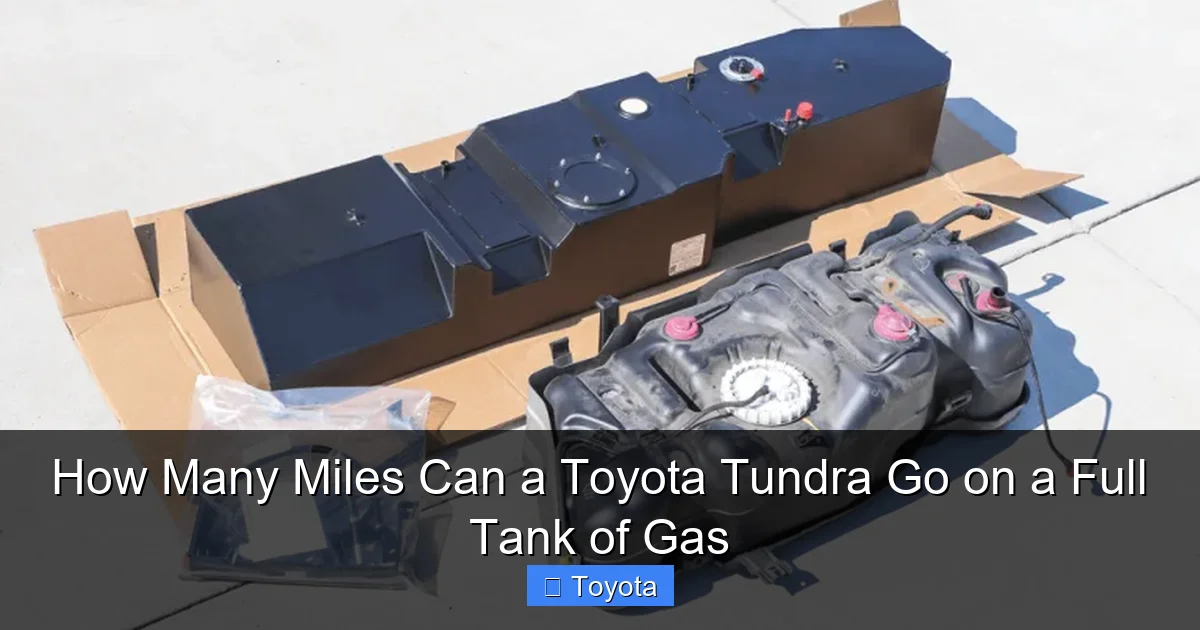
For the 2024 model year, the Toyota Tundra is a full-size powerhouse that has evolved significantly. Gone are the days of the standard V8 across the board. Now, the lineup is powered by either a twin-turbo 3.5L V6 gasoline engine or the more advanced i-FORCE MAX hybrid system, which pairs that V6 with an electric motor. This shift has dramatically changed the fuel economy landscape. The gas tank itself also varies. The standard tank for most recent models is 22.5 gallons, but some configurations, like the SR5 and certain trims, offer an optional larger 38-gallon tank. That extra 15.5 gallons can add over 200 miles to your range in ideal conditions! We’ll break down the specifics by model year and engine so you can find the exact numbers for your truck.
EPA Estimates vs. Your Real-World Driving
The Environmental Protection Agency (EPA) provides fuel economy estimates that are great for comparing vehicles on a dealer’s lot. However, they are based on standardized laboratory tests. Your actual miles per gallon (MPG)—and therefore your total range—will almost always differ. The EPA might say a certain Tundra gets 18 MPG combined, but your real-world average could be 16 MPG if you do a lot of city driving or 20 MPG if you’re a gentle highway cruiser. This discrepancy is why understanding the factors that affect your truck’s efficiency is more important than just memorizing a number.
Let’s do a quick example. A 2023 Tundra Limited 4×4 with the standard twin-turbo V6 and the 22.5-gallon tank has an EPA rating of 18 MPG combined (16 city/20 highway). Using the EPA combined number, your theoretical range is 18 MPG x 22.5 gallons = 405 miles. But if you’re driving 70% city, your real MPG might drop to 15. That same tank now gives you 337.5 miles—a difference of nearly 70 miles! This is why knowing your own driving habits is the first step to accurate range prediction.
Tundra Fuel Tank Capacity and MPG by Generation
To give you a clear picture, let’s look at the fuel tank sizes and EPA-estimated MPG for the most relevant Tundra generations. This will help you establish a baseline range for your specific vehicle. We’ll focus on the last two major redesigns, as they represent the vast majority of trucks on the road today.
Visual guide about How Many Miles Can a Toyota Tundra Go on a Full Tank of Gas
Image source: streettrucksmag.com
The 2007-2021 Model Years (The V8 Era)
This generation is famous (or infamous) for its robust but thirsty 5.7L V8 engine. Fuel efficiency was not its strong suit, but it made up for it with torque and reliability. The gas tank size for these models was typically 22.5 gallons for most trims, though some earlier years and specific packages could have a 24.6-gallon tank.
- Engine: 5.7L V8 (381 hp, 401 lb.-ft. torque)
- EPA MPG (Typical 4×4): 13 city / 17 highway / 14 combined
- Typical Tank Size: 22.5 gallons (24.6 gallons on some models)
- Calculated Range (22.5 gal tank, 14 MPG combined): Approximately 315 miles.
If you own one of these trucks, you know that 300-350 miles per tank was a common real-world experience, especially when the truck was empty. Add a heavy trailer or a loaded bed, and that number could plummet to the 200-mile range. The large tank was a necessity to compensate for the lower fuel economy. For owners of these models, understanding how to reset the maintenance light after a long trip is also part of the ownership experience, which you can learn about in our guide on how to reset the maintenance light on a 2017 Toyota Tundra.
The 2022-Present Model Years (The Twin-Turbo & Hybrid Era)
The complete redesign for 2022 was a game-changer. Toyota ditched the old V8 for a twin-turbo 3.5L V6 across all models and introduced the i-FORCE MAX hybrid powertrain as an option on most trims. Fuel economy improved dramatically, and with it, range. The standard tank is 22.5 gallons, but an optional 38-gallon tank is available on SR5, Limited, and Platinum trims (4×4 models only). This larger tank is a massive advantage for range.
- Engine A: Twin-Turbo 3.5L V6 (348 hp, 397 lb.-ft. torque)
- Engine B: i-FORCE MAX Hybrid V6 (437 hp, 583 lb.-ft. torque)
- EPA MPG (Typical 4×4 V6): 19 city / 22 highway / 20 combined
- EPA MPG (Typical 4×4 Hybrid): 20 city / 24 highway / 22 combined
- Typical Tank Size: 22.5 gallons standard, 38.0 gallons optional
- Calculated Range (V6, 22.5 gal tank, 20 MPG combined): 450 miles.
- Calculated Range (Hybrid, 22.5 gal tank, 22 MPG combined): 495 miles.
- Calculated Range (Hybrid, 38 gal tank, 22 MPG combined): A staggering 836 miles!
As you can see, the combination of the hybrid’s superior MPG and the massive 38-gallon tank creates a Tundra that can genuinely challenge some efficient SUVs for long-distance range. For the hybrid model with the big tank, a drive from Los Angeles to Las Vegas (270 miles) and back with some city driving to boot could theoretically be done on one tank. That’s a huge leap from the V8 era.
Real-World Factors That Reduce Your Tundra’s Range
Now we get to the heart of the matter. The numbers above are best-case scenarios. Your actual “miles to empty” reading is a live calculation that changes minute-by-minute based on dozens of factors. Understanding these will help you manage expectations and drive more efficiently. It’s not just about the truck; it’s about how you use it.

Visual guide about How Many Miles Can a Toyota Tundra Go on a Full Tank of Gas
Image source: autozonic.com
The Weight of the Job: Towing and Cargo
This is the single biggest range-killer for any truck, especially a full-size like the Tundra. Adding weight forces the engine to work harder, burning more fuel to maintain speed. The EPA estimates are for an empty truck. Towing a 7,000-pound trailer can easily drop your MPG by 30% or more. That 495-mile hybrid range could fall to under 350 miles. The same goes for a bed full of heavy tools, gravel, or equipment. Every 100 pounds of extra weight can reduce MPG by about 1-2%. So, if you regularly tow or carry heavy loads, you must mentally subtract a significant chunk from your theoretical tank range.
Driving Style and Environment
How you drive matters immensely. Jackrabbit starts, speeding, and constant braking are the enemies of efficiency. On the other end of the spectrum, using cruise control on flat highways is one of the best ways to maximize range. Terrain plays a huge role too. Climbing steep grades consumes fuel rapidly, while descending can sometimes help (with modern engine management). Extreme temperatures also hurt. In winter, the engine runs longer to warm up, and the cabin heater draws power. In summer, the air conditioning compressor places a constant load on the engine. If you live in a very hilly area or a place with extreme weather, your average MPG will be lower than the EPA estimate.
Tire Pressure and Type
This is an easy one to forget. Under-inflated tires create more rolling resistance, forcing the engine to work harder. The difference between 30 PSI and 35 PSI (or your door jamb’s recommended pressure) can be a 3% change in fuel economy. For a Tundra, that’s several miles per tank. Also, the type of tires matters. Aggressive all-terrain or mud-terrain tires have deeper tread blocks and are heavier, which hurts MPG more than standard highway all-season tires. If you’ve recently changed tires and noticed a drop in range, this could be the culprit.
Maximizing Your Toyota Tundra’s Fuel Range
While you can’t change your truck’s fundamental engineering, you can adopt habits and maintenance routines to claw back every possible mile. These tips are especially valuable for those with older V8 Tundras or anyone looking to stretch their fuel budget further.
Visual guide about How Many Miles Can a Toyota Tundra Go on a Full Tank of Gas
Image source: i.ytimg.com
Smart Driving Techniques
The way you operate the pedals has a direct impact. The goal is smooth, predictable driving. Accelerate gently from a stop, as if there’s an egg under your foot. Anticipate traffic flow to avoid unnecessary braking. On highways, use your cruise control. Driving at a constant 65 MPH is far more efficient than fluctuating between 60 and 75. While the Tundra is powerful, you don’t need to use that power all the time. For highway driving, setting the speed lower (within legal limits) can yield massive MPG gains due to reduced aerodynamic drag. If you’re cruising on a long, flat highway, try 65 instead of 75 and watch your range estimator climb.
Rigorous Maintenance Schedule
A well-maintained engine is an efficient engine. This goes beyond just regular oil changes. A clogged air filter restricts airflow to the engine, making it work harder. Old spark plugs can cause incomplete combustion. Using the correct viscosity of oil (0W-20 for newer models) reduces internal friction. One of the most overlooked items is the fuel system. Over time, fuel injectors can get clogged, leading to a poor fuel spray pattern. A professional fuel system cleaning every 30,000-50,000 miles can help restore lost MPG, especially on higher-mileage trucks. Keeping up with these items ensures your Tundra is performing as intended. You can find general guidance on maintenance intervals in our article about how many miles for an oil change on a new car, which applies foundational principles to all vehicles.
Comparing Tundra Range to Other Toyota Models
It’s helpful to put the Tundra’s range in context. As a full-size truck, its primary competition is the Ford F-150, Chevy Silverado, and Ram 1500. But how does it stack up against other Toyotas? Interestingly, a modern Tundra hybrid with the 38-gallon tank can have a similar or even greater range than some of Toyota’s popular SUVs. For example, a Toyota Sienna minivan has a 20-gallon tank and gets about 35 MPG combined, giving it a range of roughly 700 miles. That’s impressive for a minivan. You can see the specifics in our deep dive on how many miles a Toyota Sienna can go on empty. The Tundra’s advantage is its massive tank, which compensates for its lower MPG compared to a hybrid minivan. For a midsize sedan like the Camry, which has a ~15.8-gallon tank and gets up to 47 MPG hybrid, the range is about 740 miles. However, the Tundra’s utility in towing and carrying capacity is in a completely different league. The trade-off for that utility is generally lower MPG, but modern engineering has narrowed that gap considerably.
Practical Tips and Final Thoughts
So, what’s the bottom line for you as a Tundra owner? First, find your truck’s exact gas tank size. This is in your owner’s manual or on a sticker inside the fuel door. Second, track your real-world MPG for a few fill-ups. Reset your trip odometer at each fill-up, drive normally, and then divide the miles driven by the gallons you put in. This gives you your personal MPG baseline. Multiply that by your tank size to get your personal, realistic range.
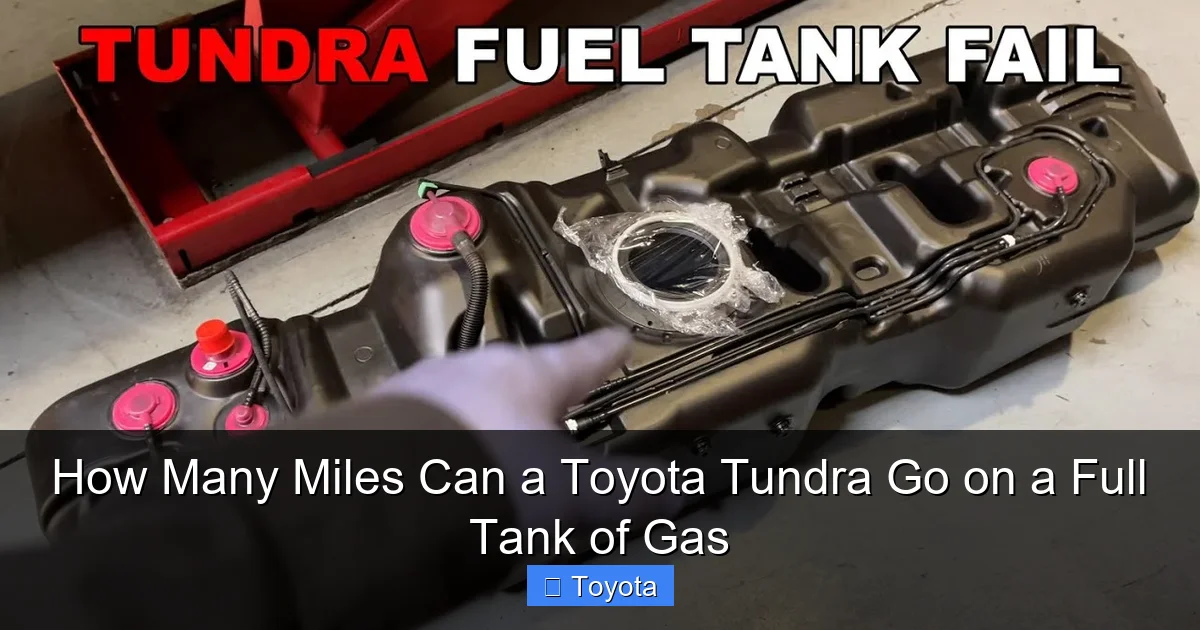
When planning a long trip, especially if towing, use this personal MPG number. If your personal combined MPG is 16 and you have a 22.5-gallon tank, plan your fuel stops around the 350-mile mark, not the 450-mile EPA estimate. Always fill up before the gas light comes on. That light is your last warning, and the remaining distance (often 30-60 miles) is a buffer for emergencies, not standard procedure. Running your Tundra consistently on low fuel can overheat and damage the in-tank fuel pump, which is cooled by being submerged in gasoline. This is a common issue across many makes, as discussed in our article on how many miles you can drive when the gas light comes on in a Toyota Camry.
Finally, appreciate the progress. If you drive a 2022+ Tundra, especially the hybrid with the large tank, you have one of the most range-capable full-size trucks ever made. You can confidently tackle long distances. If you have an older V8 model, its range is more modest, but its legendary reliability and towing prowess remain unparalleled. By understanding your vehicle, driving smartly, and maintaining it meticulously, you can maximize every drop of fuel and enjoy the full capability of your Toyota Tundra.
Frequently Asked Questions
How many miles can I drive after the gas light comes on in my Toyota Tundra?
Once the gas light illuminates, you typically have between 30 to 60 miles of range remaining, based on a reserve of 2-3 gallons of fuel. However, this is an emergency buffer only. You should not make a habit of driving this far on empty, as it can damage the fuel pump. Always plan to refuel shortly after the light comes on.
Does the 38-gallon tank come standard on all 2022+ Tundras?
No, the 38-gallon tank is an optional upgrade. It is available on SR5, Limited, and Platinum trims with 4×4. The standard tank for most 2022+ models is 22.5 gallons. The 38-gallon tank is not available on the base SR trim or on 2WD models, and it’s not compatible with all cab/bed configurations.
How does towing a trailer affect my Tundra’s fuel range?
3Towing significantly reduces your range, often by 25-40% or more depending on the trailer weight and aerodynamics. The added mass requires much more energy to accelerate and maintain speed, especially on hills. Always calculate your trip fuel needs based on your worst-case towing MPG, which you can determine by monitoring your fuel economy on a short towing trip.
Which Tundra model year has the best fuel range?
The 2022 and newer Tundra models, specifically those equipped with the i-FORCE MAX hybrid powertrain and the optional 38-gallon tank, offer the best fuel range. The combination of superior hybrid efficiency (up to 22 MPG combined) and the largest available fuel tank can yield a potential range of over 800 miles under ideal conditions, far surpassing the older V8 models.
Can using premium gasoline increase my Tundra’s range?
For the current twin-turbo V6 and hybrid Tundras, Toyota recommends using regular unleaded gasoline with an octane rating of 87 AKI. Using premium (91 AKI or higher) is not required and generally will not improve fuel economy or range. For the older 2007-2021 V8 models, premium was also not required. Using the correct fuel for your engine is what matters for efficiency and performance.
How often should I check my tire pressure to maintain optimal range?
You should check your Tundra’s tire pressure at least once a month and before any long trip. Temperature changes affect pressure. Refer to the recommended PSI on the driver’s door jamb sticker, not the tire sidewall. Keeping tires properly inflated is one of the simplest and most effective ways to ensure you get the maximum range and lifespan from your tires.
