How Many Gallons Does a Ford F150 Hold

Contents
- 1 Key Takeaways
- 2 📑 Table of Contents
- 3 Introduction: More Than Just a Number
- 4 Understanding Fuel Tank Capacity: It’s All in the Configuration
- 5 Model Year Breakdown: The Numbers by Generation
- 6 Real-World Implications: What Does This Mean For You?
- 7 Maintenance, Efficiency, and Your Fuel Tank
- 8 Conclusion: Know Your Truck
- 9 Frequently Asked Questions

Car Floor Mats (Universal)

Car Armrest Cushion

Car Trash Can

Car Wax Polish
The Ford F-150’s fuel tank capacity isn’t a single number—it varies significantly by model year, engine, cab configuration, and bed length. Typically, modern F-150s hold between 23 and 36 gallons, with the largest tanks found in certain high-performance or heavy-duty towing packages. Understanding your specific truck’s capacity is crucial for calculating real-world driving range, planning long trips, and managing fuel stops efficiently.
Key Takeaways
- Capacity Varies Widely: Your F-150’s tank size depends on its generation, engine, cab style (Regular, SuperCab, SuperCrew), and bed length (5.5′, 6.5′, 8′).
- Modern Range: For 2021-2024 models, capacities range from 26.5 to 36 gallons. The 23-gallon tank is now rare, mostly in older or base models.
- Towing & Hauling Matters: Trucks equipped for max towing (like those with the 3.5L EcoBoost V6 or 5.0L V8) often get the larger 33-gallon or 36-gallon tank to extend range between fuel stops.
- Not All “Big” Tanks Are Equal: A 2024 F-150 Limited’s 30-gallon tank is different from a 2018 F-150 Lariat’s 36-gallon tank due to changes in tank design and vehicle weight across generations.
- Reserve Fuel is Key: Your “real” usable fuel is less than the advertised capacity. Ford designs a reserve (usually 1-2 gallons) that the gauge doesn’t fully reflect to protect the fuel pump.
- Check Your Door Jamb: The most accurate way to know your tank size is to check the manufacturer’s label inside the driver’s side door jamb or your owner’s manual.
[FEATURED_IMAGE_PLACEHOLDER]
📑 Table of Contents
Introduction: More Than Just a Number
So, you’re eyeing a Ford F-150, or maybe you already own one. It’s America’s best-selling truck for a reason—it’s tough, versatile, and can be configured to do almost anything. But when it comes to the practicalities of owning a full-size pickup, one question bubbles up faster than a summer road trip’s fuel gauge: how many gallons does a Ford F150 hold?
It seems like a simple question. You just pop the hood, find the tank, and read a number, right? Wrong. The Ford F-150, spanning over a decade of production and countless configurations, doesn’t have a one-size-fits-all answer. The capacity is a moving target, influenced by everything from the engine under the hood to the length of the bed out back. Getting this right isn’t just trivia; it’s about knowing your truck’s true range, planning adventures without anxiety, and understanding the engineering trade-offs behind your specific rig.
Think of it this way: a contractor hauling tools in a SuperCrew with the 6.5-foot bed has different needs than a weekend warrior with a Regular Cab, 8-foot bed, and a big V8. Their fuel tanks are likely different sizes. This guide will pull back the curtain. We’ll break down the numbers by generation, explain the “why” behind the variations, and give you the tools to find the exact capacity for your F-150, no matter the year.
Understanding Fuel Tank Capacity: It’s All in the Configuration
Before we dive into specific gallons, let’s establish a core principle: Ford builds the F-150 to match the tank to the truck’s intended role. A truck designed for maximum towing capacity needs more fuel to make long hauls between stations. A base-model work truck with a shorter bed might sacrifice tank size for cost or weight savings. The configuration is king.
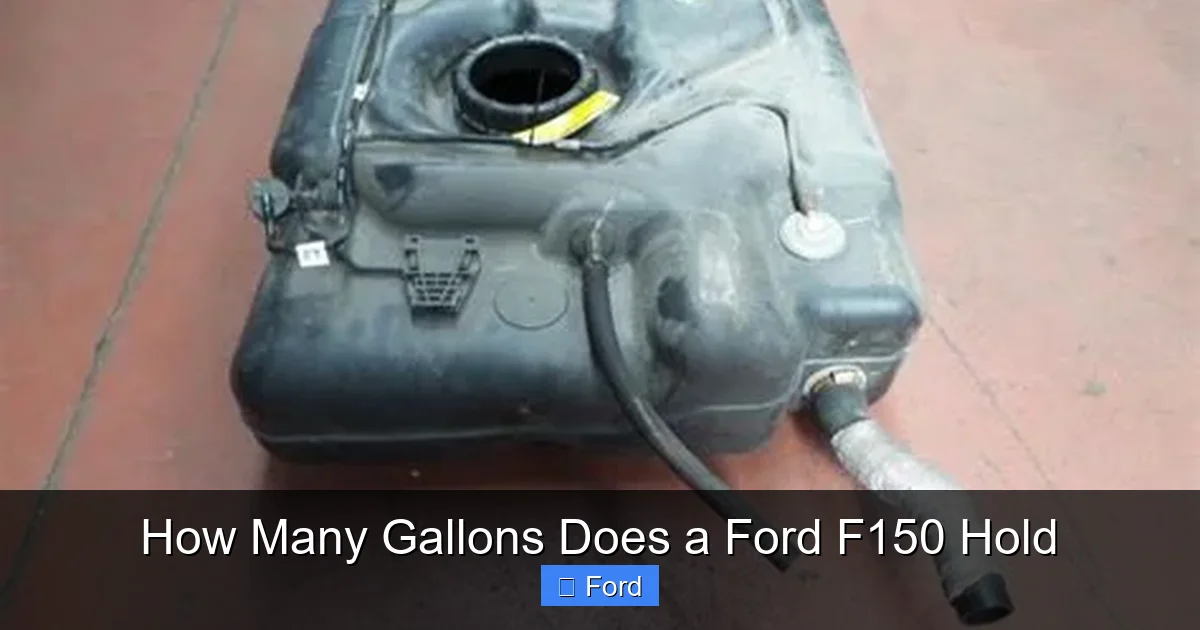
Visual guide about How Many Gallons Does a Ford F150 Hold
Image source: autozonic.com
The Big Three: Cab, Bed, and Engine
Three primary factors dictate your F-150’s fuel tank size:
- Cab Configuration: This is the passenger compartment. A Regular Cab has two doors and a single row of seats. A SuperCab (or Extended Cab) has small rear access doors and a small back seat. A SuperCrew has four full doors and a spacious rear cabin. Generally, larger cabs have different underbody structures that can affect tank placement and size. The tank often sits behind the rear axle, and the space available changes with cab length.
- Bed Length: This is the cargo box. Common lengths are 5.5 feet, 6.5 feet, and 8 feet. The bed length itself doesn’t directly change the tank size, but it’s almost always paired with a specific cab style. For example, you can’t get an 8-foot bed with a SuperCrew cab on most modern generations. The cab/bed combo defines the truck’s overall wheelbase and frame, which in turn dictates the space available for the fuel tank.
- Engine & Drivetrain: This is the biggest variable. A base V6 or turbocharged four-cylinder might be paired with a standard tank. But when you opt for the powerful 3.5L EcoBoost V6 (a favorite for towing) or the robust 5.0L V8, Ford frequently upgrades you to a larger capacity tank as part of a “Max Trailer Tow” or “Heavy-Duty Payload” package. The logic is sound: more power often means more fuel consumption, especially when working hard.
Why Your “Gallons” Might Not Match the Sticker
Here’s a pro tip: the number on the gas cap or in your manual is the total capacity. But you’ll rarely, if ever, be able to put that exact amount in when the pump clicks off. Why?
- The Reserve: Automakers intentionally leave 1-2 gallons of “unusable” fuel at the bottom of the tank. This protects the electric fuel pump, which is submerged in fuel to keep it cool and lubricated. Running the tank completely dry can destroy the pump.
- Expansion Space: Fuel expands with temperature. The tank’s design includes “ullage” space—air above the fuel—to accommodate this expansion without overflowing or causing vapor lock issues.
- Pump Nozzle & Foam: Modern pumps have vapor recovery systems and shut off early to prevent spillage. The foam and vapor space in the filler neck also mean you can’t fill to 100% of the tank’s geometric volume.
So, if your manual says 30 gallons, your realistic “usable” fuel might be around 28-29 gallons. For range calculations, using 85-90% of the advertised capacity is a safe, conservative estimate.
Model Year Breakdown: The Numbers by Generation
Now for the meat of the matter. Let’s walk through the modern F-150 generations (since 2009) and list the common tank sizes. Remember, these are the advertised total capacities.
Visual guide about How Many Gallons Does a Ford F150 Hold
Image source: appgecet.co.in
Twelfth Generation (2009-2014)
This generation started the trend of multiple tank sizes. The most common were:
- 23 Gallons: Found on many base models with shorter beds and the 3.7L V6 or early 3.5L EcoBoost.
- 26 Gallons: A very common size for SuperCrew models with the 5.0L V8 and 6.5-foot bed.
- 31 Gallons: The large tank, typically reserved for Max Trailer Tow packages with the 6.2L V8 (2010-2014) or certain EcoBoost configurations.
An interesting note: some 2011-2014 models with the 3.7L V6 and 8-foot bed could also have the 31-gallon tank, showing how bed length could sometimes override engine choice.
Thirteenth Generation (2015-2020)
This generation saw a major redesign and a shift in tank offerings. The 23-gallon tank became exceedingly rare.
- 26 Gallons: The standard for many configurations, especially Regular Cab and SuperCab models with 6.5-foot beds and non-towing engines.
- 33 Gallons: This became the iconic “big tank” for this generation. It was standard on:
- All SuperCrew models with the 5.0L V8 and 6.5-foot bed.
- Most models equipped with the 3.5L EcoBoost V6 and the Max Trailer Tow package.
- All models with the 6.5-foot bed and the 2.7L EcoBoost V6 if they had the optional larger tank.
- 36 Gallons: This was the top-tier tank, almost exclusively paired with the 6.5-foot bed on SuperCrew models and the 8-foot bed on Regular Cab models when equipped with the 3.5L EcoBoost V6 and the Max Trailer Tow package. It was the king of range for this era.
A quick example: A 2018 F-150 Lariat, SuperCrew, 6.5′ bed, with the 3.5L EcoBoost and Max Tow package almost certainly had the 36-gallon tank. The same truck with the 2.7L EcoBoost and no tow package likely had the 26-gallon tank.
Fourteenth Generation (2021-Present)
The latest generation further refined the options. The 26-gallon tank is now mostly for base XL models with specific configurations. The lineup is cleaner:
- 26.5 Gallons: The new base size, found on XL and XLT models with the 3.3L V6, 2.7L EcoBoost, or 5.0L V8, typically with the 5.5′ or 6.5′ bed and SuperCrew or SuperCab.
- 30 Gallons: A common mid-size tank for Lariat and King Ranch models with the 5.0L V8 or 3.5L EcoBoost and the 6.5′ bed.
- 33 Gallons: Available on Platinum and Limited models with the 3.5L EcoBoost and 6.5′ bed, and on certain XL/XLT models with the Max Trailer Tow package.
- 36 Gallons: Still the largest, but now its availability is more restricted. It’s primarily for the 2021-2023 F-150 Raptor (with the 3.5L High-Output EcoBoost) and specific 2024+ models with the 3.5L EcoBoost and the Max Trailer Tow package on the 6.5′ bed. For 2024, the standard tank for a 3.5L EcoBoost SuperCrew 6.5′ bed is 30 gallons, with the 36-gallon being a package option.
The introduction of the hybrid PowerBoost (3.5L V6 + electric motor) in 2021 also brought its own tank sizing, typically 26.5 or 30 gallons depending on the trim and bed.
Real-World Implications: What Does This Mean For You?
Knowing the gallon count is step one. Step two is translating that into your daily driving experience. This is where the rubber meets the road—or rather, the fuel meets the engine.

Visual guide about How Many Gallons Does a Ford F150 Hold
Image source: thedrive.com
Calculating Your True Range
Don’t just look at the tank size. Your real-world range is a simple formula: (Tank Capacity x MPG) = Approximate Range. But you must use realistic MPG for your driving style and load.
- City/Commuting: If you have a 30-gallon tank and get 18 MPG in stop-and-go traffic, your range is about 540 miles. But remember, you shouldn’t run it to empty. Plan refueling around 400-450 miles to be safe.
- Highway Cruising: That same truck might get 22 MPG on the highway, stretching the range to 660 miles. A 36-gallon tank at 22 MPG is a staggering 792-mile theoretical range—perfect for cross-country trips.
- Towing/Hauling: This is the big variable. Towing a heavy trailer can cut your MPG by 30-50%. A 30-gallon tank that normally gives 600 miles might only provide 300-400 miles when towing a large boat or camper. This is why max-tow packages include the bigger tanks—to compensate for the drastic drop in efficiency under load.
Practical Tip: Use your truck’s trip computer after a few fill-ups to get an accurate, personalized MPG reading for your typical driving. It’s more reliable than the EPA estimate.
The Towing and Hauling Equation
If you bought an F-150 to work, the tank size is non-negotiable. Imagine towing a large fifth-wheel trailer across Texas. Fuel stations can be far apart. A 23-gallon tank getting 10 MPG while towing gives you a nerve-wracking 230-mile range before reserve. A 36-gallon tank in the same scenario? 360 miles. That extra 130 miles can mean the difference between a relaxing trip and a white-knuckle search for a diesel pump.
This is also where comparing to other vehicles is useful. A full-size SUV like the Nissan Armada or Toyota Tacoma has different priorities. The Armada, a large SUV, might have a similar 26-28 gallon tank for family hauling. The Tacoma, a midsize truck, has a much smaller tank (around 18-21 gallons) reflecting its different use case. Your F-150’s tank is engineered for the heavy-duty life it’s built for.
Fuel Economy vs. Tank Size: The Trade-Off
Here’s a common misconception: a bigger tank means worse MPG because it’s heavier. While a full tank of gas weighs about 6-7 pounds per gallon (a 36-gallon tank adds ~200 lbs of fuel weight), this is a drop in the bucket compared to the truck’s curb weight (usually 4,500-5,500 lbs). The impact on MPG is negligible in daily driving.
The real trade-off is cost and packaging. A larger tank costs more to manufacture and install. It also takes up valuable space in the underbody, which can interfere with other components or ground clearance. Ford’s engineers make a conscious decision: for a base-model commuter truck, a 26-gallon tank is sufficient and saves cost. For the customer who will tow 10,000 lbs, they offer the 36-gallon tank as part of a premium package because the value of extended range outweighs the cost.
Maintenance, Efficiency, and Your Fuel Tank
Your fuel tank is more than just a container; it’s part of a complex system. Keeping it healthy ensures you get the full, advertised capacity and protects your engine.
The Silent Guardian: Fuel Pump Cooling
As mentioned, your fuel pump lives inside the tank. It’s cooled by the gasoline surrounding it. This is why you should never consistently drive with the gauge on “E.” Running the tank too low starves the pump of its cooling medium, leading to overheating and premature failure. Replacing an in-tank fuel pump is a labor-intensive (read: expensive) job. Using your full tank capacity regularly, but refueling when you have 1/4 tank or more, is the best practice for pump longevity.
Filling Up: Does “Pump Click-Off” Mean Full?
No. When the pump nozzle clicks off, it’s detecting a change in vapor pressure, indicating the tank is nearly full. But due to the “slosh” effect and the design of the filler neck, you’re usually at 95-98% of total capacity. If you want to maximize range for a long trip, you can carefully “top off” by slowly squeezing the trigger after the first click. But be warned: overfilling can force liquid fuel into the evaporative (EVAP) system, which is designed only for vapors, and can trigger a check engine light and costly repairs. It’s generally not recommended.
Damage and Deformation
Modern F-150 tanks are high-density polyethylene (plastic). They’re resistant to rust but can be damaged by impacts from debris or off-road obstacles. A severe dent can reduce capacity or, worse, compromise the tank’s integrity. If you suspect damage after hitting something, have it inspected. Also, while rare, some older models (pre-2004) had steel tanks that could rust from the inside if water or condensation accumulates.
Conclusion: Know Your Truck
So, how many gallons does a Ford F150 hold? The answer, as we’ve seen, is: it depends. It depends on whether your truck is a 2015 Regular Cab workhorse or a 2024 SuperCrew luxury hauler. It depends on the rumble of your engine and the length of your bed. The range spans from a modest 23 gallons to a road-tripping 36 gallons.
The power of this knowledge isn’t just in quoting a number. It’s in the confidence it gives you. You can calculate your true range for that next hunting trip or cross-country move. You can understand why your friend’s identical-looking F-150 gets further on a tank. You can make an informed choice if you’re shopping, knowing that a “Max Trailer Tow” package isn’t just about horsepower—it’s often about the 36-gallon tank that comes with it.
The final, most important step is to check your specific vehicle. Pop open your driver’s door and look at the tire information sticker on the jamb. Often, the fuel tank capacity is listed there. Your owner’s manual is the ultimate authority. With that number in hand, you can truly harness the capability of your Ford F-150, mile after mile, gallon after gallon.
Frequently Asked Questions
Does the Ford F-150 have a 22-gallon tank?
No, the smallest tank in the modern F-150 lineup (2009-present) is 23 gallons, found on some early 2009-2014 base models. The current smallest for 2021-2024 is 26.5 gallons. A 22-gallon tank was never a factory option for the F-150.
How far can a Ford F-150 go on a full tank?
This varies dramatically by tank size and fuel economy. A 2024 F-150 with the 2.7L EcoBoost (26.5 gal tank) getting 20 MPG combined has a theoretical range of about 530 miles. A 2023 F-150 with the 3.5L EcoBoost and 36-gallon tank getting 19 MPG combined can theoretically reach 684 miles. Towing can cut these ranges by half or more.
Can I upgrade my F-150’s fuel tank to a larger size?
Aftermarket larger tanks are available but are not simple plug-and-play upgrades. They require modifications to the underbody, fuel lines, and filler neck, and must be certified for safety and emissions. It’s a complex, expensive job. Your best path to a larger tank is to purchase a used F-150 from the factory that already has the desired tank size for your model year and configuration.
Does the Raptor have a bigger fuel tank?
Yes. The current F-150 Raptor (2021-2023) comes standard with a 36-gallon fuel tank to support its high-performance off-road capabilities and the thirstier 3.5L High-Output EcoBoost engine. This is larger than the standard tank for most other F-150 trims with the same engine.
Why does my Ford F-150’s fuel gauge seem to drop quickly at first?
This is common in many vehicles and is due to the design of the fuel sender unit. The first 1/4 to 1/3 of the tank is often measured by a different part of the float arm or a different resistance curve, which can make the gauge drop faster initially. It doesn’t mean you have less fuel; it’s a calibration quirk. The lower half of the gauge is usually more linear.
Is a 23-gallon tank too small for an F-150?
For many owners, especially those who tow, haul, or do long highway driving, 23 gallons is considered quite small today. It leads to more frequent fuel stops and less margin for error on long trips. This is why Ford largely phased it out after the 2014 model year, offering 26+ gallons as the new standard to meet customer expectations for range in a full-size truck. If you own an older 23-gallon tank model and frequently tow, planning fuel stops becomes a critical part of your trip planning.