
How Many Catalytic Converters Are in a Toyota 4runner

The number of catalytic converters in a Toyota 4Runner depends on the model year, engine size, and emissions regulations. Most modern 4Runners have two to four catalytic converters, with V6 and V8 engines typically using more than four-cylinder models.
If you own a Toyota 4Runner—or you’re thinking about buying one—you’ve probably heard the term “catalytic converter” thrown around, especially when talking about emissions, performance, or unexpected repair bills. But how many catalytic converters are actually in a Toyota 4Runner? The answer isn’t as simple as you might think. It depends on several factors, including the year your 4Runner was made, the engine under the hood, and even where you live.
The catalytic converter is a critical part of your vehicle’s exhaust system. Its job is to reduce harmful pollutants like carbon monoxide, nitrogen oxides, and hydrocarbons before they exit the tailpipe. Thanks to increasingly strict environmental regulations over the past few decades, modern vehicles—including the rugged and reliable Toyota 4Runner—are equipped with more advanced and numerous emissions control systems. That means more catalytic converters.
In this guide, we’ll break down exactly how many catalytic converters you can expect in your Toyota 4Runner based on its generation, engine, and trim level. We’ll also explain why the number varies, what signs indicate a failing converter, and what it might cost to replace one. Whether you’re a long-time 4Runner enthusiast or a first-time buyer, understanding your vehicle’s emissions system can save you time, money, and headaches down the road.
So, let’s dive in and demystify the catalytic converter count in one of Toyota’s most beloved SUVs.
Key Takeaways
- Model year matters: Older 4Runners (pre-2003) often have one or two catalytic converters, while newer models (2003 and later) commonly feature two to four due to stricter emissions standards.
- Engine type affects count: V6 and V8 engines usually require more catalytic converters than four-cylinder engines to manage higher exhaust flow and emissions.
- Dual exhaust systems need dual cats: 4Runners with dual exhaust setups—common in TRD Pro and Limited trims—typically have two catalytic converters, one per exhaust bank.
- California and high-emissions states: Vehicles registered in states like California may have additional catalytic converters to meet CARB standards.
- Replacement costs vary: Replacing a catalytic converter can cost $1,000–$3,000+ per unit, making it one of the most expensive routine maintenance items.
- Signs of failure: Reduced fuel economy, check engine light, sulfur smell, or rattling noises may indicate a failing catalytic converter.
- Legal and environmental importance: Catalytic converters reduce harmful emissions and are legally required; tampering with them can result in fines.
📑 Table of Contents
- Understanding Catalytic Converters: What They Do and Why They Matter
- How Many Catalytic Converters Are in a Toyota 4Runner? A Year-by-Year Breakdown
- Engine Type and Exhaust Configuration: The Real Deciding Factors
- Signs Your Catalytic Converter Might Be Failing
- Replacement Costs and What to Expect
- Legal and Environmental Considerations
- Final Thoughts: Know Your 4Runner’s Emissions System
Understanding Catalytic Converters: What They Do and Why They Matter
Before we get into the specifics of how many catalytic converters are in a Toyota 4Runner, it helps to understand what these devices actually do—and why they’re so important.
A catalytic converter is essentially a metal canister filled with a ceramic honeycomb structure coated in precious metals like platinum, palladium, and rhodium. As exhaust gases pass through this structure, chemical reactions occur that convert harmful pollutants into less harmful substances. For example, carbon monoxide (CO) is turned into carbon dioxide (CO₂), and unburned hydrocarbons are converted into water (H₂O) and CO₂. Nitrogen oxides (NOx) are broken down into nitrogen and oxygen.
This process is crucial for meeting federal and state emissions standards. In the U.S., the Environmental Protection Agency (EPA) sets national guidelines, but states like California have even stricter rules through the California Air Resources Board (CARB). Vehicles sold in CARB-compliant states often have more robust emissions systems, which can include additional or more efficient catalytic converters.
How Catalytic Converters Work
The magic happens inside the catalytic converter through two main types of catalysts: reduction and oxidation.
The reduction catalyst uses platinum and rhodium to break down nitrogen oxides into nitrogen and oxygen. The oxidation catalyst, using platinum and palladium, helps burn off leftover fuel (hydrocarbons) and carbon monoxide by converting them into carbon dioxide and water.
Modern vehicles often use a “three-way” catalytic converter, which handles all three major pollutants—CO, NOx, and hydrocarbons—in one unit. This is why you’ll often hear the term “three-way catalytic converter” when discussing emissions systems.
Why More Converters Mean Cleaner Air
As emissions standards have tightened over the years, automakers have had to get creative. One solution is to add more catalytic converters. For example, some vehicles now use a “pre-cat” or “close-coupled” converter mounted close to the engine to heat up quickly and start reducing emissions almost immediately after startup. Then, a second “underfloor” converter is placed further back in the exhaust system to continue cleaning the gases.
This dual-converter setup is common in many modern SUVs, including the Toyota 4Runner. In some high-performance or high-displacement engines, you might even see three or four converters to ensure maximum efficiency and compliance with emissions laws.
How Many Catalytic Converters Are in a Toyota 4Runner? A Year-by-Year Breakdown
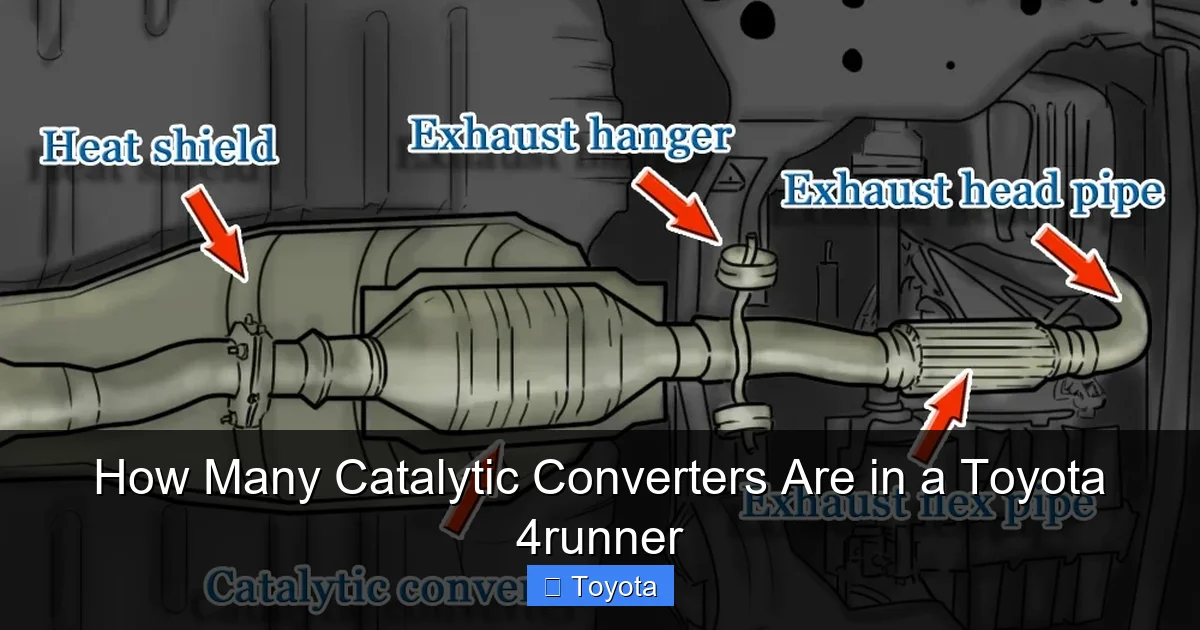
Visual guide about How Many Catalytic Converters Are in a Toyota 4runner
Image source: res.cloudinary.com
Now for the main question: how many catalytic converters are in a Toyota 4Runner? The answer varies significantly depending on the model year and engine configuration. Let’s break it down by generation.
First Generation (1984–1989)
The original Toyota 4Runner was essentially a lifted pickup truck with a removable fiberglass top. These early models were simple, rugged, and not heavily regulated when it came to emissions.
Most first-gen 4Runners came with a 2.4L four-cylinder engine (the 22R or 22RE). These engines typically had **one catalytic converter**, located in the exhaust manifold or just downstream of it. Some later models in this generation may have added a second converter as emissions standards began to tighten in the late 1980s, but it was rare.
Second Generation (1990–1995)
The second-generation 4Runner introduced more engine options, including the 3.0L V6 (3VZ-E). This was a big step up in power and emissions output.
Most second-gen 4Runners still had **one or two catalytic converters**. The four-cylinder models usually stuck with one, while the V6 versions often had two—one for each bank of cylinders. This was especially true for models sold in California or other high-emissions states.
Third Generation (1996–2002)
This generation marked a major shift. The 4Runner grew in size, power, and sophistication. The 3.4L V6 (5VZ-FE) became the standard engine, and emissions controls became more advanced.
Most third-gen 4Runners have **two catalytic converters**. One is typically mounted close to the engine (the “pre-cat”), and the second is located further back in the underfloor position. Some high-output or California-spec models may have additional converters or more complex exhaust routing, but two is the norm.
Fourth Generation (2003–2009)
With the introduction of the fourth generation, Toyota upgraded to a 4.0L V6 (1GR-FE) engine. This engine produces more power and, consequently, more emissions. To meet stricter EPA and CARB standards, Toyota increased the number of catalytic converters.
Most fourth-gen 4Runners have **two to three catalytic converters**. The standard setup includes a close-coupled converter near the engine and an underfloor converter. Some models, especially those with dual exhaust systems or sold in California, may have a third converter or a more complex manifold design that effectively functions as multiple catalytic zones.
Fifth Generation (2010–Present)
The current generation of the Toyota 4Runner continues to use the 4.0L V6 engine, but with refinements for better fuel economy and emissions control. This is where things get interesting.
Most fifth-gen 4Runners have **two catalytic converters**, but some trims and configurations may have **up to four**.
Here’s why: The 4.0L V6 is a V-shaped engine with two cylinder banks. Each bank has its own exhaust manifold. On models with dual exhaust systems—like the TRD Pro, Limited, or certain Sport trims—each manifold may have its own catalytic converter. That’s two right there.
Additionally, some models include a “pre-cat” or “manifold-integrated” converter built directly into the exhaust manifold, and a second “underfloor” converter further down the line. In high-spec or California-emissions models, you might see a total of **four catalytic converters**: two close-coupled (one per bank) and two underfloor.
For example, a 2023 Toyota 4Runner TRD Pro with dual exhaust likely has four catalytic converters—two near the engine and two under the vehicle. Meanwhile, a base SR5 model with a single exhaust may only have two.
Engine Type and Exhaust Configuration: The Real Deciding Factors
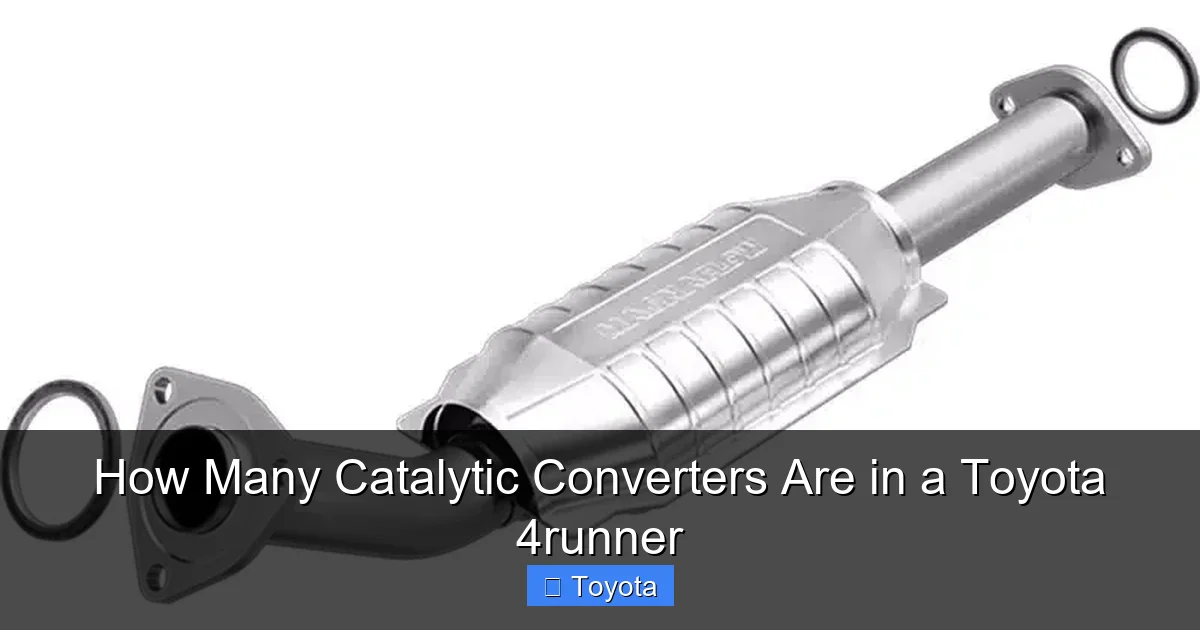
Visual guide about How Many Catalytic Converters Are in a Toyota 4runner
Image source: realtruck.com
While model year gives you a general idea, the real determining factors for how many catalytic converters are in your 4Runner are the engine type and exhaust system design.
V6 vs. Four-Cylinder Engines
The Toyota 4Runner has never offered a four-cylinder engine in its modern generations (post-2003). However, earlier models did. The key takeaway is that V6 and V8 engines (like the rare 4.7L V8 in some 2003–2009 models) produce more exhaust flow and emissions, requiring more catalytic converters to clean the gases effectively.
For example:
– A 1995 4Runner with a 2.4L four-cylinder: 1 catalytic converter.
– A 2005 4Runner with a 4.0L V6: 2–3 catalytic converters.
– A 2007 4Runner with a 4.7L V8 (rare): 3–4 catalytic converters.
Single vs. Dual Exhaust Systems
This is a major factor in the fifth generation. Most base 4Runners come with a single exhaust system, which typically uses one or two catalytic converters. However, higher trims like the TRD Pro, Limited, and某些 Sport models feature dual exhaust systems—one for each cylinder bank.
Dual exhaust means dual catalytic converters—at minimum. And because each bank may have both a close-coupled and underfloor converter, the total can reach four.
California and High-Emissions States
If your 4Runner was originally sold or registered in California, New York, Vermont, or Maine, it likely meets CARB standards. These vehicles often have more stringent emissions controls, which can include additional catalytic converters or more efficient designs.
For example, a CARB-compliant 2020 4Runner may have four catalytic converters, while the same model sold in Texas might only have two. Always check your vehicle’s emissions label (usually under the hood) to confirm compliance.
Signs Your Catalytic Converter Might Be Failing
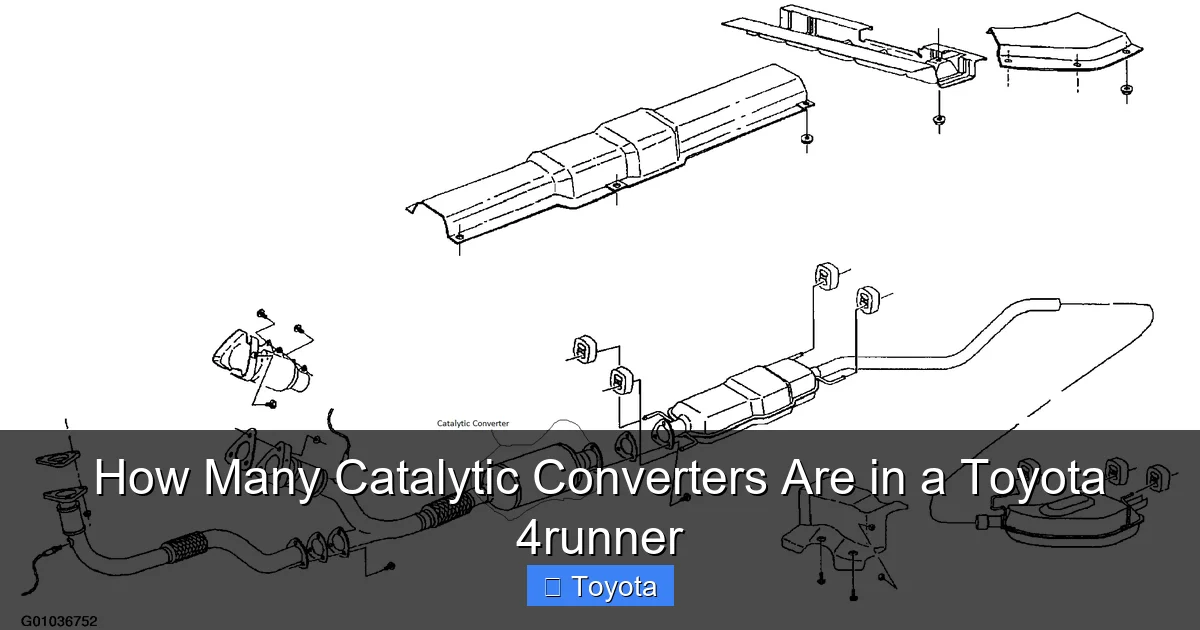
Visual guide about How Many Catalytic Converters Are in a Toyota 4runner
Image source: 2carpros.com
Knowing how many catalytic converters your 4Runner has is one thing—knowing when one might be failing is another. A bad catalytic converter can hurt performance, reduce fuel economy, and cause your vehicle to fail emissions tests.
Common Symptoms of a Failing Catalytic Converter
- Check Engine Light: The most common sign. Your vehicle’s onboard diagnostics system may detect inefficient catalytic converter operation (often flagged as P0420 or P0430 codes).
- Reduced Fuel Economy: A clogged converter restricts exhaust flow, making the engine work harder and burn more fuel.
- Loss of Power: Especially noticeable when accelerating or climbing hills. The engine may feel sluggish or unresponsive.
- Sulfur or Rotten Egg Smell: A failing converter may not properly process hydrogen sulfide, leading to a strong sulfur odor from the exhaust.
- Rattling Noise: Over time, the internal honeycomb structure can break apart. If you hear a rattling sound from under the vehicle, especially when idling, the converter may be damaged.
- Excessive Heat Under the Vehicle: A clogged converter can overheat, sometimes glowing red-hot under the car.
What to Do If You Suspect a Problem
If you notice any of these symptoms, don’t ignore them. Have your vehicle inspected by a qualified mechanic or Toyota dealership. They can use a scan tool to check for trouble codes and perform a backpressure test to confirm if the catalytic converter is clogged.
Keep in mind that some symptoms—like poor fuel economy or a check engine light—can also be caused by other issues, such as a faulty oxygen sensor or spark plugs. A proper diagnosis is essential.
Replacement Costs and What to Expect
Catalytic converters are expensive—there’s no way around it. But understanding the costs can help you budget and avoid surprises.
Average Replacement Costs
The cost to replace a catalytic converter in a Toyota 4Runner varies based on:
– The number of converters needed
– Whether you use OEM (Toyota) or aftermarket parts
– Labor rates in your area
Here’s a general breakdown:
– **OEM (Toyota) catalytic converter:** $1,200–$3,000+ per unit
– **Aftermarket catalytic converter:** $400–$1,200 per unit
– **Labor:** $150–$400 (depending on accessibility)
So, if your 4Runner has two converters and you need to replace both, you could be looking at $2,000–$6,000 at a dealership. Aftermarket options can reduce that cost, but be cautious—some may not meet emissions standards or could trigger check engine lights.
Tips to Save Money
- Use a reputable aftermarket brand: Look for converters certified by the EPA or CARB. Brands like MagnaFlow, Walker, and Eastern Catalytic are reliable.
- Get multiple quotes: Prices vary widely between shops. Get estimates from at least three mechanics or exhaust specialists.
- Check your warranty: Some extended warranties or certified pre-owned plans may cover catalytic converter replacement.
- Prevent theft: Catalytic converters are prime targets for thieves due to their precious metals. Park in well-lit areas, install a protective shield, or etch your VIN on the converter.
Legal and Environmental Considerations
Catalytic converters aren’t just about performance—they’re a legal requirement. Tampering with or removing them is illegal under federal law (Clean Air Act) and can result in fines up to $25,000 per violation.
Why You Can’t Just Remove It
Some people think about removing the catalytic converter to improve performance or sound. While it might give a slight horsepower boost, the downsides far outweigh the benefits:
– Your vehicle will fail emissions inspections.
– You’ll likely trigger a check engine light.
– You’re contributing to air pollution.
– You could face hefty fines.
In many states, even installing a “high-flow” catalytic converter that isn’t EPA- or CARB-certified is illegal.
The Environmental Impact
Catalytic converters play a vital role in reducing smog and protecting public health. A single properly functioning converter can reduce harmful emissions by up to 90%. Given that millions of vehicles are on the road, that adds up to a massive environmental benefit.
By maintaining your 4Runner’s catalytic converters, you’re not just keeping your SUV running smoothly—you’re doing your part for cleaner air.
Final Thoughts: Know Your 4Runner’s Emissions System
So, how many catalytic converters are in a Toyota 4Runner? The short answer: it depends. Most modern 4Runners have two to four, with the exact number influenced by model year, engine size, exhaust configuration, and emissions standards.
Understanding your vehicle’s setup can help you diagnose problems, plan for maintenance, and make informed decisions about repairs. Whether you’re driving a classic 1990 4Runner with one converter or a 2023 TRD Pro with four, keeping your emissions system in good shape is essential for performance, legality, and the environment.
Regular maintenance, prompt attention to warning signs, and using quality replacement parts will keep your 4Runner running strong for years to come. And now, you know exactly what’s under that rugged SUV—converter by converter.
Frequently Asked Questions
How many catalytic converters does a 2020 Toyota 4Runner have?
A 2020 Toyota 4Runner typically has two to four catalytic converters, depending on the trim and exhaust system. Base models with single exhaust usually have two, while dual-exhaust trims like the TRD Pro may have four.
Can I drive my 4Runner with a bad catalytic converter?
You can drive short distances, but it’s not recommended. A failing converter can reduce performance, damage the engine, and cause your vehicle to fail emissions tests. Have it inspected as soon as possible.
Are catalytic converters worth stealing?
Yes, unfortunately. They contain precious metals like platinum, palladium, and rhodium, which can be sold for scrap. This has led to a rise in catalytic converter thefts, especially on SUVs like the 4Runner.
How long do catalytic converters last?
Most catalytic converters last 100,000 to 150,000 miles. However, damage from oil leaks, coolant contamination, or physical impact can shorten their lifespan.
Can I replace a catalytic converter myself?
It’s possible if you have mechanical experience and the right tools, but it’s not recommended for most people. The job requires lifting the vehicle, cutting or unbolting exhaust components, and ensuring proper alignment. Professional installation is safer and often required for warranty compliance.
Do all 4Runners have the same number of catalytic converters?
No. The number varies by model year, engine, and trim. Older models may have one or two, while newer high-trim models with dual exhaust can have up to four.