How Many Air Filters Does a 2010 Toyota Corolla Have

Contents
- 1 Key Takeaways
- 2 📑 Table of Contents
- 3 Introduction: The Unsung Heroes Under Your Hood and In Your Dashboard
- 4 The Two Air Filters Explained: Engine vs. Cabin
- 5 Deep Dive: The Engine Air Filter
- 6 Deep Dive: The Cabin Air Filter
- 7 The Real-World Consequences of Neglecting Your Air Filters
- 8 Maintenance Best Practices and Smart Tips
- 9 Conclusion: A Simple Habit for a Healthy, Efficient Corolla
- 10 Frequently Asked Questions
Tire Shine Spray

Car Trash Can

Car Interior LED Light
Car Inverter
Your 2010 Toyota Corolla has two essential air filters: the engine air filter and the cabin air filter. The engine filter shields your motor from harmful debris, while the cabin filter cleans the air you breathe inside the vehicle. Both are vital for optimal performance, fuel efficiency, and interior air quality, requiring regular inspection and replacement to prevent expensive repairs and ensure a healthy driving environment.
Key Takeaways
- Two Filters Total: The 2010 Toyota Corolla is equipped with exactly two air filters: one for the engine and one for the cabin (HVAC system).
- Engine Air Filter Location: It resides in a rectangular black plastic air box in the engine bay, typically on the driver’s side near the battery.
- Cabin Air Filter Location: It is located behind the glovebox compartment; you must drop the glovebox to access it.
- Replacement Intervals: The engine filter should be checked every 15,000-30,000 miles and replaced as needed. The cabin filter is generally replaced every 15,000-30,000 miles or yearly, especially in dusty/polluted areas.
- Neglect Has Consequences: A clogged engine filter reduces power, fuel economy, and can damage sensors or the catalytic converter. A dirty cabin filter compromises HVAC efficiency and can harm health.
- DIY-Friendly: Both filters are simple to replace with basic tools, making them ideal for do-it-yourself maintenance and cost savings.
- Filter Quality Matters: Always use the correct filter size and a reputable brand (OEM or high-quality aftermarket) to ensure proper fit and filtration.
📑 Table of Contents
- Introduction: The Unsung Heroes Under Your Hood and In Your Dashboard
- The Two Air Filters Explained: Engine vs. Cabin
- Deep Dive: The Engine Air Filter
- Deep Dive: The Cabin Air Filter
- The Real-World Consequences of Neglecting Your Air Filters
- Maintenance Best Practices and Smart Tips
- Conclusion: A Simple Habit for a Healthy, Efficient Corolla
Introduction: The Unsung Heroes Under Your Hood and In Your Dashboard
When you think about maintaining your trusty 2010 Toyota Corolla, your mind probably jumps to oil changes, tire rotations, and brake pads. But what about the humble air filters? These unassuming components are the silent guardians of your engine’s health and your personal well-being inside the car. They work tirelessly, day in and day out, to keep destructive particles out of sensitive systems. Yet, they’re often overlooked until a problem arises. Understanding exactly how many air filters your Corolla has—and what each one does—is a foundational piece of automotive knowledge that empowers you as a car owner. It’s not just about a part; it’s about protecting your investment, ensuring efficiency, and breathing easy. So, let’s clear the air and answer the core question: How many air filters does a 2010 Toyota Corolla have?
The straightforward answer is two. Like most modern vehicles, your 2010 Corolla is equipped with a dedicated engine air intake filter and a separate cabin air filter (also called a pollen or HVAC filter). While they both perform the basic task of filtration, their locations, purposes, and maintenance needs are distinct. This article will serve as your complete guide. We’ll explore each filter in detail—where to find them, how they function, the telltale signs they need changing, and exactly how to replace them yourself. By the end, you’ll know your Corolla’s filtration system inside and out, ready to keep it running cleanly for years to come.
The Two Air Filters Explained: Engine vs. Cabin
It’s crucial to distinguish between these two filters because confusing them is a common mistake. They are not interchangeable. One protects the engine’s combustion chamber; the other protects the passenger compartment. Let’s break them down.

Visual guide about How Many Air Filters Does a 2010 Toyota Corolla Have
Image source: m.media-amazon.com
The Engine Air Filter: Your Motor’s First Line of Defense
The engine air filter is your car’s respiratory system’s gatekeeper. Its sole job is to allow only clean, particle-free air into the engine’s intake manifold. Your engine runs on a precise mixture of air and fuel. If that air is loaded with dust, pollen, dirt, and even small insects, those abrasive contaminants can wreak havoc inside the combustion chamber. They can score cylinder walls, damage pistons and piston rings, and gum up sensitive sensors like the Mass Air Flow (MAF) sensor. A clean engine air filter ensures optimal airflow, which is directly tied to efficient fuel combustion, maximum horsepower, and solid fuel economy. Think of it as the bouncer at an exclusive club—only the right air gets in, keeping the troublemakers out.
The Cabin Air Filter: Your Personal Breathing Space
The cabin air filter, often nestled in the HVAC (Heating, Ventilation, and Air Conditioning) system, is all about you and your passengers. Its job is to filter the air that blows through your dashboard vents before you inhale it. It traps dust, pollen, mold spores, soot, and even some exhaust fumes and odors. For anyone with allergies, asthma, or simply a desire for a fresh-smelling car, this filter is non-negotiable. A clogged cabin filter doesn’t just reduce airflow from your vents; it can force your HVAC system to work harder, strain the blower motor, and allow allergens and pollutants to circulate freely inside the cabin. It’s your first line of defense against the outside world’s airborne nastiness.
Deep Dive: The Engine Air Filter
Now that we know what it does, let’s get hands-on with the engine air filter on your 2010 Corolla.

Visual guide about How Many Air Filters Does a 2010 Toyota Corolla Have
Image source: shunauto.com
Location and How to Access It
Finding the engine air filter on a 2010 Toyota Corolla is straightforward. Open the hood and look for a large, black, rectangular plastic box (the air intake assembly) on the driver’s side of the engine bay, usually near the battery. This is the air filter housing. The top of the box is secured by either a couple of metal clips or a few screws. On the Corolla, it’s most commonly held by two or four phillips-head screws or spring-loaded metal clamps. You’ll need a basic screwdriver or possibly just your fingers to release the clips. Once the top is off, you’ll see the filter itself—a pleated, paper-like (or sometimes cotton gauze) element sitting inside the housing.
Pro Tip: Before you start, make sure the engine is cool. Also, avoid shaking the dirty filter excessively over the engine bay, as dislodged debris could fall into the intake. Do this task over a trash can or a clean surface.
Function and Importance in Plain Terms
The science is simple: your engine needs a massive volume of air to burn fuel efficiently. For every gallon of gasoline, your engine theoretically needs about 10,000 gallons of air! That’s a staggering amount. The engine air filter’s pleats are designed to maximize surface area for trapping particles while offering minimal resistance to airflow. When clean, it’s nearly transparent to air. When clogged, it starves the engine of oxygen, forcing the computer to compensate by injecting more fuel (a “rich” mixture). This rich mixture burns hotter and dirtier, leading to the problems we’ll discuss later. A clean filter is fundamental to the engine’s overall health and efficiency, working in harmony with proper lubrication and clean fuel.
When to Replace It: Mileage and Visual Inspection
Toyota’s official maintenance schedule for the 2010 Corolla often lists the engine air filter as a “check” item at major service intervals (like every 30,000 miles). However, this is a one-size-fits-all guideline. Your replacement interval depends entirely on your driving environment. If you drive on dusty rural roads, in heavy construction zones, or in areas with high pollen counts, you’ll need to replace it much sooner—possibly every 15,000 miles or even annually. City driving in stop-and-go traffic can also draw in more contaminants.
Don’t rely on mileage alone. The best practice is to inspect the filter visually at every oil change. Here’s how: remove the filter and hold it up to a bright light (sunlight or a flashlight). If you can see light easily through the pleats, it’s still serviceable. If the pleats appear dark gray or black and no light penetrates, it’s time for a new one. A filter caked with dirt and debris is obviously overdue.
Step-by-Step Engine Air Filter Replacement
Replacing this filter is one of the easiest DIY tasks on the Corolla. Here’s a simple guide:
- Gather Tools: You’ll typically need a Phillips-head screwdriver or a socket wrench, depending on your housing’s fasteners. Have a clean rag handy.
- Open the Housing: Release the clips or unscrew the fasteners securing the air box top. Lift the top straight up and set it aside.
- Remove the Old Filter: Gently pull the old filter straight up. It might be a bit snug. Note its orientation—there’s usually a rubber seal on the bottom that should face down into the housing.
- Clean the Housing: Use the rag to wipe out any loose debris or dust from the inside of the air box. Check the rubber seal for cracks; replace the entire housing if it’s damaged.
- Install the New Filter: Place the new filter in the exact same orientation as the old one. Ensure it sits flat and seals properly against the housing walls. The rubber gasket should make contact.
- Reassemble: Place the top back on, ensuring it’s aligned correctly, and secure all clips or screws. Double-check that it’s sealed tightly to prevent unfiltered air from sneaking in.
Important: Always use the correct filter for your 2010 Corolla’s engine (1.8L 2ZR-FE). The part number is usually printed on the old filter or can be found at any auto parts store. Using the wrong size filter allows dirt to bypass it entirely.
Deep Dive: The Cabin Air Filter
Now let’s move inside the car to the filter that directly impacts your daily comfort.

Visual guide about How Many Air Filters Does a 2010 Toyota Corolla Have
Image source: hvacseer.com
Where to Find It: Behind the Glovebox
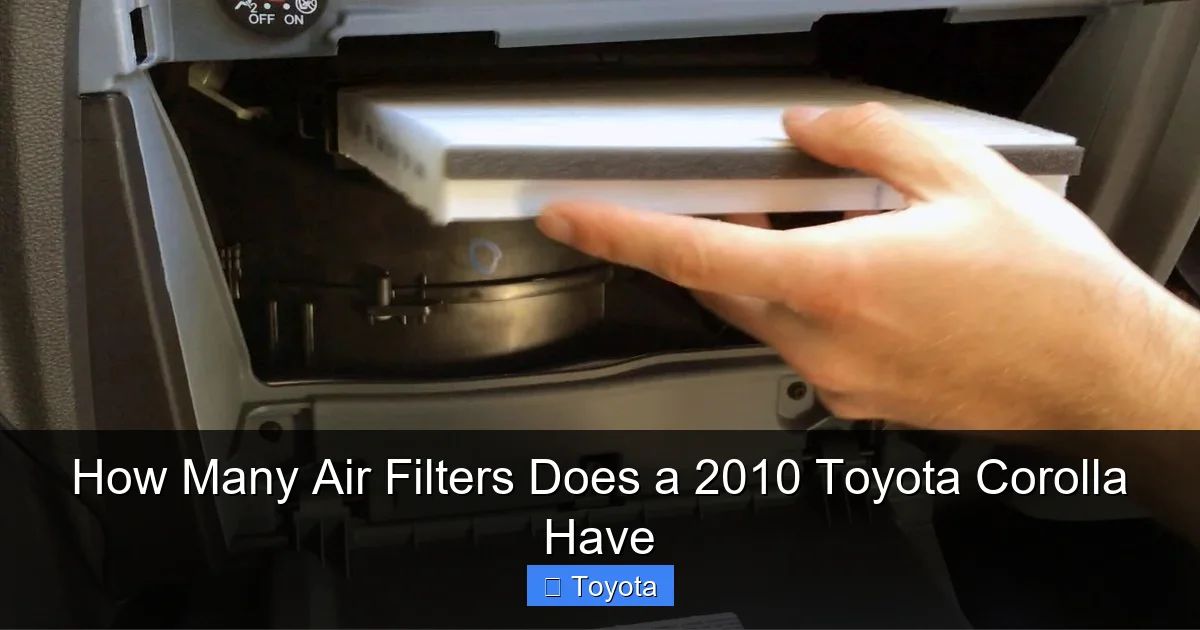
The cabin air filter on the 2010 Toyota Corolla is located behind the glovebox compartment. To access it, you’ll need to remove the glovebox. This sounds more intimidating than it is. Start by opening the glovebox and emptying its contents. You’ll see two or three plastic pins or clips on the top inside of the glovebox door that hold it to the dashboard. These are usually simple plastic retainers. Push them in (sometimes while pulling the glovebox door down) to release the top. The glovebox door will then swing down freely, revealing a plastic cover panel behind it. This panel is the access point to the cabin filter housing. Remove the screws (usually two) holding this cover, and you’ll see the filter slot.
Pro Tip: Place a small towel or box under the glovebox to catch any screws. Also, if the plastic pins are stubborn, consult a YouTube video specific to your model for a visual guide—it can be a huge help for this step.
What It Filters Out and Why It’s a Health Essential
This filter is typically a combination of pleated paper and activated carbon (in higher-grade filters). The paper layer catches physical particulates like dust, pollen, and soot. The carbon layer helps absorb odors, exhaust fumes, and gaseous pollutants. In areas with heavy traffic, wildfire smoke, or industrial pollution, the carbon layer is especially valuable. For allergy sufferers, a clean cabin filter is as important as taking medication—it prevents sneezing, itchy eyes, and respiratory discomfort during your commute. Neglecting it means you’re essentially breathing the same air as outside, but recirculated and concentrated inside your car’s confined space.
Replacement Interval and Environmental Factors
Toyota’s manual suggests checking the cabin filter every 15,000 miles and replacing it as needed. Again, environment dictates reality. If you live in a city with poor air quality, a desert area with constant dust, or a region with high pollen counts (like the American South in spring), you should plan on replacing it every 12,000-15,000 miles or once a year. A musty odor from your vents is a classic sign of a clogged or moldy cabin filter, especially in humid climates. Reduced airflow from your vents, even on the highest fan setting, is another clear indicator.
DIY Replacement Tips for the Cabin Filter
The process is slightly more involved than the engine filter but still very manageable:
- Drop the Glovebox: With the glovebox empty, release the top pins/clips as described. The glovebox door will hang down. You may need to disconnect a small plastic rod or electrical connector for the glovebox light—be gentle.
- Remove the Access Panel: Unscrew the plastic cover behind the glovebox. It’s usually held by two screws.
- Extract the Old Filter: Slide the old filter out. Note its direction; arrows on the filter frame indicate airflow direction (usually pointing toward the cabin/blower). The new filter must be inserted the same way.
- Clean the Housing: Wipe out any debris from the filter housing with a rag. Check for leaves or larger debris that may have accumulated.
- Install the New Filter: Slide the new filter in, respecting the airflow arrow direction.
- Reassemble: Replace the access panel and screws, then lift the glovebox door back into place and secure the top pins/clips. Ensure the light connector is reattached if you disconnected it.
Filter Types: You can choose a standard particulate filter or an upgrade with activated carbon for odor removal. Ensure you buy the correct part number for a 2010 Corolla. They are often sold as “cabin air filter” or “pollen filter.”
The Real-World Consequences of Neglecting Your Air Filters
Knowing when to replace filters is one thing; understanding why it matters is what motivates action. Let’s explore what happens when you ignore these vital components.
Engine Air Filter Neglect: A Cascade of Problems
A severely clogged engine air filter creates a restrictive bottleneck for airflow. The engine’s computer (ECU) detects this through the MAF sensor and tries to compensate by adding more fuel. This “rich” condition has several negative outcomes:
- Reduced Power and Acceleration: The engine literally can’t breathe. You’ll notice sluggish response, especially when trying to pass on the highway or climb hills.
- Poor Fuel Economy: A rich mixture burns more fuel per mile. You could see a drop of 5-10% in MPG, costing you significantly at the pump over time.
- Increased Emissions: Incomplete combustion produces higher levels of hydrocarbons and carbon monoxide. This not only harms the environment but also puts extra strain on your catalytic converter, potentially leading to its premature failure—a very expensive repair.
- Engine Damage: Over time, the extra heat and carbon deposits from a rich mixture can foul spark plugs, damage oxygen sensors, and cause carbon buildup on valves. In extreme cases, dirt particles that sneak past a damaged filter can score cylinder walls, leading to major engine overhaul.
Cabin Air Filter Neglect: Health and Comfort at Risk
The consequences here are more immediate and personal:
- Allergy and Asthma Flare-ups: Pollen, mold spores, and dust mites proliferate in a clogged filter, directly impacting respiratory health.
- Musty Odors: A damp, dirty filter becomes a breeding ground for mold and mildew, which then blows through your vents, creating a persistent, unpleasant smell.
- Weak HVAC Performance: Your fan will sound loud but produce weak airflow. The blower motor has to work much harder, potentially shortening its lifespan. You’ll also notice slower defrosting/defogging in cold or humid weather.
- Foggy Windows: Reduced airflow from the defroster can make it harder to clear your windshield, a major safety issue.
The Environmental Connection
While often overlooked, a clean engine air filter contributes to cleaner emissions. An engine running with the correct air-fuel ratio burns fuel more completely, producing fewer harmful pollutants. This helps your Corolla pass emissions tests and reduces its overall carbon footprint. It’s a small but meaningful part of being a responsible vehicle owner.
Maintenance Best Practices and Smart Tips
Armed with knowledge, let’s establish a smart maintenance routine for your Corolla’s filters.
Creating a Personalized Replacement Schedule
Don’t just follow the generic manual. Assess your driving conditions:
- Severe Service: Frequent dusty roads, heavy traffic, extreme temperatures, or high pollen areas. Replace engine and cabin filters every 12,000-15,000 miles or yearly.
- Normal Service: Mostly highway driving in clean, temperate climates. You might stretch to 30,000 miles for the engine filter, but still inspect the cabin filter annually due to its impact on comfort.
Pro Tip: Mark your calendar or set a reminder in your phone when you install a new filter. Note the date and mileage. Pair filter checks with your oil change—it’s an easy habit to build. When you’re checking your oil level, quickly glance at the air filter housing to see if it’s due.
Choosing the Right Replacement Filter
You have two main options: OEM (Original Equipment Manufacturer) or aftermarket.
- OEM: Sold at Toyota dealerships. Guaranteed to meet Toyota’s specifications. Often a bit more expensive but offers peace of mind.
- Aftermarket: Brands like K&N, Fram, Bosch, and WIX are widely available at auto parts stores and online. They are often cheaper and sometimes offer performance variants (like reusable K&N filters). For the cabin filter, brands like Purolator, Fram, and Bosch are reliable. Read reviews and ensure the part matches your exact year, make, model, and engine size.
Avoid: Cheap, no-name filters with flimsy construction. Poor seals or low-grade media defeat the purpose of filtration.
Professional vs. DIY: Making the Right Call
Both filters are squarely in the beginner-friendly DIY category. The engine filter takes 5-10 minutes and requires one tool. The cabin filter takes 15-30 minutes and might require a bit more patience with the glovebox. You’ll save significant money on labor costs. However, if you’re uncomfortable with any step, or if your glovebox mechanism is stuck, a quick visit to a trusted mechanic is worth the cost. They can also inspect for related issues, like a cracked air box or mold in the HVAC system, during the swap.
Conclusion: A Simple Habit for a Healthy, Efficient Corolla
So, to circle back: your 2010 Toyota Corolla has two air filters, each with a critical, distinct mission. The engine air filter is the guardian of your motor’s performance and longevity. The cabin air filter is the protector of your health and comfort. Treating them with regular attention—inspecting them at every oil change, replacing them when they’re dirty, and never ignoring the signs of a clog—is one of the easiest and most cost-effective ways to keep your Corolla running smoothly, efficiently, and safely for the long haul. It’s a small investment of time and money that pays massive dividends in reliability, fuel savings, and peace of mind. Now that you know exactly what you’re dealing with, you can confidently check, replace, and discuss these filters like a pro. Your Corolla will thank you with many more miles of faithful service.
Frequently Asked Questions
How often should I replace the engine air filter in my 2010 Toyota Corolla?
Inspect it every 15,000 miles and replace it when it appears dirty or clogged. Under normal conditions, replacement is typically needed every 30,000 miles. In dusty or high-pollen environments, plan for every 15,000 miles or once a year.
Where exactly is the cabin air filter located in a 2010 Corolla?
It’s located behind the glovebox. To access it, you must open the glovebox, release the top pins or clips to let the door swing down, and then remove the plastic access panel secured by a couple of screws directly behind the glovebox.
Can I wash and reuse the standard paper engine air filter?
No. The standard disposable paper filter is not designed to be cleaned. Washing it will damage the fibers and ruin its filtration capability. Simply replace it with a new one. However, if you have a reusable cotton gauze filter like K&N, you can wash and re-oil it according to the manufacturer’s instructions.
What are the most common symptoms of a bad cabin air filter?
The primary signs are significantly reduced airflow from your vents (even on high fan speed) and a persistent musty or moldy odor when the HVAC system is on. You might also notice increased dust settling on your dashboard and faster fogging of windows.
Does a clogged engine air filter really affect gas mileage?
Yes, significantly. A restricted filter starves the engine of air, forcing the computer to use more fuel to maintain power. You can lose up to 10% of your fuel efficiency. Replacing a severely clogged filter can often restore lost MPG.
Is the cabin air filter the same as the engine air filter?
Absolutely not. They are completely different filters for different systems. The engine filter is for the motor’s intake and is located in the engine bay. The cabin filter is for the HVAC system and is inside the dashboard. They are not interchangeable and have different part numbers and specifications.