
How Long Does It Take to Charge a Bmw Battery?

Charging a BMW battery isn’t a one-size-fits-all process. The time required can range from a few hours to overnight, depending heavily on your battery’s state of charge, the charger type, and your specific BMW model. Using the correct charger and understanding your battery’s health are critical to avoid damage and ensure longevity. Always prioritize safety and consult your owner’s manual for model-specific guidance.
Key Takeaways
- Charger type is the biggest factor: A standard trickle charger can take 12-48 hours, while a smart/maintenance charger works faster and safer for long-term care.
- A completely dead battery requires special care: Jump-starting is for immediate use, but a full charge on a dedicated charger may take 6-24 hours. Never attempt to charge a physically damaged or frozen battery.
- BMW battery chemistry matters: Most modern BMWs use AGM (Absorbent Glass Mat) batteries, which require a charger with an AGM-specific setting for optimal and safe charging.
- Driving to recharge is inefficient: It can take 30 minutes to several hours of driving at highway speeds to significantly replenish a depleted battery, and it’s hard on the alternator.
- Battery health dictates time: An old, sulfated, or weak battery will accept a charge much more slowly, or not at all, regardless of charger quality.
- Safety first: Always charge in a well-ventilated area, wear eye protection, and connect chargers correctly to prevent sparks or damage to the vehicle’s sensitive electronics.
- Consult your manual: Your BMW’s owner’s manual provides the definitive battery location, type, and any manufacturer-specific charging recommendations.
📑 Table of Contents
- Understanding the BMW Battery: It’s Not Just a Box of Acid
- Charger Types: The #1 Determinant of Charge Time
- The Step-by-Step Charging Process for Your BMW
- Factors That Dramatically Affect Your BMW Battery Charge Time
- What About Jump-Starting and Driving to Recharge?
- Maintenance, Longevity, and When to Replace
- Troubleshooting: When Charging Doesn’t Go as Planned
- Conclusion: Patience, the Right Tools, and BMW-Specific Knowledge
Understanding the BMW Battery: It’s Not Just a Box of Acid
Let’s be honest, when your BMW won’t start, your first thought is usually about the battery. But before we talk about charging times, we need to understand what makes a BMW battery, well, a BMW battery. It’s not the same as the battery in your friend’s economy car from a decade ago. Modern BMWs are packed with electronics—computers, sensors, comfort features—that put a constant, small drain on the battery even when the car is parked. This is called “parasitic drain.” The battery itself has evolved too. Since the early 2000s, BMW has predominantly used Absorbent Glass Mat (AGM) batteries. These are sealed, maintenance-free, and more powerful than traditional flooded lead-acid batteries. They’re designed to handle the deep discharges from start-stop systems and provide reliable power for all those luxury gadgets. This AGM technology is crucial because it dictates how you must charge it. Using an old-school, cheap charger not designed for AGM batteries can damage them, shorten their life, and ultimately make your BMW battery charge time a moot point because you’ll need a new one.
Another key point: battery location. For years, BMW stored the main battery in the engine bay. However, to optimize weight distribution and free up engine bay space, many modern BMWs (like the 3 Series, 5 Series, X5, etc.) have moved the primary 12V battery to the trunk or under the rear seat. This is important for you to know because accessing it to charge it is a different process. Always check your owner’s manual first. Some models even have a small auxiliary battery in the engine bay for the starter motor, but the main battery is the one you’ll be charging. Knowing your specific model’s setup is the first step to a successful charge.
The Role of the Alternator vs. a Dedicated Charger
It’s a common misconception that once you jump-start or drive your BMW, the alternator will fully recharge the battery. While the alternator’s job is to maintain the battery’s charge while the engine runs, it’s not designed to fully recharge a deeply discharged battery. Think of it like this: the alternator is a trickle charger on overdrive, meant to replace the small amount of power used to start the car and run accessories. If your battery is very low, say below 50% charge, the alternator has to work extremely hard to catch up. This can overheat it, shorten its lifespan, and still may not bring the battery to a full, healthy 100% state of charge. A deeply discharged battery often needs a slow, deliberate charge from a dedicated, smart battery charger to properly restore its chemistry. This is why simply driving around after a jump-start is often not the best long-term solution for a weak battery.
Charger Types: The #1 Determinant of Charge Time
This is the heart of the matter. The type of charger you use will dictate your BMW battery charge time more than any other factor. Let’s break them down, from slowest (and often cheapest) to fastest and smartest.
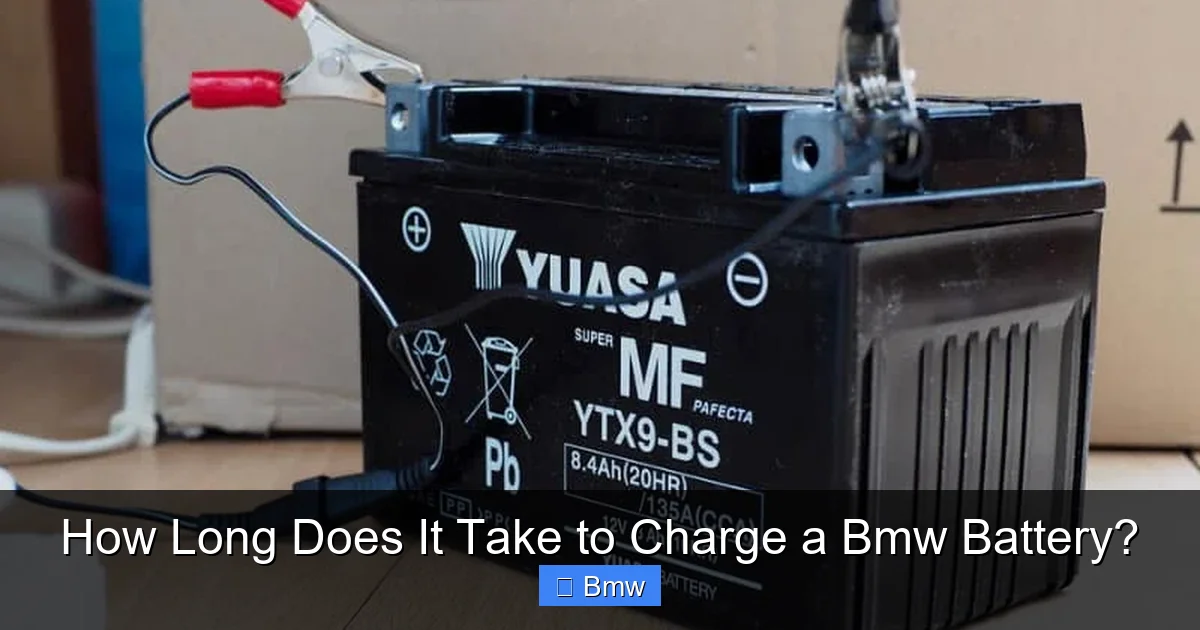
Visual guide about How Long Does It Take to Charge a Bmw Battery?
Image source: bikersrights.com
1. Basic Linear/Trickle Chargers (The “Dumb” Chargers)
These are the simple, often green-box chargers you might find in a garage. They provide a small, constant amperage (usually 1-2 amps) regardless of the battery’s state. They are very slow. For a typical 70-100 Ah (Amp-hour) BMW AGM battery that is completely dead (0% charge), it could take 24 to 48 hours or more to reach a full charge. Their main downside is that they must be manually disconnected once the battery is full. If you forget, you risk overcharging, which boils off the electrolyte (in non-sealed batteries) and damages the internal plates. For an AGM battery, this can be catastrophic. They are only suitable for very small top-up charges on healthy batteries, not for reviving dead ones.
2. Smart/Multi-Stage Chargers (The Recommended Choice)
This is what you should use for your BMW. These chargers are microprocessors controlled. They automatically go through stages: Desulfation/Recovery (to break down sulfate crystals on old batteries), Bulk Charge (high current to bring voltage up quickly), Absorption (tapering current to safely reach 100%), and Float/Maintenance (a tiny trickle to keep it full forever). Because they adjust the amperage based on the battery’s needs, they are faster, safer, and more effective. A good 5-10 amp smart charger can typically bring a deeply discharged AGM battery from 0% to 100% in 6 to 12 hours. Many have AGM-specific settings that optimize the charging voltage profile for your BMW’s battery type. This is the ideal tool for the job. For a great overview of different charging methods and their general timeframes, you can read more about how long it takes to charge a car battery with various devices.
3. Jump Starters & Power Supplies
These are portable battery packs designed for emergency starts, not for charging. They deliver a huge burst of power for a few seconds to crank the engine. After a successful jump-start, your BMW’s own alternator will begin the slow process of replenishing the battery. Do not use a jump starter as a charger; it’s not designed for that and will likely fail to provide a sustained charge. If your battery is so dead it needs a jump, plan on using a proper smart charger afterward for a full recharge.
The Step-by-Step Charging Process for Your BMW
Now that you have the right charger (a smart charger with an AGM setting), let’s walk through the process. Rushing or skipping steps can damage your BMW’s expensive electronic modules.
Visual guide about How Long Does It Take to Charge a Bmw Battery?
Image source: drivinglife.net
Preparation and Safety First
Park your BMW on a level surface, engage the parking brake, and turn off all accessories. Open the trunk or rear seat to access the battery. If it’s under the rear seat, remove the seat cushion according to your manual’s instructions. Important: Many BMWs have a “Battery Registration” or “Battery Coding” requirement. When you replace the battery, the car’s computer must be told a new battery is installed via a diagnostic tool (like BMW’s ISTA or a high-quality OBD2 scanner). However, for charging an existing battery, this is not required. Just be aware that if the battery is replaced, this coding step is essential for proper charging system function. Before connecting anything, set your smart charger to the AGM setting if it has one, and select the appropriate amperage (5-10A is fine for most).
Connecting the Charger Correctly
This is critical. Locate the battery terminals. The positive is red (+) and the negative is black (-). Always connect the positive (red) charger clamp to the positive battery terminal first. Then, connect the negative (black) charger clamp to a clean, unpainted metal bolt or bracket on the BMW’s chassis or engine block, away from the battery itself. This is called “negative ground” and is a safety precaution. If you connect the negative clamp directly to the battery’s negative terminal and then accidentally touch the positive clamp to metal, you create a spark that could ignite any hydrogen gas the battery might emit. Connecting to the chassis avoids this risk. Double-check all connections are secure.
Setting the Charger and Monitoring
Plug in the charger. It should begin its cycle, often indicated by a light or display. For a deeply discharged battery, it may spend a long time in the “Bulk” phase. Do not be alarmed by this. Let it run. A full charge cycle on a smart charger is automatic. You do not need to time it. The charger will switch to “Float” or “Maintenance” mode when done. For a typical AGM battery in a BMW, you can expect the active charging phase (until it hits Float) to last between 6 and 15 hours depending on depletion. Once in Float mode, it can stay connected indefinitely to maintain a perfect charge, which is great for seasonal vehicles or cars driven infrequently. This concept of long-term, safe maintenance is explored further in articles about how long it takes to trickle charge a car battery.
Factors That Dramatically Affect Your BMW Battery Charge Time
Even with the perfect charger, other variables play a huge role. Understanding these will help you set realistic expectations.
Visual guide about How Long Does It Take to Charge a Bmw Battery?
Image source: redwaybattery.com
State of Discharge (How Dead Is It?)
This is the most obvious factor. A battery that’s at 50% charge will take roughly half the time to charge as one at 0%. But here’s the catch: as a battery charges, its acceptance rate (how easily it takes current) slows down. The last 20% of charge (from 80% to 100%) takes significantly longer than the first 20%. So a battery at 20% might take 4 hours to get to 80%, but then another 4-6 hours to top off to 100%. Smart chargers handle this automatically, but it explains why a “full” charge can feel like it takes forever once the indicator gets close to complete.
Battery Age and Health
An old battery is a slow-charging battery. Over years, lead sulfate crystals harden on the plates (sulfation), and the internal components degrade. A weak or failing 5-year-old AGM battery might accept a charge very sluggishly, or it might show a “full” voltage quickly but then drain overnight because it can’t hold the charge. If your BMW battery charge time suddenly seems much longer than it used to, the battery itself is likely the problem, not the charger. A simple load test at a auto parts store (often free) can tell you if the battery is still healthy.
Temperature Extremes
Cold is the enemy of battery chemistry. A cold battery has reduced capacity and accepts a charge much more slowly. If it’s freezing outside, your charge time could double. Conversely, very high heat can also accelerate water loss (in flooded batteries) and damage. Ideally, charge your BMW’s battery in a cool, dry place like a garage. If you must charge it in the cold, be patient. Some smart chargers have temperature compensation features that adjust the voltage slightly for better performance in extreme temps.
Battery Capacity (Amp-Hours)
A larger battery stores more energy and therefore takes longer to fill. A BMW i3 electric vehicle has a massive high-voltage traction battery, but we’re focusing on the 12V system. Even within 12V batteries, a base model 3 Series might have a 70Ah battery, while an X7 with lots of options might have a 90Ah or larger battery. More Amp-hours means more total energy to put back in, so a larger battery will take longer to charge from the same depleted state with the same charger.
What About Jump-Starting and Driving to Recharge?
These are common “quick fix” methods, but they come with significant caveats regarding charge time and battery health.
The Jump-Start: A Temporary Solution
When you use jumper cables or a portable jump starter, you’re essentially borrowing power from another vehicle’s battery to crank your BMW’s engine. This provides a very small amount of charge to the BMW’s battery—maybe 1-2% at best. The real work begins after the engine is running. The alternator now has to replenish the massive amount of energy used to start the car (hundreds of amps for a few seconds) and then continue running the car’s systems. If the battery was very low, the alternator will be working at near-maximum output for a long time. This is stressful for it and may not fully restore the battery. The time to charge a car battery after a jump start via driving alone is highly variable, but a rule of thumb is at least 30-60 minutes of continuous highway driving (above 2000 RPM) to get a meaningful charge. Stop-and-go city driving does very little. For more details on this process, see how long it takes for car battery to charge after a jump.
Driving to Recharge: The Inefficient Method
Let’s say your BMW’s battery is at 30% and you want to drive to recharge it. At idle, the alternator might produce 20-50 amps. At 3000 RPM, it might produce 80-120 amps. A 70Ah battery at 30% needs roughly 50Ah of charge to get to 100%. In an ideal world, at 100 amps output, that’s 30 minutes. But it’s not ideal. The alternator’s output drops as the battery voltage rises, and your car’s lights, infotainment, and engine control units are drawing power the whole time. Realistically, you’re looking at 1.5 to 3 hours of steady, highway-speed driving to get a decent recharge. This is hard on the alternator and inefficient for fuel consumption. A dedicated charger is always the better, faster, and more complete method.
Maintenance, Longevity, and When to Replace
Proper charging isn’t just about fixing a dead battery; it’s about preventing the problem in the first place.
Using a Smart Maintainer/Trickle Charger
If you don’t drive your BMW regularly—say, it’s a weekend car, a second vehicle, or you’re going on vacation—a smart trickle charger or battery maintainer is your best friend. These devices are designed to be connected for months at a time. They constantly monitor the battery’s voltage and only provide a tiny “float” charge when needed to keep it at 100%. This prevents the slow self-discharge that all batteries experience and eliminates the risk of overcharging. For a BMW that sits, this can easily add 2-3 years to your battery’s life. The time it takes to charge a neglected battery with one of these is the same as a standard smart charger initially, but then it switches to a perpetual maintenance mode. You can learn more about the long-term benefits of trickle charging a car battery.
Signs Your BMW Battery is Nearing the End
Even with perfect charging, batteries die. Typical AGM battery life in a BMW is 4-7 years, depending on climate and usage. Watch for these signs: slow or hesitant engine cranking, especially when cold; the check engine light or battery warning light illuminating; electrical glitches (like radio presets resetting); and a swollen or bloated battery case. If your battery is over 4 years old and you’re having to charge it frequently, it’s time for a replacement test. A weak battery will take forever to “charge” because it can’t hold the energy. Remember, charging a dead battery is one thing, but if it’s a dead car battery due to internal failure, no charger will revive it permanently.
The Importance of Battery Registration on Modern BMWs
I must mention this critical step for battery replacement. When you put a new battery in a BMW from roughly 2007 onward, the car’s engine control unit (ECU) needs to be informed. This is done via a diagnostic scan tool that “registers” the new battery and tells the car its specifications (type: AGM or flooded, capacity, etc.). The car’s charging system then adjusts its output accordingly. If you skip this step, the alternator may continue to charge at the rate set for the old, weaker battery, which can overcharge and destroy the new AGM battery within a year or two. This is a BMW-specific procedure that requires professional tools or a very advanced consumer scanner. It’s not part of the charging process for an existing battery, but it is the most important step when replacing one.
Troubleshooting: When Charging Doesn’t Go as Planned
You’ve followed all the steps, but the battery won’t take a charge or the charger shows an error. Here’s what to check.
Charger Shows “Bad Battery” or Won’t Switch Stages
First, ensure your charger is set to AGM if your BMW uses an AGM battery (almost certainly it does). If it still won’t charge, the battery may have an internal short circuit, a broken cell, or be so sulfated it’s unrecoverable. Try cleaning the terminals with a baking soda/water mix and a wire brush to ensure good contact. If the battery is physically swollen, leaking, or frozen, do not attempt to charge it. Dispose of it properly and get a new one.
Battery Charges but Drains Overnight
This indicates the battery is weak and can’t hold a charge, OR your BMW has a significant parasitic drain. A small drain (30-50 milliamps) is normal for clock and memory. A drain over 200 milliamps indicates a module or accessory is staying on. This is a common issue in BMWs with faulty control units or aftermarket accessories (alarms, stereos). A mechanic can perform a “parasitic drain test” to find the culprit. Charging a battery that’s being constantly drained is like trying to fill a bucket with a hole in it.
Warning Lights After Charging
If you get a battery or charging system warning light after installing a newly charged battery, first check the connections. Are they tight and clean? Is the negative cable properly grounded to the chassis? If connections are good, the issue might be the battery registration mentioned earlier (if it’s a new battery) or a faulty alternator. The alternator might not be producing enough voltage (should be ~13.8-14.4V with engine running) to keep the system charged.
Conclusion: Patience, the Right Tools, and BMW-Specific Knowledge
So, how long does it take to charge a BMW battery? The honest, most useful answer is: it depends. With a proper smart charger set for AGM batteries, you’re looking at a window of 6 to 15 hours for a full charge from a deeply discharged state. A trickle charger could take days. Jump-starting and driving is an unreliable method that may take hours of highway driving and still not result in a full, healthy charge. The key takeaway is to invest in a quality smart charger, understand your specific BMW’s battery location and type, and always prioritize safety. Remember, a battery is a consumable part. Proper charging and maintenance will maximize its lifespan and save you from the frustration of a stranded BMW. If you’re ever in doubt, especially concerning battery registration or persistent electrical issues, consult with a BMW specialist. They have the diagnostic tools to ensure your car’s sophisticated electrical system is perfectly balanced and your battery is charging exactly as the engineers intended.
Frequently Asked Questions
Can I use a regular car battery charger on my BMW?
You can, but it’s not recommended. Most BMWs use AGM batteries, which require a charger with an AGM-specific setting or a smart charger that automatically adjusts. Using a basic, non-smart charger risks overcharging and damaging the expensive AGM battery.
How long should I drive my BMW after a jump start to recharge the battery?
You should drive for at least 30 to 60 minutes at steady highway speeds (above 2000 RPM) to allow the alternator to put a meaningful amount of charge back into the battery. Short trips or idling will not sufficiently recharge it.
Is it safe to leave my BMW battery on a trickle charger all winter?
Yes, absolutely—but only if you are using a smart trickle charger or battery maintainer. These devices automatically switch to a float mode once the battery is full, providing just enough voltage to maintain the charge without overcharging. Never use a basic, non-smart charger for long-term connection.
My BMW battery is completely dead. Can I still charge it?
Often, yes. A battery that reads 0 volts might just be deeply discharged, not necessarily ruined. Use a smart charger with a recovery or desulfation mode. However, if the battery is physically damaged, frozen, or has a bad cell, it will not accept a charge and must be replaced.
Why does my BMW battery keep dying even after I charge it?
This usually points to one of two issues: 1) The battery is old and can no longer hold a charge, or 2) There is a parasitic drain in the electrical system where a module or accessory is drawing power when the car is off. A professional parasitic drain test is needed to diagnose the latter.
Do I need to register a new battery in my BMW before or after charging it?
Battery registration is only required when you replace the battery, not when you charge an existing one. You register the new battery using a diagnostic scan tool to tell the car’s computer about the new battery’s specifications. This ensures the charging system works correctly. You charge the new battery fully before installation, then perform the registration procedure after it’s installed.
