How Long Does It Take for a Car Battery to Charge
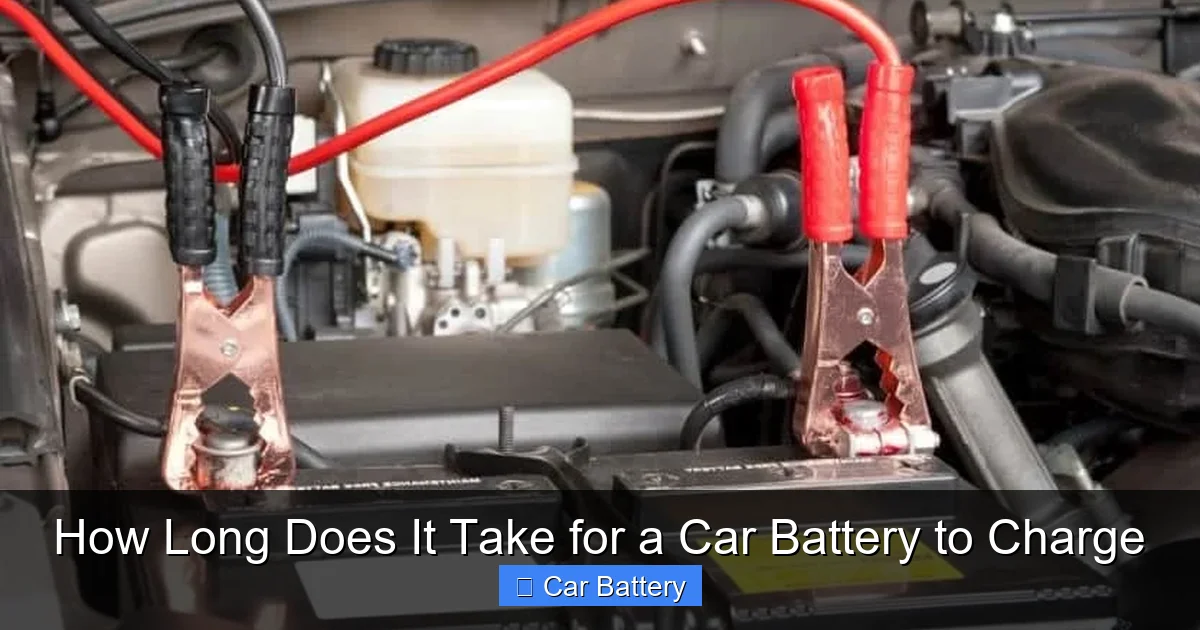
Charging a car battery typically takes 4 to 24 hours, depending on the charger type, battery condition, and state of charge. While a trickle charger may take a full day, a smart charger can restore power in just a few hours—knowing the difference helps you avoid being stranded.
In This Article
- 1 Key Takeaways
- 2 📑 Table of Contents
- 3 How Long Does It Take for a Car Battery to Charge?
- 4 Understanding Car Batteries and Charging Basics
- 5 Factors That Affect Charging Time
- 6 How Long Does It Really Take? Real-World Examples
- 7 Types of Car Battery Chargers and Their Speeds
- 8 Tips to Speed Up Charging and Maintain Battery Health
- 9 When to Replace Instead of Recharge
- 10 Conclusion
- 11 Frequently Asked Questions
Key Takeaways
- Charging time varies widely: A fully dead battery can take 4 to 24 hours to recharge, depending on the charger and battery size.
- Charger type matters most: Trickle chargers are slow but safe; smart chargers adjust output for faster, safer charging.
- Battery condition affects speed: Old or damaged batteries charge slower and may never reach full capacity.
- State of charge is key: A partially drained battery charges much faster than one that’s completely dead.
- Temperature plays a role: Cold weather slows chemical reactions, increasing charging time.
- Alternator charges while driving: A healthy alternator can recharge a weak battery in 30 minutes to an hour of driving.
- Maintenance prevents long charges: Regular checks and cleaning terminals help maintain optimal charging efficiency.
📑 Table of Contents
- How Long Does It Take for a Car Battery to Charge?
- Understanding Car Batteries and Charging Basics
- Factors That Affect Charging Time
- How Long Does It Really Take? Real-World Examples
- Types of Car Battery Chargers and Their Speeds
- Tips to Speed Up Charging and Maintain Battery Health
- When to Replace Instead of Recharge
- Conclusion
How Long Does It Take for a Car Battery to Charge?
So your car won’t start. You turn the key, and all you hear is a faint click—or maybe nothing at all. Your first thought? “Is the battery dead?” And if it is, your next question is probably: “How long will it take to charge it?”
The truth is, there’s no one-size-fits-all answer. Charging time depends on several factors, including the type of charger you’re using, how dead the battery is, the battery’s age and health, and even the weather. But don’t worry—we’re going to break it all down so you know exactly what to expect and how to get back on the road safely and efficiently.
Whether you’re dealing with a weekend warrior SUV, a daily commuter sedan, or an older vehicle that’s seen better days, understanding how long it takes for a car battery to charge can save you time, money, and a lot of frustration. In this guide, we’ll walk you through the science behind battery charging, the different types of chargers available, real-world charging scenarios, and practical tips to keep your battery in top shape.
Understanding Car Batteries and Charging Basics
Visual guide about How Long Does It Take for a Car Battery to Charge
Image source: autocarelabs.com
Before we dive into charging times, let’s get familiar with how car batteries work. Most vehicles on the road today use a 12-volt lead-acid battery. These batteries store electrical energy through a chemical reaction between lead plates and sulfuric acid electrolyte. When you start your car, the battery delivers a burst of power to the starter motor. Once the engine is running, the alternator takes over, generating electricity to power the car’s systems and recharge the battery.
But here’s the catch: car batteries aren’t designed to be deeply discharged. Unlike phone or laptop batteries, which are built for regular charging cycles, car batteries are meant to provide short, high-current bursts. If you let your battery drain too low—say, by leaving the lights on overnight—it can suffer permanent damage. That’s why knowing how to properly charge it matters.
What Does “Charging” Actually Mean?
Charging a car battery means restoring the chemical energy inside it. When a battery is discharged, the lead plates become coated with lead sulfate. Charging reverses this process by applying an external electrical current, converting the sulfate back into lead and sulfuric acid. This restores the battery’s ability to hold a charge.
The speed of this process depends on the charging current—measured in amps. A higher amp output means faster charging, but too much too fast can overheat the battery and cause damage. That’s why most modern chargers are designed to adjust their output based on the battery’s needs.
Types of Car Batteries
Not all car batteries are the same. The most common types include:
– Flooded Lead-Acid (FLA): The standard type found in most vehicles. Requires regular maintenance and can be sensitive to deep discharges.
– Absorbent Glass Mat (AGM): More durable and resistant to vibration. Common in newer cars with start-stop technology. Charges faster than FLA but requires a compatible charger.
– Gel Cell: Similar to AGM but uses a gel electrolyte. Less common and more sensitive to overcharging.
Each type has different charging requirements, so always check your battery label or owner’s manual before plugging in a charger.
Factors That Affect Charging Time
Visual guide about How Long Does It Take for a Car Battery to Charge
Image source: carbatterygeek.co.uk
Now that we understand the basics, let’s look at what really determines how long it takes for a car battery to charge. It’s not just about plugging in and waiting—several variables come into play.
Battery Capacity (Ah Rating)
Car batteries are rated in amp-hours (Ah), which tells you how much charge they can store. A typical car battery has a capacity of 40 to 70 Ah. The higher the Ah rating, the longer it will take to charge—assuming the same charging current.
For example, a 50 Ah battery being charged at 10 amps would theoretically take 5 hours to go from 0% to 100%. But in reality, charging isn’t 100% efficient. Some energy is lost as heat, and charging slows down as the battery fills up. So, you’ll likely need closer to 6–7 hours.
State of Charge (SoC)
How dead is your battery? This is one of the biggest factors. A battery that’s only 20% discharged will charge much faster than one that’s completely flat.
Let’s say your battery has 30% charge left. That means it only needs to regain 70% of its capacity. If it’s a 50 Ah battery, that’s 35 Ah to restore. At 10 amps, that’s about 3.5 hours—plus some extra time for inefficiencies.
But if the battery is completely dead (0% SoC), you’re looking at a much longer process. And if the battery has been dead for days or weeks, sulfation (a buildup of lead sulfate crystals) may have occurred, making it even harder to charge.
Charger Type and Output
This is where things get interesting. Not all chargers are created equal. The type of charger you use has a huge impact on charging time.
– Trickle Chargers (1–3 amps): These are the slowest but safest. Ideal for maintaining a battery over long periods (like during winter storage). A 1-amp trickle charger might take 24 hours or more to fully charge a dead battery.
– Standard Chargers (4–10 amps): Common for home use. A 6-amp charger can recharge a moderately drained battery in 4–8 hours.
– Smart Chargers (4–15 amps with auto features): These detect the battery’s state and adjust voltage and current accordingly. They can charge faster and safer, often completing the job in 2–6 hours.
– Jump Starters with Charging Function: Portable devices that can give your battery a quick boost. Some include built-in chargers, but they’re usually limited to 2–4 amps, so full charging still takes time.
Battery Age and Health
An old or damaged battery won’t charge as efficiently. Over time, lead plates degrade, and the battery loses its ability to hold a charge. A battery older than 4–5 years may only accept 60–70% of its original capacity, even when fully charged.
If your battery is more than five years old and frequently needs charging, it might be time for a replacement. Trying to charge a failing battery can be frustrating—it may take longer, overheat, or fail to hold a charge at all.
Temperature and Environment
Cold weather slows down the chemical reactions inside the battery, making it harder to charge. In freezing temperatures, a battery may take 20–30% longer to charge. Conversely, high heat can increase charging speed but also raises the risk of overcharging and damage.
Ideally, charge your battery in a cool, dry place—around 60–80°F (15–27°C). If you’re charging in winter, consider bringing the battery indoors or using a charger with temperature compensation.
How Long Does It Really Take? Real-World Examples
Visual guide about How Long Does It Take for a Car Battery to Charge
Image source: cdn.shopify.com
Let’s put theory into practice with some common scenarios.
Scenario 1: Partially Drained Battery (Lights Left On)
You left your headlights on overnight, and now the car won’t start. The battery is probably around 30–40% charged.
– Charger: 6-amp smart charger
– Battery: 50 Ah, relatively new
– Estimated Time: 3–5 hours
The smart charger will start with a higher current to quickly restore most of the charge, then taper off as the battery fills up. You should be able to start the car within a few hours.
Scenario 2: Completely Dead Battery (No Click)
The battery is fully discharged—maybe you tried to start the car multiple times with no success.
– Charger: 10-amp standard charger
– Battery: 60 Ah, in good condition
– Estimated Time: 8–12 hours
Even with a higher amp charger, a dead battery takes time. The first 70–80% might charge in 6 hours, but the final 20% (called the “absorption phase”) is slower and crucial for full capacity.
Scenario 3: Old Battery (5+ Years Old)
Your battery is old and has been struggling in cold weather.
– Charger: 6-amp smart charger
– Battery: 50 Ah, degraded capacity (~60% of original)
– Estimated Time: 10–16 hours (if it charges at all)
An old battery may not accept a full charge. The charger might detect low voltage and reduce output, or the battery could overheat. In this case, replacement is often the better option.
Scenario 4: Using the Alternator (Driving)
You jump-started the car and now want to recharge the battery by driving.
– Condition: Battery was 50% charged
– Driving Time: 30–60 minutes of highway driving
A healthy alternator can recharge a weak battery relatively quickly. But if the battery was deeply discharged, you may need 1–2 hours of driving to restore full charge. Note: Short trips (under 15 minutes) won’t help much—the alternator needs time to work.
Types of Car Battery Chargers and Their Speeds
Choosing the right charger can make a big difference in how long it takes for a car battery to charge. Let’s compare the most common types.
Trickle Chargers
– Output: 1–3 amps
– Best For: Long-term maintenance, seasonal storage
– Charging Time: 24+ hours for a full charge
– Pros: Safe, affordable, prevents overcharging
– Cons: Very slow; not ideal for emergency use
Trickle chargers are great if you have a classic car or motorcycle that sits for months. But if you need your car tomorrow, this isn’t the best choice.
Standard Battery Chargers
– Output: 4–10 amps
– Best For: Occasional use, home garages
– Charging Time: 4–12 hours
– Pros: Faster than trickle chargers; widely available
– Cons: Can overcharge if left unattended; no smart features
These are the chargers you’ll find at most auto parts stores. They’re reliable but require monitoring. Never leave one plugged in overnight without checking it.
Smart Chargers (Automatic Chargers)
– Output: 4–15 amps (adjustable)
– Best For: Everyday use, all battery types
– Charging Time: 2–8 hours
– Pros: Auto-detects battery type and state; prevents overcharging; fast and safe
– Cons: More expensive
Smart chargers are the gold standard. They use microprocessors to monitor voltage, current, and temperature. They’ll start with a bulk charge, switch to absorption mode, then float mode to maintain charge. Many can even desulfate old batteries.
Jump Starters with Charging Function
– Output: 2–4 amps (charging mode)
– Best For: Emergency boosts, portable use
– Charging Time: 6–12 hours for a full charge
– Pros: No outlet needed; doubles as a jump starter
– Cons: Limited charging speed; battery capacity affects performance
These are handy for roadside emergencies, but don’t rely on them for full charging. Use them to get the car started, then drive or use a wall charger.
Tips to Speed Up Charging and Maintain Battery Health
Want to reduce charging time and keep your battery in great shape? Follow these practical tips.
Use the Right Charger for Your Battery
Always match your charger to your battery type. AGM and gel batteries require specific charging profiles. Using a standard charger on an AGM battery can damage it. Look for chargers labeled “AGM-compatible” or “multi-chemistry.”
Clean the Battery Terminals
Corrosion on the terminals increases resistance, slowing down charging. Use a mixture of baking soda and water to clean the terminals, then apply a thin layer of petroleum jelly to prevent future buildup.
Charge in a Warm Environment
Cold batteries charge slower. If possible, bring the battery indoors or park the car in a garage before charging. Avoid charging in direct sunlight or extreme heat.
Don’t Overcharge
Leaving a battery on the charger too long can cause overheating, water loss, and reduced lifespan. Smart chargers prevent this, but if you’re using a standard charger, unplug it once the battery is full.
Drive Regularly
Short trips don’t give the alternator enough time to recharge the battery. Aim for at least 20–30 minutes of driving a few times a week to keep the battery topped up.
Test Your Battery Annually
Most auto shops offer free battery testing. A load test can reveal if your battery is holding a charge. Replace it before it fails completely.
When to Replace Instead of Recharge
Sometimes, no amount of charging will fix a battery. Here are signs it’s time for a replacement:
– The battery is more than 5 years old
– It frequently dies, even after charging
– It swells or leaks
– The charger shows “bad battery” or won’t hold a charge
– You notice a sulfur (rotten egg) smell
Replacing a battery is cheaper and safer than repeatedly trying to revive a failing one. Most batteries last 3–5 years, depending on climate and usage.
Conclusion
So, how long does it take for a car battery to charge? The answer depends—but now you know what factors matter most. From charger type and battery condition to temperature and state of charge, each plays a role in determining charging time.
In general, expect 4 to 24 hours for a full charge, with smart chargers offering the best balance of speed and safety. And remember: regular maintenance and smart charging habits can prevent many battery issues before they start.
Whether you’re dealing with a quick top-up or a full recharge, using the right tools and techniques will keep your car ready to go when you are. Don’t wait until you’re stranded—take care of your battery today, and it’ll take care of you tomorrow.
Frequently Asked Questions
How long does it take to charge a car battery at 10 amps?
At 10 amps, a typical 50–60 Ah battery can take 6–10 hours to fully charge from dead. The first 70–80% may charge in 4–6 hours, but the final phase is slower to prevent overcharging.
Can you overcharge a car battery?
Yes, overcharging can cause overheating, water loss, and damage. Use a smart charger with auto-shutoff to avoid this. Never leave a standard charger connected indefinitely.
How long should I drive to recharge a dead battery?
After a jump start, drive for at least 30–60 minutes at highway speeds to allow the alternator to recharge the battery. Short trips won’t provide enough charge.
Is it safe to charge a car battery overnight?
It’s safe if you use a smart charger with automatic shutoff. Standard chargers can overcharge if left too long, so monitor them or use a timer.
Can a completely dead battery be recharged?
It depends. If the battery is old or has sulfated, it may not accept a charge. A healthy battery can usually be recharged, but deeply discharged batteries take longer and may lose capacity.
Does cold weather affect charging time?
Yes, cold temperatures slow chemical reactions in the battery, increasing charging time by 20–30%. Charge in a warm garage when possible for best results.