How Long Does a 30 Lb Propane Tank Last
Knowing how long a 30 lb propane tank lasts helps you plan for grilling, camping, or home heating without running out unexpectedly. The answer depends on your appliance’s BTU rating, usage frequency, and environmental conditions—but with the right info, you can estimate runtime and avoid mid-cookout surprises.
If you’ve ever fired up your grill for a summer cookout only to hear that sputtering flame fade into silence, you know the frustration of an empty propane tank. Whether you’re grilling burgers, heating your RV, or running a backup generator, understanding how long a 30 lb propane tank lasts is essential for planning and peace of mind. The good news? With a little knowledge, you can predict how long your tank will last and avoid being left in the cold—literally or figuratively.
A 30 lb propane tank is one of the most common sizes for residential and recreational use. It’s large enough to power major appliances for extended periods, yet portable enough to move around the yard or load into a vehicle. But “how long does it last?” isn’t a one-size-fits-all answer. The runtime depends on several factors, including the type of appliance, how often you use it, the outside temperature, and even how well you maintain your tank. In this guide, we’ll break down everything you need to know to estimate your propane usage, maximize efficiency, and keep your fuel supply reliable.
By the end of this article, you’ll be able to calculate approximate burn times for your specific setup, understand the role of BTUs in fuel consumption, and learn practical tips to make your propane last longer. Whether you’re a weekend warrior griller or a full-time RVer, this information will help you get the most out of every pound of propane.
In This Article
- 1 Key Takeaways
- 2 📑 Table of Contents
- 3 Understanding Propane Tank Capacity and BTUs
- 4 How Different Appliances Affect Tank Life
- 5 Factors That Influence Propane Tank Runtime
- 6 Tips to Extend the Life of Your 30 lb Propane Tank
- 7 When to Refill or Replace Your Tank
- 8 Conclusion
- 9 Frequently Asked Questions
- 9.1 How long does a 30 lb propane tank last on a gas grill?
- 9.2 Can I use a 30 lb propane tank for my RV?
- 9.3 Does cold weather affect how long a propane tank lasts?
- 9.4 How can I tell how much propane is left in my tank?
- 9.5 Is it better to refill or exchange a propane tank?
- 9.6 Can I store a 30 lb propane tank indoors?
Key Takeaways
- Runtime varies by appliance: A 30 lb propane tank can last anywhere from 18 to 20 hours on a standard gas grill, but only 8–10 hours on a high-BTU patio heater.
- BTU rating is key: Higher BTU appliances consume propane faster—always check your device’s BTU output to estimate burn time.
- Usage patterns matter: Intermittent use (like weekend barbecues) extends tank life, while continuous use (like heating an RV) drains it quickly.
- Temperature affects performance: Cold weather slows vaporization, reducing efficiency and potentially shortening runtime in winter conditions.
- Tank maintenance extends life: Proper storage, leak checks, and keeping the tank upright help ensure safe, efficient use.
- Refill vs. exchange: Refilling your own tank is often cheaper and more eco-friendly than swapping at retail exchange stations.
- Smart monitoring helps: Use a propane gauge or scale to track fuel levels and avoid unexpected runouts during critical use.
📑 Table of Contents
Understanding Propane Tank Capacity and BTUs
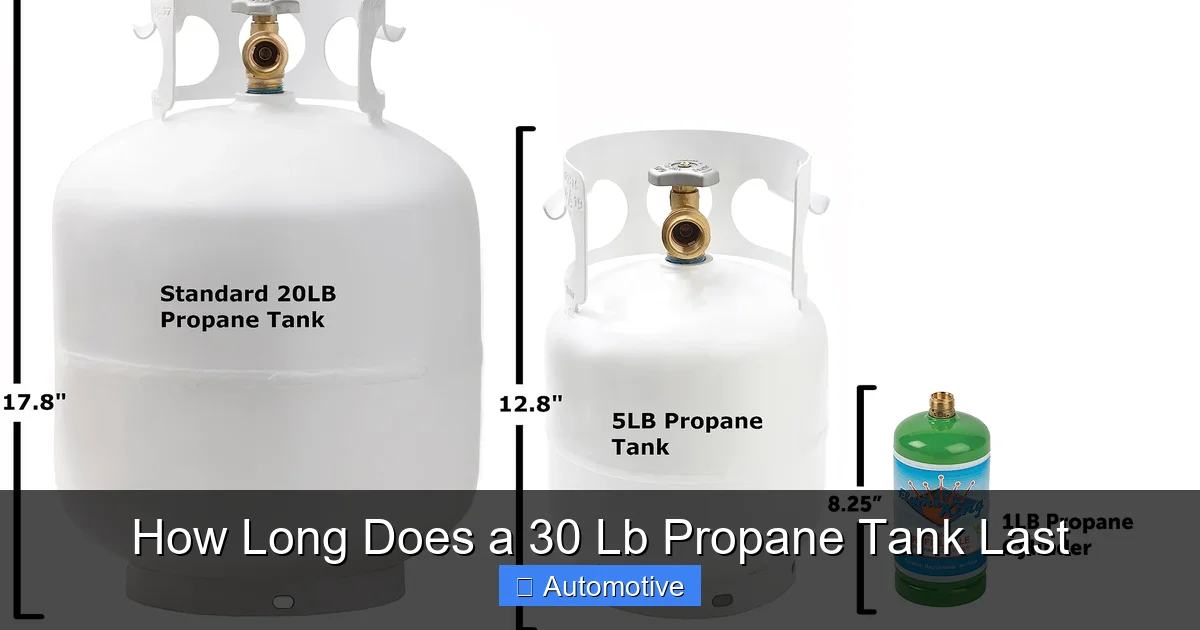
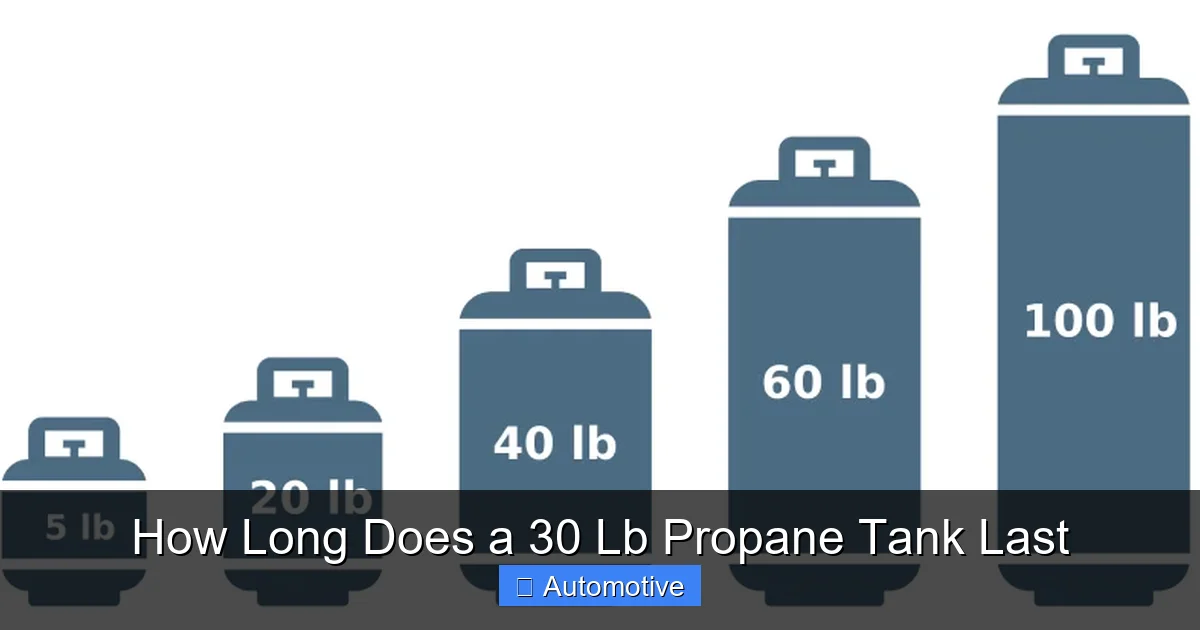
Before diving into runtime estimates, it’s important to understand what’s inside that 30 lb tank and how it’s measured. A 30 lb propane tank doesn’t actually hold 30 pounds of liquid propane at all times—due to safety regulations, tanks are only filled to about 80% capacity to allow for expansion. This means a full 30 lb tank holds approximately 24 pounds of propane.
Now, here’s where the magic happens: propane is measured in British Thermal Units (BTUs), which represent the amount of heat needed to raise the temperature of one pound of water by one degree Fahrenheit. One gallon of propane contains about 91,500 BTUs, and since propane weighs about 4.2 pounds per gallon, a 30 lb tank (with ~7.1 gallons) holds roughly 650,000 BTUs of energy.
This BTU number is crucial because it directly relates to how long your tank will last. Every propane-powered appliance has a BTU rating—this tells you how much fuel it consumes per hour. For example, a typical gas grill might burn at 30,000 BTUs per hour. If you divide the total BTUs in your tank (650,000) by the appliance’s hourly usage (30,000), you get about 21.6 hours of runtime. That’s a solid estimate for continuous use.
But remember: most people don’t run their grill nonstop for 21 hours. Real-world usage is usually intermittent—30 minutes here, an hour there—so your tank will last much longer in practice. Still, knowing the math helps you plan for longer events or multiple uses.
Why BTU Ratings Matter
The BTU rating of your appliance is the single biggest factor in determining how long your propane will last. Higher BTU means more heat output, but also faster fuel consumption. For instance, a high-performance outdoor patio heater might run at 40,000 BTUs, while a small camping stove could be as low as 5,000 BTUs.
Let’s look at a few common examples:
– A standard 4-burner gas grill: 30,000–40,000 BTUs
– A portable propane heater: 10,000–20,000 BTUs
– An RV furnace: 20,000–30,000 BTUs
– A propane fire pit: 30,000–50,000 BTUs
If you’re using multiple appliances at once—say, a grill and a fire pit—you’ll need to add their BTU ratings together to get total consumption. This is especially important for RVers or cabin owners who rely on propane for heating, cooking, and hot water.
Calculating Runtime: A Simple Formula
To estimate how long your 30 lb tank will last, use this simple formula:
Runtime (hours) = Total BTUs in tank ÷ Appliance BTU per hour
Using the numbers above:
– Total BTUs in a 30 lb tank: ~650,000
– Grill at 35,000 BTUs/hour: 650,000 ÷ 35,000 ≈ 18.6 hours
So, under continuous use, your grill would run for about 18–19 hours. But again, most grilling sessions are 1–2 hours long, so you could get 10–15 cookouts from a single tank.
For intermittent use, multiply the runtime by your average usage per session. If you grill for 1.5 hours per week, a 30 lb tank could last you 12–15 weeks.
How Different Appliances Affect Tank Life
Visual guide about How Long Does a 30 Lb Propane Tank Last
Image source: learnmetrics.com
Not all propane appliances are created equal—and neither is their impact on your tank’s lifespan. Let’s break down how common uses affect how long a 30 lb propane tank lasts.
Gas Grills and Outdoor Cooking
Gas grills are the most common use for a 30 lb propane tank. A typical mid-sized grill burns between 30,000 and 40,000 BTUs per hour. Based on our earlier calculation, that means you’ll get about 16 to 21 hours of continuous burn time.
But here’s the reality: most people don’t grill for 20 hours straight. A weekend barbecue might last 2 hours. If you grill once a week, your tank could last 8–10 months. That’s why many homeowners go through just one or two tanks per year.
Pro tip: Use a lower heat setting when possible. Cooking at medium instead of high can reduce BTU usage by 25–30%, significantly extending your tank life.
Patio Heaters and Fire Pits
Outdoor heaters and fire pits are popular for extending the outdoor season into cooler months. However, they can be major propane guzzlers. A standard patio heater might run at 40,000 BTUs, meaning a 30 lb tank would last only about 16 hours of continuous use.
If you use your heater for 3 hours per evening, that’s just over 5 nights of warmth. For frequent users, this means refilling or exchanging tanks every week or two during peak season.
Fire pits vary widely—some are designed for ambiance and run at lower BTUs (20,000–30,000), while others are built for serious heat and can exceed 50,000 BTUs. Always check the manufacturer’s specs.
RV and Camper Use
For RVers, a 30 lb propane tank is often the primary fuel source for heating, cooking, and refrigeration. But usage adds up fast. An RV furnace might run at 25,000 BTUs, and if it cycles on and off throughout the night, it can consume a significant portion of your tank.
In cold weather, an RV furnace might run 6–8 hours per night. At 25,000 BTUs, that’s 150,000–200,000 BTUs per night—about 25–30% of your tank’s total capacity. That means a 30 lb tank could last just 3–4 nights in winter conditions.
Cooking and water heating add to the load. A propane-powered water heater might use 10,000 BTUs per shower, and a stove burner can run at 8,000–10,000 BTUs. For full-time RVers or winter campers, it’s common to go through a 30 lb tank every week or two.
Backup Generators and Emergency Use
Propane-powered generators are a reliable backup during power outages. A 5,000-watt generator might consume about 2.5 gallons of propane per hour—roughly 10.5 pounds. That means a 30 lb tank (24 lbs of propane) would last about 9–10 hours under full load.
However, most generators don’t run at 100% capacity continuously. If your generator cycles on and off to meet demand, runtime can extend to 15–20 hours. Still, for prolonged outages, you may need multiple tanks or a larger propane system.
Portable Stoves and Camping Gear
On the other end of the spectrum, small camping stoves use very little propane. A typical backpacking stove burns at 5,000–8,000 BTUs. At that rate, a 30 lb tank could theoretically last 80–130 hours—though no one carries a 30 lb tank on a hike!
Most campers use smaller 1 lb or 5 lb cylinders. But if you’re car camping or hosting a large group, a 30 lb tank with a regulator can power multiple stoves or a large camp kitchen for days.
Factors That Influence Propane Tank Runtime

Visual guide about How Long Does a 30 Lb Propane Tank Last
Image source: girlscangrill.com
While BTU ratings give you a baseline, real-world runtime can vary based on several external factors. Understanding these can help you plan better and avoid unexpected runouts.
Frequency and Duration of Use
How often and how long you use your appliance has a huge impact. Intermittent use—like weekend grilling—stretches your tank life significantly. Continuous use, such as running a heater all night, drains it quickly.
For example, using a 30,000 BTU grill for 1 hour per week gives you about 65 hours of total runtime. But using it for 3 hours every day drops that to just over 7 days.
Outdoor Temperature and Weather
Cold weather affects propane performance. Propane exists as a liquid under pressure and turns to gas as it’s released. In freezing temperatures, the vaporization process slows down, reducing the amount of gas available to your appliance.
This means your heater or grill may struggle to maintain flame in very cold conditions, and your tank may appear to “run out” faster than expected. In extreme cold, a 30 lb tank might deliver only 70–80% of its rated capacity.
To combat this, keep your tank in a sheltered, above-freezing location when possible. Never store propane tanks in enclosed spaces like garages or sheds—always keep them outside and upright.
Altitude and Air Pressure
High-altitude locations can also affect performance. At higher elevations, lower air pressure reduces combustion efficiency, meaning your appliance may burn more propane to achieve the same heat output.
If you live or camp above 5,000 feet, you may notice shorter runtimes. Some appliances have altitude adjustment settings—check your manual.
Tank Age and Condition
Older tanks may have rust, leaks, or valve issues that reduce efficiency. A damaged or poorly maintained tank won’t deliver fuel as effectively, leading to shorter runtime and potential safety hazards.
Always inspect your tank for dents, rust, or leaks before use. Replace tanks that are more than 12 years old or have been recertified multiple times.
Regulator and Hose Efficiency
The regulator and hose connecting your tank to the appliance play a critical role. A faulty or undersized regulator can restrict gas flow, causing weak flames and inefficient burning.
Use a high-quality, properly sized regulator and inspect hoses for cracks or wear. Replace hoses every 5–10 years or as recommended by the manufacturer.
Tips to Extend the Life of Your 30 lb Propane Tank

Visual guide about How Long Does a 30 Lb Propane Tank Last
Image source: camperupgrade.com
Now that you know what affects runtime, here are practical tips to make your propane last longer and perform better.
Use a Propane Gauge or Scale
One of the biggest frustrations is not knowing how much fuel is left. A simple propane gauge (like a dial or digital meter) or a hanging scale can tell you exactly how much propane remains.
Scales are especially useful—just hang the tank from a hook and read the weight. Subtract the tare weight (printed on the tank) from the total to get the propane weight. A full 30 lb tank weighs about 55 lbs total (30 lbs propane + 25 lbs tank).
Practice Efficient Cooking and Heating
Small changes in usage habits can add up. On the grill, use lower heat settings and close the lid to trap heat. Preheat only when necessary—most grills reach temperature in 10–15 minutes.
For heaters, use a thermostat or timer to avoid running them unnecessarily. Zone heating (warming only the area you’re using) is far more efficient than heating an entire space.
Maintain Your Appliances
Dirty burners, clogged vents, or malfunctioning thermostats can cause inefficient fuel use. Clean your grill grates and burners regularly, and have heaters and furnaces serviced annually.
A well-maintained appliance burns propane more efficiently, giving you more heat per BTU and longer tank life.
Store Tanks Properly
Always store propane tanks upright in a cool, dry, well-ventilated area—never indoors. Keep them away from heat sources, direct sunlight, and flammable materials.
In winter, avoid placing tanks on cold concrete, which can accelerate cooling and reduce vaporization.
Refill Instead of Exchange
Propane exchange programs (like Blue Rhino) are convenient, but you often get a partially filled tank and pay a premium. Refilling your own tank at a local propane dealer is usually cheaper and ensures you get a full 30 lbs.
Plus, refilling reduces waste—exchange programs often discard usable propane when swapping tanks.
Plan Ahead for Long Trips or Events
If you’re heading out for a weekend camping trip or hosting a big party, calculate your expected usage and bring extra fuel. It’s better to have too much than not enough.
For RVers, consider installing a dual-tank setup with an automatic switchover valve. This allows you to use one tank while the other is being refilled, ensuring continuous supply.
When to Refill or Replace Your Tank
Knowing when to refill or replace your tank is just as important as knowing how long it lasts. Running a tank completely empty can cause air to enter the system, leading to sputtering flames or difficulty relighting.
Most experts recommend refilling when the tank reaches 20–25% capacity. For a 30 lb tank, that’s about 6–7 lbs of propane remaining.
Use a gauge or scale to monitor levels. If you don’t have one, try the “warm water test”: pour warm (not hot) water down the side of the tank. Feel for a cool spot—the propane level is where the temperature changes.
Never store an empty tank for long periods. Residual propane can degrade and cause odor issues. If you’re not using it, consider returning it to a dealer or recycling center.
Conclusion
So, how long does a 30 lb propane tank last? The answer isn’t fixed—it depends on your appliance, usage habits, and environment. But with the right knowledge, you can estimate runtime and make informed decisions.
On average, a 30 lb tank provides 650,000 BTUs of energy. A standard grill might last 18–20 hours of continuous use, while a high-BTU heater could drain it in 8–10 hours. For most homeowners, that translates to several months of weekend grilling or a few weeks of RV travel.
By understanding BTUs, monitoring usage, and maintaining your equipment, you can maximize efficiency and avoid mid-cookout surprises. Whether you’re firing up the grill, warming up the patio, or powering your RV, a little planning goes a long way.
Remember: propane is a reliable, versatile fuel—but only if you use it wisely. Keep your tanks full, your appliances clean, and your expectations realistic. With these tips, you’ll get the most out of every pound of propane.
Frequently Asked Questions
How long does a 30 lb propane tank last on a gas grill?
A 30 lb propane tank typically lasts 18 to 20 hours of continuous use on a standard gas grill burning at 30,000–35,000 BTUs. For intermittent weekend use, it can last 8–12 months.
Can I use a 30 lb propane tank for my RV?
Yes, a 30 lb tank is commonly used in RVs for heating, cooking, and hot water. However, in cold weather, it may only last 3–5 days due to high furnace usage.
Does cold weather affect how long a propane tank lasts?
Yes, cold temperatures slow propane vaporization, reducing efficiency. In freezing conditions, a tank may deliver only 70–80% of its rated capacity.
How can I tell how much propane is left in my tank?
Use a propane gauge, a hanging scale, or the warm water test. The most accurate method is weighing the tank and subtracting the tare weight.
Is it better to refill or exchange a propane tank?
Refilling is usually cheaper and more eco-friendly, as you get a full tank and avoid waste. Exchange programs often provide partially filled tanks at a higher cost.
Can I store a 30 lb propane tank indoors?
No, propane tanks should always be stored outdoors in a well-ventilated area, away from heat sources and flammable materials. Indoor storage is unsafe and violates most fire codes.